


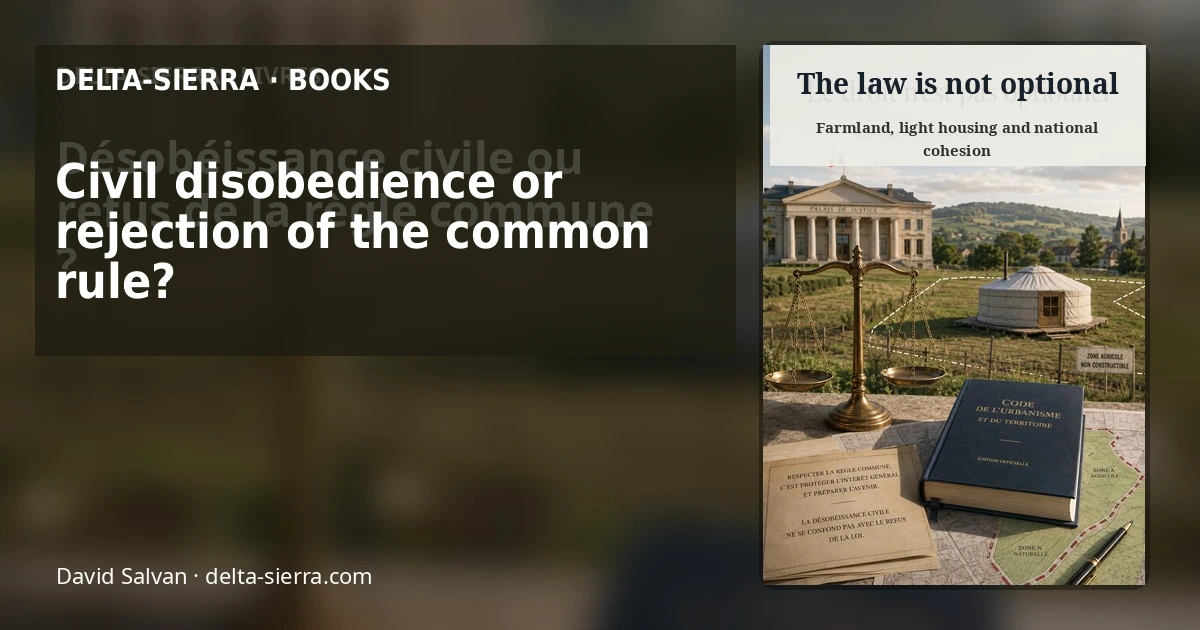
A democracy guarantees everyone the right to challenge a law, call for its repeal, bring cases before the competent courts, demonstrate, publish, petition and try to persuade a majority to change it. It does not, however, recognize an individual right to suspend a rule simply because one considers it bad. In France, national sovereignty belongs to the people, who exercise it through their representatives and by referendum, while the law is intended to be the same for everyone. A rule may be absurd, excessive or deeply contestable; as long as it remains in force and no exception provided by law applies, personal disagreement does not make it optional. The so-called “Désobéissance Fertile” case, decided in Limoges in August 2026, provides a particularly instructive example: an urban-planning offence was established and sanctioned, but the court did not order the dwellings to be dismantled. That decision does not legalize the installations and does not make agricultural land buildable. Above all, it forces a more fundamental question: what becomes of equality before the rules if the person who complies gives up a project, while the person who chooses to violate the rule can hope to retain the material situation created by that violation?
The judgment of August 26, 2026 is presented cautiously: the full reasoned decision was not readily available in an official public database when this article was written, and the appeal period had not yet expired as of August 31, 2026.
Introduction. What happened, and who is Désobéissance Fertile?
Désobéissance Fertile is an environmental movement that advocates forms of living presented as frugal, autonomous and regenerative of natural environments. Around Jonathan Attias and Caroline Perez, the collective has notably developed the “Croissant Fertile” site in Marval, Haute-Vienne, where several forms of lightweight, demountable or reversible housing have been installed. The movement does not hide its strategy: it openly disobeys certain urban-planning rules that it considers unsuited to the ecological emergency, seeks to provoke public debate and wants the law to evolve in favour of reversible housing. In 2024, the municipality drew up an official report concerning some installations; after interviews, the case was brought before the Limoges criminal court on July 1, 2026. The prosecution requested a financial penalty and that the site be vacated with the structures dismantled. On August 26, 2026, Jonathan Attias was ultimately found guilty of an urban-planning offence and fined €600, but the court did not order dismantling or restoration of the site. The collective immediately presented the absence of demolition as a victory and as a “signal” for other lightweight-housing residents. It is this gap between the legal reality of a conviction and the political meaning attached to the absence of restoration that warrants closer analysis.
The case is all the more interesting because it is taking place in a municipality already identified by the Chambre régionale des comptes de Nouvelle-Aquitaine (regional audit chamber) as having long experienced installations of lightweight dwellings that did not comply with urban-planning rules. In a final observations report deliberated on July 24, 2025, the financial court noted that around twenty lightweight dwellings were installed within the municipality, that the phenomenon had grown since 2023, and that the mayor had made only very limited use of the legal means available to enforce the applicable rules. The 2026 trial therefore did not emerge in an administrative vacuum: it took place in an area where the issue of lightweight housing, its oversight and the effective application of the law had already been documented by an independent public institution.
1. A “victory” that must be described precisely
It is entirely understandable that those concerned speak of victory in view of their personal situation. They faced a very concrete measure: having to leave their home and dismantle the installations. The court did not order that. For a family that has organized its life on the site, the difference is enormous. But a legal analysis cannot stop at the legitimate feelings of the people concerned. The judgment, as reported by the available sources, contains two elements that must be read together: first, guilt for an urban-planning offence and a €600 fine; second, no order to dismantle or restore the site. The first element confirms that the rule was violated. The second indicates that the judge did not consider it necessary to draw all the material consequences requested by the prosecution from that violation.
This distinction is consistent with the very logic of the French Urban Planning Code. Article L. 480-5 provides that, in the event of conviction for certain offences, the court also rules on compliance, demolition or restoration of the site to its previous condition. In other words, finding an offence and ordering demolition are related but distinct questions. A person may be guilty without demolition being ordered; conversely, the absence of demolition does not turn the initial act into a lawful one. That is why the phrase “we won the right to stay” may describe a practical consequence of the judgment, but becomes misleading if it is understood to mean “the court recognized that the installation complied with the law.” Nothing in the publicly available material supports such a conclusion.
An important methodological caution must also be maintained: the full reasoned text of the August 26, 2026 judgment is not, as of the date of this article, readily available in an official public database. Press reports and communications from the parties make it possible to know the announced outcome, but they do not replace the court’s written reasons. It would therefore be excessive to attribute to the judge a general formula such as “family life takes precedence over urban-planning law” until the full reasoning has been reviewed.
A second caution is required as of August 31, 2026: the judgment was handed down five days earlier. Article 498 of the French Code of Criminal Procedure provides, in principle, a ten-day period to appeal a contradictory criminal judgment, with special rules where the period runs from service of the judgment. Local press also reported after the ruling that Jonathan Attias had ten days to decide whether to appeal. At that date, it is therefore premature to present the decision as final, and even more so as settled case law. An appeal could change the outcome or, at the very least, provide new reasoning that would alter the scope of the analysis.
2. Civil disobedience is not a legal prerogative: citizens do not choose which laws they obey
“Civil disobedience” is a political and philosophical concept traditionally referring to the public, conscious and generally non-violent violation of a rule in order to denounce its content or bring about its amendment. The phenomenon can be studied, its history explained and the motivations of those who resort to it understood. But that label creates no general right to disobey under French law and does not constitute a parallel democratic route allowing each citizen to select the rules to which they consent. A democracy protects freedom of opinion, criticism of the law, demonstration and political action; it does not turn individual conviction into a power to suspend a rule. Calling an act “civil disobedience” therefore describes a political intention. It does not make the act lawful, erase the offence or create immunity from the consequences provided by law.
The democratic foundation is essential here. Article 3 of the Constitution states that national sovereignty belongs to the people, who exercise it through their representatives and by referendum, and specifies that no section of the people and no individual may claim to exercise it. Article 6 of the Declaration of the Rights of Man and of the Citizen recalls that the law is the expression of the general will, that all citizens may contribute to its formation, and that it must be the same for all, whether it protects or punishes. These principles certainly do not mean that a parliamentary majority may do anything it wishes: the legislature itself remains subject to the Constitution, fundamental rights, applicable international law and judicial review. But they symmetrically exclude the idea that a citizen may declare themselves sovereign on their own behalf and substitute a personal rule for the common rule. Losing an election, being in the minority on an issue or considering a law unjust is not, in itself, enough to make that law inapplicable to the person challenging it. It remains applicable until it is amended, repealed, annulled or lawfully set aside under the conditions provided by the legal order.
Citizens have many avenues precisely to challenge a rule they consider bad: public debate, association-based action, demonstrations, petitions, contacting members of Parliament, elections, supporting other candidates, appeals against administrative decisions, litigation and, where a statutory provision infringes rights and freedoms guaranteed by the Constitution, the priority preliminary ruling on constitutionality. There are also specific legal mechanisms, such as necessity under Article 122-7 of the French Criminal Code or proportionality review required by certain higher-ranking norms. The distinction is fundamental: in such cases, the exception itself comes from the law and its conditions are assessed by a competent authority; it is not self-awarded by the person who decides that their cause is sufficiently just to free them from the rule. The Cour de cassation illustrated this particularly clearly on June 10, 2026 in a home-schooling case: parents had deliberately refused to follow the authorization procedure while invoking a “principle of civil disobedience.” The court upheld the reasoning that this deliberate refusal was not a valid excuse, because the people concerned had an authorization and appeal procedure available to them. Citizens may fight the law; they cannot, on their own authority, become lawmakers for themselves.
3. Common law is not an à-la-carte menu: it is the condition of civic equality
Urban-planning law is sometimes presented as an accumulation of administrative constraints opposed to individual freedom. Some rules may indeed be excessive, poorly calibrated, costly or no longer suited to current needs. It may seem deeply unfair that a formality is required for a small extension, greenhouse, shed or development whose impact appears negligible to its owner. But the feeling that a rule is absurd is not a legal category authorizing each person to decide that it no longer applies. The democratic response is to seek its simplification, amendment or repeal, to challenge the decision where an appeal exists, or, if one does not wish to accept the risk of a penalty, to refrain from the prohibited act. This principle can be frustrating; it is nonetheless the very condition of common law. As long as a rule applies, it organizes everyone’s rights and obligations: a buyer of buildable land pays a price that reflects a right to build, a farmer can rely on the protection of agricultural land, the municipality plans its networks and services, and neighbours also make decisions on the basis of a supposedly common framework.
Democracy therefore means neither blind obedience to the government of the day nor the personal sovereignty of each citizen. Those who govern are constrained by a legal order that stands above them: the Constitution, fundamental rights, applicable international conventions, and review by the Conseil constitutionnel, administrative courts and ordinary courts within their respective jurisdictions. Citizens benefit from these guarantees and may invoke them. But they too are subject to rules that are lawfully applicable. This reciprocity is essential: Parliament cannot free itself from the Constitution; citizens cannot free themselves from a law merely because they consider it unjust. A democracy worthy of the name offers ways to change the law; it does not recognize a general right to make it optional by individual decision.
This requirement applies regardless of political or moral orientation. If we accept today that an environmental collective may permanently disregard an urban-planning rule because it believes its cause is superior to the rule, it becomes difficult to explain why the same reasoning should be refused tomorrow to a religious community, a survivalist group, a tourism operator, a wealthy landowner, a company or any citizen convinced that their own cause deserves an exception. The criterion can never be how sympathetic we find the offender. Common law may be criticized, challenged and reformed; while it remains in force, it cannot become an à-la-carte menu.
4. Article 8 of the European Convention on Human Rights is not a building permit above the Urban Planning Code
One of the most dangerous shortcuts would be to summarize the judgment as follows: “the right to family life takes precedence over urban-planning law.” Article 8 of the European Convention on Human Rights does indeed guarantee respect for private and family life, home and correspondence. But paragraph 2 of that same article expressly provides that interference by a public authority may be permitted where it is in accordance with the law and necessary in a democratic society, notably for the protection of public order, the prevention of crime, the protection of health or the protection of the rights and freedoms of others. Protection of the home is therefore strong, but it is not absolute.
The applicable legal reasoning is proportionality. Where a restoration measure would result in the destruction of people’s actual home, the judge must examine concretely whether that interference is proportionate to the public-interest objective pursued. This does not mean that the home always prevails. Recent case law from the Cour de cassation provides particularly useful insight in a different procedural context: on June 25, 2026, the Third Civil Chamber, ruling in summary proceedings based on ending a manifestly unlawful disturbance, upheld demolition and eviction measures following works carried out in violation of urban-planning rules, while noting that the personal circumstances of those concerned had been taken into account by postponing enforcement for one year. This case is therefore not the exact procedural counterpart of the Limoges criminal case, but it demonstrates an essential point: Article 8 requires interests to be balanced; it does not erase urban-planning regulations and does not, as a matter of principle, prohibit demolition or eviction.
This distinction is fundamental for anyone who might wish to reproduce the Désobéissance Fertile experience. Establishing one’s home on non-buildable land does not automatically create a legal shield. The judge may take into account the length of occupation, the presence of children, the vulnerability of the occupants, the nature of the offence, the environmental sensitivity of the site, the existence of alternatives, the seriousness of the impacts and the conduct of those concerned. Two apparently similar cases may therefore lead to different outcomes. Presenting the Limoges decision as a new general rule would expose other families to a real legal risk.
5. The central problem: can one create the very situation that will later be used to obtain an exception?
Imagine two people looking at the same non-buildable agricultural plot. The first consults the town hall before buying, learns that they cannot establish their main residence there and gives up. They may have to buy much more expensive buildable land or abandon the project. The second buys the plot anyway, installs a dwelling, lives there for several years, builds a family and social life there, and then tells the judge that restoring the site would now disproportionately interfere with their home and family. If the second person ultimately retains the material benefit of the installation while the first gave up because they complied with the rule, a fairness problem immediately arises.
This difficulty obviously does not authorize a judge to ignore the safeguards imposed by law. If a higher-ranking rule requires a proportionality review, the judge must perform it; if a legally recognized ground excluding liability is invoked, the judge must verify its conditions. But this judicial protection confers no general legitimacy on a strategy of violating first and negotiating later. On the contrary, it reveals the perverse effect of a fait accompli: the longer the administration waits, the more the factual situation becomes entrenched; the more entrenched it becomes, the more humanly difficult restoration becomes; and the more difficult it becomes, the more litigation arguments the offender has for asking to remain. The law must therefore be applied early enough to prevent time from turning deliberate violation into a strategic advantage. Proportionality review belongs to the judge; citizens do not have a right deliberately to manufacture the situation that will make that review more favourable.
The risk becomes even greater when the movement concerned publicly announces that it wants to turn its decision into a tool for “those who come next.” It is no longer merely a matter of protecting a particular family from a consequence considered excessive; it is a matter of making the case into a strategic model. A legal system that encouraged citizens to think it better to build first and discuss later would create exactly the opposite of the behaviour urban-planning law seeks to organize: obtain authorization beforehand, while impacts can still be avoided, rather than negotiate after installation, when the human and political cost of reversing course has become very high.
6. Why are agricultural and natural lands protected?
An obvious point, often lost in the debate, must be recalled: an agricultural or natural plot is not simply cheaper building land. Its lower price results, among other factors, precisely from more limited use rights. Urban-planning rules pursue objectives that go far beyond the aesthetics of buildings. Article L. 101-2 of the Urban Planning Code notably refers to combating urban sprawl, economical use of natural areas, preservation of land used for agricultural and forestry activities, public safety and health, risk prevention, protection of water, soils, landscapes, biodiversity and ecological continuity, as well as combating soil artificialization.
These objectives explain the principle of limited buildability. In municipalities with neither a local urban plan, an equivalent planning document, nor a municipal map, Article L. 111-3 provides in principle that construction may be authorized only within already urbanized areas. Article L. 111-4 provides exceptions, notably for certain buildings and installations necessary for agricultural operations, but those exceptions are regulated. A common misconception must therefore be corrected: being a farmer does not provide a general right to build one’s house wherever one wishes in the fields. What matters legally includes, among other things, whether the construction is necessary for the agricultural activity and whether all applicable conditions are met.
Protecting agricultural land also serves a long-term sovereignty interest. Land gradually converted to residential use does not easily become available agricultural land again. Even where a dwelling is physically demountable, residential use produces effects: access, parking, sanitation, storage, possible fencing, networks, emergency-service needs, waste collection, human presence and conflicts of use. Lightweight housing may have a substantially lower impact than a conventional detached house, but “lower impact” is not synonymous with “no impact.” The law must precisely organize this continuum rather than pretend it does not exist.
7. A yurt, tiny house or demountable home does not exist in a legal vacuum
Another frequently heard argument is that lightweight housing is “not really a building” because it is demountable, installed without heavy foundations or made from minimally processed materials. Yet French law explicitly recognizes the category of “demountable residences constituting the permanent home of their users.” Article R. 111-51 of the Urban Planning Code defines them as installations without foundations, equipped internally or externally, which may be independent of public networks, are intended for housing and occupied as a principal residence for at least eight months a year, while the whole structure must remain easily and quickly demountable. The ecological, lightweight or reversible nature of a dwelling therefore does not place it outside the law; it brings it within a specifically identified legal regime.
The most directly revealing provision is Article L. 444-1 of the Urban Planning Code. It provides that developing built or unbuilt land to allow the installation of demountable residences constituting their users’ permanent homes is subject, depending on the case, to a development permit or prior declaration. Above all, it specifies that such land must be located in buildable sectors, while allowing authorization in limited-size and limited-capacity reception sectors, known as STECAL, under the conditions laid down in Article L. 151-13. This provision alone refutes the idea that lawmakers forgot reversible housing: they provided for it, but did not grant it a general freedom to locate on any agricultural or natural land.
The level of authorization then depends on the number of residences, their floor area and the configuration of the development. The Code notably requires a development permit for a site allowing at least two demountable residences that together create more than 40 square metres of total floor area; developments with several demountable residences below this threshold and not subject to a development permit are notably subject to prior declaration. These thresholds should not be turned into a universal recipe applicable to every isolated yurt: on the contrary, they illustrate the existence of a graduated regime whose exact application depends on the concrete project and the other applicable local or national rules.
Article L. 151-13 complements this system by allowing local urban plans, exceptionally, to designate STECAL within natural, agricultural or forest zones in which, among other things, demountable residences constituting their users’ permanent homes may be authorized. The regulations must then govern their height, siting, density, integration into the environment, and conditions relating to networks, hygiene and safety. A legal route therefore already exists to integrate lightweight housing into land-use planning without abandoning collective planning.
That is precisely what makes the debate more demanding. The choice is not between an archaic system that bans all innovation and ecological disobedience as the only possible path. The real question is whether local authorities make sufficient use of the existing tools, whether those tools are simple and open enough, and whether they need reform. It is entirely possible to support more STECAL, faster procedures and better recognition of reversible housing while refusing to make installation without authorization an ordinary method of settlement.
8. Land prices: why allowing circumvention would create economic injustice
The price difference between agricultural land and buildable land is not an anomaly that one can simply exploit cleverly. It largely reflects the difference in the rights attached to the land. Buildable land benefits from the legal possibility of hosting buildings, network infrastructure and collective planning, all of which have value. Agricultural land is much cheaper precisely because it does not freely allow the same uses. If it were accepted that one could simply buy inexpensive agricultural land, install lightweight housing on it and then obtain its permanence a few years later, that would create a particularly unfair form of regulatory arbitrage.
The first consequence would affect those who comply with the rules. Why would they pay the price of buildable land if someone else can obtain a comparable residential outcome through a strategy of prior installation on land acquired far more cheaply? The second consequence would affect farmers. Once a clandestine or semi-tolerated residential market develops on agricultural land, the price of some plots can incorporate a “hope value” linked to housing, increasing competition with productive use. The third consequence would affect local authorities, which could find themselves facing needs for networks, roads, emergency services or waste management that had not been planned.
The paradox would therefore be striking: a practice presented as a social response to excessive housing costs could, if generalized without rules, shift speculative pressure onto agricultural land. The right answer to the housing crisis is not to pretend that all categories of land are interchangeable, but to create a lawful supply of lightweight housing in areas where its impact is controlled and where everyone’s rights and obligations are known before installation.
9. The Nouvelle-Aquitaine Regional Audit Chamber report changes how the local case should be read
The Marval-Milhaguet case deserves particular attention because of an official document that predates the trial: the final observations report of the Chambre régionale des comptes de Nouvelle-Aquitaine (regional audit chamber), deliberated on July 24, 2025. The report devotes an entire section to “the installation of demountable dwellings in breach of the Urban Planning Code.” It notes that the municipality has no PLU or PLUi and that the National Urban Planning Regulations therefore provide the applicable framework. The Chamber also sets out the requirements that must be met before demountable residences are installed, including development or installation authorization, proof of reversibility and an assessment of technical feasibility.
The financial court then notes that, since at least 2010, the municipality has experienced installations of lightweight dwellings that do not comply with urban-planning rules. It reports a significant increase since 2023, with sixteen dwellings counted by the municipality and nineteen by the Ouest-Limousin inter-municipal authority, the latter estimating that the actual number may be higher in light of aerial surveys. The report therefore does not describe a theoretical conflict between an isolated family and an overzealous administration, but a territorial phenomenon significant enough to become a subject of scrutiny of municipal management.
The report also contains an institutional configuration that deserves to be mentioned with great caution. The Chamber notes that one of the shareholders of the property company that installed the first lightweight dwellings in 2010 was a deputy mayor responsible for urban-planning services and municipal buildings, and that another deputy mayor, responsible for the environment, occupied one of these dwellings. This finding does not, by itself, establish a conflict of interest, unlawful favour or any offence, and it would be abusive to present it that way. It does, however, reinforce the institutional interest of the case and justify close examination of the local conditions under which urban-planning controls were exercised or, conversely, insufficiently exercised.
The Chamber also notes concrete issues relating to sanitation. According to the report, the first two inspections carried out on equipment serving two yurts found that grey water was discharged through buried or semi-buried systems such as planted filters or filter trenches that were deemed non-compliant. It also states that several owners were not paying certain local taxes, the incentive-based household-waste collection charge, or fees due for inspections by the public non-collective sanitation service. These findings must not automatically be attributed to Jonathan Attias or Caroline Perez: the report covers several installations in the municipality and does not allow all occupants to be conflated. They nevertheless show why hygiene, taxation, waste and sanitation requirements are not bureaucratic details invented to discourage alternative lifestyles.
Finally, the Chambre régionale des comptes de Nouvelle-Aquitaine criticizes the municipality’s insufficient use of the instruments available to enforce the law. It states that the mayor had limited himself to sending a simple letter to fifteen owners of lightweight dwellings, without a formal order to regularize their situation, and that only one offence report had been drawn up. Recommendation No. 5 explicitly calls on the municipality to implement the provisions of the Urban Planning Code in order to enforce the rules governing the siting of lightweight dwellings. This context is essential for understanding a classic fait-accompli mechanism: when public oversight is late or insufficient, unlawful situations have time to become stable living arrangements, making any later restoration measure more difficult both humanly and legally.
This finding must also be updated: the Chambre régionale des comptes de Nouvelle-Aquitaine report was deliberated in July 2025 and therefore necessarily describes the law applicable at that time. Article L. 481-1 of the Urban Planning Code was substantially strengthened from November 28, 2025. Where an offence report has been drawn up and the statutory conditions are met, the competent authority may now, independently of criminal proceedings, impose a fine of up to €30,000, order the person concerned to bring the installation into compliance or submit a regularization application, and attach a penalty payment of up to €1,000 per day, capped at €100,000 in total. Under certain conditions, the prefect may substitute for a competent authority that remains inactive; the provision also allows, for certain installations that pose a clear safety or health risk or are located outside urban areas, official enforcement after a formal order has gone unheeded, and it even governs some situations involving judicial demolition. In August 2026, positive law is therefore more coercive than the framework described in the 2025 report.
10. The ecological paradox: the contested rules also protect the environment
One of the most interesting aspects of the debate lies in a paradox rarely emphasized by advocates of ecological disobedience. Some of the urban-planning rules they challenge were strengthened precisely in the name of environmental concerns: preserving agricultural land, limiting scattered development, combating soil artificialization, maintaining ecological continuity, protecting landscapes, anticipating natural risks and avoiding dispersed housing. The opposition is therefore not simply “environmentalists versus the administration.” In some cases, it may be a conflict between two conceptions of ecology: one based on individual frugality and reversible housing; the other on collective planning of land use.
Some lightweight dwellings may indeed have an excellent environmental footprint. A small bioclimatic, reversible, energy-autonomous structure using few materials may cause far less harm than a large conventional detached house. But land-use planning cannot be considered only at the scale of the individual object. Density, multiplication of installations, car traffic, access, emergency-service needs, sanitation, water withdrawals, waste, cumulative effects and gradual landscape change must also be considered. An installation acceptable in isolation can become problematic when replicated hundreds or thousands of times.
That is why the argument “our dwelling is ecological, so the ban makes no sense” is insufficient. The relevant question is: “what general conditions would allow this type of housing to be authorized without undermining the territory’s agricultural, landscape, health and environmental objectives?” Framed this way, confrontation becomes a public-policy proposal. It forces the definition of thresholds, criteria and controls applicable to everyone, instead of asking a court retrospectively to validate the legitimacy of one particular approach.
11. The legal precedent is limited; the behavioural precedent may be far more dangerous
The word “precedent” is often used too broadly. In ordinary language, any court decision can become an argument: a lawyer can cite it, comment on it and ask another court to adopt similar reasoning. But the main risk of the Limoges judgment may lie elsewhere. It is behavioural. Someone who learns only the media outcome may retain a very simple sequence: unlawful installation, prosecution, financial conviction, but material continuation on the site. Even if that reading is legally incomplete, it can create a very concrete incentive to try the same strategy, even though no other litigant is guaranteed the same result.
France does not, however, apply a general system of binding precedent comparable to stare decisis in common-law countries. A decision by a criminal court does not bind other criminal courts. A court in Clermont-Ferrand, Béziers, Nantes or Lille may assess similar facts differently. A court of appeal may overturn or amend a judgment. The Cour de cassation does not retry the facts but reviews, among other things, whether the law was correctly applied. To speak of a genuinely strong line of case law, one must observe repeated solutions and, above all, decisions from the higher courts.
There is also, as of August 31, 2026, a decisive timing issue: the August 26 judgment is still within the period during which an appeal may, in principle, be lodged under Article 498 of the Code of Criminal Procedure. It is therefore legally premature to speak of “settled” case law. A first-instance decision that may still be reviewed cannot reasonably be presented as a new national rule for lightweight housing.
The higher case law currently available does not establish any automatic right to remain in a home built or installed in breach of urban-planning rules. It requires a proportionality review and, depending on the circumstances, permits demolition and eviction. The June 25, 2026 decision of the Third Civil Chamber of the Cour de cassation, delivered in summary proceedings in a procedural context different from the Limoges criminal trial, is nevertheless highly instructive: it upholds demolition and eviction measures postponed by one year and considers that this solution does not violate Article 8. The legal message is therefore much more nuanced than the activist slogan: the home matters, but it does not inherently neutralize the urban-planning order.
12. Comparison with highly protected areas shows why the principle cannot be left to individual judgment
A deliberately provocative comparison helps illustrate the difficulty. If everyone could decide that the low footprint of their dwelling and the merit of their project justified an exemption, why would that logic automatically stop at the boundary of an ordinary agricultural plot? Why not invoke the same values to settle in a particularly sensitive natural area, the core of a national park, a protected coastal zone or near a major heritage site? The obvious answer is that the public interests at stake would be stronger there and the law imposes additional protections. But that is precisely the point: a rule external to the individual project is needed to determine where the limit lies.
The Vallée des Merveilles, in the heart of Mercantour National Park, illustrates the reasoning. No one would seriously consider that an occupant could decide alone that their yurt is ecological enough to become a permanent residence in the middle of an area subject to strong natural and heritage protections. The value of the site, its ecosystems, rock engravings, visitor pressure and park rules impose restrictions. Marval is obviously not comparable in the intensity of protection, but the legal logic is the same: acceptable impact cannot be defined unilaterally by the person wishing to settle.
This thought experiment recalls a rule of political method: to know whether a principle is sound, it must be tested beyond the sympathetic case that gave rise to it. An exception considered fair for people committed to environmentalism must be capable of being formulated so that it remains fair when invoked by people whose project we regard as less virtuous. It is this capacity for generalization that distinguishes law from favour.
13. Equality before the rules: the hardest question for defenders of the fait accompli
Consider a nurse, a factory worker, a retiree or a single-parent family who cannot afford buildable land. Their social motivations may be at least as strong as those of an environmental collective. If each of them buys agricultural land, installs a tiny house, solar panels, a composting toilet and a rainwater-harvesting system, why should they receive a different answer? If the argument is based on frugality, frugality must be objectively defined. If it is based on reversibility, reversibility must be defined. If it is based on the project’s ecological contribution, the criteria and the authority responsible for checking them must be defined. As soon as one tries to generalize the reasoning, one inevitably returns to the need for common standards.
The difficulty is greater still when some projects have a strong capacity for media mobilization. A rule of law should not become easier to negotiate because the offender has a large audience, a petition with tens of thousands of signatures, support from associations or an effective communications strategy. These means are entirely legitimate for seeking political reform; they should not become, directly or indirectly, an advantage in materially obtaining an exemption that less visible citizens would not receive.
Equality therefore does not mean treating every situation in blindly identical fashion. Judges must be able to take particular circumstances into account. But equality requires the criteria for distinction to be rational, reviewable and transferable. Being an activist, the sympathy inspired by a project or its ideological presentation cannot be criteria. If reversible housing deserves a new place in French law, that place must be open to everyone who meets the same conditions, not only to those who were willing to disobey first.
14. What an intelligent reform of lightweight housing could actually provide
Criticizing a fait accompli does not require defending the status quo. On the contrary, the case may show that French law should offer more numerous, clearer and more realistic routes for permanent lightweight housing. A serious reform could facilitate the creation of dedicated areas in rural municipalities that want them, simplify procedures for very low-impact projects and develop a more consistent national regime for demountable residences. But that opening should be accompanied by precise safeguards so that administrative simplicity does not turn into deregulation of land use.
For example, the law could provide limits on floor area and density, a genuine demountability requirement, limits on soil sealing, emergency-service access rules, sanitation controls, drinking-water requirements, fire-risk prevention, a clear waste regime, guarantees for restoring the site when it is abandoned, and an adapted tax framework allowing residents to contribute fairly to collective services. Projects could be excluded from highly productive agricultural land, high-risk zones and the most sensitive natural areas, while being facilitated in rural sectors identified as compatible with this type of housing.
Such a reform would have a major democratic advantage: it would turn what is currently presented as a gain achieved through disobedience into a right accessible under defined conditions. Citizens would no longer have to choose between giving up their project and settling illegally in the hope that, several years later, a court will consider demolition disproportionate. The administration, for its part, would recover its normal role: examining the project before it produces its effects, rather than managing after the fact a conflict that has become humanly intractable.
15. What the Limoges judgment must not be taken to mean
The first mistake would be to believe that agricultural land in France has become buildable for lightweight housing. It has not. The second would be to believe that a yurt escapes urban-planning law because it is demountable. That is false: Articles R. 111-51 and L. 444-1 specifically provide for the regime governing demountable residences and the land intended to host them. The third would be to believe that Article 8 of the European Convention on Human Rights guarantees anyone unlawfully settled a right to remain. Higher case law shows otherwise. The fourth would be to believe that the Limoges decision now binds every French court. It does not, and as of August 31, 2026 it may still be followed by an appeal. Finally, the fifth would be to believe that a €600 conviction amounts to retrospective authorization. A criminal conviction accompanied by the absence of demolition does not become a development permit and does not, by itself, regularize the urban-planning situation.
One confusion must nevertheless be avoided: saying that civil disobedience is not a right does not mean asking a judge to ignore safeguards provided by the law itself. Where a higher-ranking rule requires proportionality review, where a legally defined ground excluding liability is genuinely established, or where a court must set aside a rule that conflicts with a higher-ranking norm, the judge must do so. This is neither tolerance of disobedience nor a reward granted to the offender: it is the application of the legal order itself. The boundary must remain perfectly clear. An exception established by law is a rule of law; an exception a citizen grants themselves because they consider their cause just is not.
The strongest criticism is therefore this: the system must prevent the deliberate violation of a rule from becoming, over time, more advantageous than prior compliance with it. Judges remain free to apply the safeguards imposed by statute, the Constitution and international conventions. Citizens, however, cannot present as a personal right the act of circumventing a rule, waiting until the situation becomes humanly difficult to undo, and then asking that this difficulty produce the advantage that prior authorization would have denied. This distinction concerns the system, not the individuals. It is all the more important when an organized movement publicly presents a decision as a signal that can be used by “those who come next.”
Conclusion. Democracy gives the right to fight the law, never the right to exempt oneself from it
The Désobéissance Fertile case allows a distinction to be stated that should be elementary. The Limoges court did not grant everyone the right to install a yurt on non-buildable agricultural land. An urban-planning offence was established and sanctioned. The absence of dismantling reflects a particular judicial assessment whose full reasoning must still be examined cautiously and which, as of August 31, 2026, may still be followed by further proceedings. It turns neither the installation into a lawfully authorized construction nor disobedience into an autonomous source of rights.
The democratic issue runs deeper. In a representative system, a citizen may lose an election, see a law adopted that they profoundly oppose, and regard that law as absurd, unjust or morally shocking. They retain the right to fight it by every lawful means: persuade, publish, demonstrate, petition, bring cases before the courts, question elected officials, support a reform proposal, vote for different representatives or contribute personally to public debate. They may also invoke before a court the higher-ranking norms and review mechanisms recognized by the legal order. What they cannot claim as a democratic principle is that personal disagreement is enough to make the rule optional for them. Accepting democracy also means accepting that a lawfully adopted decision may be the very one one fought politically, until the day it can be lawfully changed. Without that limit, there is no longer a common rule, only a juxtaposition of individual sovereignties.
Civil disobedience is a political and historical fact; it is not, however, a legal prerogative that the rule of law is required to enshrine. A person may materially decide to break a rule in the name of their convictions. They must then understand that they are indeed committing a violation and that they cannot derive from the supposed nobility of their cause either immunity or a right to retain the material advantages produced by the offence. The legal order may provide a justification, a ground excluding liability, an appeal, proportionality review or the setting aside of a rule contrary to a higher-ranking norm; when it does, those mechanisms belong to the law and are applied by the competent institutions. It is never for the offender to grant them to themselves in advance. The Cour de cassation recalled this in June 2026 in the case of parents who had refused an authorization procedure in the name of civil disobedience: holding a conviction and disagreeing with the rule does not dispense anyone from using the procedures provided by law.
That is why the democratic response to a badly drafted law is not to make everyone the judge of their own law. It is to use the mechanisms that can change the rule: political action, public mobilization, elections, parliamentary work, judicial remedies, constitutional review and, where necessary, reform of the law itself. For lightweight housing, the real victory would therefore not be to multiply irregular installations until restoring the sites becomes humanly or politically difficult. It would be to obtain a new, clear and general rule applicable to everyone who meets the same conditions. Someone who refuses this route may of course materially choose to disobey, but cannot demand that society then transform that disobedience into an acquired right. Common law may be challenged and reformed; while it remains in force, it cannot become an à-la-carte right.
Methodological note on the August 26, 2026 decision
As of August 31, 2026, this article relies on publicly available information concerning the judgment of the Limoges criminal court. Because the full text of the reasoning had not been identified in an official public database when this document was prepared, formulations attributed to the court’s reasoning are deliberately cautious. Since the judgment was delivered on August 26, it is still, as of that date, within the period during which an appeal may in principle be lodged under Article 498 of the Code of Criminal Procedure, subject to the special rules governing when the period begins to run. If the full judgment is published, if an appeal is lodged or if an appellate decision is issued, the analysis will need to be updated on the basis of the exact reasons and the subsequent procedural history.
The factual and legal elements are checked against the cited public sources. Political and institutional assessments are part of the analysis presented in the article.
Main legal and documentary references
- Désobéissance Fertile, official website, message “We are staying on our land”
- Citoyliens, “Lightweight housing: Désobéissance Fertile wins the right to remain on its land,” August 26, 2026
- Seven Radio, “Yurts installed illegally in Haute-Vienne: Limoges court convicts activist but leaves his dwellings in place,” August 27, 2026
- La Relève et La Peste, “Victory for lightweight housing: this family can remain in its petal house,” August 26, 2026
- Nouvelle-Aquitaine Regional Audit Chamber, Final observations report, municipality of Marval-Milhaguet, deliberated July 24, 2025
- Urban Planning Code, Article L. 101-2, objectives of public authorities’ action on urban planning
- Urban Planning Code, Articles L. 111-3 and L. 111-4, limited buildability and exceptions
- Urban Planning Code, Article L. 151-13, limited-size and limited-capacity reception sectors and demountable residences
- Urban Planning Code, Article L. 480-5, compliance, demolition and restoration of sites
- Council of Europe, European Convention on Human Rights, Article 8
- Cour de cassation, Third Civil Chamber, June 25, 2026, appeal No. 22-13.550
- Urban Planning Code, Article L. 444-1, land developed for the installation of demountable residences constituting permanent homes
- Urban Planning Code, Article R. 111-51, definition of demountable residences constituting their users’ permanent homes
- Urban Planning Code, Article R. 421-19, developments subject to a development permit, including certain installations of demountable residences
- Urban Planning Code, Article R. 421-23, developments subject to prior declaration, including certain installations of demountable residences
- Urban Planning Code, Article L. 481-1, administrative fine, formal notice, penalty payment and administrative measures
- Code of Criminal Procedure, Article 498, appeal period in criminal matters
- Constitution of October 4, 1958, Article 3, national sovereignty exercised by the people through their representatives and by referendum
- Declaration of the Rights of Man and of the Citizen of 1789, Article 6, law as the expression of the general will and equality of all before the law
- Constitution of October 4, 1958, Article 61-1, priority preliminary ruling on constitutionality
- Criminal Code, Article 122-7, necessity and conditions excluding criminal liability
- Cour de cassation, Criminal Chamber, appeal No. 25-87.438, decision concerning reliance on civil disobedience in a home-schooling case