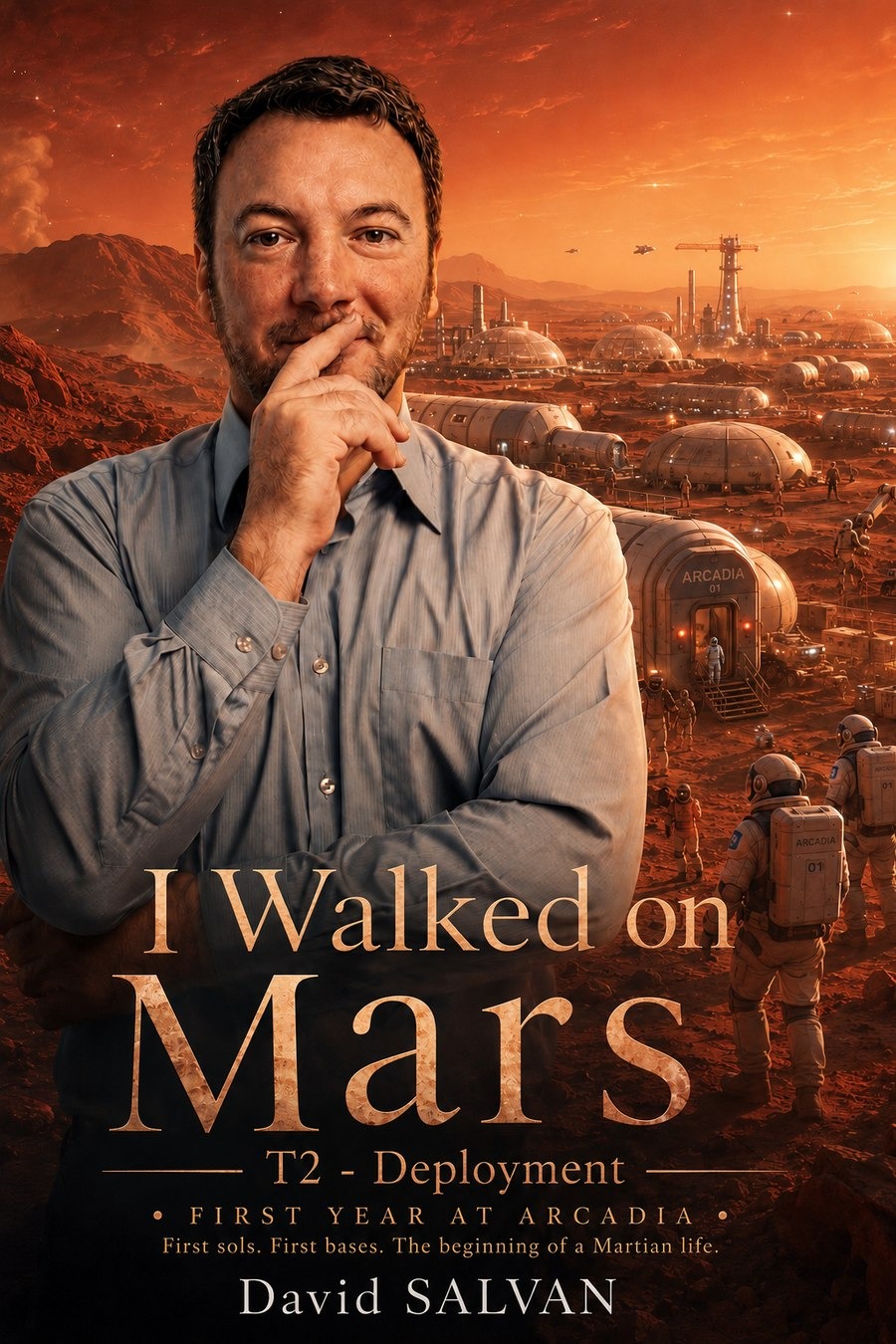
After the journey comes the hardest ordeal: to stay.
This second visual volume accompanies I Walked on Mars — Book 2: Deployment and gathers the images that nourished the writing of Arcadia's first year. It is no longer only about imagining the departure, the training or the crossing. Now a nascent city must be given form: its airlocks, its corridors, its domes, its greenhouses, its workshops, its machines, its rest areas, its fragilities and its first rituals.
For setting foot on Mars is not yet living there. One must learn to breathe a manufactured air, share spaces that are too cramped, organize the work, monitor the water, produce the energy, tame the robots, repair what breaks, invent common rules and transform a technical base into a human community.
This photo book therefore explores the deployment of Arcadia in all its complexity: the first days beneath the regolith, the arrival of the modules and the machines, the collective meals, the fatigue, the tensions, the maintenance gestures, the birth of a daily life and the slow emergence of a habitable world.
But Mars is not only an engineering challenge. It is also a place where love must find its place, where Stella carries life in a world that has never known it, where David discovers the weight of his role, where friendships consolidate, where the cracks appear, where secrets begin to weigh on the city.
Some sequences are presented as visual variations: an airlock that opens, a hand laid on a wall, a robot at work, a meeting under white light, an anxious gaze, a couple in a cabin, a child at the heart of a new world. These images do not seek only to illustrate the story. They show how a colony takes shape, how a hostile planet becomes, little by little, a place of life.
Between technical realism, collective adventure, political tensions and intimate history, these images created by artificial intelligence open the doors to the first Martian year: the one in which Arcadia ceases to be a promise and becomes a city.