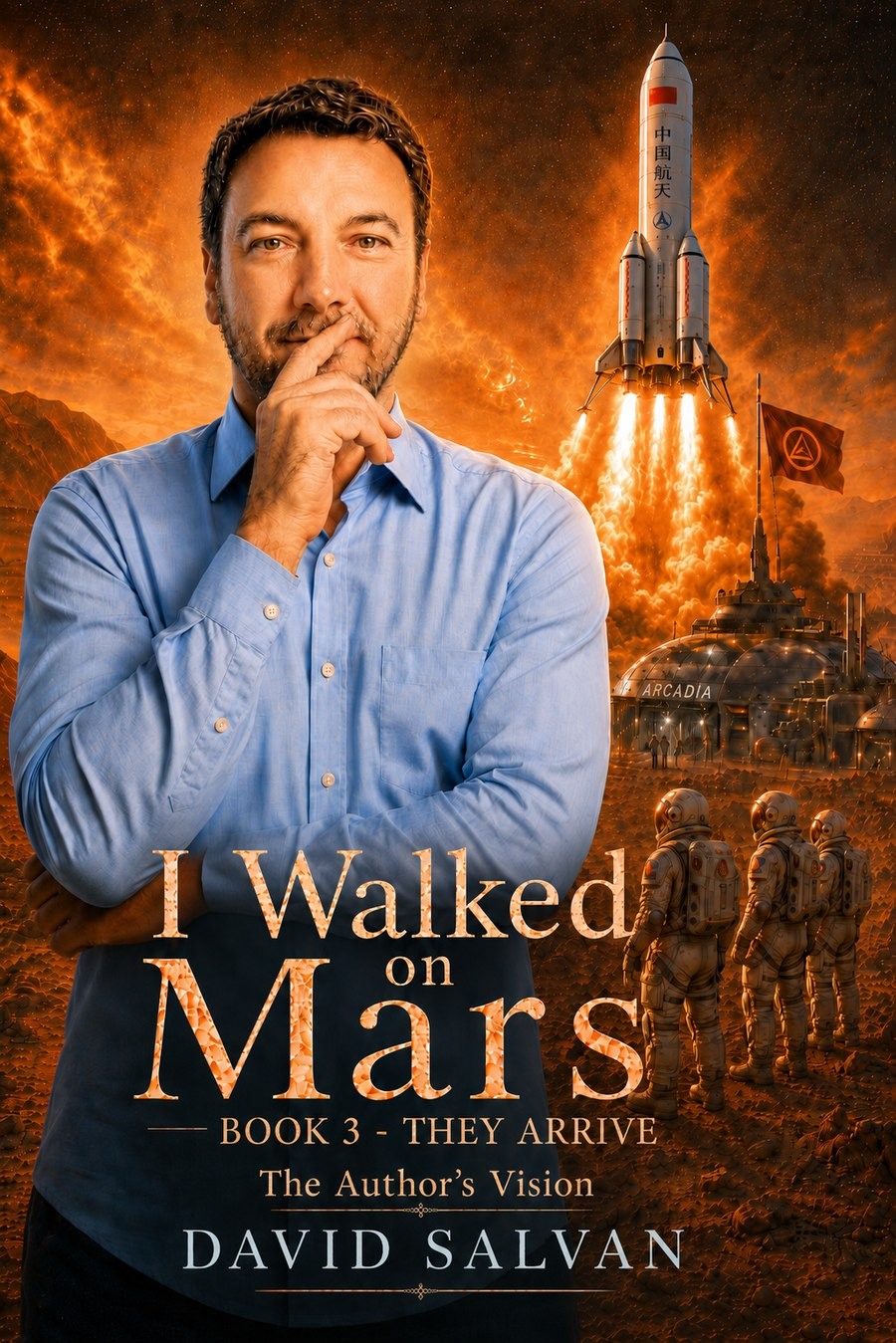
After the founding comes another ordeal: to endure.
This third visual volume accompanies I Walked on Mars — Book 3 and gathers the images that nourished the writing of Arcadia when it gradually ceases to be only a fragile city and becomes a world under construction.
It is no longer only about arriving, surviving or deploying the first infrastructure. From now on, Mars must learn to transmit: to the children who grow up there, to the new colonists who arrive, to the teams who build the schools, the workshops, the research centres, the advanced greenhouses, the enlarged habitats and the first places truly designed for something other than emergency.
For a colony does not become a civilization when it knows how to produce air, water or energy. It becomes one when it begins to educate, to heal, to decide, to love, to remember, to train those who have known the Earth only through the tales of adults.
This photo book therefore explores the Arcadia of the long term: the children born or raised under low gravity, the Martian classrooms, the laboratories, the expansion sites, the families settling in, the friendships that transform, the responsibilities that grow heavier and the first tensions of a society that can no longer be content to obey a plan sent from Earth.
But Mars is not only a futuristic backdrop. It is a place that transforms bodies, bonds and certainties. David is no longer only the man who walked on Mars; he becomes one of those who must help the city understand what it is becoming. Stella, Hannah and the others each carry a part of this shift: that of a space adventure becoming a human, family and political story.
Some sequences are presented as visual variations: a child facing the red horizon, a classroom under a dome, a hand laid on thick glass, a team at work in the dust, an anxious gaze before a collective decision, a couple marked by the years, a city spreading beneath the regolith. These images do not seek only to illustrate the narrative. They show how Mars ceases to be a goal and becomes a heritage.
Between technical realism, memory of the pioneers, transmission, the birth of a new society and intimate history, these images created by artificial intelligence open the doors to a vaster, more complex, more living Arcadia: the one in which the first Martian city begins to understand that it already no longer belongs solely to those who founded it.