


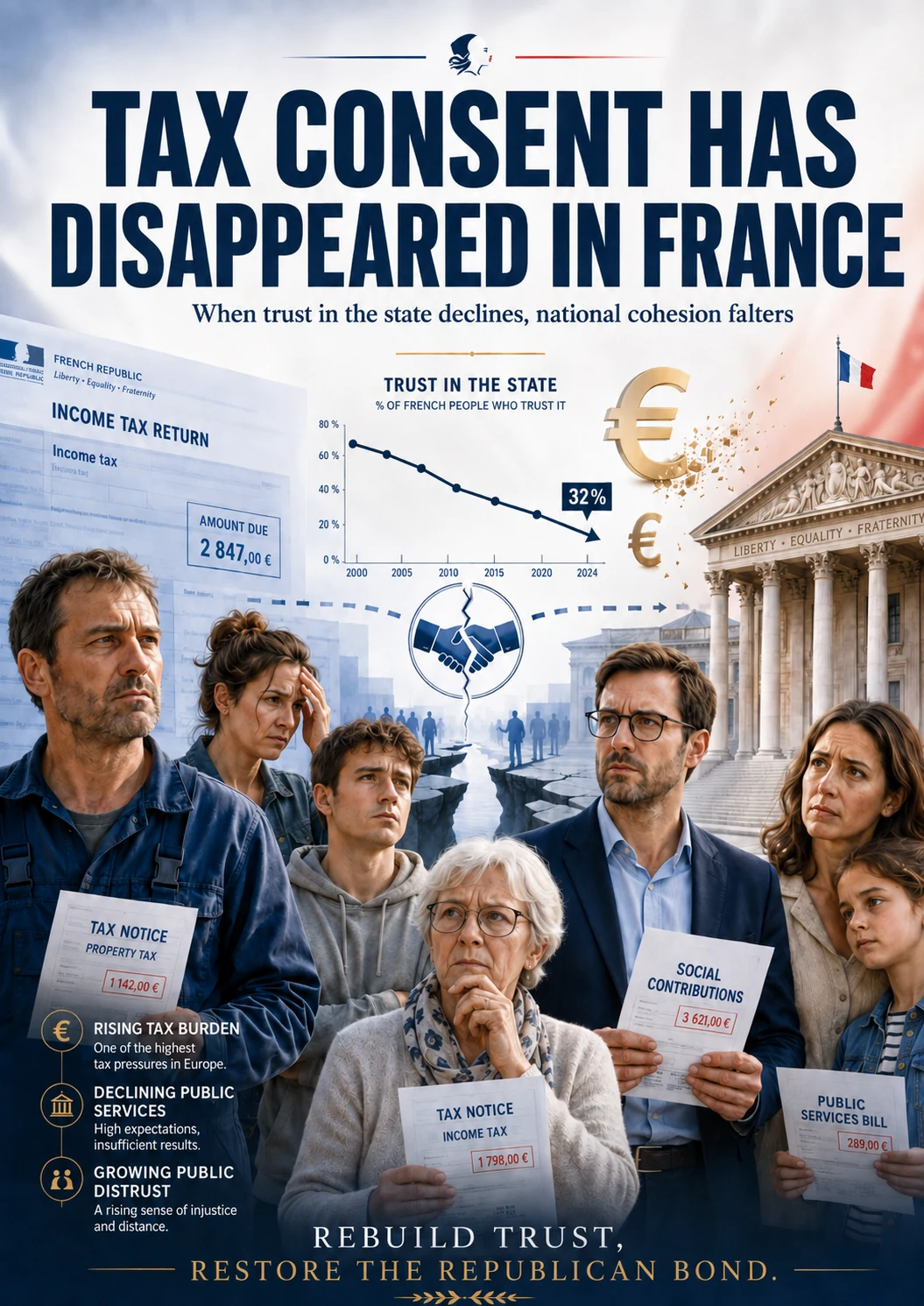
France still retains tax civic-mindedness. What is no longer assured is the trust that turns a legal duty into a politically accepted common contribution. This dossier distinguishes constitutional law from public perception and examines the point at which a levy on the fruits of labour can be experienced morally and politically as spoliation when the link between taxation, results and consent breaks down.
Methodological note: a severe political argument must be factually defensible
This article advances a severe thesis: in France, tax consent is no longer assured. It does not claim that every French citizen now rejects collective contribution. That would be false. The strongest surveys show that a large majority still regard paying taxes and social contributions as a civic act. At the same time, they show collapsing trust in how the state uses public money and deep dissatisfaction with public services. The defensible conclusion is not that tax consent has vanished from every individual, but that it is no longer a stable national political consensus and must be rebuilt. The dossier therefore examines the point at which a contribution that remains legally due can cease to be experienced as participation in a common undertaking and instead be felt, politically and morally, as a levy on the fruits of one’s labour. [1][2][3]
The same discipline applies to spectacular examples. The French tax administration does not officially use satellites or drones to hunt a private greenhouse: its 'Foncier innovant' program uses public aerial imagery from IGN, algorithms and human verification. Ukraine is not 'the most corrupt country in the world'; Transparency International's 2025 CPI gave it 36/100 and ranked it 104th of 182. And in 2026 it is no longer accurate to say France has no money to buy additional Canadair aircraft: two additional aircraft were ordered in June 2026, while Senate work still documented the age and capacity risks of the existing fleet. Correcting these shortcuts strengthens rather than weakens the broader criticism. [11] [22] [23] [28]
The thesis is therefore precise: France still possesses tax civic-mindedness, but it is consuming the reservoir of trust that makes that civic-mindedness politically sustainable.
Stop talking about mild “erosion”: tax consent is no longer assured
The most revealing number is 51%, read correctly. In November 2025 Elabe measured that 51% of French people considered the payment of taxes and levies justified because it finances public services, ten points lower than in March 2024. With a sample of 1,000 people, Elabe reports a margin of error of about 3.1 points around 50% at a 95% confidence level. One cannot claim a statistically certain anti-tax majority. One can say that the country is almost split in two on the concrete justification of taxation after a sharp decline. [1]
That result coexists with an apparently contradictory one: 79% still describe paying taxes and social contributions as a 'civic act' in the 2025 barometer of the Conseil des prélèvements obligatoires. Yet in the same survey only 22% say they trust the state to use public funds well, down from 33% two years earlier. [2] The paradox is central: many citizens accept the principle of common contribution while losing confidence in its use.
This is the difference between tax compliance and tax consent. Compliance can be produced by law, withholding, audits, penalties and enforcement. Socio-political consent requires something else: the belief that the burden is necessary, broadly fair and connected to legitimate collective outcomes. OECD work on tax morale emphasizes trust in government, perceived fairness and quality of public services among the factors that support voluntary compliance. [29]
1. The fiscal pact has split in two
Elabe reported that 86% of respondents considered taxes and levies badly used by public authorities. In a separate December 2025 survey, 87% judged public money badly used and 87% considered the state insufficiently transparent about that use. [1] [3] These are not narrow majorities of irritation; they are near-consensus levels of distrust.
The service side makes the problem harder. Sixty-two percent said they were dissatisfied with the quality of public services and 66% felt that quality had deteriorated in recent years. Justice, roads, hospitals, administrative services and schools all attracted substantial dissatisfaction. The taxpayer's complaint therefore changes from 'I pay a lot' to 'I pay a lot and do not see enough in return'. [3]
Fifty-nine percent felt that they contribute more to the system than they receive from it; only 7% thought they receive more, while 23% felt roughly balanced. [3] This is not an actuarial audit of each household's benefits. Politically, however, it measures the perceived social contract. France retains a strong civic core, but that civic commitment increasingly behaves like a reserve that government can deplete.
2. Four budget numbers explain much of the anger
France objectively sits near the top of the developed world for taxation and public spending. This does not prove that the spending is useless: a social state finances pensions, healthcare, education, public safety, infrastructure and transfers. It does mean that the obligation to demonstrate results rises with the effort demanded from taxpayers.
In 2025 compulsory levies represented 43.6% of GDP according to Insee. For 2024, the latest comparable OECD revenue statistics placed France at 43.5%, second in the OECD behind Denmark at 45.2%, against an OECD average of 34.1%. [6] [7] Public expenditure represented 57.3% of GDP in 2025. Insee's European comparison using Eurostat data put France at 57.2%, against 49.5% for the EU-27. [8] [9]
High revenue still did not balance the accounts: the 2025 public deficit was €152.5 billion, 5.1% of GDP, and public debt reached €3,536.1 billion at the end of the first quarter of 2026, or 117.5% of GDP. [8] [10] The serious answer is neither 'everything is waste' nor 'there is no problem because every program has a purpose'. At this scale, even a few points of inefficiency represent tens of billions of euros, so a high-tax state owes its citizens an equally demanding culture of performance and accountability.
3. Tax enforcement enters the profiling era — and the political symbolism is powerful
The contemporary taxpayer no longer deals only with an administration that receives forms and checks documents. The DGFiP cross-references large datasets, uses data mining and predictive tools, and applies artificial intelligence to help select audits. Its CFVR treatment is described by the administration as profiling through predictive analysis to identify potential tax failures. It can mobilize fiscal, banking, property and administrative data as well as other indicators; a human agent must review proposed cases before action is taken against a taxpayer. [12]
In February 2026 the government told the National Assembly that data analysis was behind 50% of audits of professionals and, since 2025, 50% of audits of individuals, reaching a target earlier than originally planned. It also confirmed intensified data exchanges between DGFiP and social-security bodies. [13] The Cour des comptes had already quantified the organizational break: in part of audit programming, a team of 32 people assisted by data mining had replaced a system involving roughly 500 people in 2018, a reduction of 427 full-time equivalents without reducing programming volume. [14]
Technically this is a productivity success. Politically it demonstrates how rapidly the state can modernize its ability to target taxpayers. The 'Foncier innovant' program makes the symbol even more visible: public aerial imagery, AI-assisted extraction of buildings and pools, comparison with declarations, human verification and possible taxation. More than 20,000 previously untaxed swimming pools were identified during the experiment. [11] The issue is not that anti-fraud technology is illegitimate; 82% even thought authorities did too little against tax fraud. [1] The issue is the perceived asymmetry when individual errors are detected faster than public-sector failure is visibly corrected.
4. When the taxpayer no longer sees an arbiter but an adversary
A tax administration must be feared by fraudsters and recognized as legitimate by good-faith taxpayers. Too little enforcement rewards evasion; excessive power perceived without reciprocal transparency breeds hostility toward the institution itself. The law and public perception are not the same thing. DGFiP is not institutionally an 'enemy': it applies legislation, collects revenue needed by the state and operates under procedural guarantees and appeals. Yet an institution can be legally legitimate and still be experienced as hostile.
The everyday vocabulary says a great deal: “levy”, “tax hammering”, “racketeering”, “spoliation”, “confiscation”. It would be too easy to dismiss these words as mere rhetorical excess. They express a break in perception: a state that always seems able to demand more and deploy increasingly powerful controls, while appearing far less able to demonstrate, euro by euro, that the same standards of performance, economy and accountability apply to itself. The word “spoliation” is not used here as a blanket legal characterization of the French tax system; it describes the political feeling that arises when taxpayers no longer recognize, in the share taken from their labour, a sufficiently legitimate counterpart in the common good.
The political danger grows when tax enforcement modernizes faster than public services are perceived to improve. Citizens see automation, profiling and cross-checking, while also seeing court delays, hospital strain, administrative closures, degraded roads or overloaded classrooms. They compare lived experience with the power deployed against private non-compliance.
The term “confiscatory” is not foreign to French law. The Constitutional Council has held that equality before public burdens would be violated if a tax were confiscatory or imposed an excessive burden on a category of taxpayers in light of their ability to pay. [32] This case law does not allow French taxation as a whole to be labelled legally “confiscatory”: the assessment depends on the characteristics of each tax and the taxpayer’s situation. It nevertheless establishes an essential point: positive law itself recognizes a boundary beyond which taxation can become excessive.
Tax is legally neither theft nor spoliation: it finances the common contribution provided for by the French constitutional order. But that legal characterization does not settle the political question. When the state takes a substantial share of the fruits of people’s labour, while 87% of French people say public money is badly used and only 22% say they trust the state to use public funds well, the common contribution can cease to be experienced as such. For a growing share of taxpayers it can instead be felt as an imposed levy on the product of their work, to the point of taking, in their perception, the traits of a genuine spoliation of the fruits of their labour. That is precisely the point at which tax compliance may survive while tax consent disappears.
From Bastiat to today: when excessive taxation becomes spoliation or confiscation
This idea did not begin with contemporary tax debates. It runs through an important part of French political economy. These writers were not all speaking about France in 2026 and their doctrines differ; quoting them does not turn their texts into statistical evidence about the present. They do show, however, that the boundary between legitimate contribution, excessive taxation, interference with property and the feeling of confiscation is a longstanding question in economic thought.
Frédéric Bastiat, The Law (1850): “When a portion of wealth passes from the person who acquired it, without his consent and without compensation [...] there is spoliation.” [33]
Jean-Baptiste Say, Treatise on Political Economy: “All excessive taxes [...] no longer produce additional revenue, without ceasing to cause additional harm.” [34]
Jean-Marc Daniel, Les impôts. Histoire d’une folie française (2017): “Bad taxation [...] stifles the economy [...] and sustains a feeling of confiscation and abuse.” [35]
Patrick Artus, 2024: “The rate of compulsory levies [is] significantly higher in France than in the other euro-area countries.” [36]
The comparison with current data does not consist in making Bastiat or Say diagnose France in 2026. It consists in noting that France today combines one of the highest levels of compulsory levies in the OECD [7], massive distrust in the use of public funds [1][3], and very low trust in the state’s ability to use those funds well [2]. In that context, the feeling of confiscation is no longer a marginal word: it becomes a politically intelligible consequence of the break between the effort demanded and the perceived legitimacy of its use.
5. The fiscal crisis overlaps a crisis of political trust
No tax system floats above the political system that decides it. Consent depends on trust in those who vote expenditure, set rates, create exemptions and explain sacrifices. The 2026 CEVIPOF political-trust barometer measured only 22% trust in politics, with very low scores for national political institutions. [4]
A CEVIPOF research note published soon afterwards found that 76% of respondents perceived French elected officials and political leaders as 'rather corrupt', up from 65% in 2022 and 2023. [5] This must be stated correctly: it does not prove that 76% of officials are corrupt. It measures perception. For tax legitimacy, perception alone can be damaging. A fiscal democracy cannot sustainably act as though three people in four suspecting its political leaders has no consequence.
The moral chain is simple: I contribute because the rule is legitimate; the rule is legitimate because institutions retain a minimum of trust; I accept effort because I believe money is used in the public interest. The legal chain can remain intact even when the political chain is badly weakened.
6. 1789 already linked contribution, consent, use and accountability
Criticizing compulsory levies is not the same as denying taxation. The 1789 Declaration of the Rights of Man and of the Citizen states that a common contribution is indispensable for the maintenance of public force and administration and that it must be distributed according to ability to pay. [15] Tax is therefore not legally theft; it is a foundation of the modern state and national solidarity.
But the Declaration does not stop at the obligation. Article 14 gives citizens the right to ascertain the necessity of the public contribution, to consent to it freely and to follow its use; Article 15 states that society has the right to require every public agent to account for his administration. [15] Constitutional law adds an essential precision: Article 14 does not mean that each individual taxpayer must personally consent to each tax. The Constitutional Council connects the principle to Parliament's tax-making authority under Article 34. [30]
This article therefore also uses 'consent' in a socio-political sense close to tax morale: the adherence and confidence that make a compulsory levy durably acceptable. A government can automate collection; a democracy cannot automate consent.
7. Taxpayers see public mistakes — and pay for them too
Large states cannot run thousands of projects without failure. Innovation carries risk, and an administration paralyzed by fear of error would be costly as well. Some failures nevertheless become politically toxic because citizens feel that public mistakes do not carry the same moral price as private ones.
SIRHEN, the Education Ministry's human-resources information system, became a symbol. The Cour des comptes reported that its estimated cost had moved from €60 million to €323 million by 2017. Its 2020 public report said total expenditure had exceeded €400 million by the end of 2019 while the system managed only 2% of Education Ministry personnel. [16] [17]
In August 2026 a parliamentary question brought the police Scribe/XPN program back into public debate, citing a Cour des comptes settlement order that assessed an overall cost of €257.4 million including development and the operational value of investigators' lost time, against an initial budget of €11.28 million. [18] This figure must not be misrepresented as €257.4 million in software invoices. Separately, the Cour des comptes had already documented structural weaknesses, a freeze in March 2021, abandonment in October 2021 and €13.3 million in spending from 2016 to 2022. [31]
The political question is symmetry of responsibility. As the state perfects tools for detecting private errors, it must make equally visible the mechanisms that detect, stop and learn from public failure.
8. “Where did the money go?” has spread across political camps
The debate is no longer owned by one political family. Politicians, associations and think tanks publish competing estimates of fraud, waste and possible savings. Their numbers must be labelled for what they are when they do not come from official audit bodies.
Nicolas Dupont-Aignan's 2021 book *Où va le pognon ?* advanced a political thesis of €100 billion a year in fraud and waste. [24] Sarah Knafo's 2025 Orange speech presented a counter-budget claiming €63 billion in immediate savings. [25] Contribuables Associés published a militant compilation of waste cases, while GenerationLibre analyzed municipal subsidies in Paris, Lyon and Marseille and produced its own savings scenario. [26] [27] These sources are not equivalent to Cour des comptes audits and should never be presented as official estimates.
Their political importance is nevertheless real: they express a question that has escaped specialist budget circles. Why ask for higher levies before demonstrating that major existing spending is useful, controlled and periodically reviewed? A high-tax state cannot answer that question with contempt; it must answer with auditable data.
9. Ukraine: support can be defended while taxpayer frustration remains understandable
Public debate about aid to Ukraine illustrates why fiscal legitimacy requires precise numbers and explicit choices. France documented more than €5.135 billion in military support on the perimeter reported as of May 2024, including equipment and contributions to the European Peace Facility. In March 2025 the Presidency announced a further €2 billion package, while France Diplomatie reported €471.6 million in humanitarian aid by July 2026. [19] [20] [21]
Those figures do not prove that support is illegitimate. A government can defend aid on strategic, security and humanitarian grounds. Taxpayers can simultaneously ask how priorities are compared with domestic needs. The article rejects inflated claims about Ukrainian corruption and notes the documented CPI result instead. [22] The democratic requirement is not to pretend every euro has an obvious alternative use; it is to show choices, objectives, outcomes and trade-offs clearly.
10. Tax compliance and tax consent: the distinction that can destabilize a country
A state can maintain high compliance long after enthusiasm has disappeared. Withholding, reporting duties, automated cross-checks, third-party data and enforcement can keep revenue collection strong. That is not proof of political consent. It may simply mean that non-compliance is difficult and costly.
The difference matters because systems based mainly on constraint can become brittle when they are asked to absorb repeated tax increases, crises or exceptional levies. Tax morale research shows that perceived fairness, institutional trust and service quality help sustain voluntary compliance. [29] Compliance is a legal outcome; consent is political capital.
France's risk is therefore not necessarily an immediate 'tax revolt'. It is the normalization of a society that pays because it must while progressively ceasing to believe that the bargain is fair. That change can affect compliance at the margins, electoral behavior, willingness to accept reform and the legitimacy of future crisis measures.
11. Why French people no longer want to “pay more”
The refusal to pay more cannot be understood by tax rates alone. It combines a high existing burden, persistent deficits, rising debt, dissatisfaction with public services, distrust in the use of money and a political system perceived as insufficiently accountable. Each factor reinforces the others.
A new levy can therefore trigger anger disproportionate to its nominal size because it is interpreted through the existing stock of distrust. Citizens may hear 'new contribution' while thinking about project overruns, unfulfilled promises or services they feel have deteriorated. The political price of an additional euro rises when the state has not convincingly explained the previous euro.
12. What the state should do to avoid a durable break in the fiscal pact
First, make every major expenditure traceable and intelligible. Citizens should be able to follow a program from authorization to execution, amendments, contractors, milestones, final cost and measured outcome without navigating dozens of incompatible databases.
Second, apply a genuine stop-loss doctrine to major public projects. Overspending should trigger explicit review gates, not automatic continuation because money has already been spent. Third, apply to waste the same detection culture used against fraud: data analysis can identify duplicated purchasing, abnormal cost drift, underused assets and recurrent procurement anomalies, provided that human review and legal safeguards remain in place.
Fourth, subject tax algorithms to democratic audit. The public does not need the source code of every anti-fraud model, but it does need clear rules on data categories, error rates, human review, discrimination controls, retention, redress and independent oversight. Fifth, before raising a levy, review the spending line or policy objective it is meant to finance and publish the alternatives. Sixth, make responsibility visible: when a major project fails, the public should see who decided, which warnings existed, what changed and what was learned.
These proposals do not promise zero waste or zero fraud. Their purpose is symmetry: an accountable state should impose on itself a culture of evidence, correction and traceability comparable to the culture it increasingly imposes on taxpayers.
13. The danger is not “tax revolt” but a country that pays without believing
The most plausible danger is quieter than a dramatic tax rebellion. It is the normalization of cynicism: paying because deduction is automatic, while assuming public money will be badly used; complying with audits while no longer seeing the administration as a legitimate arbiter; accepting new levies only through resignation.
A democracy can survive a period of anger. It is harder to sustain a long-term fiscal model when the relationship between obligation and legitimacy becomes permanently detached. France's remaining civic attachment to taxation is therefore not evidence that there is no crisis. It is the resource that should be protected before it is exhausted.
The right to tax remains. The need for common contribution remains. What is no longer guaranteed is the political confidence that makes those facts acceptable. Rebuilding that confidence requires public services that perform, spending that can be followed, algorithms that can be challenged and leaders who accept visible responsibility for results.
When tax trust is lost, taxpayers do not necessarily stop paying. They stop believing that they are paying for a common undertaking. The amount taken then becomes, in lived experience, a share of the fruits of labour from which they are deprived before being convinced of its use. This is the precise point at which a contribution that remains legal and compulsory can be experienced morally as spoliation: not because tax is legally equivalent to theft, but because the link between the levy, the result and consent has broken. The state then ceases to be perceived as the organizer of the common good and becomes, for a growing share of the population, the actor that takes before it has convinced.
What the article claims — and what it does not
| Claim | Qualification |
|---|---|
| Tax consent is no longer assured. | ANALYTICAL THESIS SUPPORTED BY EVIDENCE. The 51% result puts opinion around a near-even split once the survey’s margin of error is considered. The ten-point decline, massive distrust over the use of funds and falling confidence support “no longer assured”, without proving that consent has totally disappeared. |
| All French people now reject taxation. | No. 79% still regard paying taxes and social contributions as a civic act. |
| Tax is legally theft. | No. The common contribution is constitutionally grounded and necessary. The dossier distinguishes that legal characterization from the political judgment that, when consent and trust collapse, a levy on the fruits of labour can be experienced as genuine spoliation. |
| The dossier claims that the whole French tax system is legally confiscatory. | No. It argues that, given the level of taxation and measured distrust in its use, a feeling of spoliation can be politically and morally understandable. In law, whether taxation is confiscatory depends on the characteristics of the tax and the taxpayer’s ability to pay; the Constitutional Council expressly recognizes this limit. [32] |
| DGFiP uses satellites or drones to find garden sheds. | Not in the official scheme cited. Foncier innovant uses public IGN aerial imagery and human verification. |
| Ukraine is the most corrupt country in the world. | No. The 2025 Corruption Perceptions Index gives it 36/100 and ranks it 104th of 182. That remains concerning, but the claim would be false. |
| France does not buy Canadair aircraft. | False in 2026: two additional aircraft were ordered. The documented problems concern age, availability and capacity risk. |
| All political leaders are corrupt. | No. The 76% figure measures respondents’ perception, not the criminal reality of elected officials. |
Sources and references
Survey results measure opinions and perceptions, not individual facts. Work by associations, political figures and think tanks is cited as part of public debate, not as official audit findings. Budgetary and institutional data are preferred where available. “Tax consent” is distinguished from its strict constitutional meaning; likewise, “spoliation” is used in a political and moral register when it is not a precise legal characterization. Historical quotations are used as landmarks in economic thought, not as statistical evidence about contemporary France. Official publication titles are retained in their original language.
- [1] Elabe, “The French, the budget and taxation”, November 5, 2025 — source — 86% believe taxes are misused; 51% believe payment is justified by public services. Sample of 1,000 people; around 50%, margin of error of approximately 3.1 points with a 95% confidence level. View source
- [2] Council of Mandatory Levies / Court of Auditors, Barometer 2025 — source — 79% “civic act”; confidence in the State for the use of funds: 22%. View source
- [3] Elabe, “The French and the use of public money”, December 3, 2025 — source — 87% public money misused; 62% dissatisfied with services; 59% feel they contribute more than they receive. View source
- [4] CEVIPOF, Political Trust Barometer 2026 — source — 22% trust in politics; very low levels for national institutions. View source
- [5] CEVIPOF, research note, March 2026 — source — 76% perception of corruption among elected officials and political leaders. View source
- [6] Insee, taux de prélèvements obligatoires, mai 2026 — source — 43.6% of GDP in 2025, provisional figure. View source
- [7] OCDE, Revenue Statistics 2025 — source — France 43.5% in 2024, 2nd in the OECD; OECD average 34.1%. View source
- [8] Insee, compte des administrations publiques en 2025 — source — Spending 57.3% of GDP; public deficit €152.5 billion. View source
- [9] Insee / Eurostat, public spending in the European Union, July 2026 — source — France 57.2% of GDP in 2025; EU-27 49.5%. View source
- [10] Insee, dette publique au 1er trimestre 2026 — source — €3,536.1 billion; 117.5% of GDP. View source
- [11] DGFiP, généralisation du Foncier innovant — source — Public aerial images IGN, AI, building/pool detection and human verification. View source
- [12] DGFiP, CFVR processing presentation document — source — Profiling by predictive analysis and categories of data processed. View source
- [13] National Assembly, answer to written question no. 10400, 10 February 2026 — source — Analysis of data underlying 50% of professional and individual controls; exchanges with social organizations. View source
- [14] Court of Auditors, IA at the Ministry of Economy and Finance, 2024 — source — CFVR: productivity gains and programming of tax control. View source
- [15] Declaration of the Rights of Man and of the Citizen, Articles 13 to 15 — source — Common contribution, consent and the right to demand an account. View source
- [16] Cour des comptes, programme SIRHEN, 6 mars 2017 — source — Estimated cost increased from €60 million to €323 million at this stage of the project. View source
- [17] Court of Auditors, 2020 Annual Public Report, “The National Education human resources information system: a modernization at an impasse” — source — More than €400 million in expenditure at the end of 2019; SIRHEN then managed only 2% of the staff of the National Education system. View source
- [18] National Assembly, written question no. 17697, August 11, 2026 — source — Parliamentary question citing a settlement order of the Court of Auditors: €257.4 million total announced cost, including development and lost operational time; project presented as not operationally deployed. View source
- [19] Ministry of the Armed Forces, assessment of military support to Ukraine as of May 1, 2024 — source — €3.035 billion of equipment + €2.1 billion FEP = more than €5.135 billion on this scope. View source
- [20] Élysée, entretien avec Volodymyr Zelensky, 26 mars 2025 — source — Announcement of an additional €2 billion in military support. View source
- [21] France Diplomatie, aide humanitaire à l’Ukraine — source — €471.6 million as of July 1, 2026. View source
- [22] Transparency International Ukraine, CPI 2025 — source — Ukraine: 36 points out of 100, 104th out of 182. View source
- [23] Ministry of the Interior, forest fires, June 5, 2026 — source — Order for two additional Canadair aircraft, nearly €200 million. View source
- [24] BNFA, bibliographical note of Nicolas Dupont-Aignan, “Where does the money go?” — source — Political essay published in 2021; thesis of €100 billion of fraud/waste. View source
- [25] Sarah Knafo, discours d’Orange, août 2025 — source — Counter-budget claiming €63 billion in immediate savings. View source
- [26] Taxpayers United, “The Black Book of Public Money” — source — Militant presentation of about one hundred cases. View source
- [27] GenerationLibre, « Le grand gaspillage », mars 2026 — source — Analysis of municipal subsidies; scenarios specific to the think tank. View source
- [28] Sénat, PLF 2026, Sécurité civile — source — Canadair fleet: average age 27.5 years, 9 of the 12 operational on July 1, 2025; capacity risk. View source
- [29] OECD, “Tax citizenship: What motivates individuals and businesses to pay taxes?” — source — Tax citizenship is the intrinsic motivation to pay tax; trust in the state, perceived fairness and quality of public services are among the factors in the voluntary compliance with tax obligations. View source
- [30] Constitutional Council, decision no. 2010-5 QPC of 18 June 2010 and commentary — source — The principle of consent to taxation of article 14 is implemented by article 34 of the Constitution; case law links it to the consent of Parliament, not to an individual agreement of each taxpayer. View source
- [31] Court of Auditors, “The management of the digital transformation of the State by the interministerial directorate for digital affairs”, 2024 — source — Scribe project: structural weaknesses identified; frozen in March 2021, abandoned in October 2021; €13.3 million of expenditure between 2016 and 2022. View source
- [32] Conseil constitutionnel, décision n° 2026-1189 QPC du 27 mars 2026 — Article 13 of the 1789 Declaration would be breached if a tax were confiscatory or imposed an excessive burden relative to ability to pay. View source
- [33] Frédéric Bastiat, La Loi, 1850 — Definition of “legal spoliation” and discussion of transfers organized by law without consent or compensation. View source
- [34] Jean-Baptiste Say, Traité d’économie politique, book III, chapter X — Critique of excessive taxation and its economic and social effects. View source
- [35] Jean-Marc Daniel, Les impôts. Histoire d’une folie française, Tallandier, 2017; passage quoted in a 2018 review — Bad taxation can stifle the economy and sustain a sense of confiscation and abuse. View source
- [36] Patrick Artus, « Quelle réforme fiscale en France ? », Cercle des économistes, 29 October 2024 — Notes that compulsory levies are significantly higher in France than in the other euro-area countries. View source
Editorial note
This article is a critical analysis of public policy. It explicitly distinguishes established facts, survey perceptions, legal characterizations and political or moral judgments. It makes no individual allegation of corruption, misappropriation or illegality without a competent decision or source. When it uses “spoliation” or “confiscation” outside a strict legal meaning, it presents them as political characterizations of the relationship between the level of taxation, perceived results and consent. Economic data may be revised by statistical authorities.