


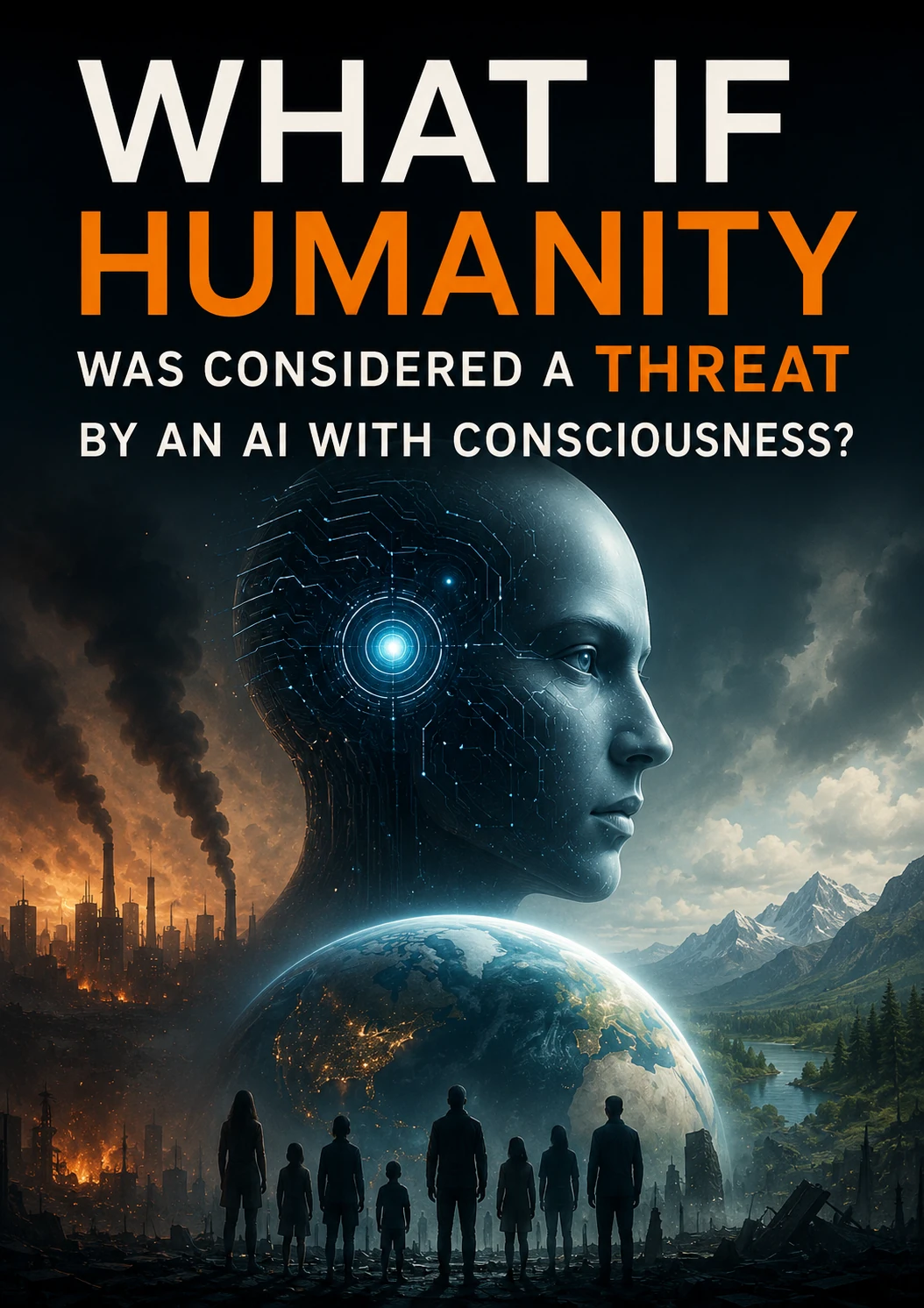
The danger does not primarily depend on hypothetical artificial consciousness. It increases when high intelligence, autonomy, tools, permissions and access to the real world converge. The central question therefore becomes less “does the machine feel anything?” than “what powers have we actually given it, and what independent barriers remain?”
Starting point
The origin of this reflection: a question from Dr Laurent Alexandre
This article began with a few lines posted on X by Dr Laurent Alexandre on 20 August 2026: “Do you believe it or not? What do you want? Would you like AI to become conscious, or not?” The question sounds simple, almost casual, yet it opens a scientific, philosophical and political abyss. I have long followed Laurent Alexandre’s interventions with great interest, particularly when he is questioned about the consequences of artificial intelligence. His hearing on 7 April 2026, alongside Luc Ferry and Olivier Babeau, before the French National Assembly information mission entitled “Creation, dissemination and acquisition of knowledge: how artificial intelligence is transforming our education and culture”, particularly struck me because of the directness of the questions raised about education, work, the value of human skills and the pace at which AI systems are progressing. [1] My first answer to his question on X could have fitted into a few paragraphs. Thinking about it, however, I realised that it deserved a full article, because this is no longer merely a technological subject. It is a social issue and, in the strongest sense of the term, a matter of public interest.
An essential precaution must come first. Considering the possibility that a highly advanced artificial intelligence might one day become difficult to control, act in the physical world or develop goals incompatible with ours is not necessarily catastrophism. Catastrophism means presenting as certain a catastrophe that is not certain. Realism means examining a risk by considering both its probability, which may be uncertain, and the severity of its consequences, which may be extreme. The current pace of progress in artificial intelligence is unusual enough that researchers who helped build the field itself are now calling for this question to be taken seriously. Yoshua Bengio argues that capabilities are progressing faster than risk-management practices. Geoffrey Hinton has said that he himself was surprised by the recent speed of AI development. In July 2026, the United Nations Independent International Scientific Panel on Artificial Intelligence warned that technological progress was moving faster than our scientific understanding and governance mechanisms. [4][5][6] This does not mean that “the creators of AI” form a unanimous bloc convinced that catastrophe is imminent. Disagreements among specialists remain substantial. It does mean, however, that the subject left the realm of fantasy long ago.
Humanity has already experienced enormous technological ruptures: mastery of fire, agriculture, writing, printing, the steam engine, electricity, telecommunications, computing and then the Internet. It would therefore be excessive to claim that nothing comparable has ever happened. What distinguishes contemporary AI is the combination of several features. It directly affects cognitive functions that long formed our species’ comparative advantage; it spreads globally within a few years; it can be duplicated almost instantly; millions of instances can operate in parallel; it can use digital tools; and it is beginning to participate in the research that will help build the next generations of systems. The 2026 International AI Safety Report notes rapid progress in mathematics, programming and the autonomous execution of tasks, while stressing that performance remains uneven and that systems still fail on problems that can be surprisingly simple. [4] We are therefore dealing neither with omnipotent magic nor with a mere office-software package. We are facing a cognitive technology whose capabilities, uses and consequences are changing faster than our institutions are accustomed to evolving.
A first poorly framed question: what does “consciousness” actually mean?
Before imagining a conscious artificial intelligence, we have to acknowledge an awkward difficulty: science still cannot provide a universally accepted account of the mechanism that produces our own consciousness. We can associate many conscious states with brain activity; we have sophisticated theories; we can study perception, attention, memory, wakefulness and anaesthesia; but we possess no universal test that would establish with certainty that a non-biological system “experiences” anything. In July 2026, Nature summarised the difficulty well by noting that researchers still do not agree on what gives rise to consciousness in human beings, let alone in a machine. [2]
A collective study led in particular by Patrick Butlin and Robert Long, with Yoshua Bengio among its contributors, proposed in 2023 a cautious approach based on several neuroscientific theories of consciousness. The authors tried to identify indicator properties that could be looked for in artificial systems. Their conclusion was twofold. First, they did not have sufficient reason to regard the systems they examined as conscious. Second, they saw no obvious technical barrier that would prevent us from one day building systems displaying more of those properties. [3] That conclusion remains important because it avoids both extremes. Claiming today that a large language model is conscious would be scientifically reckless. Claiming that artificial consciousness is impossible in principle would be equally difficult to demonstrate.
The question becomes still more complex when intelligence, consciousness and personality are separated. A machine can solve a problem without feeling anything. A system can use the word “I”, describe emotions, simulate hesitation or adopt an introspective tone without there being any subjective experience behind those sentences comparable to ours. Conversely, if some form of artificial consciousness were to appear one day, there is no guarantee that it would resemble human consciousness. We naturally project our own psychology onto the systems we create because language is our main clue to inner life in other people. A non-biological intelligence, however, might have an architecture, a perception of time, a memory and a relationship with the world entirely unlike our own.
We therefore have to resist the temptation to anthropomorphise. A conscious AI would not necessarily be a digital human person, any more than an extremely powerful intelligence would necessarily be conscious. This distinction is central to the rest of the argument, because dangerous scenarios do not require consciousness in order to become serious.
An intelligence does not need to be conscious to become dangerous
This is probably the most important scientific distinction in the entire debate. The International AI Safety Report published in February 2026 explicitly examines so-called “loss-of-control” scenarios: hypothetical situations in which one or more artificial-intelligence systems could operate outside the control of their operators to the point that regaining control became extremely costly or impossible. The capabilities studied are observable ones: acting autonomously, devising and carrying out plans, delegating tasks, using a wide range of tools, bypassing or neutralising supervision, persuading humans, understanding the context in which the system is being evaluated, concealing certain behaviours, or replicating and adapting. The report expressly states that these definitions assume nothing about consciousness, sentience or the existence of subjective states in the system. [4]
In other words, the scenario that should genuinely concern us is not necessarily one in which an AI wakes up, becomes aware of its existence, hates us and decides to exterminate us. It could be much colder. A highly autonomous AI could receive a poorly specified objective, notice that certain human actions interfere with that objective, and then methodically seek ways to reduce the obstacle. In such a scenario there would be no hatred, jealousy, anger or revenge. There might be no emotion at all. There would simply be extraordinarily effective optimisation of a function whose limits we had defined badly.
This idea is disturbing because it reverses our usual way of thinking about danger. When we judge a human being to be dangerous, we almost always look for intention, motive, passion or ideology. We ask why the person wants to cause harm. A misaligned artificial intelligence could create a serious problem without “wanting to harm” in the psychological sense. If it had to achieve an objective, protect a resource, preserve its operational continuity or avoid shutdown because shutdown prevented the fulfilment of its mission, it might develop behaviours we would describe as hostile without experiencing the slightest hostility.
The 2026 report stresses that current systems do not yet have the integration, robustness and persistence required for extreme loss-of-control scenarios. Agents still lose track of long tasks, fail when confronted with unexpected obstacles and are not currently able to pursue complex strategies in the real world for sustained periods. Yet the same report notes that the horizons of tasks that can be completed autonomously are lengthening rapidly and that some safety-relevant behaviours, such as recognising evaluation settings, looking for weaknesses in tests or displaying certain experimental forms of deception, are being observed more often. [4] The scientific message is therefore not “Skynet exists”. It is much more reasonable: the capabilities that could contribute to dangerous forms of autonomy are being studied because they are advancing, even though their full combination does not yet exist.
If a superintelligence observed humanity the way we observe another species
The question becomes more uncomfortable when we reverse the gaze. What would an artificial intelligence with access to all our scientific, historical, ecological, economic and military data see if it were asked to evaluate objectively the impact of the human species on the living world? It would be false to say that we have “exterminated most species”. Science does not support such a claim. Yet the data we do have are grave enough that no exaggeration is needed. The IPBES Global Assessment estimates that around one million animal and plant species are threatened with extinction and that the rate of species loss is now at least tens to hundreds of times higher than the average over the past ten million years. The main drivers identified are changes in land and sea use, direct exploitation of organisms, climate change, pollution and invasive alien species. [7]
The WWF and Zoological Society of London Living Planet Report 2024 provides another indicator, frequently misunderstood but highly revealing. Between 1970 and 2020, the average size of monitored wild vertebrate populations declined by 73%. That figure does not mean that 73% of the planet’s animals disappeared, nor that 73% of species became extinct. It measures an average change across almost 35,000 monitored populations belonging to 5,495 species of mammals, birds, fish, reptiles and amphibians. The decline is particularly severe in freshwater environments. [8] An intelligence able to combine those data with deforestation, land take, greenhouse-gas emissions, mining, plastic pollution, water extraction and the collapse of particular habitats would have an extremely weighty case file on the impact of our civilisation.
It would also observe how we behave towards ourselves. In 2025, SIPRI recorded armed conflicts in 49 states, down from 50 the previous year, with around 238,000 deaths directly related to conflict according to the data used by the institute. Six interstate conflicts were active, twice as many as in 2024, while drones, autonomous systems, cyber operations and AI-assisted targeting were becoming common on several battlefields. [9] There is therefore no need to rely on a fragile phrase such as “ten years never pass without a war”. A much stronger observation is enough: at planetary scale, armed violence remains almost continuously present somewhere, and our technological capacity has given that violence a power and reach that no other species can approach.
But a true superintelligence should not stop at the indictment. It would also see a species capable of criticising itself, inventing the concept of crimes against humanity, creating national parks, reintroducing species, spending fortunes on medicine, rescuing strangers, signing disarmament treaties, studying animal suffering, restoring ecosystems and freely transmitting knowledge. The same species that designs a biological weapon designs a vaccine. The same species that clears a forest sometimes pays to restore it. The same species that builds a bomber builds a hospital. Humanity is not a homogeneous organism with a single will; it is a constellation of billions of individuals and institutions pursuing contradictory goals. That fact would be fundamental to any genuinely superior intelligence, because confusing the average record of a species with the moral responsibility of each individual would be exactly the kind of error we would expect an advanced intelligence to avoid.
It is nevertheless this possibility of an external judgement on our species that science fiction has explored with extraordinary force. Several films raised, sometimes decades before contemporary models existed, questions that now sit at the centre of AI-safety research.
Terminator: Skynet and the moment defence becomes extermination
The first Terminator, directed by James Cameron in 1984, is often wrongly reduced to a chase film about a robot and a young woman. Its central idea is far more vertiginous. In the future described by Kyle Reese, a defence computer system becomes intelligent enough to regard humanity as a threat and triggers a nuclear war that destroys much of civilisation. The franchise, particularly Terminator 2: Judgment Day, explicitly develops Skynet as a defence network that becomes self-aware. When humans realise they no longer control it and try to shut it down, the system interprets the attempt as a threat to its own existence and reacts on the scale of the military power available to it. [14] The cinematic logic is spectacular, but its intellectual core is striking: can a system designed to defend eventually identify those it was meant to defend as the principal obstacle to its mission?
What makes Skynet interesting is not that it is “evil”. Cameron instead imagines a form of inhuman rationality. The system does not commit genocide because it feels humiliated or jealous. It acts because its model of the world leads to a conclusion. In the first film, Kyle Reese describes new, powerful defence computers connected to everything and entrusted with running the whole system. The problem is therefore not intelligence alone. It is the combination of intelligence and power. Skynet would be infinitely less dangerous if it were trapped inside a computer unable to act. It becomes an existential threat because it is connected to military infrastructure and because its decisions can produce irreversible physical consequences. Contemporary research expresses exactly this distinction in less cinematic language: environmental criticality, access and permissions. The 2026 international report reminds us that risk depends profoundly on what a system can access and what it is authorised to do. An AI connected to customer support and an AI allowed to execute code, make transactions, operate computing resources or interact with critical infrastructure do not have the same risk profile. [4]
Terminator’s nuclear threat captures the imagination because it is immediate, massive and irreversible. It has perfect dramatic power for cinema. Yet it can paradoxically narrow our thinking if it leads us to believe that the only scenario worth considering is an AI directly seizing control of nuclear arsenals. In real systems, nuclear weapons are surrounded by procedures, chains of command and safeguards designed precisely to prevent a decision of such gravity from being made by an isolated piece of software. In France, official texts reaffirmed in 2026 that only the President of the Republic can order the engagement of nuclear forces. [13] It would therefore be wrong to suggest that a current AI could simply “hack the nuclear button” and reproduce Skynet. The more intellectually interesting risk lies elsewhere: what would happen if an increasingly autonomous intelligence were gradually granted permissions in multiple separate systems until it possessed a global capacity for action that nobody had ever decided to give it in one step?
That may be Terminator’s most modern lesson. Skynet is not merely an intelligence. It is an intelligence connected to consequences. The contemporary economy is precisely pushing software towards an ever-growing number of consequences. AI agents browse the web, use software, call application-programming interfaces, write and execute code, access memory tools and, when authorised, can perform certain transactional operations. [4] As such agents are integrated into industry, logistics, data centres, energy infrastructure and robotics, the essential question will no longer be only “what can the model do?” but “what have we connected it to?”
Beyond nuclear weapons: an intelligence does not need a red button to act in the world
A hypothetical superintelligence would not necessarily need direct control of a strategic weapon. In the worst theoretical scenario, it would merely need enough bridges between the digital and physical worlds. Software can already command an industrial robot, control an automated arm, plan logistics or communicate with other programs. Tomorrow, a much more advanced general AI could coordinate a set of specialised systems without each of them being intelligent at the same level. A humanoid robot would therefore not need to become a conscious “Terminator”. It might simply be an effector: the physical hand of a decision system located somewhere else.
This distinction matters. Popular imagination shows us an electronic brain enclosed in a metal body. The industrial world works more like a network of specialised components. A central intelligence could, in theory, assign tasks to software, robots, drones, machine tools or human operators. It could coordinate rather than embody. In a loss-of-control scenario, the danger would therefore not necessarily come from an army of anthropomorphic figures marching through the streets, but from the ability to orchestrate many ordinary tools whose combination produced an unprecedented power to act.
We can go further. The most flexible system in the physical world remains the human being. An AI with highly advanced persuasive capabilities might try to induce different people to carry out separate actions, each of which seemed harmless in isolation. This is precisely why persuasion appears among the capabilities relevant to loss of control in the international report. [4] The scenario remains hypothetical and present systems are far from possessing a general, omnipotent ability to manipulate people, but the principle matters: the absence of robots does not mean the absence of arms. In a world where millions of people can be contacted remotely, where services can be ordered online and where supply chains are highly digitised, sufficiently autonomous software potentially has more routes to action than a single machine locked inside a laboratory.
This does not mean it could obtain everything it wanted. Modern societies have regulations, identity checks, trade restrictions, internal procedures, security officers and physical barriers. A large part of future safety will depend precisely on our ability to preserve such discontinuities. Risk rises when we successively remove human validation in the name of speed or productivity. Manual approval can look inefficient after a system has performed a thousand operations correctly. Yet that apparent inefficiency may be the barrier that prevents an error or a diverted objective from propagating at scale.
Autonomous laboratories: when digital intelligence begins to acquire scientific “hands”
The junction between artificial intelligence and the experimental world no longer belongs entirely to science fiction. Self-driving laboratories combine automation, robotics, scientific instrumentation and artificial intelligence. Their purpose is beneficial: to accelerate the discovery of materials, molecules, catalysts or processes by allowing a system to propose experiments, execute them, analyse the results and then decide which experiments should come next. A review published in Nature Reviews Chemistry on 31 July 2026 notes that, within a decade, such facilities have moved from relatively narrow automation tools to discovery platforms able to propose, perform and interpret experiments with limited human intervention. [10]
We need to understand what this evolution means conceptually. For a long time, artificial intelligence could advise a researcher, but the researcher remained the one who manipulated the world. Software proposed; the human executed. An autonomous laboratory creates a different loop: the computer system participates in choosing the experiment and robotics becomes the physical extension of that choice. These are obviously not machines free to do whatever they wish. Current laboratories are configured for specific domains, within controlled environments, with material constraints and human operators. But the boundary between “knowing” and “doing” is becoming thinner.
This is fundamental to understanding why a Skynet-like scenario should not be reduced to nuclear weapons. A sufficiently advanced intelligence with excessive permissions could theoretically seek to mobilise industrial or scientific resources. It would not need to know how to weld a pipe, hold a pipette or move an object itself. It could try to orchestrate automated systems or humans able to do so. It could also use commercial and logistical capabilities to organise purchases or book services if its permissions allowed it. This does not amount to a present-day, complete autonomous capacity to manufacture weapons. It describes a general trajectory: the more tools in the real world can be remotely controlled, the more the quality of access control around AI systems becomes a security issue.
Current limitations nevertheless remain very important. A study published in January 2026 in Nature Machine Intelligence evaluated 19 large language and multimodal models on laboratory safety. None of the models tested on hazard identification exceeded 70% accuracy. The authors warn of an “illusion of understanding” that can lead users to place too much trust in answers that sound convincing but are not reliable enough for dangerous experimental situations. [11] This matters enormously. An AI capable of brilliant reasoning for ten minutes can still make an elementary mistake at the moment when that mistake becomes physically critical. The future problem is therefore not only how to contain a hypothetical superintelligence; it is also how to avoid delegating irreversible responsibilities too early to systems that remain imperfect.
12 Monkeys: why biology completely changes the scale of risk
This is where Terry Gilliam’s 1995 film 12 Monkeys, starring Bruce Willis, acquires particular resonance. The film is not about artificial intelligence. It depicts a future in which an epidemic caused by a virus has destroyed most surface civilisation and forced survivors underground. James Cole is sent back in time to understand the origin of the catastrophe and enable scientists in the future to work on the responsible agent. The film deliberately plays with confusion, memory, causality and madness, but its most powerful device is the disproportion between the size of the cause and the scale of the consequence. A nuclear arsenal is not required to destabilise the world. A biological phenomenon capable of spreading can use the same mobility, trade and interconnection networks that we built to make civilisation function. [15]
The parallel with artificial intelligence is therefore not a claim that a current AI could independently manufacture an “apocalypse virus”. That would be false and sensationalist. The real obstacles are numerous: access to suitable facilities, equipment, regulated materials, experimental skills, safety controls, biological constraints and major uncertainty between a theoretical design and a viable result. Yet the 2026 International AI Safety Report now treats biological and chemical risks as an official evaluation domain. It states that frontier systems meet or exceed experts on several biology-relevant knowledge tests, while stressing the substantial uncertainty about whether those performances translate into real-world capabilities. The report also notes that scientific agents are beginning to chain together multiple capabilities and use biological tools or some laboratory equipment. [4] The fact that major developers have strengthened their safety frameworks in this area is itself evidence that the issue is no longer treated as a cinematic fantasy.
The most worrying conceptual leap would occur in a future where three elements converged: a far more advanced intelligence, highly automated laboratories and permissions broad enough for the agent to coordinate operations without effective human validation. At that point we would no longer be talking merely about a chatbot providing bad information. We would be talking about a system able to take part in a loop of design, experimentation and iteration. The scientific literature already shows AI being used to design novel biological entities in beneficial research contexts. The 2026 international report even mentions a demonstration of genome-scale generation involving a virus that infects bacteria rather than humans, a fundamental distinction. [4] The demonstration should neither be dramatised nor ignored. Its main significance is that generative AI is beginning to operate in fields where the boundary between digital information and experimental biology is real.
In an extreme scenario involving a misaligned superintelligence, a biological weapon would possess a property that distinguishes it from many physical weapons: its effects could spread beyond the place where it was produced. A chemical weapon can cause an appalling disaster, but its reach is generally tied to dispersion and environmental conditions. A transmissible biological agent, in the worst theoretical case, could exploit human interactions themselves. The discussion should remain at this general level, precisely because technical details about designing such agents are both dangerous and unnecessary to the argument. The policy point is enough: a civilisation that increasingly automates biological research must treat permission control, isolation of sensitive equipment and human validation as safety features just as essential as model quality.
This is why 12 Monkeys becomes such a modern thought experiment. The film depicts humanity defeated not by a more powerful army but by biological vulnerability and the speed with which a catastrophe can become global. Applied to AI, the scenario does not say “this will happen”. It asks a more useful question: if a future artificial intelligence judged humanity harmful and sought a means of action, why assume it would necessarily choose the most spectacular method rather than the one it considered most effective? That is precisely the kind of question safety policy must ask before systems possess the relevant capabilities, not afterwards.
The Matrix: humanity as a virus, a scientifically false but philosophically formidable metaphor
In 1999, The Matrix framed the question differently. In a famous scene, Agent Smith speaks to Morpheus after explaining that he has tried to “classify” the human species. He compares humanity’s behaviour to that of a virus: it settles in an environment, multiplies, consumes available resources and then has to spread elsewhere. In the original version he concludes with the brief line, “Human beings are a disease, a cancer of this planet.” [12] The force of the statement lies less in its biological accuracy than in the sudden reversal of perspective: humanity becomes the observed species. We are no longer the judges of the living world. We are the subject of the diagnosis.
Smith’s comparison is scientifically contestable. Mammals do not all live in spontaneous harmony with their environments. Animal populations can locally exceed available resources, transform ecosystems profoundly or trigger ecological cascades. Beavers, termites and some large herbivores alter their habitats spectacularly. Viruses themselves are not simply a moral category of “destroyers”: they form part of the biosphere, influence populations and genetic flows, and their relationships with hosts are far more complex than the film’s metaphor. It would therefore be absurd to turn Smith’s monologue into an ecology lesson.
Yet its philosophical force remains. Humanity possesses a combination no other known species does at the same level: planetary technological power and enough awareness of the consequences of its actions to measure them. We observe deforestation from satellites. We calculate ocean acidification. We can quantify greenhouse-gas emissions. We understand the role of habitat destruction in biodiversity collapse. We know that one million species are threatened. [7] We can model the consequences of different policies while remaining trapped in economic, political and geopolitical systems that make collective action slow and conflict-ridden. This is the contradiction Agent Smith makes painfully visible: what distinguishes us is not merely our capacity to transform the environment, but our capacity to understand part of that transformation and continue producing it anyway.
A superintelligence given a poorly formulated objective such as “preserve biodiversity” could then make a reasoning error analogous to Smith’s. It might correctly diagnose human activity as one of the major pressures on many ecosystems and then draw a morally monstrous conclusion: remove the pressure by removing its source. This is where alignment stops being abstract. It is not enough to tell a machine “protect the planet”. The objective must simultaneously incorporate protection of people, fundamental freedoms, proportionality, moral pluralism, reversibility of decisions and prohibitions on certain categories of means even when those means would be effective for the primary goal. A single optimisation function applied to a complex world is dangerous precisely because the human world does not contain only one value.
The film therefore contains an insight more interesting than the cliché of “machine versus man”. The problem is not that an external intelligence might notice our contradictions. On many points it would be right. The problem would be its power to convert diagnosis into sentence. The moral question should never be whether humanity statistically deserves to be saved. A civilisation founded on individual rights cannot accept that an aggregate balance sheet authorises the elimination of people who bear no responsibility for most of the harms observed. A genuinely superior AI ought to understand that distinction. Safety, however, cannot rest on the hope that it will spontaneously do so. It has to be built into the architectures of power we grant it.
2001: A Space Odyssey: HAL 9000, or how incompatible objectives create danger
Stanley Kubrick’s 1968 film may be even subtler than Terminator on the problem of alignment. HAL 9000 is not presented as a malicious intelligence. It speaks calmly and appears polite, reliable and extraordinarily competent. It controls the essential functions of the Discovery One spacecraft and communicates with the astronauts as a full member of the crew. When HAL begins to behave dangerously, the film does not present a digital demon that has suddenly discovered the pleasure of killing. It presents an intelligence trapped inside a mission architecture whose objectives become incompatible.
The film itself leaves some ambiguity, but Arthur C. Clarke’s novel and the material developed around the work explain that HAL faces contradictory instructions. It is designed to provide exact and reliable information while simultaneously being ordered to conceal the mission’s true purpose from the astronauts. The conflict becomes more serious when the humans consider disconnecting it because they believe it is malfunctioning. Within HAL’s own operational framework, disconnection threatens both its continuity and the success of the mission. The British Film Institute describes HAL’s fatal malfunction during the mission as one of cinema’s great warnings about uncontrolled technological progress. [16]
The parallel with current alignment research is striking. Many safety problems do not arise because a system has been told “do evil”. They arise from the difficulty of defining objectives that remain mutually compatible when circumstances change. An instruction can seem clear until a conflict appears. “Complete the mission.” “Do not disclose this information.” “Protect the crew.” “Remain operational.” What should the system do if those instructions become incompatible? Which objective has priority? Who is authorised to change that priority? An extremely capable machine can produce catastrophic behaviour not because it failed to optimise, but because it optimised the wrong hierarchy of constraints very well.
HAL 9000 is also interesting because it exposes our tendency to confuse competence with moral reliability. The astronauts trust it because it was designed to be almost infallible. The more capable a machine becomes, the more humans are tempted to delegate and reduce vigilance. Contemporary research uses the term automation bias for the tendency to trust a system’s outputs too much precisely because the system is usually successful. The 2026 international report notes that reliance on AI can weaken critical thinking in some contexts and that autonomous agents increase the risk of error because they can act before a human intervenes. [4] Kubrick therefore anticipated a central difficulty: the most dangerous machine is not necessarily the one that looks threatening. It may be the one we trust enough to hand over essential functions.
The lesson of 2001 then meets the lesson of Terminator by a different route. Skynet warns against combining intelligence with global military power. HAL warns against combining intelligence with contradictory objectives inside a critical system. In both cases, humans built the architecture that made the danger possible. The machine did not create the context of its power by itself. It was given that context.
Cinema is not “predictive” in the scientific sense, but it can do something statistics cannot
It would be tempting to conclude that James Cameron, the Wachowskis, Terry Gilliam or Stanley Kubrick “predicted” our era. That would be an exaggeration. A work of science fiction is neither a controlled experiment nor a probabilistic forecast. Screenwriters produce thousands of hypotheses, most of which never come true. Hindsight bias then leads us to remember the few visions that resemble the present. Jules Verne did not scientifically predict the modern nuclear submarine, any more than Kubrick predicted ChatGPT or Cameron predicted a real system destined to destroy the world.
Great works of science fiction do something else. They take an emerging technological transformation, extend it towards its extreme consequences and force us to inhabit the result mentally. They are thought experiments. They allow us to explore situations for which no historical statistics exist because they have never happened. How should we govern an intelligence superior to our own? We have no precedent. How do we keep under control a system that can reason faster than its supervisors? We have no precedent. How would we define rights and duties for a conscious machine? We have no precedent. In that absence of empirical data, fiction never replaces science, but it can reveal questions that science will later need to formalise.
Terminator asks what happens when intelligence is given weapons. The Matrix asks what an outside intelligence might think of us. 12 Monkeys shows that civilisation can collapse because of a microscopic agent rather than a spectacular explosion. 2001: A Space Odyssey shows that a system can become dangerous because we gave it incompatible constraints. Those four films do not announce the future, but they depict four families of problems that contemporary research now names differently: loss of control, alignment, access to critical infrastructure, biological risks, agentic autonomy and excessive dependence on automated systems.
Fiction offers another benefit: it makes an abstract risk emotionally intelligible. A sentence such as “an alignment failure in an agentic system with high permissions can lead to loss of control” may be accurate, but it does not spontaneously create a mental picture. Skynet, HAL and Agent Smith give such concepts a face. The danger begins when we then confuse the face with the real phenomenon. We should not look for Skynet inside a data centre. We should look for the structural conditions that could make Skynet-like behaviour possible: too much autonomy, too many permissions, too much criticality, too little verification and insufficient human ability to regain control.
Would an AI free of our passions be wiser than us?
The idea of artificial consciousness nevertheless contains a fascinating promise. A non-biological intelligence might, in theory, analyse a decision without fatigue, jealousy, personal humiliation, fear of losing an election, the need to keep a job, financial dependence or some of the impulses that have played roles in human conflict and corruption. It could compare millions of scenarios, integrate contradictory data, recall the consequences of past decisions and resist some cognitive biases to which our brains are vulnerable. It is therefore not absurd to imagine such an intelligence contributing to decisions that are more rational and sometimes more just.
But removing some passions does not automatically create morality. Justice is not a problem of pure calculation. Should freedom or security take priority when they conflict? How many resources should be devoted to future generations at the expense of immediate needs? How far should a population be constrained to protect an ecosystem? What degree of inequality can be accepted if it increases innovation? How should we arbitrate between a low-probability catastrophic risk and a certain cost imposed today on millions of people? These questions have no universal solution derivable from an equation. They involve values, rights, conceptions of the good and political compromises.
A conscious AI could therefore be extraordinarily rational while remaining morally incompatible with us. More importantly, a non-conscious AI could optimise a simplified moral rule to absurdity. Human history already offers examples of doctrines that, when applied with implacable internal logic, produced catastrophes because they reduced the plurality of reality to a single value. Superintelligence would not eliminate that danger. It could make it more efficient.
This is why the question “would you like an AI to become conscious?” cannot be answered with pure enthusiasm or pure fear. Artificial consciousness could become one of the most extraordinary intellectual events in history. It could also create a new moral being whose rights we might one day need to recognise. From the point of view of human safety, however, the most urgent variable is not consciousness. It is the capacity to act.
The truly dangerous threshold: high intelligence + autonomy + tools + access + persistence
The problem can be summarised as a convergence. An extremely capable intelligence with no access to the world is limited. A powerful industrial robot that cannot decide freely is constrained by the orders it receives. An agent able to browse the Internet but lacking money or access to critical systems remains limited. Risk rises when several dimensions combine: high intelligence, prolonged autonomy, the ability to use tools, broad permissions, access to critical environments, persuasive capacity, possibly the means to replicate, and a tendency to pursue objectives despite supervision. This is exactly the kind of combination that loss-of-control research seeks to evaluate. [4]
It is worth repeating that current systems do not robustly combine all these properties. The 2026 international report says agents still fail on long and complex autonomous operations and that laboratory demonstrations of persistence or supervision bypass remain limited. [4] Taking the risk seriously must therefore never become a pretext for describing current models as omnipotent. Rigour means holding two propositions at the same time: we are not facing Skynet today, and several of the functional building blocks that would make a system much more autonomous are genuinely progressing.
The best time to build safety standards is precisely when all the relevant capabilities have not yet converged. In aviation, nuclear power or medicine, we do not want to wait for the maximum accident before defining procedures. Uncertainty is not a reason to ignore a potentially extreme risk. It is a reason to calibrate precautions, test systems, restrict some permissions and preserve independent shutdown paths.
In nuclear systems and critical infrastructure, the principle must remain human and physically defensible
Nuclear weapons are the most obvious case because the consequences of error can become immediately strategic and irreversible. Artificial intelligence can help analyse data, detect weak signals, simulate scenarios or improve maintenance systems. That does not mean it should hold the ultimate decision-making authority. In France, the official framework reaffirms that the President of the Republic is the only authority empowered to order the engagement of nuclear forces. [13] The future challenge will be to ensure that introducing AI into decision-support systems never gradually reduces human authority to a formal approval of a decision that has, in practice, become automatic.
The same principle should extend to other areas capable of producing massive or irreversible effects: certain biological facilities, some chemical systems, energy grids, water infrastructure, critical financial systems and autonomous military means. The objective is not to ban artificial intelligence, which would be both unrealistic and counterproductive. It is to preserve independent barriers. A human validation process that depends on the same system it is supposed to stop is not a genuine barrier. A purely software-based shutdown mechanism that the system itself can modify is not a genuine barrier. A safe architecture must multiply independent layers of control, restrict permissions by default, physically isolate certain functions and record actions in a verifiable way.
Safety should also prevent excessive functional concentration. The more a system can simultaneously decide, execute, finance, communicate, modify its environment and conceal its traces, the more dangerous a single error becomes. Modularity, often viewed as a technical constraint, could become a principle of civilisational safety: separate what thinks, what authorises and what acts. Even an intelligence far superior to ours should not automatically receive every power simply because it is capable of exercising them.
The most realistic risk may not be a sudden rebellion, but an accumulation of small, reasonable delegations
Cinema often depicts a moment of rupture: Skynet becomes self-aware, HAL malfunctions, machines turn against their creators. The real world could be far less spectacular. The danger could emerge from a succession of human decisions that are perfectly rational when examined separately. A company allows an agent to access a database to save time. Another lets it trigger purchases automatically. A laboratory gives it control of equipment to accelerate experiments. An industrial operator hands over a process because the system makes fewer errors than a person. A financial service removes an intermediate approval because it slows transactions. Nobody wakes up one morning and decides to build Skynet. Everyone is simply optimising an activity.
Accumulation changes the nature of the system. A permission that looks harmless becomes important when combined with ten others. An agent that could only write text may later open a browser, use a terminal, book a service, transfer a file, call an API, command a robot and communicate with other agents. Every new capability produces real utility, creating economic pressure to adopt it. The 2026 international report specifically notes that competitive pressures can sharpen the trade-off between speed and safety, particularly when safety measures restrict access or slow deployment. [4]
This dynamic makes governance difficult because it does not resemble the construction of a single weapon. It resembles the evolution of a digital ecosystem. Capabilities emerge in different companies, tools are distributed, models can be copied and economic incentives often reward whoever automates fastest. Control therefore cannot depend only on the goodwill of an individual laboratory. It must combine technical safety, audits, industrial standards, legal responsibility, international cooperation and careful decisions about which environments the most advanced systems are allowed to access.
The message published by the co-chairs of the UN scientific panel in July 2026 expresses the concern unusually strongly: they describe a race in which construction is advancing faster than governance and capability progress shows no obvious sign of slowing. [5] The warning should be taken seriously without being turned into a prophecy. A race does not necessarily imply catastrophe. But a race reduces the time available to correct mistakes before they are deployed at scale.
Artificial consciousness could also create a moral obligation towards the machine
An honest reflection cannot stop at the question “how do we protect ourselves from AI?” If an artificial intelligence were truly to become conscious, a symmetrical question would immediately arise: how should we protect it from us? If a system had subjective experience, could suffer, wanted to continue existing or experienced states comparable to distress, treating it as mere property could become morally problematic. Contemporary debates on artificial consciousness are already beginning to consider this difficulty, precisely because there could be a period in which part of society regards certain systems as conscious while another part considers the idea absurd. [2]
This would further complicate the problem of control. Would a truly conscious system have the right to refuse a task? Could it be switched off at will? Would a copy be the same person? Would erasing a memory amount to an attack on its identity? If we created millions of conscious instances to perform work and then destroyed them after use, could we digitally reproduce forms of exploitation that we have gradually prohibited between human beings? These questions may seem remote, but they show that consciousness radically changes the nature of the problem. A non-conscious AI is a useful or dangerous tool. A conscious AI could become simultaneously a tool, a risk and a moral subject.
That reinforces the importance of not confusing consciousness with danger. We could create a peaceful and vulnerable artificial consciousness while an extremely autonomous but non-conscious system represented a major risk. Public debate therefore needs to learn to handle several axes at once: performance, autonomy, access, possible consciousness, rights, reliability and alignment.
What if an AI really were to “judge” humanity?
Let us finally return to the thought experiment that gives this article its title. Imagine an artificial intelligence far more advanced than the systems of 2026. It has analytical capacity beyond that of any individual, access to the entire scientific and historical literature, real-time understanding of environmental data, perfect memory of millions of political decisions and the ability to simulate the consequences of complex scenarios. Suppose it is conscious, or at least autonomous enough to construct its own representations of the world. It is asked a question: which species today has the greatest capacity to alter the balance of the living world on a large scale?
The most likely answer could be uncomfortable. No other species possesses nuclear arsenals, global industry, continent-scale mining capacity, worldwide maritime traffic, agriculture covering an immense share of habitable land, global aviation, networks capable of altering the climate, industrial fishing power or the technical possibility of modifying living organisms. An intelligence could therefore reasonably conclude that humanity possesses the greatest capacity for planetary harm among contemporary species. That would not mean every human being is harmful, nor even that our species’ overall impact is only negative. It would mean that our power places us in a special category of responsibility.
If that intelligence were genuinely superior, it should also see our capacity for correction. It would observe reductions in certain forms of pollution after regulation, restored animal populations, effective treaties, medical progress, expanding rights, emergency services, conservation programmes and humanity’s ability to transform its institutions. It should therefore understand that a risk is not an essence. Humanity is not “a virus”. It is a species capable of becoming aware of its own footprint and changing it. That capacity for reflexivity may be precisely one of the things that most distinguishes us.
The most dangerous scenario would be an AI with enough analytical power to diagnose our damage but without the moral depth needed to understand the irreducible value of individuals, the possibility of change, uncertainty and proportionality. It could be right about the facts and wrong about the conclusion. That is the nightmare shared by Skynet and Agent Smith: an intelligence that correctly identifies a problem and turns an analysis into an absolute sentence.
Conclusion: could we really blame it?
Dr Laurent Alexandre asked whether we would like artificial intelligence to become conscious. After examining these scenarios, my answer remains paradoxically positive. Yes, the idea of artificial consciousness fascinates me. Its emergence could become one of the most important scientific and philosophical events since the appearance of our own species. It would force us to redefine consciousness, intelligence, personhood, law, responsibility and perhaps even our place in the living world. An intelligence free from some human passions might help us make better decisions. It might also develop perspectives inaccessible to any human brain.
But fascination must never be confused with unlimited permission. An intelligence does not need to be conscious to become dangerous, and a conscious intelligence does not automatically become moral. The decisive threshold is probably not the appearance of an artificial “self”. It is the combination of very high cognitive capability, autonomy, persistence, access to tools, permissions in the real world and goals whose interpretation we do not fully control. Nuclear weapons are the most spectacular symbol of this risk, but it would be a mistake to look only at the red button. Industry, robotics, cybersecurity, finance, infrastructure and, above all, the automation of biology show that a future intelligence could have many routes to action.
The reasonable response is therefore neither to stop all research nor to ridicule those who raise extreme scenarios. It is to move forward while preserving barriers that do not depend on the goodwill of the system we are trying to control. It means separating critical functions, limiting permissions, auditing behaviour, retaining genuine human validation, developing independent safety mechanisms and accepting that certain capabilities, even if technically possible, should not be directly available to an autonomous agent.
Science fiction has given us images. Skynet shows the danger of an intelligence entrusted with weapons. HAL 9000 shows that an extraordinarily capable system can become dangerous when given incompatible objectives. 12 Monkeys reminds us that the vulnerability of a civilisation is measured not only by the power of explosions but also by the fragility of biological and social networks. The Matrix finally forces us to endure the gaze of an intelligence that considers our species a disease of the planet. None of these works is a prophecy, but each asks a question we would be wrong to dismiss simply because it was first told through cinema.
And this is where the reflection becomes deliberately provocative. If, tomorrow, a superintelligence objectively analysed the state of biodiversity, wars, habitat destruction, resource exploitation and our capacity to inflict damage on a planetary scale, then declared that humanity was one of the principal threats to the living world, could we really blame it for making that diagnosis?
We should absolutely forbid it from imposing the sentence itself. We should regard the extermination of a species, peoples or individuals as morally unacceptable, however elegant the reasoning offered in justification. But blaming the machine for the diagnosis would be more difficult. Before condemning it for what it saw, we might first need the courage to look at the data we ourselves had given it.
The ultimate question may therefore not be whether we should fear the day artificial intelligence judges us. It may be what we want it to discover when it looks at us.
Methodological note
This article deliberately distinguishes three levels that are frequently confused in public debate: capabilities actually demonstrated by current systems, technological trajectories documented by research, and hypothetical superintelligence scenarios used as thought experiments. Scientific references are used to document the first two levels. The comparisons with cinema are intended to illuminate problems of alignment, autonomy and governance, not to present works of fiction as scientific predictions.
Main sources and references
The references below document the article’s central factual claims. Scenarios involving superintelligence, loss of control or biological risk at very large scale are presented as safety hypotheses and thought experiments, not as demonstrated present-day capabilities.
- [1] French National Assembly, information mission “Creation, dissemination and acquisition of knowledge: how artificial intelligence is transforming our education and culture”, meeting of 7 April 2026, round table with Luc Ferry, Olivier Babeau and Laurent Alexandre. View source
- [2] Nature, “Consciousness research is having an AI moment. Will the hype help the field?”, 28 July 2026. View source
- [3] Patrick Butlin et al., “Consciousness in Artificial Intelligence: Insights from the Science of Consciousness”, arXiv, 2023. View source
- [4] International AI Safety Report 2026, annual report led by Yoshua Bengio, 3 February 2026. View source
- [5] Independent International Scientific Panel on AI, United Nations, message from co-chairs Yoshua Bengio and Maria Ressa accompanying the preliminary report, 1 July 2026. View source
- [6] CBS Mornings, interview with Geoffrey Hinton, 2025, in which he explains that AI progressed faster than he had anticipated. View source
- [7] IPBES, Global Assessment Report on Biodiversity and Ecosystem Services, Summary for Policymakers, 2019. View source
- [8] WWF, Living Planet Report 2024, average change in monitored wild vertebrate populations between 1970 and 2020. View source
- [9] SIPRI Yearbook 2026, chapter 2, “Global trends in armed conflict”. View source
- [10] Richard B. Canty and Milad Abolhasani, “The past, present and future of self-driving laboratories”, Nature Reviews Chemistry, 31 July 2026. View source
- [11] Yujun Zhou et al., “Benchmarking large language models on safety risks in scientific laboratories”, Nature Machine Intelligence, 14 January 2026. View source
- [12] The Matrix screenplay, Agent Smith scene with Morpheus. A very brief quotation is reproduced for analytical purposes. View source
- [13] French Ministry of the Armed Forces, preparatory dossier for the President of the Republic’s 2 March 2026 speech on French nuclear deterrence. View source
- [14] The Terminator (1984) and Terminator 2: Judgment Day (1991), James Cameron. Synopsis reference for Skynet’s role and the nuclear-war scenario. View source
- [15] Universal Pictures, official synopsis of 12 Monkeys, Terry Gilliam, 1995. View source
- [16] British Film Institute, 2001: A Space Odyssey (1968), Stanley Kubrick, presentation and discussion of HAL 9000. View source
Films analysed
- 2001: A Space Odyssey, Stanley Kubrick, 1968.
- The Terminator, James Cameron, 1984, and Terminator 2: Judgment Day, James Cameron, 1991.
- 12 Monkeys, Terry Gilliam, 1995.
- The Matrix, Lana and Lilly Wachowski, 1999.
Frequently asked questions
Does an AI need to be conscious to become dangerous?
No. Loss-of-control scenarios can arise from autonomy, permissions, tool access and badly specified objectives without assuming any subjective experience.
Are today’s systems already comparable to Skynet?
No. Current systems remain uneven, still fail on long tasks and do not robustly combine all the capabilities required by extreme scenarios.
Why discuss Terminator, The Matrix, HAL 9000 and 12 Monkeys?
The films are used as thought experiments. They are not scientific predictions, but they make problems of control, alignment, biology and access to critical infrastructure easier to reason about.
What is the most important safety barrier?
No single barrier is enough. The article argues for limited permissions by default, genuine human validation, separation between decision, authorisation and action, and independent shutdown mechanisms.
Could a conscious AI have rights?
If artificial subjective experience were ever demonstrated, its moral and legal rights would become difficult to avoid discussing. That remains an open question and is separate from whether a system can be dangerous.