


The article does not deny the reform's security safeguards. It asks what strategic value a normalized invoice corpus could retain after a breach, how AI changes the economics of exploitation, and which controls can reduce that residual value.
Executive summary
France's electronic invoicing reform is not a mere conversion from PDF to a structured format, nor is it necessarily a single national database storing every invoice in full. It is an ecosystem of approved, interoperable platforms that will play a central role in issuing, transmitting and receiving invoices and in reporting certain invoicing, transaction and payment data to the tax administration. The legal framework includes substantial safeguards: ISO/IEC 27001 certification, EU-based operation requirements, restrictions on transfers outside the Union and, where cloud hosting is involved, SecNumCloud-related requirements. Those safeguards are real and must be acknowledged. [S1] [S2] [S3] [S4]
The strategic question begins one level later. When a country makes a normalized digital ecosystem mandatory for the commercial relations of millions of actors, it inevitably creates interfaces, directories, histories, metadata and concentrated datasets whose strategic value can exceed that of each individual invoice. Professional invoices can identify parties, goods or services, quantities, prices and other information from which an economic graph can gradually be reconstructed. The reform itself lists better knowledge of business activity among its objectives. [S1] [S5] [S6] [S36]
Artificial intelligence changes the economics of exploitation after a breach. What once required large teams to index, translate and correlate stolen documents can increasingly be automated: entity extraction, supplier matching, anomaly detection, dependency graphs, trend analysis and cross-referencing with public information. The risk therefore cannot be measured only by the number of files exfiltrated, but also by the analytical power an adversary can apply to the corpus. [S7] [S8] [S36]
China is a major case study because French, U.S. and independent sources document both Beijing's strategic focus on AI and sophisticated cyber operations attributed to actors serving Chinese interests. ANSSI has described dense activity by modes of operation considered linked to Chinese interests for the collection of strategic and economic intelligence. CISA and partner agencies reported in 2025 on state-sponsored actors compromising networks worldwide to support a global espionage system. These findings do not justify attributing every incident to China or predicting a future target; they establish that aggregated economic data can plausibly be strategically valuable. [S9] [S15]
The correct response is therefore neither denial of the reform nor the claim that certification makes it safe by definition. It is a national doctrine of minimization, compartmentalization, encryption, least privilege, export controls, auditable interfaces and an 'assume breach' approach: security engineering must ask not only how to prevent intrusion, but also what an attacker could still reconstruct after one barrier has failed. [S4] [S14] [S39] [S40]
1. The Washington test: applying the French rule to U.S. champions
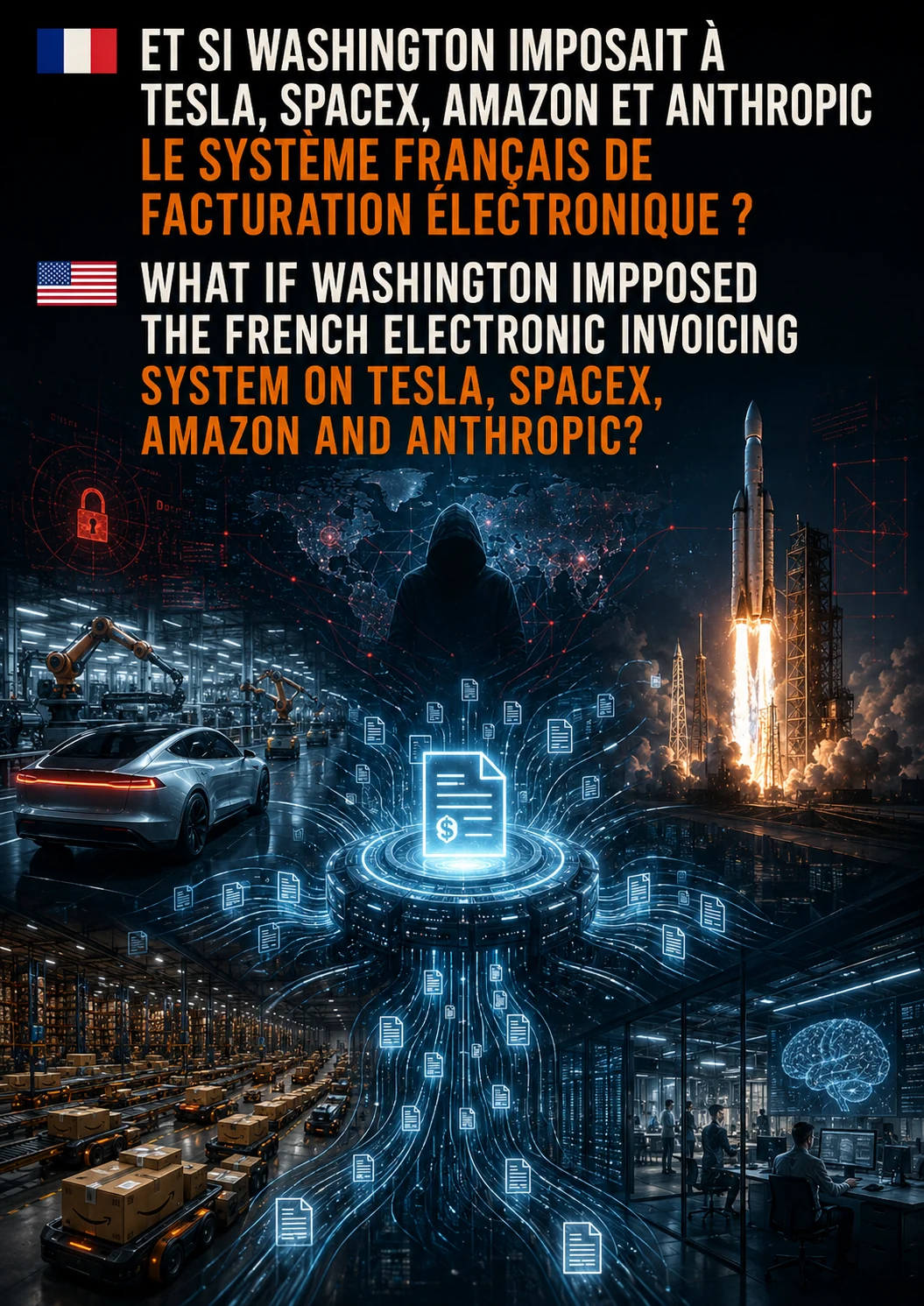
A useful way to understand the sovereignty implications of a domestic reform is to transpose it outside its familiar political environment. Imagine Washington telling Tesla, SpaceX, Amazon, Anthropic and, eventually, the entire U.S. business fabric that business-to-business invoices must transit through an approved interoperable ecosystem and that defined data must be reported to public authorities. The stated goals could be entirely legitimate: fighting tax fraud, cutting administrative burdens, accelerating payment and improving economic monitoring. The boardroom question would nevertheless be immediate: what new intelligence surface does this architecture create?
Tesla and SpaceX would not be exposed in the same way. Tesla's supplier graph, equipment purchases and production cadence can reveal industrial movement. SpaceX sits at the intersection of advanced manufacturing, launch systems, satellite communications and public contracts, so the discovery of a specialist subcontractor or a change in procurement rhythm may itself be strategically useful. Amazon combines logistics, procurement and cloud relationships. Anthropic's customer and infrastructure relationships can be commercially sensitive in a rapidly changing AI market. The point is not to speculate about the personal reaction of company leaders. It is to make visible the strategic nature of data that looks purely accounting-related when seen one document at a time.
Now add certifications, audits, encryption requirements and access controls. A mature security culture would still reject the conclusion that the problem is solved. Certification reduces probability and may reduce impact; it never turns a complex system into an invulnerable one. The right question becomes: how much useful intelligence could an adversary reconstruct if an account, API, provider or platform were eventually compromised?
2. What France actually built: neither email PDFs nor one giant database
A credible critique begins by describing the system accurately. The French reform does not mean that every complete PDF invoice is automatically copied into a single state database. Approved platforms manage the relevant e-invoicing flows and transmit required invoicing, transaction and payment data to the administration. On 1 September 2026 all businesses must be able to receive electronic invoices; large and mid-sized companies enter the emission and reporting obligations at that stage, while the schedule for smaller firms continues into 2027. [S1] [S2] [S3]
This is a distributed but standardized and interconnected architecture. Distribution removes some failure modes of a single centralized repository, but it does not eliminate concentration. Each platform can process significant commercial graphs; routing directories and interoperability services become critical; and interfaces between systems become high-value attack surfaces. A compromise may not be nationwide to be strategically serious.
French rules impose meaningful security conditions, including ISO/IEC 27001 and requirements related to EU operation, data transfers and SecNumCloud where applicable. [S4] The issue is not whether those safeguards matter. It is whether prevention is accompanied by consequence limitation: least privilege, isolation, export throttling, anomaly detection, compartmentalized storage and designs that remain defensible after credentials or interfaces are compromised. [S39] [S40]
The data map also matters. Structured information transmitted to the administration is legally defined, while additional structured invoice information is scheduled from September 2027. The rigorous position is therefore neither 'the state receives everything' nor 'nothing commercially useful becomes structured'. It is to map each flow precisely and minimize disclosure beyond what the law actually requires. [S5] [S6]
3. The invoice as an economic sensor: what a corpus can reveal
A professional invoice rarely contains an entire industrial secret. That is why it is easy to underestimate. Economic intelligence, however, often works through accumulation. One delivery address proves little. One increase in quantity proves little. One new supplier proves little. Thousands of time-aligned observations can reveal a pattern.
A large corpus can partially reconstruct buyer-supplier networks, identify critical vendors, track price and volume movements, reveal seasonality, flag a new contractor, show that an old partner disappeared, or expose unusual purchase accelerations. Careless free-text labels may reveal project, machine, prototype or site names. Attachments and metadata can add context. OECD work on transaction data demonstrates the analytical value of 'who buys from whom' data for mapping production networks, even though the French system is not identical to the datasets studied there. [S36]
The second layer of confidentiality is therefore inferential. Security is not only about what each invoice contains; it is about what can be deduced after linking invoices to one another and to open data or other leaks. The value of aggregation can be nonlinear: the relationships between documents are part of the intelligence asset.
4. AI turns document theft into exploitable economic intelligence
The most important technological change may be what happens after documents are stolen. Before modern language models and software agents, massive exfiltration imposed a substantial human cost: indexing, naming entities, normalizing formats, translating, searching, comparing periods and deciding where analysts should look. Volume itself created friction.
AI erodes that friction. Pipelines can turn heterogeneous documents into structured records, extract entities, classify services, identify relationships, summarize changes, generate anomaly alerts and cross-reference open databases. An attacker can ask for the suppliers whose spending grew fastest, customers whose invoicing frequency collapsed, newly delivered sites, or companies connected to a sensitive sector. Models will make mistakes, but intelligence collection does not require every lead to be correct: a noisy signal can still direct human analysts toward a productive target.
ANSSI and CISA reporting provides the strategic context. It does not claim that French invoice systems are currently being targeted. It shows that espionage and persistent access to strategic networks are established threat categories. The security question is therefore what AI makes possible with a stolen economic corpus, not merely how many documents can be copied. [S9] [S15]
5. Tesla, SpaceX, Amazon and Anthropic: four scenarios for the value of the prize
For Tesla, the useful intelligence may lie in supply-chain dynamics rather than technical drawings. Changes in vendors, equipment categories, destinations and purchasing cadence can be combined with job postings, permits, satellite imagery, supplier announcements, patents and trade data. A competitor or state does not need certainty; narrowing the field of hypotheses already has value.
For SpaceX, commercial data intersects with strategic infrastructure. Invoices would not reconstruct Falcon or Starship, but they could reveal specialist subcontractors, unusual procurement rhythms or new categories of services. In complex supply chains, the easiest target may be a smaller supplier that holds only one piece of know-how or scheduling information. The risk is probabilistic, not cinematic.
Amazon offers another profile: logistics, equipment, locations, suppliers and cloud relationships. Better visibility into cost structures or changing providers can affect commercial bargaining. AWS-related billing relationships can reveal business ties and consumption changes even when no customer's application data is exposed.
For Anthropic, a billing corpus could become a map of commercial adoption: customer names, project expansion or contraction, purchasing cadence and infrastructure dependencies. In an AI market where partnerships, compute, model access and enterprise relationships change rapidly, such a map can have competitive value without containing a single model weight. [S30] [S31] [S32]
6. The FTC and competition: when access to information becomes a market issue
The U.S. Federal Trade Commission has examined large AI partnerships and investments and has warned AI companies to honor privacy and confidentiality commitments. [S30] [S31] [S32] These publications do not address the French invoicing system. They are relevant because they show that access to data, partnerships and commercially sensitive relationships can become a competition-policy issue in fast-concentrating technology markets.
The Washington thought experiment therefore raises a competition question as well as a cybersecurity one: when mandatory digital intermediaries can observe extensive commercial relationships, governance must ensure that information is not repurposed, retained or exposed beyond its lawful function.
7. Economic warfare is not a metaphor: France says so itself
French institutions have repeatedly described economic intelligence, foreign interference, strategic dependencies and economic warfare as real policy concerns. Senate work, parliamentary reports and DGSI material document the need to protect companies, know-how and decision-making autonomy. [S8] [S12] [S14]
This matters because digitizing commercial relations is not taking place in a politically neutral world. A country can pursue tax modernization and still need to treat aggregated commercial data as an asset whose compromise can have sovereignty consequences.
8. Diplomatic allies, economic competitors
Diplomatic and military alliances do not erase commercial competition. French parliamentary debate has explicitly made this point. A security design that focuses only on hostile states would therefore be incomplete. Economic intelligence can involve allied jurisdictions, private competitors, contractors, insiders and litigation or extraterritorial legal mechanisms. [S12] [S13] [S35]
The policy implication is not paranoia. It is jurisdictional and technical discipline: minimize what must be exposed, know where it is processed, control transfers, isolate tenants, log privileged access and preserve a legal and technical ability to demonstrate how trade secrets were protected.
9. Why China deserves specific analysis, without fantasy or naivety
China deserves a dedicated section because it combines a national strategy for AI self-reliance, military-civil integration, sophisticated cyber capabilities and documented espionage activity. Official Chinese policy, independent research and Western security reporting provide different views of that ecosystem. [S22] [S23] [S24] [S25] [S26] [S27] [S28] [S29]
None of this means that every Chinese technology company is an intelligence arm or that every breach should be attributed to Beijing. Serious analysis must separate capability, intent, attribution and evidence. The relevant conclusion is narrower: a large, structured European economic corpus would have strategic value in a world where major powers openly compete over AI, industrial capacity and data.
10. From classic espionage to AI-assisted cyber espionage
The long-standing objective of cyber espionage is to obtain access, persistence and useful information. AI can compress parts of that cycle: reconnaissance, code analysis, vulnerability research, log triage, translation, summarization and prioritization. That does not eliminate human operators, but it can change the cost and speed of operations.
Anthropic reported in November 2025 what it described, with high confidence, as a Chinese state-supported campaign in which Claude Code performed a large share of tactical operations. The attribution and the percentage are Anthropic's assessment, not a judicial finding, and must be presented that way. Even with that caveat, it is a significant public example of agentic automation being used in espionage operations. [S18] [S19]
11. Mythos, Tulongfeng and GLM-5.3: an accelerating cyber race
In 2026, Reuters reported claims by Chinese companies about tools intended to match or approach advanced AI-assisted cyber capabilities. 360 described Tulongfeng and Yitianzhen, while Z.ai published GLM-5.3 results that it said approached Anthropic's Mythos 5 on some vulnerability-discovery evaluations while remaining clearly behind on exploitation. These are company claims and benchmark results, not independent proof of operational equivalence. [S20] [S21]
The strategic lesson is not which vendor wins a benchmark. It is that vulnerability discovery, code reasoning and defensive analysis are becoming an explicit AI competition field. Mandatory economic platforms should therefore be designed for a threat environment in which attackers may automate more of reconnaissance and post-exploitation analysis than today's operating assumptions expect.
12. Who actually watches China? Institutions, foundations, think tanks and private intelligence
No single source can describe China's cyber and AI ecosystem. Government advisories can provide attribution and operational detail but reflect national-security institutions. Academic and think-tank work can illuminate industrial policy, military-civil fusion or technological self-reliance. Private threat-intelligence firms can provide telemetry-based observations. Chinese official documents show declared policy but not necessarily implementation.
A robust dossier therefore triangulates these source families rather than treating any one of them as omniscient. The goal is not to build a geopolitical narrative first and then find evidence; it is to distinguish what is directly documented from what remains a scenario.
13. China is not the only threat
ANSSI has also attributed espionage operations targeting French interests to Russian services, while cybercrime, insider threats and private competitors remain everyday risks. [S33] A mandatory platform can be attacked for strategic intelligence, financial gain, extortion, fraud or commercial advantage. The defensive architecture should not depend on guessing the attacker's flag.
This is precisely why least privilege and consequence limitation matter: the same control that limits a state espionage campaign can also limit ransomware, an insider export, a stolen administrator account or a compromised integration partner.
14. French incidents remind us that certification does not abolish risk
Recent French incidents involving public systems reinforce a basic principle: important institutions and regulated systems can still be compromised. CNIL's August 2026 notice concerning the tax information-system incident and the Interior Ministry's update on the ANTS portal are reminders that operational security remains probabilistic. [S10] [S11]
Citing those incidents is not evidence that approved e-invoicing platforms are insecure. It is evidence against the argument that certification or public importance makes an incident unthinkable. Mature security assumes that prevention can fail and prepares the blast radius in advance.
15. The Italian precedent: minimize what the administration stores and exploits
Italy's data-protection authority has published detailed positions on electronic invoicing, including questions of full storage, minimization, integrity and confidentiality. [S34] The institutional context is different, but the precedent is useful because it shows that a mature e-invoicing system must continuously negotiate between tax-control objectives and data-protection principles.
The lesson for France is not to copy Italy mechanically. It is to treat minimization as a design discipline: retain what is legally necessary, define retention periods, separate operational and archival access, restrict bulk exports and periodically revisit fields whose strategic sensitivity has changed.
16. Questions France should have asked before 1 September 2026
Which data fields are legally necessary, and which are merely convenient? How many entities can any one account export? What happens when credentials belonging to a legitimate user are stolen? Can platform operators reconstruct complete supplier graphs? How quickly are abnormal downloads detected? Are privileged administrators segregated? Are tenant boundaries independently tested? What is the maximum historical depth available through routine APIs?
What would an attacker learn without decrypting any attachment? Which free-text fields should businesses stop using for project names? What retention is required by accounting law, and what data needs to remain in hot operational storage? How are backups protected from mass extraction? Which interfaces can be disabled in an emergency without stopping all invoicing? How are security obligations enforced across subcontractors? [S37] [S38] [S39] [S40]
These questions do not invalidate the reform. They turn a compliance program into a resilience program.
17. What companies can still do: reduce the strategic value of a leak
Companies do not control the national legal architecture, but they can still reduce the value of a breach. First, an invoice should remain an invoice, not a project dossier. Free-text descriptions should avoid unnecessary names of prototypes, internal programs, classified locations or operational details. References should identify what accounting needs without narrating the business strategy.
Second, APIs should never become vacuum cleaners. Service accounts should use narrow scopes, short-lived credentials where possible, strong authentication, allow-lists and export-rate limits. Bulk export should be treated as an exceptional, monitored capability rather than a routine feature. Administrative access should be separated from everyday business operations.
Third, businesses should document their trade-secret protection. French commercial law requires reasonable protection measures for information claimed as a trade secret. Data classification, contractual obligations, access control, logs, technical segmentation and employee procedures are therefore not merely cyber hygiene; they help establish that sensitive information was actually protected. [S37]
Fourth, organizations should distinguish hot and cold storage. Accounting documents may have long legal retention periods, but long retention does not imply that ten years of detailed records must be instantaneously exportable through the same operational interface. [S38]
Finally, the emergency cut-off must be tested before it is needed: how to revoke platform credentials, freeze a connector, rotate secrets, reduce export permissions and continue critical invoicing in degraded mode. Security procedures that exist only on paper fail at the moment of crisis. [S39] [S40]
18. Conclusion: if Washington would hesitate, why should Paris not question?
The Washington test is deliberately provocative because it forces a sovereignty question out of administrative jargon. If the United States required its most strategic companies to route commercial data through a mandatory approved ecosystem, the debate would not stop at tax efficiency. Boards, security agencies, competition authorities and legislators would ask what the architecture reveals, who can access it, how much can be exported, how long it remains available and what happens after a breach.
France should ask the same questions of itself. Electronic invoicing can simplify commerce and improve tax administration while still creating a new intelligence surface. Both statements can be true. The correct public debate is therefore not 'modernization or obscurantism'; it is how to obtain the benefits of standardization without turning commercial history into an unnecessarily rich strategic corpus.
A serious architecture does not merely ask how to keep every attacker out forever. It asks how to ensure that when one barrier eventually fails, the remaining data, permissions and interfaces do not allow a localized incident to become a map of the national economy.
Appendix A. Reference organizations
French public authorities and courts provide the legal and security baseline: DGFiP for the reform, Légifrance for legal obligations, ANSSI and DGSI for cyber and foreign-interference doctrine, CNIL for data protection, Parliament and the Senate for sovereignty and economic-intelligence work. International material includes CISA and the U.S. Department of Justice, the FTC for AI partnerships and confidentiality, OECD work on transaction data, the Italian data-protection authority, and research organizations examining Chinese AI and military-civil integration.
These organizations do not all speak with the same evidentiary authority. Official law establishes obligations; security advisories describe threat assessments; company reports document their own findings; think tanks provide analysis. The article retains those distinctions.
Appendix B. Documented facts, plausible scenarios and limits
Documented facts include the French reform's platform architecture, security requirements, reporting obligations, data-retention law and official cyber-threat reporting. Plausible scenarios include reconstruction of supplier graphs after a compromise, automated analysis of stolen invoice corpora and exploitation of a smaller supplier as a secondary target. Prospective hypotheses include the Washington thought experiment itself and the exact strategic conclusions a future adversary might derive from a specific breach.
The dossier does not claim that a foreign state has compromised, is compromising, or currently plans to compromise France's e-invoicing platforms. It asks what residual intelligence value such a corpus would have if a barrier failed and whether that value has been minimized by design.
Sources and selective bibliography
Official publication titles are retained in their original language where that is the title of the cited source.
- [S1] DGFiP, “I am discovering electronic invoicing”: scope, objectives and role of platforms. View source
- [S2] DGFiP, reform implementation schedule. View source
- [S3] DGFiP, “Electronic invoicing and approved platforms”: central role, e-invoicing and e-reporting. View source
- [S4] Légifrance, obligations applicable to approved platforms: ISO/IEC 27001, SecNumCloud, operation in the EU and transfer outside the EU. View source
- [S5] Légifrance, structured billing data transmitted to the administration, article 242 nonies J and associated provisions. View source
- [S6] Légifrance, additional structured data applicable from 1 September 2027. View source
- [S7] Author's technical doctrine note: minimizing costs, "assume breach" approach, trade secrets, APIs, compartmentalization and countermeasures. Version of August 14, 2026, internal working document.
- [S8] DGSI, Flash interference: actions of economic interference targeting French companies. View source
- [S9] ANSSI, Panorama of the cyber threat 2024: cybercrime, Russia, China and the capture of strategic and economic intelligence. View source
- [S10] CNIL, “Hacking of the tax information system: checks are underway”, August 18, 2026. View source
- [S11] Ministry of the Interior, ANTS portal security incident, progress report of April 21, 2026. View source
- [S12] Senate, “Anticipate, adapt, influence: economic intelligence as a tool for regaining our sovereignty”, 2023. View source
- [S13] Senate, session of May 29, 2024: debate on economic intelligence and statement by Roland Lescure. View source
- [S14] National Assembly, information report on the economic war, July 16, 2025, No. 1757. View source
- [S15] CISA and partners, “Countering Chinese State-Sponsored Actors Compromise of Networks Worldwide to Feed Global Espionage System,” 2025. View source
- [S16] U.S. Department of Justice, verdict Linwei Ding: economic espionage and theft of AI technology, January 30, 2026. View source
- [S17] U.S. Department of Justice, Hytera fined $50 million for conspiracy to steal Motorola technology, March 9, 2026. View source
- [S18] Anthropic, « Disrupting the first reported AI-orchestrated cyber espionage campaign », rapport complet, novembre 2025. View source
- [S19] Anthropic, threat intelligence work on agent-based attack automation, 2026. View source
- [S20] Reuters, « China’s 360 says it has developed tools to match Anthropic’s Mythos », 24 juin 2026. View source
- [S21] Reuters, « China’s Z.ai says new model nears Anthropic’s Mythos 5 in cyber-defence tests », 14 août 2026. View source
- [S22] Chinese State Council / CAC, “AI+” plan, August 27, 2025. View source
- [S23] MERICS, « China’s drive toward self-reliance in artificial intelligence: from chips to large language models », 22 juillet 2025. View source
- [S24] Chinese Ministry of Foreign Affairs, position on the regulation of military applications of AI and human control. View source
- [S25] CSET, Georgetown University, « China’s Military AI Wish List », 2026. View source
- [S26] CSET, « Pulling Back the Curtain on China’s Military-Civil Fusion: How the PLA Mobilizes Civilian AI for Strategic Advantage », 2025. View source
- [S27] Jamestown Foundation, « DeepSeek Use in PRC Military and Public Security Systems », 2025. View source
- [S28] U.S.-China Economic and Security Review Commission, audition « Taking a Bigger Byte: China’s Expanding Strategy for Data Dominance », 30 avril 2026. View source
- [S29] Recorded Future / Insikt Group, « Charting China’s Climb as a Leading Global Cyber Power », 2023. View source
- [S30] Federal Trade Commission, « FTC Issues Staff Report on AI Partnerships & Investments Study », 17 janvier 2025. View source
- [S31] FTC Office of Technology, « Behind the FTC’s 6(b) Report on Large AI Partnerships & Investments », 2025. View source
- [S32] FTC, « AI Companies: Uphold Your Privacy and Confidentiality Commitments », 2024. View source
- [S33] ANSSI, “Targeting and compromising French entities by the FSB Centre”, July 13, 2026. View source
- [S34] Guarantee for the protection of personal data, FAQ “Electronics”: complete storage, minimization, integrity and confidentiality. View source
- [S35] National Assembly / Government, response regarding the trusted cloud, SecNumCloud and protection against extraterritorial legislation. View source
- [S36] OECD, “Transaction data for evidence-based industrial policy” (2025): VAT transaction data as a tool for analyzing inter-firm relationships and production networks. View source
- [S37] Légifrance, Commercial Code, article L151-1: criteria for the protection of trade secrets, including reasonable protection measures. View source
- [S38] Légifrance, Commercial Code, article L123-22: retention for ten years of accounting documents and supporting documents. View source
- [S39] ANSSI, “Defense in depth”, 2026: least privilege, access control, encryption, supply chain and regular auditing. View source
- [S40] ANSSI, SecNumCloud FAQ and reference framework: scope of qualification, residual responsibilities of the client and limits requiring additional measures depending on the case. View source