

A collection that makes the saga visible
Complete Author’s Vision collection: a narrative visual atlas of the people, habitats, equipment, cities and civilisational choices behind I Walked on Mars.
The Author’s Vision collection is designed as a parallel reading experience. Each image answers a staging question: what could credible selection look like? What does a candidate see in an interface? How does a habitat express safety? What does a repairable workshop look like? How does a growing city signal public space and institutions? The collection can therefore be read as a narrative atlas.
Putting the four volumes together also reveals the evolution of Arcadia. Early images are dominated by selection, training and preparation; then come structures for survival and production; the city grows, receives more people and diversifies its uses; finally political and cultural signs appear that would have no meaning in a temporary base camp.
Each image can be read at several levels. First is narrative: where are we in the story? Second is functional: what is this place or object for? Third is human: how do people move through it and what relationships does that create? Fourth is documentary: which elements are compatible with real constraints and which remain artistic or fictional choices? The detailed pages keep those levels separate so that illustration never becomes technical proof.
A visual chronology of Arcadia’s transformation
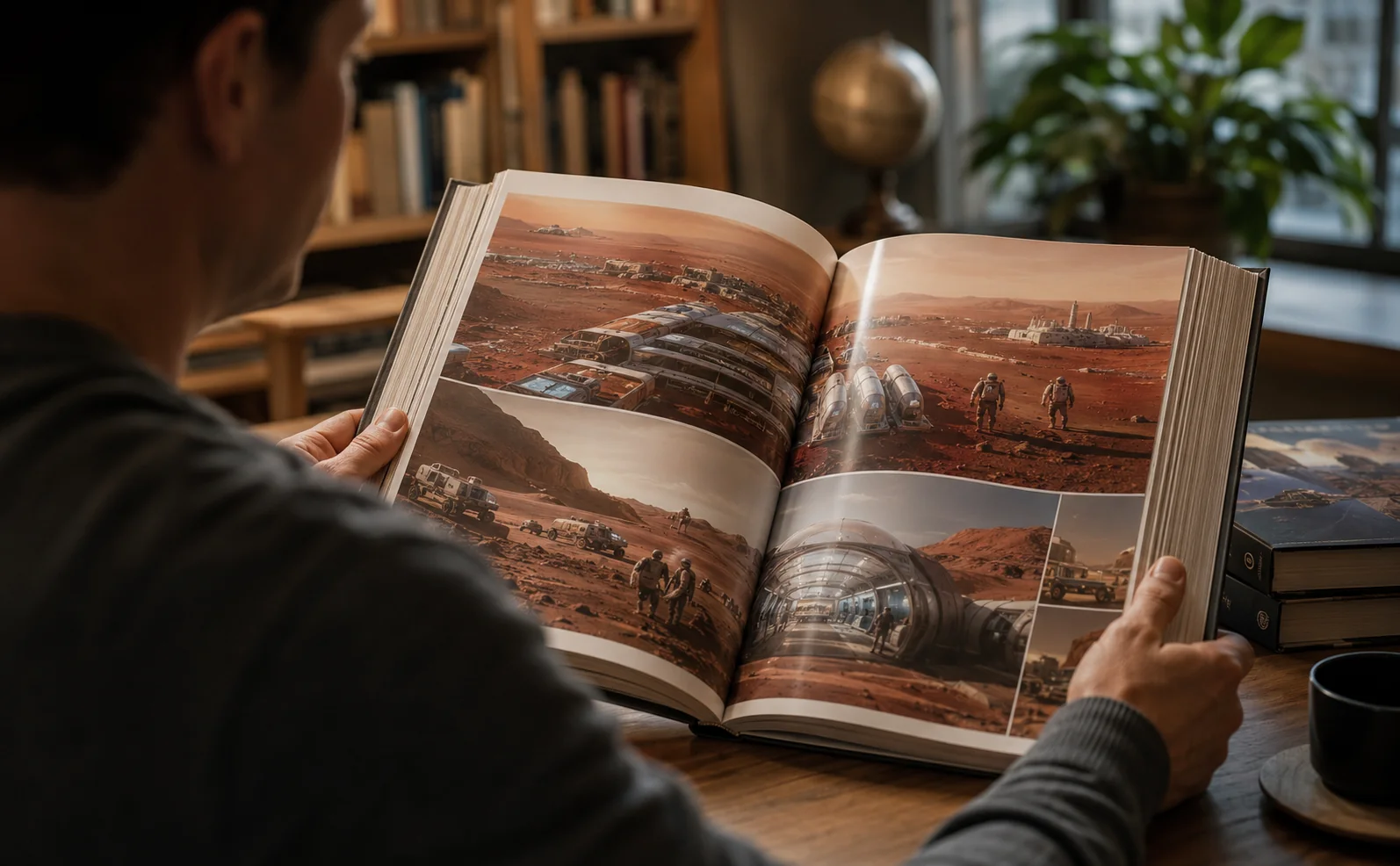
The four Author’s Vision books provide another entrance into the same universe. They show selection interfaces, training spaces, habitats, workshops, vehicles, districts, public places and political symbols. Image does not replace text; it tests coherence. A room, suit, rover or public square already tells us something about how people work, move, decide and live together.
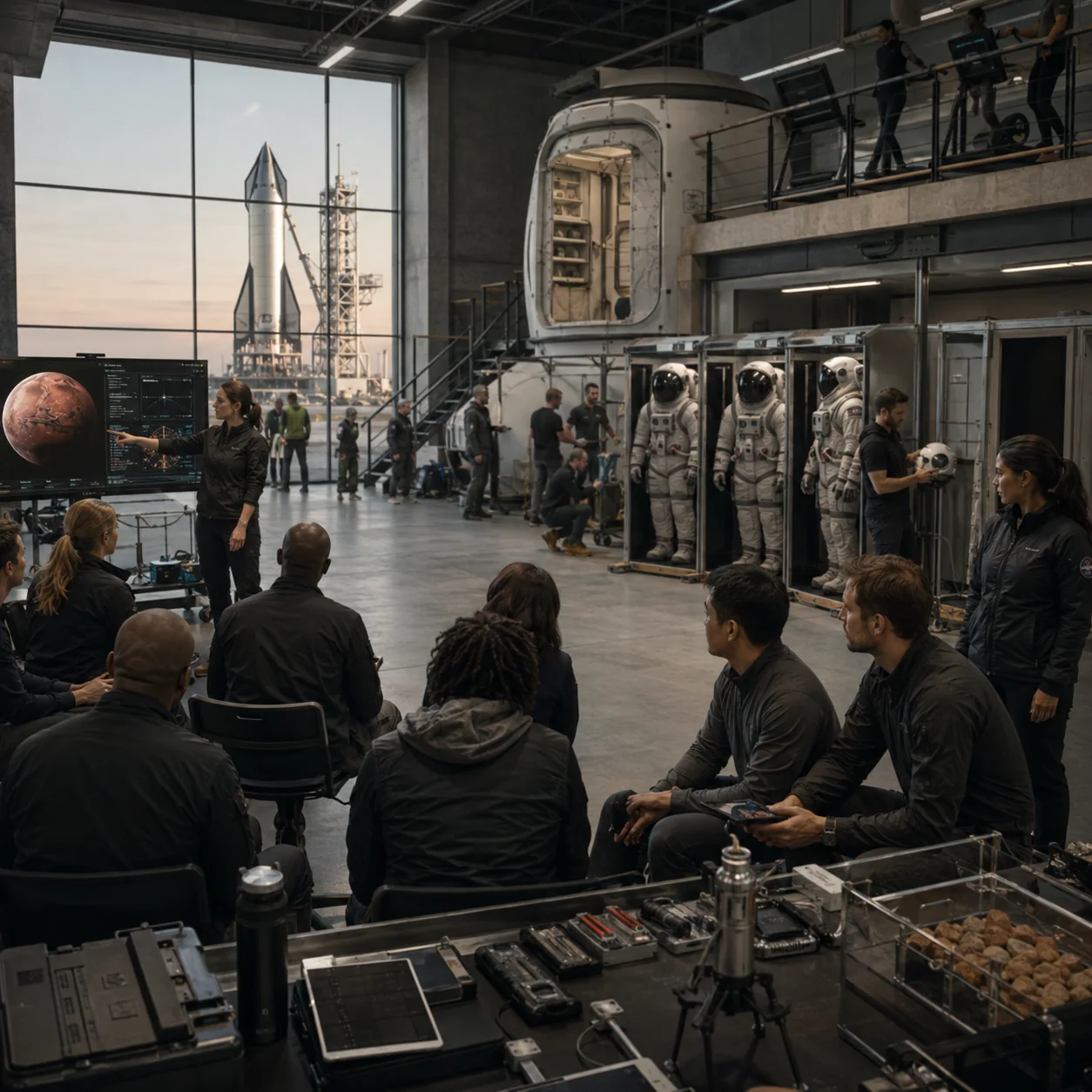
Visual Book One follows selection, interviews, training, crew formation, HERMES and the moment when the project stops being abstract and becomes a personal trajectory.
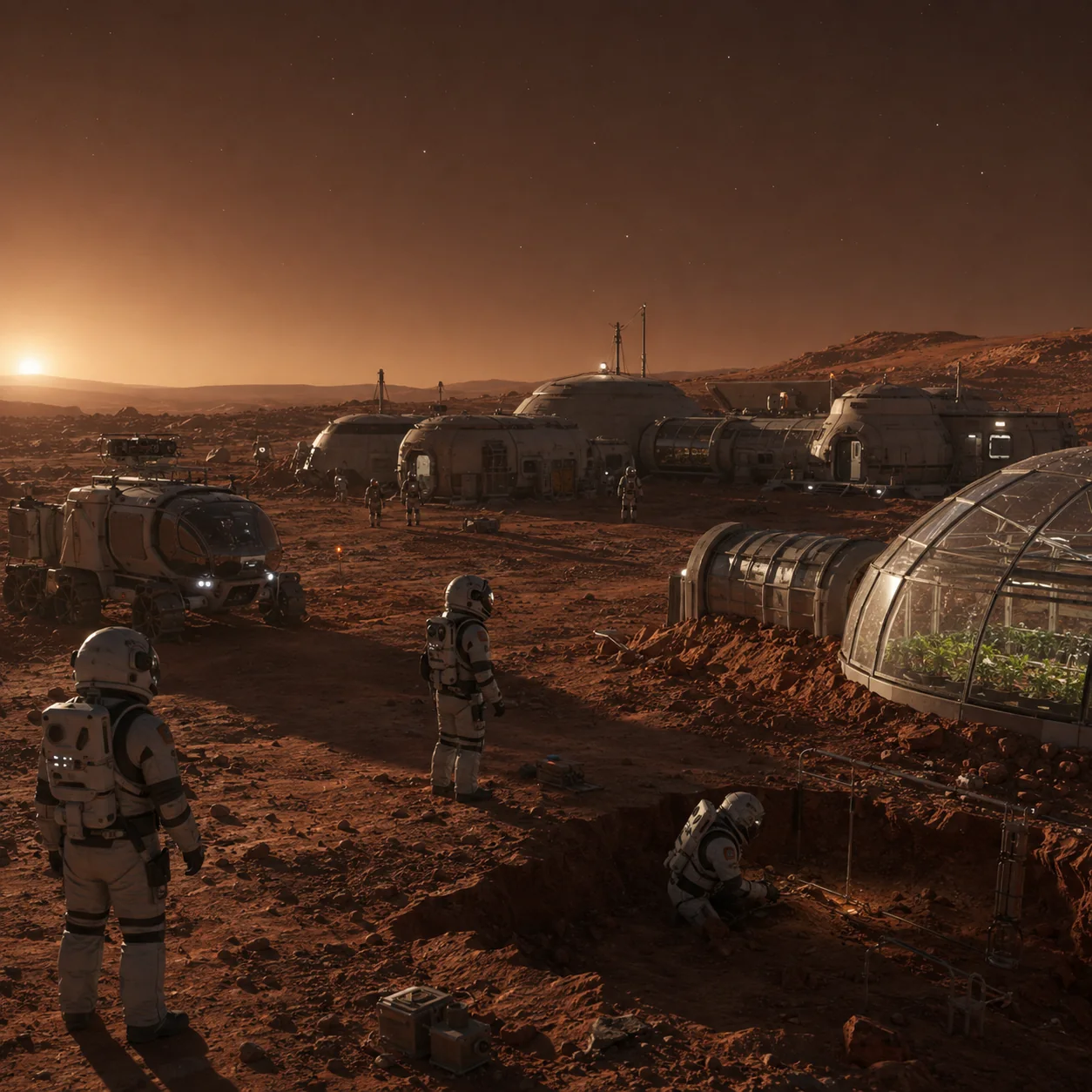
Visual Book Two follows landing and the first settlement cycle: habitats, energy, workshops, agriculture, mobility, maintenance and the first routines of the colony.
Visual Book Three shows the change of scale: additional arrivals, districts, collective equipment, industrial work, children and the appearance of a society that is no longer simply a crew.
Visual Book Four portrays Arcadia as a political city: public space, institutions, symbols, autonomy, conflicts of legitimacy and a new relationship with Earth.
Habitats, equipment and landscapes
Boxes remain for components that genuinely need separation, such as bibliographic information, the gallery, extracts or purchasing options. Editorial prose should read like a chapter or digital art book. This is also better for discoverability: captions, explanations and relationships between images become indexable language rather than an experience hidden inside a gallery.
The second visual volume changes vocabulary. Modules, freight flows, workshops, power equipment, vehicles, greenhouses and technical zones reveal the sequence of deployment. The aim is not to assemble attractive “Mars base” pictures but to show what is temporary, what becomes permanent, what exists only for survival and what already prepares the next stage of expansion.
Comparing scenes makes the first year legible. A rough path becomes a logistics route, storage becomes organised, protection increases and activities separate for safety. The images become a way to see architecture absorbing constraints over time.
In the fourth visual volume, a plaza, an assembly hall, an emblem or the organisation of public space can no longer be treated as decoration. They express how Arcadia represents itself. Architecture becomes political when it shapes who can gather, who can observe decisions, which spaces belong to everyone and how life-critical systems remain protected from institutional conflict.
The editorial commentary keeps a clear boundary: an illustration depicts a fictional future; it does not prove that an institution would work in that form. Its value is to give abstract questions of legitimacy, governance and independence a visible environment before directing readers toward documentary Mars dossiers.
Images as an extension of the narrative
The first visual volume gives shape to everything that still happens on Earth: application interfaces, exercises, medical spaces, training rooms, HERMES, clothing and crew relationships. This prevents a basic misunderstanding. Book One is not primarily a collection of red Martian landscapes; it is about preparing the people who may one day live there.
Every image can therefore be read as a question. What does an interface ask from a candidate? What do training spaces reveal about mission priorities? Why is clothing designed in a particular way? Which actions must become routine before departure? Long Web captions make those questions searchable and give the images a depth that a simple gallery cannot provide.
The collection becomes most useful when all four volumes are read as a single graphic timeline. Interfaces, clothing, vehicles, habitats, workshops, districts and meeting places recur and evolve. Comparing them shows the growth of Arcadia better than isolated image cards.
From the Author’s Vision to the novels and ARCADIA
ARCADIA gathers the technical material dispersed through the fiction: habitat architecture, air, water, energy, agriculture, industry, mobility, maintenance, health, storage, safety, redundancy and operational governance. It is the natural companion to Books Two and Three, but also a standalone entry point for readers who are not primarily looking for fiction and want to understand the constraints of a first large human settlement on Mars.
By the third visual volume, Arcadia should no longer look occupied by one small crew. Collective spaces, housing, industry, education, health and mobility form an urban geography. Different professions, generations and rhythms can coexist inside a single scene. The environment therefore begins to reveal social choices: commuting distance, access to public places, the position of workshops, spaces for children and the meeting of different cultures.
That change matters to the story because a base can be organised around one mission while a city must serve people who do not all share the same daily objective. The visual companion makes demography, economy and emerging Martian identity visible rather than merely describing them.