


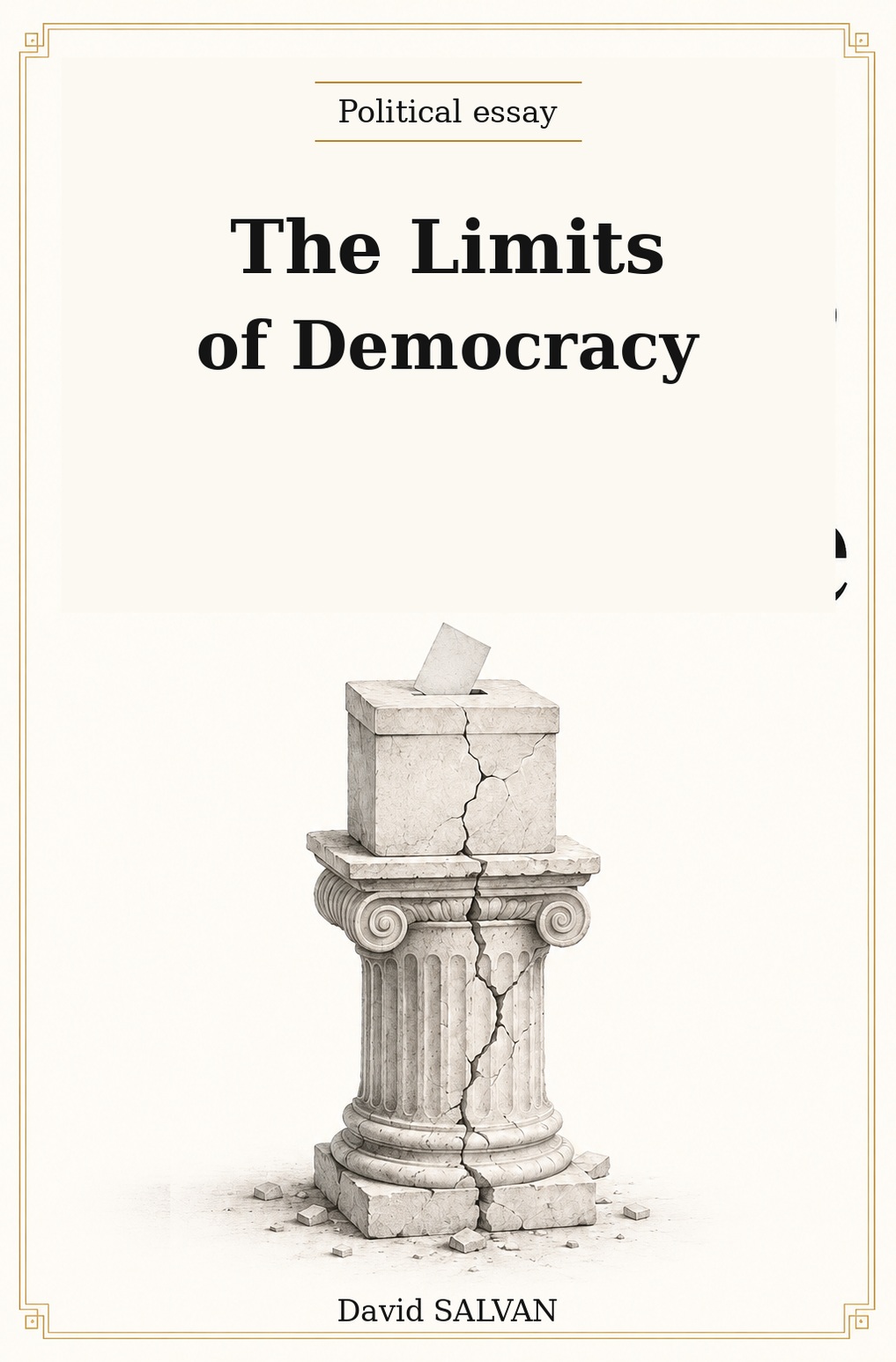
What this book helps the reader understand
- Why elections alone do not exhaust the meaning of democracy.
- How information, selection and responsibility shape public decisions.
- What ancient and modern political systems reveal about the weaknesses of majority rule.
- Why institutional safeguards can protect freedom without abolishing popular sovereignty.
Questions this book addresses
Two vital functions: the filter and the switch
Democracy must allow a population to replace its rulers, but it must also filter candidates, claims and decisions.
The book studies the tension between openness and competence, between the right to decide and the need to prevent irreversible collective mistakes.
Twenty-five centuries of political comparison
From Athens and the trial of Socrates to representative institutions, constitutions and modern media systems, the analysis compares mechanisms rather than celebrating a single regime.
The objective is to identify recurring vulnerabilities: manipulation, short-term incentives, weak accountability and the concentration of influence.
Can a democracy vote for its own collapse?
The central question is uncomfortable: can a formally legitimate decision destroy the conditions that made legitimate choice possible?
The essay examines constitutional limits, emergency powers, institutional checks and the responsibility of elected leaders.
France as a case study
French institutions, political recruitment, public debate and administrative centralisation provide a concrete field of observation.
The book does not claim that France is unique; it uses the French case to test more general propositions.
Neither worship of the crowd nor fascination with authority
The argument rejects both blind confidence in collective opinion and the authoritarian fantasy of an infallible ruler.
It seeks a model in which power can be removed, expertise can be heard, decisions can be reviewed and citizens remain sovereign.
English interior previews
These pages come from the English-language edition. Click an image to open the full-size preview. Printed paperback interiors may be black and white even when the digital preview is shown in colour.


Available English editions
The links below lead to the English-language edition of The Limits of Democracy. No English interior preview is displayed on this English retail page.
Frequently asked questions
Is this book opposed to democracy?
No. It argues that democracy survives only when its procedures, safeguards and responsibilities are taken seriously.
Is an English edition available?
Yes. The English Kindle and paperback editions are available through the links above.