


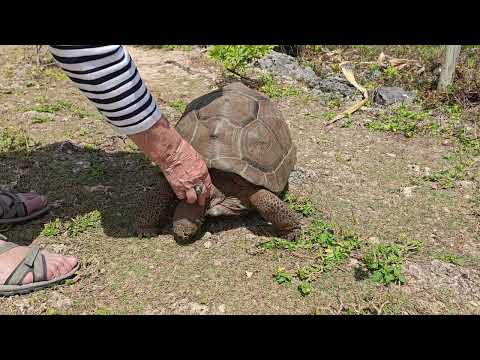
A visit combining animals, vegetation and the underground landscape
The historical video card links this outing to YouTube ID 8rfq5PENejQ and François Leguat Reserve in south-west Rodrigues. The visit combines subjects that could easily be treated separately: giant tortoises, native-plant restoration, a natural-history museum and Grande Caverne. That mixture is exactly what makes the episode useful, because conservation biology and limestone geology have to be read together.
The reserve’s official site describes a roughly 20-hectare property with hundreds of giant tortoises, tens of thousands of native trees and a limestone landscape containing nine caves. The video is the record of a visit; numerical claims in this dossier are tied to the reserve and tourism-office sources rather than estimated from the footage.
Why Aldabra tortoises are living on Rodrigues
Rodrigues once had endemic giant tortoises of its own, which are now extinct. The reserve states that between 1730 and 1770 an estimated 280,000 tortoises were taken aboard ships or killed for meat and oil. Human exploitation eliminated the local species.
In 2006 and 2007 the project introduced Aldabra and radiated tortoises, described as living species close to the extinct Rodrigues forms. This distinction is fundamental: the animals visible today are not resurrected endemic species. They are being used in an ecological-restoration and functional-replacement programme.
More than 3,000 individuals: a managed-reserve population figure
The reserve’s current tortoise page reports more than 3,000 individuals including hatchlings. The number has to be read at the correct scale: it describes a managed population at the reserve at the source date. It is not the historical wild population of Rodrigues and not an estimate of all giant tortoises in the Indian Ocean.
The range of ages visible on site nevertheless opens an educational topic. Biological restoration is judged over years and generations. Young animals provide evidence of reproduction, but full ecological success also depends on vegetation, interactions and the long-term ability to maintain the system.
Giant tortoises as potential landscape engineers
Large tortoises browse vegetation, move seeds, trample some plants and alter vegetation structure. Conservation work on Rodrigues has explored restoring such functions with ecological analogues. The reserve has planted large numbers of native plants and is trying to rebuild part of the functioning of a landscape that existed before historical extinctions.
This is sometimes described as rewilding, but the word needs precision. The property remains managed, fenced and monitored. It is an active conservation intervention using ecological analogues, not a spontaneous return to an untouched natural state.
Grande Caverne: the underground half of the landscape
The reserve stands on limestone terrain containing caves and dolines. Its official site mentions nine impressive caves, including Grande Caverne prepared for guided visits. The surface landscape of vegetation and tortoises therefore has an underground extension created by limestone dissolution.
A limestone cave develops as slightly acidic water gradually dissolves rock along fractures. Stalactites and stalagmites form through the opposite process: calcium carbonate is deposited as dripping water loses carbon dioxide. These structures grow slowly; damage is not reversible on the timescale of a human visit.
Twenty hectares: putting scale into perspective
Simple conversion
One hectare equals 10,000 m². 20 ha × 10,000 m²/ha = 200,000 m². The multiplication sign means “multiplied by”. The property therefore covers roughly 200,000 square metres, or 0.20 km².
That is not a huge area at island scale, which is part of the project’s interest: a relatively limited property can support restoration, education and conservation. Its results should not, however, be extrapolated to all of Rodrigues without additional data.
François Leguat: a name connecting history and extinction
The reserve is named after François Leguat, the Huguenot traveller whose early account described Rodrigues and parts of its fauna before several extinctions. The name is more than a biographical tribute. It connects historical observation, species loss and a modern restoration project.
The video can therefore be read on two levels. At first it is a tourist visit to tortoises and caves. At a deeper level it asks what a society chooses to do after ecological loss has been recognised: document, restore, educate, and acknowledge that some extinctions remain irreversible.
Caves can preserve evidence that the surface has lost
The educational value of the reserve lies partly in that tension. It makes irreversible extinction visible while showing that some ecological functions can still be acted upon. Restoration does not erase history; it creates a new managed state informed by what is known about previous ecosystem functioning.
Introducing a related species to recover lost functions does not guarantee that the ecosystem will respond exactly as it did with the extinct animal. Diet, body size, behaviour, density and interaction with plants can differ. Analogue-based rewilding is therefore a conservation strategy that requires monitoring and adjustment, not an automatic copy of the past.
Why an ecological analogue remains a hypothesis to monitor
Sources and verification
- Davious03 Aventures — François Leguat Reserve video: primary video referenced by the library.
- François Leguat Reserve — official site: area, visits, caves, flora and site functions.
- François Leguat Reserve — giant tortoises: historical extinction, 2006-2007 introductions and managed population.
- Rodrigues Tourism Office — Giant Tortoise and Cave Reserve: official tourism presentation and cave context.
- Madagascar Conservation & Development — Rodrigues Island: Hope thrives…: scientific conservation context.