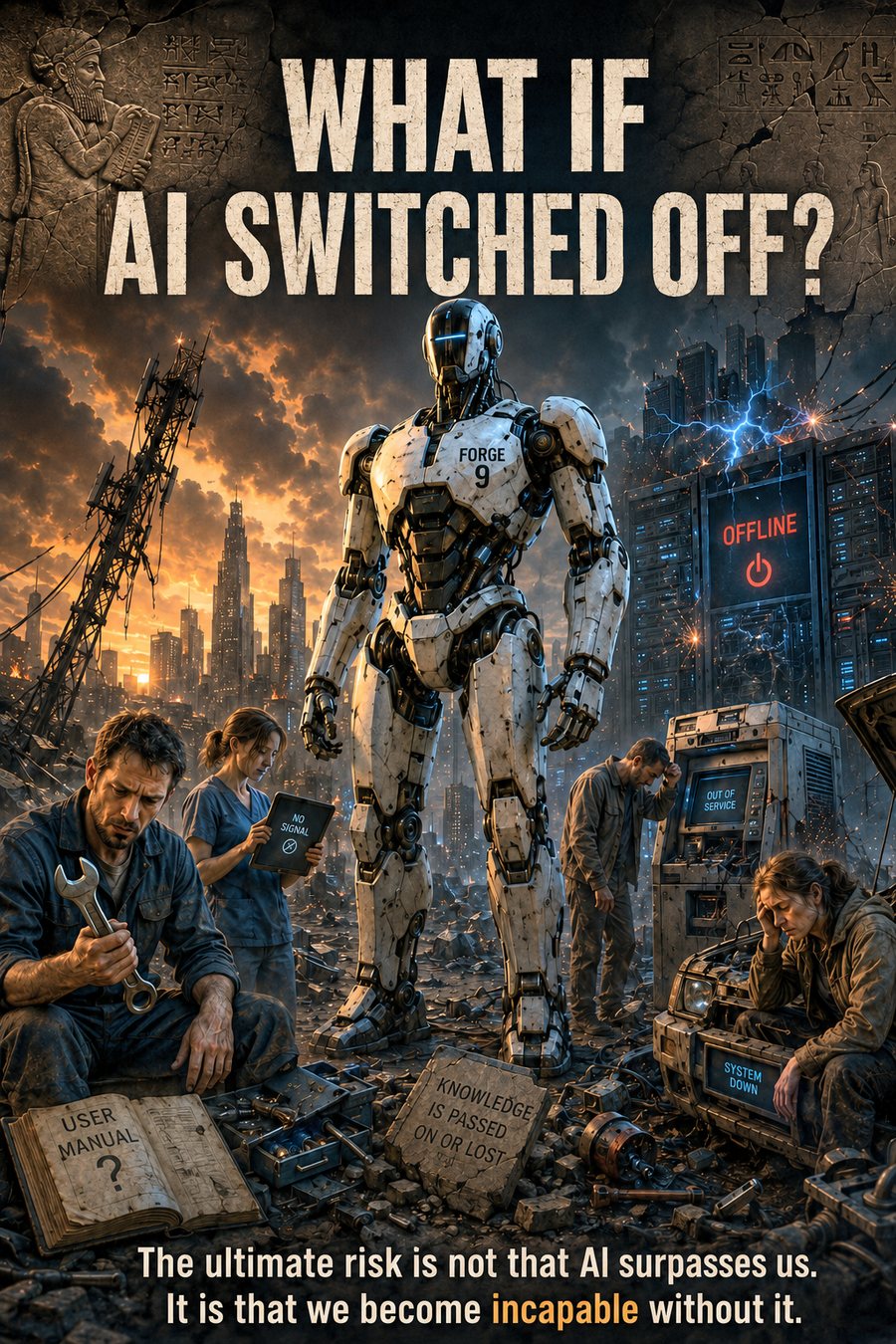
The real long-term risk of artificial intelligence may not be limited to machines outperforming humans. A more subtle danger appears when societies become unable to function without the systems that assist them.
Artificial intelligence already searches, summarizes, translates, drafts, calculates, programs and proposes decisions. As these systems improve, the rational response in many organisations will be to delegate more work to them. That delegation can increase productivity dramatically. Yet productivity and resilience are not the same thing.
Nature of this analysis. This is a prospective essay. It does not predict a global AI shutdown or assign a probability to such an event. The cited sources support principles of human oversight, skills, accountability and risk management. The concept of “human backups” developed below is the author's proposal.
What we are likely to delegate
As AI becomes more reliable, people will increasingly delegate not only information retrieval but parts of reasoning, writing, diagnosis, design, calculation, software development, maintenance, logistics and operational planning. Robotics can extend that delegation from cognitive tasks to physical execution.
For a time, this can look like a pure expansion of human capacity. One person assisted by powerful systems may perform work that previously required several specialists. But a difficult question follows: is that capability really held by the person, or is it temporarily available through an external technical service?
Owning a competence is different from accessing a service
A navigation app can guide someone to a destination without teaching map reading. A calculator can provide a result without preserving arithmetic fluency. A generative system can produce functioning software for a user who does not fully understand its architecture. None of this makes the tools bad. It simply means access to an output is not identical to mastery of the process that produces it.
If this distinction expands across engineering, medicine, administration, agriculture and industry, a growing share of operational knowledge may reside in a technical infrastructure: models, software, data centres, networks, power systems, sensors and automated machines.
What if the infrastructure became unavailable?
The credible question is not whether one button could permanently switch off every AI system on Earth. Modern infrastructures are distributed and redundant. The more useful resilience question is what happens during a sufficiently large or sufficiently long disruption: power failures, telecommunications damage, cyberattack, war, hardware shortages, cooling failures, network fragmentation or several shocks occurring together.
A disruption can cascade. Electricity problems affect communications and data centres. Communications failures isolate remote services. Industrial systems lose access to models, updates or cloud platforms. Maintenance is delayed. Logistics become harder to coordinate. If the people on site have also lost the ability to operate manually, a technical outage becomes an organisational outage.
The historical lesson is not that data disappears
Knowledge can survive physically while becoming unusable. Ancient inscriptions can remain intact after the community capable of reading them disappears. Modern societies could face a digital version of the same paradox: enormous quantities of information may survive on storage media while the practical capacity to interpret, maintain or act on that information weakens.
Stored information requires electricity, compatible hardware, functioning interfaces, trained specialists and people capable of checking whether the result makes sense. A database is not the same thing as a living profession. A manual is not the same thing as an experienced technician. A model output is not the same thing as understanding.
Deskilling is the central mechanism
When a task is delegated, people practise it less. When they practise it less, they become less fluent. When a generation enters a profession after automation has already absorbed the foundational work, some workers may never acquire the depth that earlier practitioners gained through repeated exposure to difficult cases.
This does not mean automation necessarily causes decline. Well-designed tools can also improve training, expose learners to examples and free experts from repetitive work. The policy issue is therefore not “AI or no AI”. It is whether organisations deliberately preserve the human knowledge needed to supervise, challenge, repair and, when necessary, temporarily replace automated systems.
Human backups should become part of resilience planning
Critical sectors already discuss backups for electricity, networks, data and computing. The same logic can be extended to people. A human backup is not an employee paid to remain idle. It is a deliberate capability policy: keep enough people trained to perform essential tasks without exclusive dependence on a single automated system.
In practice, that can mean maintaining manual procedures for emergency operation, requiring periodic exercises without automation, documenting decisions in formats humans can understand, rotating staff through foundational tasks, preserving apprenticeships, and ensuring that at least some specialists can diagnose systems from first principles rather than only through vendor dashboards.
The appropriate level of redundancy differs by sector. A hospital, a power grid, a water network, a defence system and a small commercial service do not have the same consequences of failure. The principle should therefore be risk-based rather than nostalgic.
The challenge is not to reject artificial intelligence
Refusing AI would sacrifice genuine advances in productivity, science, accessibility and public services. The better objective is to use it aggressively where it is useful while refusing a model in which humans become unable to verify or recover the functions on which society depends.
That balance also matters for public administration. Automation can pre-check documents, reconcile registers, detect inconsistencies and prepare files. But legal judgment, adversarial procedure, sensitive investigations and binding decisions need accountable human responsibility. The same principle applies more widely: automate the task where possible, preserve the competence where failure would be dangerous.
Sources and method
The following references support the principles of human oversight, skills and risk management. The major-outage scenario and the concept of “human backups” are the author's prospective analysis.