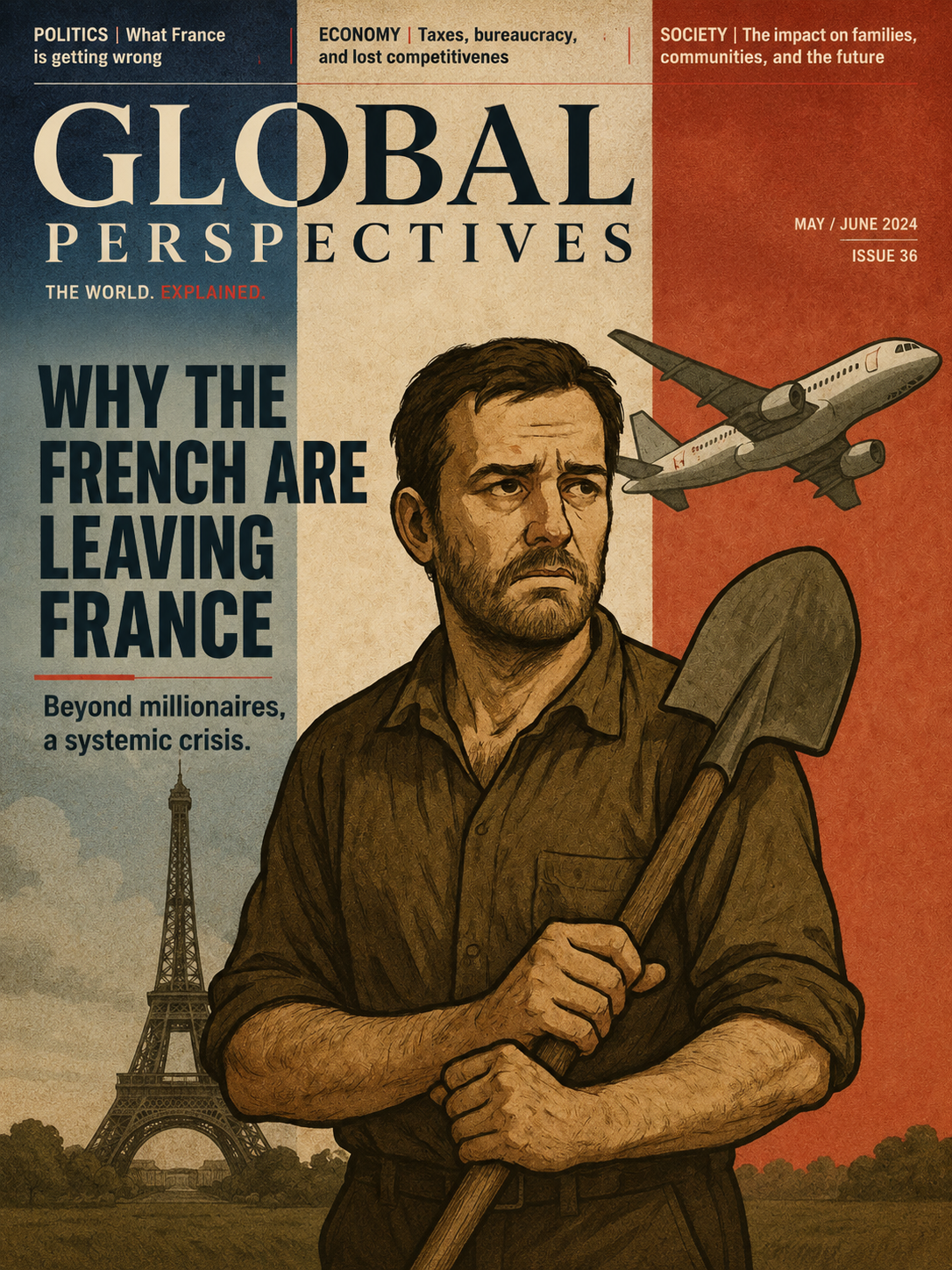
Why the French are leaving France: Beyond the millionaires, a systemic crisis. This morning I get up after a hard day on my building site marking the completion of the laying of the Gérard steel-tile roofing on the roof of my A-frame house; a triangular house. Video available here¹ and here², by the way. Over lunch I watch the news and come across this video "Why the millionaires are leaving France (and where are they going?)"³ It is a relevant and topical subject that deserves to be developed, and I am going to take my own personal case to explain why I understand those who have already left, and those who wish to do so. The recent video by Louis Esquier "Why the millionaires are leaving France (and where are they going?)" brings to light a reality far vaster than the mere flight of capital. Contrary to what the title suggests, it is not only millionaires who are considering expatriation. More than 30% of the French declare they want to leave⁴, and more than one young person in two expresses the same wish⁵. In 2024, expatriations rose by 2.8%⁶, confirming a worrying trend that reveals a deep malaise in French society. This is therefore not a simple flight of the elite, but an alarming national signal. Bureaucratic fear, fiscal pressure, insurmountable administrative obstacles and the excessive defence of the rights of bad tenants to the detriment of owners discourage an entire population of entrepreneurs, creators and citizens who simply wish to build and undertake freely.

The explosion of expatriations: figures that speak. The official statistics of the Ministry of Foreign Affairs confirm this worrying trend. As of 1 January 2025, 1,741,942 French people are registered in the register of French people established outside France, an increase of 2.8% compared to 2023⁷. This progression marks a "slight upturn" according to the ministry, after several years of decline in registrations. Experts estimate, however, that the real number of French expatriates is close to 2.5 million people, many not registering with the consular register. This increase is only the visible part of the iceberg. Surveys reveal a massive desire for elsewhere:

34% of French people aged 18-40 are considering expatriation according to a 2024 Ipsos study⁸. 54% of young French people aged 18 to 24 are thinking of leaving France according to an OpinionWay poll for Économie Matin⁹. These figures represent a historic record, beating the previous measurements which hovered around 40%. The situation is particularly critical among young graduates. A survey by the Institut Montaigne conducted among students of nine French grandes écoles reveals that 79% of students say they are ready to go abroad to look for a job after obtaining their diploma¹⁰. At HEC, for example, only 16% left for their first job in 2000, against 33% in 2013, and this proportion keeps rising.

The bureaucratic hell: when creating becomes an obstacle course. My personal experience of creating a campsite perfectly illustrates this Kafkaesque reality. After five years of administrative procedures and two years of intensive paperwork, the development permit has not even been filed yet. 📄 The insurmountable administrative complexity. The development-permit application file comprises more than 40 pages of forms accompanied by more than 50 technical appendices¹¹. This administrative complexity discourages project promoters before they can even begin. The required documents include: • Location, layout, horizontal and vertical section plans • Detailed safety notices • Potential environmental impact studies • A multitude of other supporting documents. 👨‍🎨 The obligation of an architect: a prohibitive cost. Since decree 2017-252 of 27 February 2017, the use of an architect is mandatory for subdivisions whose land area to be developed exceeds 2,500 m²¹². This obligation represents a considerable financial obstacle. Architects base their fees on the overall finished and ideal project. When a project costs 1 to 2 million euros and can take 20 to 30 years to complete, the architect asks for delirious sums from the outset, even before the project generates a single euro.

🚒 The unpredictability of the fire-service requirements. The problem of the requirements of the Departmental Fire and Rescue Services (SDIS) perfectly illustrates the unpredictability of the system. The SDIS do not indicate their requirements before the filing of the development permit. It is only during the examination, at the passage before the fire-safety commission, that additional works may be requested (manoeuvring areas, extinguishers, special accesses) according to their own internal rules. This lack of visibility makes any reliable estimate of the total cost impossible before the filing of the application, creating total financial uncertainty for project promoters.

The confiscatory taxation: taxing before producing. The French tax system applied to development projects reveals an economically aberrant logic. For my campsite project, more than 110,000 euros of development tax are demanded as soon as the permit is filed, even before a single euro of turnover and, worse, even before a single stone is laid. This tax is calculated according to precise scales, of which here is an extract¹³: • 3,000 euros per tent/caravan pitch • 10,000 euros per light leisure dwelling (HLL) • 3,000 euros for each parking area. This prior taxation constitutes a genuine economic lock. You are levied considerable sums, often two seasons before the actual launch, when you have not even started building. This is not regulation, it is economic strangulation.

The excessive protection of the environment: a pretext for stifling initiative. 💸 Dissuasive fines per square metre. France has developed an environmental approach which, under the pretext of protecting biodiversity, stifles all entrepreneurial initiative. Owners who simply wish to maintain their land find themselves threatened with fines of up to 150,000 euros for the destruction of protected species¹⁴. The Environmental Code provides for particularly heavy sanctions: "Undermining the conservation of non-domestic animal species is punishable by three years' imprisonment and a fine of 150,000 €"¹⁵.

📊 The hell of impact studies. For my campsite project, an environmental impact study of a minimum of 20,000 euros was required, just to know the impact of the tent canvases on the tufts of moss of the forest across the way. This study would have produced a report as voluminous as a 3 Suisses catalogue, for an eco-responsible campsite project! Fortunately, I was able to obtain a derogation from the DREAL (Regional Directorate for the Environment, Development and Housing) after months of waiting and permanent stress. But this derogation illustrates the absurdity of the system: why require such a costly study only to cancel it in the end? 🏛️ The impossible association. We wanted to set up a 1901-law association recognised as being of general interest in order to raise funds from foundations (which only finance associations of general interest for the tax deductions). Objective: to organise participatory building sites to bring out this atypical and demonstrative campsite. Result after 6 months of waiting, despite reminders at 2 months, 4 months and 5 months and 20 days: the tax administration waited until the last day to respond negatively. Reason: being the owner of the land AND president of the association, if we made fine achievements, this would increase the value of my land, hence "taking of interest", hence recognition of general interest refused. 6 months lost, anger, frustration for an absurd bureaucratic reason.

The housing crisis: when owners become suspects. France is experiencing a historic housing crisis that affects all territories. According to the Fondation Abbé Pierre, more than 4.2 million people were poorly housed in France in 2024, and 330,000 were homeless¹⁶. Paradoxically, instead of encouraging the landlords who could contribute to solving this crisis, the system criminalises and discourages them. ⚖️ Unbalanced rights. As a landlord, I am considered the suspect by default in any rental relationship. If a tenant does not pay, damages the dwelling or squats, I find myself bound hand and foot. Eviction procedures take months, even years, and I have no immediate recourse, even in the event of manifest damage.

More than 19,000 evictions took place in 2024¹⁷, often without lasting rehousing solutions, but the process remains laborious for legitimate owners, discouraging them from continuing to invest in rental property. 🔧 The obligation of energy renovation. This situation is all the more absurd as the mandatory energy renovation imposes additional constraints on landlords. I had to disburse 6,000 euros for the installation of a heat pump in order to have the right — the right! — to put one of my properties back on the rental market, moving my dwelling from G to D when there is no insulation at all! The declared support of the President of the Republic for the heat-pump lobby translated into a national plan to produce one million units by 2027, coupled with public subsidies, reduced VAT, and a zero-rate eco-loan for owners. While the objective of decarbonising heating is laudable, the perverse effects of this policy are very real, notably for tenants. This phenomenon is widespread: owners invest in costly equipment to avoid the rental ban, but raise rents to amortise the investment. Result: renovated dwellings become unaffordable, and non-renovated dwellings are withdrawn from the market, aggravating the housing crisis. This obligation occurs in a context of housing crisis where every available property should be precious for the rental market.

Regulatory instability: the nightmare of the EPD. The Energy Performance Diagnosis (EPD) perfectly illustrates French regulatory instability. The rules change constantly, creating permanent legal insecurity for owners. The progressive ban on the rental of "thermal sieves" (dwellings classified F and G) further aggravates the situation¹⁸. Since 1 January 2025, dwellings classified G are banned from rental, and this ban will extend to F dwellings in 2028 and then to E dwellings in 2034. This regulation affects more than 17% of the stock of French main residences, that is, about 5.2 million dwellings¹⁹, massively withdrawing dwellings from the rental market at the very moment when France faces a dramatic shortage.

Tolerated insecurity: when victims become guilty

Insecurity is progressing even in rural areas traditionally spared. On my land, I suffered two burglary attempts on my caravans. The intervention of the gendarmes took 40 minutes, leaving the criminals ample time to rummage, break and leave calmly. ⚖️ An impossible self-defence. But the most aberrant thing remains the legal ban that weighs on me from holding these burglars caught in the act. If I aim at them, even without firing, I risk being prosecuted for psychological violence. If I block them by tying them to my kiwi trellis to prevent them from fleeing while waiting for the forces of order, I would be condemned for unlawful confinement²⁰. French law protects burglars more than their victims. The statistics show that 217,000 burglaries were recorded in France in 2023²¹, but the clear-up rate remains low, particularly in rural areas where gendarmerie numbers are reduced.

A taxation that stifles even the smallest incomes. French fiscal relentlessness is not limited to large patrimonies. My YouTube channel, which earned me 90 euros, forced me to open an account with the French Customs solely to declare this derisory sum, on top of having to create a business to declare this income — a creation made impossible because my identity document is not in the right format, forcing me to redo procedures to request a new one with digitisation, which I have not even received yet, to date. This finicky bureaucracy for micro-incomes perfectly illustrates the administrative harassment suffered by all content creators and micro-entrepreneurs, while the large multinational groups continue to optimise their taxation in tax havens.

A generalised malaise: hospital, immigration, justice, army. Beyond the entrepreneurial obstacles, other factors feed the feeling of downgrading and the desire to leave: 🏥 A hospital system in crisis. In 2025, the deficit of public hospitals reaches 3.5 billion euros²², a worrying record. More than 68% of French people have given up at least one care procedure in the last 5 years²³. Paediatric emergency departments and hospital services are closing for lack of staff, with an average dilapidation rate of public establishments of 58% in 2023²⁴.

🌍 Immigration and the feeling of suffocation. A growing part of the French population, notably in the working classes and the peri-urban or rural territories, expresses the feeling of no longer being at home²⁵. This feeling, often described as "migratory submersion" or "great replacement" in certain discourses, reflects a loss of cultural, linguistic and social bearings in neighbourhoods where the proportion of inhabitants of foreign origin sometimes exceeds 50 to 70% depending on the municipalities²⁶. This malaise is fed by several factors: • Non-integration of newcomers: despite the efforts of certain local authorities, the learning of French, respect for social codes, and economic insertion remain insufficient. The unemployment rate of immigrants from the Maghreb or Turkey is twice that of natives²⁷. • Geographic concentration: for lack of a distribution policy, certain territories such as Seine-Saint-Denis or certain towns in the North have become zones of relegation, where community tensions are exacerbated. • Delinquency and insecurity: although the majority of immigrants are not delinquents, the crime rate is higher in neighbourhoods with a high migratory concentration, which feeds amalgams and fears²⁸. • Failure of republican integration: France has no municipal register nor fine mapping of the immigrant population, which makes any integration policy ineffective²⁹. • Media and political taboo: any criticism of immigration is often equated with racism or fascism, which prevents a serene and rational debate³⁰. This climate pushes certain citizens to consider expatriation, not out of rejection of the foreigner, but out of exhaustion in the face of a system that no longer listens to them. They flee a France where they have the feeling of having become foreigners in their own home, where their values are marginalised, and where the State seems powerless to guarantee national cohesion. ⚖️ Judicial laxity and excessive delays. In civil matters, the average delays reach 637 days at first instance, that is, 3 times more than in Germany³¹. France is regularly condemned for excessive slowness by the European Court of Human Rights, and certain cases illustrate the flaws of the judicial system. This situation generates a massive loss of confidence: 53% of French people declare they do not trust justice, and 67% have a negative image of it³², judging it slow, opaque, lax and ineffective. The causes are multiple: lack of human resources, budgetary under-investment, overload of the jurisdictions, complexification of procedures, and absence of structural reform despite the États généraux of justice launched in 2021. Magistrates are often overwhelmed, the registries under-staffed, and the IT tools obsolete. The budget per inhabitant devoted to justice is 72.50 € in France, against 146 € in Germany. France is regularly condemned by the European Court of Human Rights for excessive judgment delays, and litigants suffer a

moral prejudice linked to prolonged uncertainty. Eviction procedures, rental disputes, domestic violence, and even serious criminal cases are treated with delays that undermine the credibility of the institution. 🏚️ Rights of delinquents vs citizens. Before 2023, squatters benefited from delays and protections that made their eviction very difficult. Citizens' petitions denounce the fact that owners are sometimes prosecuted for having defended their property³³, creating a feeling that delinquents have more rights than honest citizens. 🪖 A weakened army. The French army struggles to recruit and retain its personnel, with a deficit of 3,000 staff in 2023³⁴. The equipment is ageing, and despite the efforts, France will not be able to deploy a division "fit for war" until 2027³⁵. Despite an increase in the Defence budget (from 39 to 60 billion euros between 2017 and 2025), the French army remains too weak to face a high-intensity conflict. It is described as a "bonsai" army³⁶: capable of doing everything, but not for long and not in mass. The numbers are insufficient, the ammunition stocks critical, and the projection capacities limited. In the event of a prolonged war, France would run out of ammunition within the first weeks³⁷. The 19th artillery brigade, supposed to embody the renewal of deep strike, does not yet have an autonomous command post, nor independent tactical transmissions³⁸. The donations to Ukraine have reduced operational capacities, and the replacements are not yet delivered. The army also suffers from a lack of transparency about its real capacities, as the government no longer communicates the precise figures on the available equipment. Strategic thinking is judged sclerotic, and the French nuclear doctrine, although powerful, isolates France from its European partners. The current army model, designed for occasional interventions in Africa or the Middle East, is no longer suited to a war on European soil, such as the one in Ukraine. Even the capacity to hold an 80 km front is called into doubt.

Understanding without judging. In view of all this, I could legitimately be tempted to give up everything, to draw a line under my efforts, and to leave this country to start again elsewhere, in an economic, legal, fiscal and administrative environment that is more attractive, more fluid, more encouraging. The idea crosses my mind, as it crosses the minds of so many other disillusioned French people. And yet... I stay. Not out of naivety or resignation, but out of visceral attachment to this land, to its culture, to what it has represented and what it could become again. My patriotism holds me back, despite the disgust that current politics inspires in me, a disgust deep enough that I withdrew from it many years ago. Staying is an act of faith, of resistance, sometimes even of discomfort — but for now, it is still my choice. Until when?

I understand those who have left and those who wish to leave, just as I understand those who want to stay or cannot do otherwise than stay. I also understand those who want to fight and are going to enter into resistance, directly or indirectly. Despite the glimmers of hope — for "hope, the quintessence of human emotions, is both our greatest strength and our greatest weakness" — when a people wants to leave, it is because the evil is deep. As John F. Kennedy said: "Those who make peaceful revolution impossible will make violent revolution inevitable." France has the choice: to simplify, to trust and to liberate the creative energies, or to continue to see its talents leave for countries that have made the choice of administrative simplicity and of trust in their entrepreneurial citizens.

See my associated articles: • Billions in savings? Yes, it is possible³⁹ • The Organised Decline of France: Economic Betrayal and Abandonment of Our Sovereignty⁴⁰ • Undertaking in France: An obstacle course or a dead end?⁴¹ • Structural and legislative failures of housing energy-renovation schemes⁴² • Democracy in Crisis: Deviations and Challenges of Our Time⁴³

Sources ¹ Triangular house video 1: https://youtu.be/lJKdGrfSxrI ² Triangular house video 2: https://youtu.be/H3pIdbMsOhw ³ Louis Esquier video: https://www.youtube.com/watch?v=qYrkcURK568 ⁴ Ipsos survey for the Maison de l'expatriation (2024): https://lepetitjournal.com/expat- mag/vie-expat/pourquoi-expatriation-seduit-monde-francais-2024-385935 ⁵ OpinionWay poll for Économie Matin (December 2023): https://www.lejdd.fr/societe/54-des-jeunes-francais-determines-quitter-la-france-en-raison-du- climat-politique-et-economique-140600 ⁶ Ministry for Europe and Foreign Affairs (February 2025): https://www.diplomatie.gouv.fr/fr/services-aux-francais/l-action-consulaire-missions-chiffres- cles/la-communaute-francaise-a-l-etranger-en-chiffres/

⁷ Decree no. 2025-104 of 3 February 2025: https://www.diplomatie.gouv.fr/fr/services-aux- francais/l-action-consulaire-missions-chiffres-cles/la-communaute-francaise-a-l-etranger-en- chiffres/ ⁸ Ipsos survey 2024: https://lepetitjournal.com/expat-mag/vie-expat/pourquoi-expatriation- seduit-monde-francais-2024-385935 ⁹ OpinionWay poll: https://www.lejdd.fr/societe/54-des-jeunes-francais-determines- quitter-la-france-en-raison-du-climat-politique-et-economique-140600 ¹⁰ Institut Montaigne: https://www.institutmontaigne.org/expressions/enquete-sur-le-depart- letranger-des-jeunes-diplomes-francais ¹¹ Service-Public.fr: https://www.service-public.fr/particuliers/vosdroits/F17665 ¹² Decree 2017-252 of 27 February 2017 and Planning Code R. 441-4.2: https://www.legifrance.gouv.fr/jorf/id/JORFTEXT000034132386 ¹³ General Tax Code, article 1635 quater A: https://www.legifrance.gouv.fr/codes/article_lc/LEGIARTI000033746940 ¹⁴ Environmental Code, articles L.415-3 to L415-8: https://www.legifrance.gouv.fr/codes/section_lc/LEGITEXT000006074220/LEGISCTA0000 06176527/ ¹⁵ Article L. 415-3 of the environmental code: https://www.legifrance.gouv.fr/codes/article_lc/LEGIARTI000038812230 ¹⁶ Fondation pour le Logement, 30th report 2025: https://www.fondationpourlelogement.fr/actualites/30e-rapport-sur-letat-du-mal-logement-en- france-2025 ¹⁷ Fondation Abbé Pierre, 2025 report: https://www.fondationpourlelogement.fr/actualites/30e-rapport-sur-letat-du-mal-logement-en- france-2025 ¹⁸ Climate and Resilience Law: https://www.service-public.fr/particuliers/actualites/A17154 ¹⁹ National Observatory of Energy Renovation: https://www.ecologie.gouv.fr/observatoire-national-renovation-energetique-onre ²⁰ Penal Code, articles 122-5 and 224-1 on self-defence and unlawful confinement: https://www.legifrance.gouv.fr/codes/article_lc/LEGIARTI000006417219 ²¹ SSMSI, 2023 assessment: https://www.interieur.gouv.fr/actualites/communiques-de- presse/insecurite-et-delinquance-en-2023-bilan-statistique-et-atlas ²² Hospital data 2025, Ministry of Health: https://www.sante.gouv.fr/ ²³ Access-to-care survey 2024: https://www.sante.gouv.fr/

²⁴ Report on the dilapidation of public establishments 2023: https://www.sante.gouv.fr/ ²⁵ Sociological studies on the sense of belonging 2024: https://www.insee.fr/ ²⁶ INSEE, immigrant population statistics: https://www.insee.fr/fr/statistiques/3633212 ²⁷ Le Point, immigration controversies: https://www.lepoint.fr/politique/les-polemiques-de-l- immigration-y-a-t-il-trop-d-immigres-05-11-2023-2542018_20.php ²⁸ SSMSI, 2023 delinquency assessment: https://www.interieur.gouv.fr/actualites/communiques-de- presse/insecurite-et-delinquance-en-2023-bilan-statistique-et-atlas ²⁹ Le Point, republican integration: https://www.lepoint.fr/politique/les-polemiques-de-l- immigration-y-a-t-il-trop-d-immigres-05-11-2023-2542018_20.php ³⁰ Atlantico, media taboo: https://atlantico.fr/article/decryptage/fascisme-partout-islamo- gauchisme-et-problemes-causes-par-limmigration-nulle-part-de-quel-mal-intellectuel-souffre- la-france ³¹ Comparative European civil justice statistics: https://www.justice.gouv.fr/ ³² Senate, report on confidence in justice: https://www.senat.fr/fileadmin/Fichiers/Images/redaction_multimedia/2021/2021- Documents_PDF/20210928_Rapport_complet_CSA.pdf ³³ Citizens' petitions on owners' rights vs squatters: https://www.change.org/ ³⁴ French Army recruitment data 2023: https://www.defense.gouv.fr/ ³⁵ French military build-up plan: https://www.defense.gouv.fr/ ³⁶ Le Point, bonsai army: https://www.lepoint.fr/monde/il-y-a-en-france-une-sclerose-de-la- pensee-militaire-et-strategique-15-01-2024-2549761_24.php ³⁷ Meta Defense, weaknesses of the armed forces: https://meta-defense.fr/2025/01/30/faiblesses-des- armees-opinion-2025/ ³⁸ Opex News, 19th artillery brigade: https://opexnews.fr/19e-brigade-artillerie-rapport- parlementaire/ ³⁹ Billions in savings? Yes, it is possible: https://www.linkedin.com/pulse/des- milliards-d%25C3%25A9conomie-oui-cest-possible-david-salvan- nquxf/?trackingId=9kvNI%2Bx5S52hunAa06YDOg%3D%3D ⁴⁰ The Organised Decline of France: https://www.linkedin.com/pulse/le-d%25C3%25A9clin- organis%25C3%25A9-de-la-france-trahison-%25C3%25A9conomique-et-david-salvan- lglvf/?trackingId=9kvNI%2Bx5S52hunAa06YDOg%3D%3D

⁴¹ Undertaking in France: https://www.linkedin.com/pulse/entreprendre-en-france-un- parcours-du-combattant-une-impasse-salvan- ddudf/?trackingId=9kvNI%2Bx5S52hunAa06YDOg%3D%3D ⁴² Failures of energy-renovation schemes: https://www.linkedin.com/pulse/d%25C3%25A9faillances-structurelles-et- l%25C3%25A9gislatives-des-de-logements-salvan- 3zwbf/?trackingId=9kvNI%2Bx5S52hunAa06YDOg%3D%3D ⁴³ Democracy in Crisis: https://www.linkedin.com/pulse/la-d%25C3%25A9mocratie-en- crise-d%25C3%25A9viations-et-d%25C3%25A9fis-de-notre-%25C3%25A9poque-salvan- vfg8f/?trackingId=9kvNI%2Bx5S52hunAa06YDOg%3D%3D