


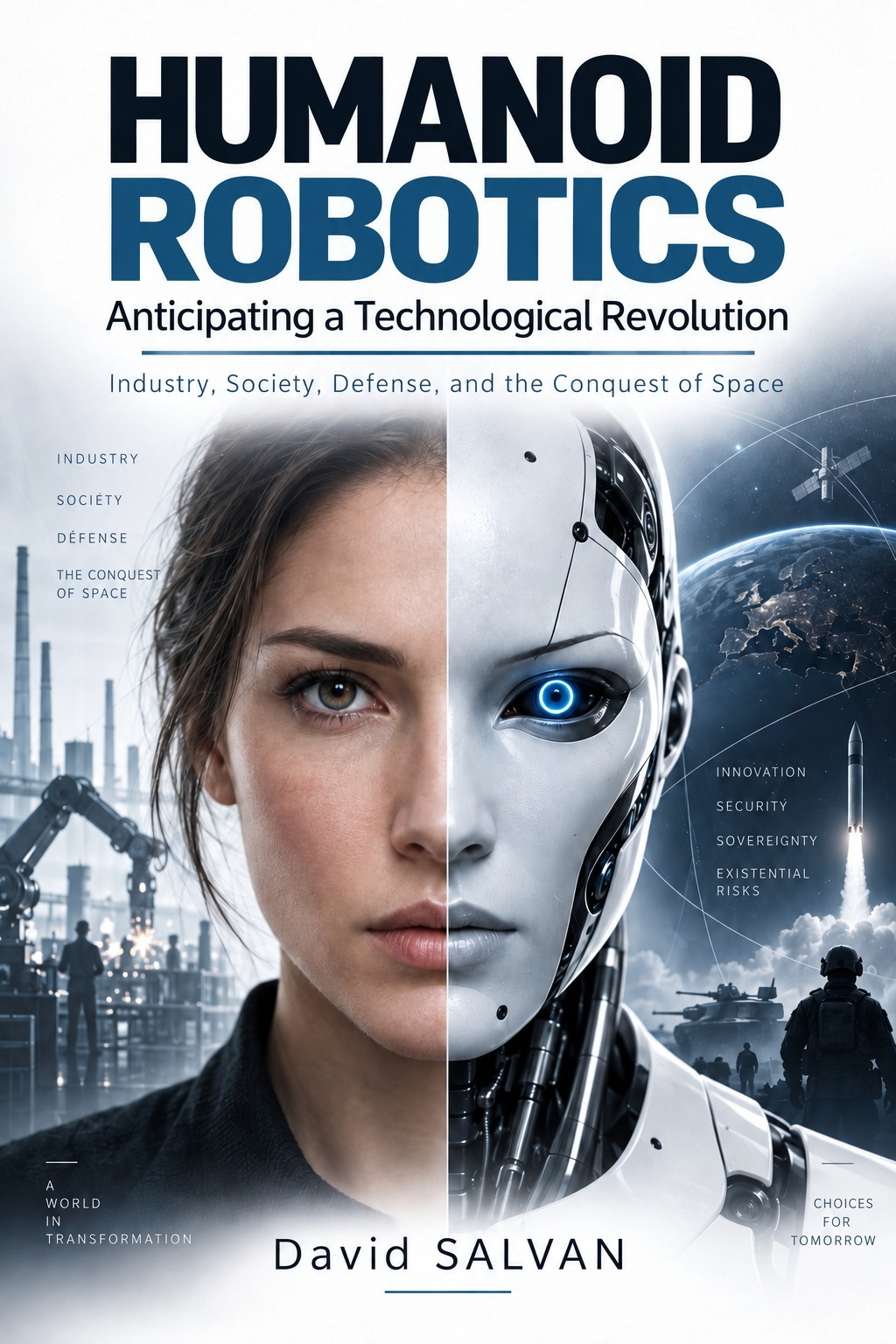
What this book helps the reader understand
- Why humanoid robots are moving from laboratory demonstrations toward industrial and service deployment.
- How embodied AI differs from software-only AI once a system can act in the physical world.
- Where value, risk and responsibility change when robots enter factories, public space, defence, hazardous environments and households.
- Why the Moon and Mars may become decisive test beds for robotic precursors, logistics and in-situ resource operations.
From research prototype to usable machine
Humanoid robotics brings together perception, locomotion, manipulation, power management, control, safety and increasingly capable AI. The important question is not whether a machine looks human, but whether a human-compatible body can perform useful work in environments designed around human reach, stairs, doors, tools and infrastructure.
The book follows this transition historically and technically, from early pioneers and research platforms to current industrial programmes, while distinguishing demonstrations from robust operational capability.
Industry, work and society
Humanoid robots may initially create value where tasks are repetitive, ergonomically difficult, dangerous or constrained by labour shortages. Their impact will nevertheless depend on reliability, cost, maintenance, integration and the organisation of work around them.
The book therefore treats employment, productivity, training, inequality and human–machine cooperation as system questions rather than as simple promises of automation.
Defence, security and sovereignty
A mobile machine with perception, manipulation and autonomous decision support changes the security problem. The analysis covers military logistics, hazardous environments, CBRN/NRBC missions, infrastructure protection, cyber-physical attack surfaces, authority, accountability and the risk of delegating force or sensitive decisions to automated systems.
Technological sovereignty also matters: actuators, batteries, sensors, compute, models, training data, communications and cloud dependencies can become strategic bottlenecks.
Why space occupies a major part of the book
On the Moon and Mars, robots can arrive before crews, inspect sites, deploy power systems, prepare habitats, move cargo, maintain equipment and support in-situ resource utilisation. This makes humanoid and semi-humanoid systems more than Earth-bound labour machines: they can become precursors and force multipliers for human exploration.
The book examines autonomy under communication delay, maintenance, dust, radiation, energy constraints, redundancy and the division of labour between specialised robots, mobile manipulators and human-compatible humanoids.
AGI, embodiment and the limits of prediction
Artificial General Intelligence (AGI) is introduced as a hypothetical intelligence capable of transferring competence across many domains. General cognitive ability, autonomy, consciousness, emotion and physical access to the world are treated as distinct dimensions.
The sensitive transition is not simply “smarter AI”. It is the combination of capable cognition with perception, mobility, manipulation and access to real infrastructure. The book separates plausible engineering trajectories from science-fiction certainty.
A laboratory of science fiction
Science fiction is used as a laboratory for questions that engineering alone cannot yet settle. Works such as I, Robot, Terminator, Westworld and Battlestar Galactica make it possible to explore authority, militarisation, coexistence, dependence and the gradual erosion of the boundary between human and machine — without confusing fiction with prediction.
Available English editions
The verified English paperback edition is available on Amazon.com through the link below.
Frequently asked questions
Is this an engineering manual?
No. It is a documented foresight and synthesis work intended for a broad but demanding audience. It explains technical foundations and system consequences without claiming to replace specialist engineering standards.
Does the book assume that AGI already exists?
No. AGI is treated as hypothetical. The book distinguishes current specialised and general-purpose AI from hypothetical AGI and from hypothetical superintelligence.
Is the English edition available now?
Yes. The verified English paperback is available through the link above.