


Paperback
Arcadia — Manual of the First Martian City
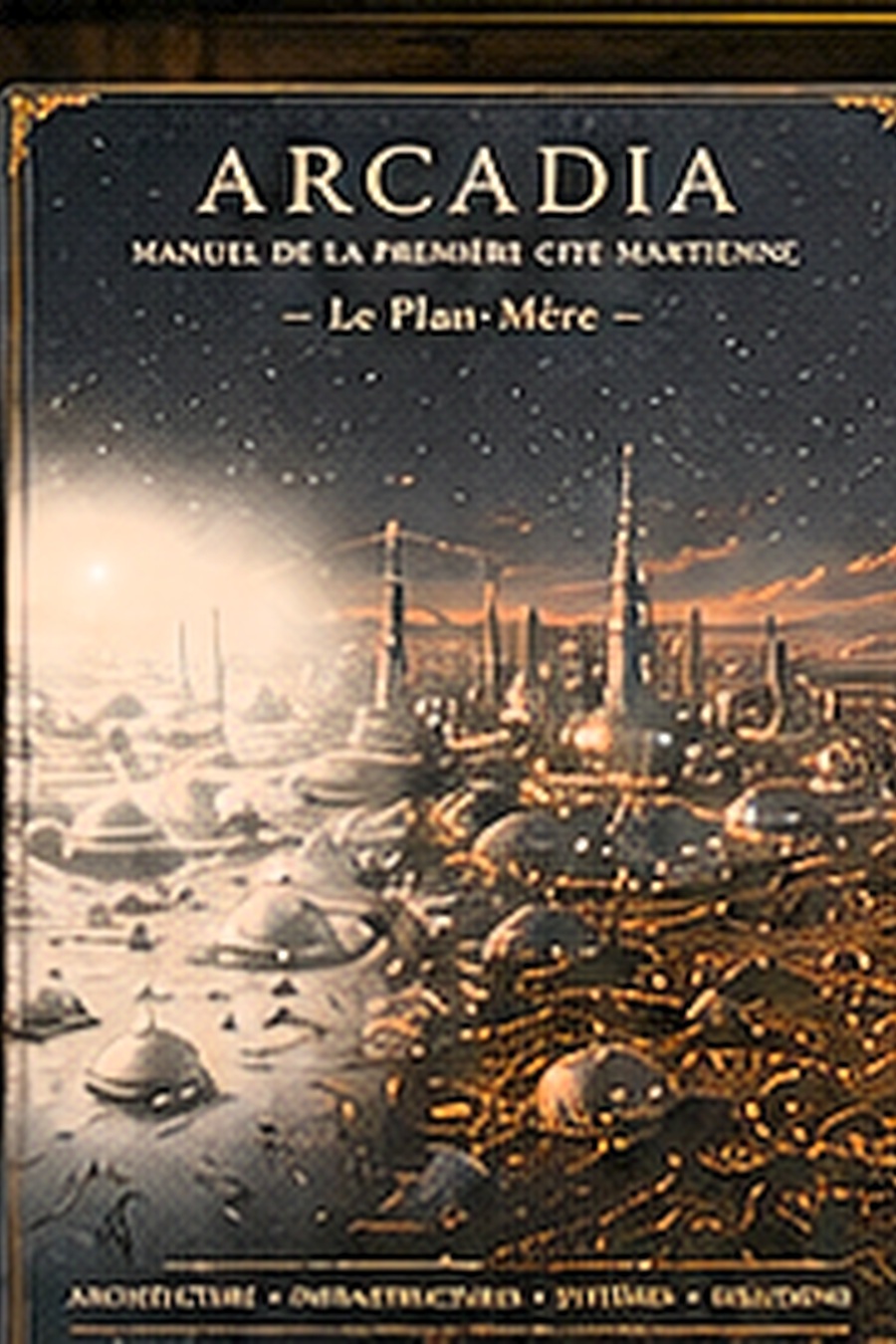
Technical and educational companion to I Walked on Mars
A systems-level exploration of what a permanent human city on Mars would require: site selection, shielding, energy, water, oxygen, food, habitats, pressurised galleries, logistics, safety, medicine, artificial intelligence and long-term growth.
Other formats and editions:
See all editions below
Direct links use confirmed ASINs only. Other published formats are listed without inventing identifiers.
Interior preview
Six English-language spreads present the technical architecture of Arcadia: logistics, artificial intelligence, construction, food systems, data infrastructure and communications.
Important : printed edition. The previews below are displayed in colour to preserve the legibility of the original illustrations on screen. Unless an edition is explicitly described as a “colour edition,” the interior of the paperback sold on Amazon is printed in black and white; the cover remains in colour. The printed book therefore differs from this digital preview.
1 / 6
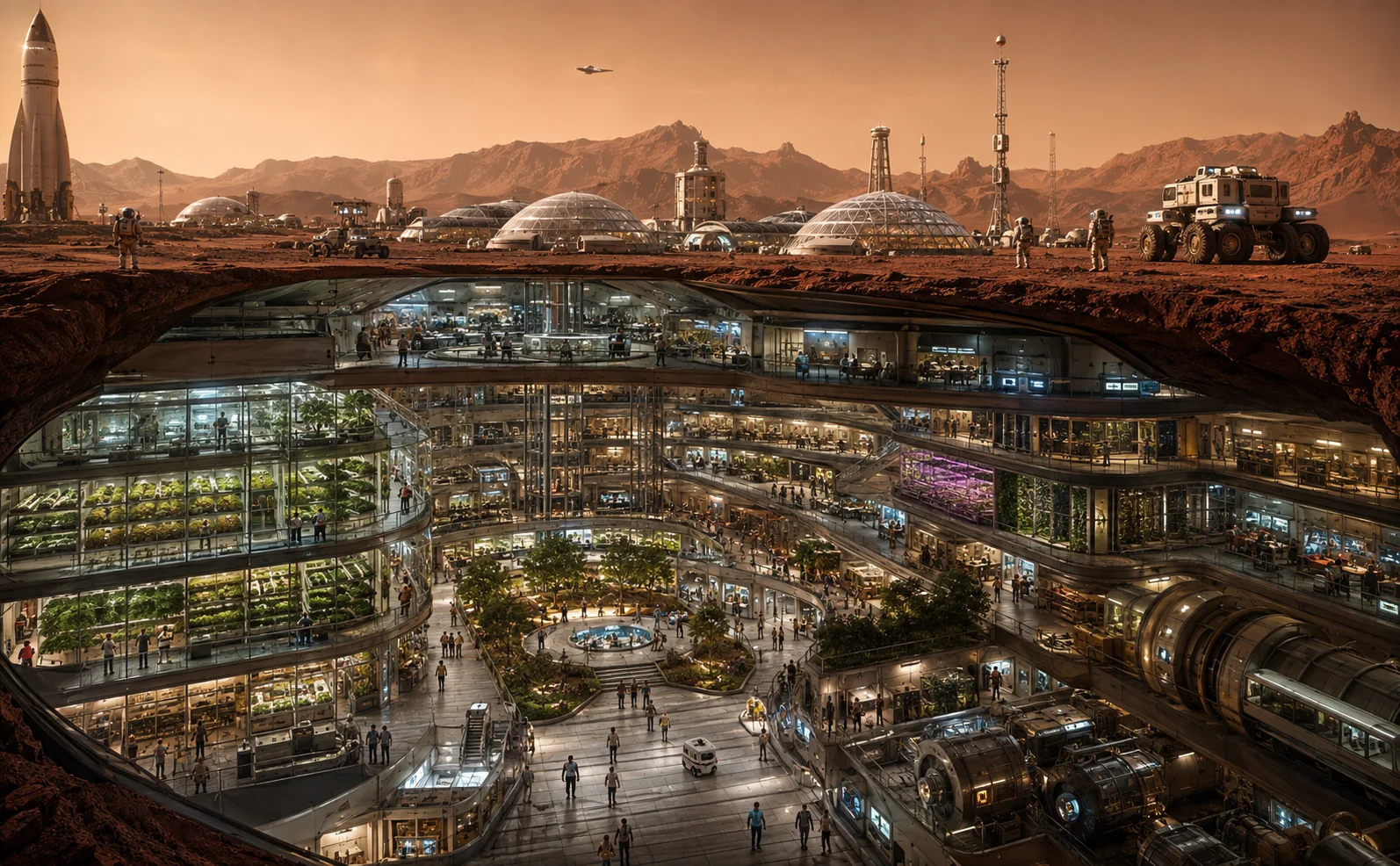
A Mars city cannot be designed by adding isolated technologies to one another. Energy affects oxygen production, water treatment, heating, food and maintenance. Habitats depend on shielding, pressure management, airlocks and access to repair networks. Logistics shape the size of inventories and the pace at which local industry must develop.
Arcadia therefore treats the settlement as a system of systems. The central question is not whether one device can work, but whether the entire city can continue functioning when equipment fails, deliveries are delayed and people must make decisions under pressure.
Pressurised cells and buried galleries are not merely shelters. They shape privacy, circulation, medical access, fire safety, social life and the psychology of a population living in confinement. The city must distinguish clean and contaminated zones, organise external work and make evacuation possible even when a route is unavailable.
A Martian habitat has to combine pressure integrity, protection, circulation, maintenance access and the ability to isolate a damaged zone. Architecture therefore becomes part of the life-support system.
ARCADIA begins from a simple premise: a Martian city cannot be understood by adding independent technology sheets together. Site choice affects transport, resource access, shielding and future expansion; those decisions in turn change energy demand, stocks and maintenance. The book therefore emphasizes chains of dependency rather than a catalogue of devices. That systems view explains why some choices have to be made early, while the settlement is still small and mistakes remain comparatively cheap to correct.
In ARCADIA, this issue is tied directly to the stage being explored: ARCADIA is a work of prospective synthesis rather than a certified engineering specification. Fiction is used as a narrative laboratory: it forces technical, human and political constraints to interact instead of being studied in isolation. Whenever the page touches a real-world issue, the linked Mars dossier helps separate documentation from the fictional hypothesis.
The English technical companion to I Walked on Mars: a documented and accessible systems-level study of siting, life support, habitats, logistics, safety and growth for a permanent Martian city.
A systems-level exploration of what a permanent human city on Mars would require: site selection, shielding, energy, water, oxygen, food, habitats, pressurised galleries, logistics, safety, medicine, artificial intelligence and long-term growth.
The book examines the choice of Arcadia Planitia, the preparation of construction areas and the role of burial or protective cover. Regolith is not simply scenery: it can become shielding, fill material and part of the construction sequence. The design must also preserve access, drainage, inspection and future expansion.
A durable settlement must reconcile several constraints at once. Protective layers have to reduce radiation and thermal exposure while remaining inspectable and maintainable; roads, utilities, cells and galleries must be installed in an order that preserves safety and future growth; and every first-generation module should be designed so that expansion does not repeatedly interrupt the systems already keeping residents alive.
Research-led companion pages
Looking for a direct answer about Mars colonization?. The English Mars hub explains the public questions independently (why go, how to survive, where to build, how to govern and how a base could become a city)before offering the books as a deeper continuation.
Architecture has to remain modular without becoming fragmented. A habitat should be isolatable after leakage or fire while retaining enough alternate routes that one corridor does not become a single point of failure. Tunnels, airlocks, service zones and shared spaces must also allow maintenance without exposing residents unnecessarily. ARCADIA treats the urban plan as part of the safety architecture, but also as the condition for a daily life that cannot remain a sequence of technical compartments forever.
Water extraction, purification, storage and recycling must be linked to oxygen production and power availability. The city needs reserves, alternative circuits and operating rules for degraded situations. A system that works only in ideal conditions is not sufficient for permanent settlement.
The book explains the importance of redundancy without pretending that every component can simply be duplicated. Mass, cost and maintenance capacity impose trade-offs. The objective is a resilient architecture, not an impossible promise of zero failure.
Breathing requires several variables to be controlled at once: oxygen, carbon dioxide, humidity, contaminants, pressure and the state of recycling loops. A settlement cannot reduce ECLSS to an oxygen bottle.
Water is simultaneously drinking supply, hygiene, agriculture, industrial feedstock and strategic reserve. As a settlement grows, recovery efficiency, buffer storage and microbial control become structural issues.
A durable settlement must be able to diagnose, disassemble, repair, recalibrate and document. A spare part is useful only if it can be identified, stored, matched to the right configuration and installed by people who know how.
This is the technical and educational companion to I Walked on Mars: a serious attempt to imagine the first large human city on the Red Planet.
Part engineering manual, part prospective essay and part guide for general readers, the book explains how a sustainable settlement could be established and expanded in Arcadia Planitia.
The purpose is not to dream vaguely about Mars, but to show step by step what a human civilisation beyond Earth would require.
Air, water and energy are three vital continuities with different behaviours. Energy can be generated and stored; water moves through uses, treatment and reserves; the internal atmosphere requires constant control of several variables. Designing them separately would be misleading because an electrical failure can stop recycling or pumping, while water-quality problems can affect food, hygiene and agriculture at once. The manual therefore pays particular attention to interfaces and failure propagation, not only to individual machines.
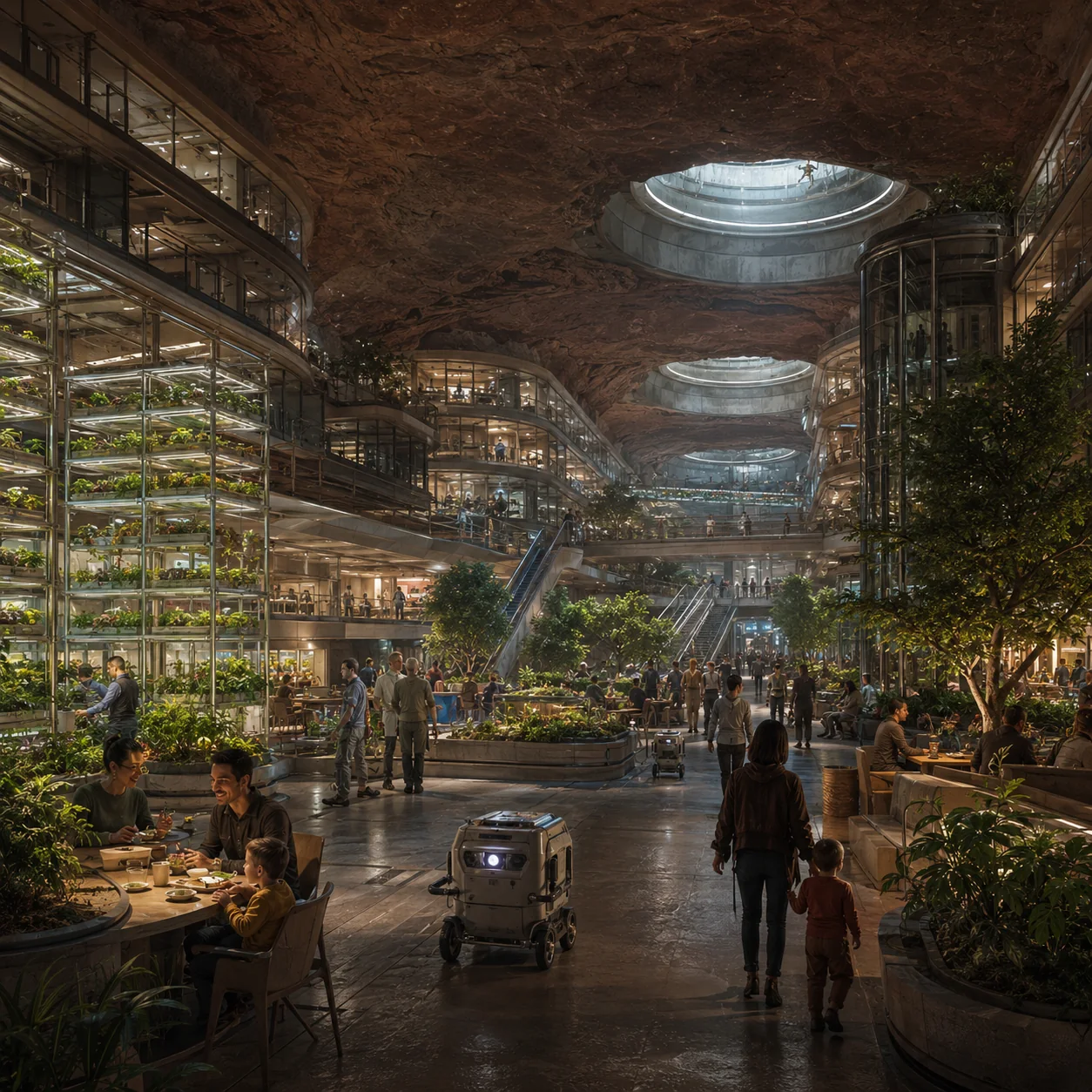
A permanent population needs more than calories. It requires crop diversity, storage, medical capability, sanitation, mental-health support and procedures that preserve human dignity during emergencies. The book approaches these functions as parts of the same civil system.
Martian agriculture combines yield, resource use, dietary variety, food safety and resilience. A harvest does not replace reserves; local production and stored food have to complement one another.
Health on Mars combines medicine, prevention, exercise, partial-gravity effects, mental health and the ability to treat people without a large hospital nearby. Habitat and organisational choices therefore have medical consequences.
Food and health put the inhabitant back at the centre of the system. Sufficient nutrition must remain varied, safe and compatible with available resources; credible medicine combines prevention, diagnostics, stocks, skills and limited capacity for heavy intervention. The interior environment also acts on body and mind. Noise, light, work rhythm, exercise, privacy and access to living plants become design variables alongside pressure, temperature and radiation protection.
Imported equipment will remain essential for a long time, but workshops, diagnostics and local manufacturing determine whether Arcadia can absorb delays and redesign components. Artificial intelligence can assist planning, monitoring and maintenance; it must not erase human responsibility or create a new single point of failure.
Demographic growth introduces schools, family housing, institutions and intergenerational questions. A base becomes a city when it begins planning for people who were not part of the original mission.
Autonomy grows when a settlement replaces part of its imported mass with materials, parts and consumables made locally. That requires processes, power, quality control and a hierarchy of what is worth producing first.
As settlements multiply, logistics becomes a network: surface routes, vehicles, intermediate stocks, mutual aid, spares and transfer schedules. Distance still matters on a planet smaller than Earth.
For the research context behind these issues, see local manufacturing, ISRU and industrial autonomy · inter-settlement logistics, reserves and mobility
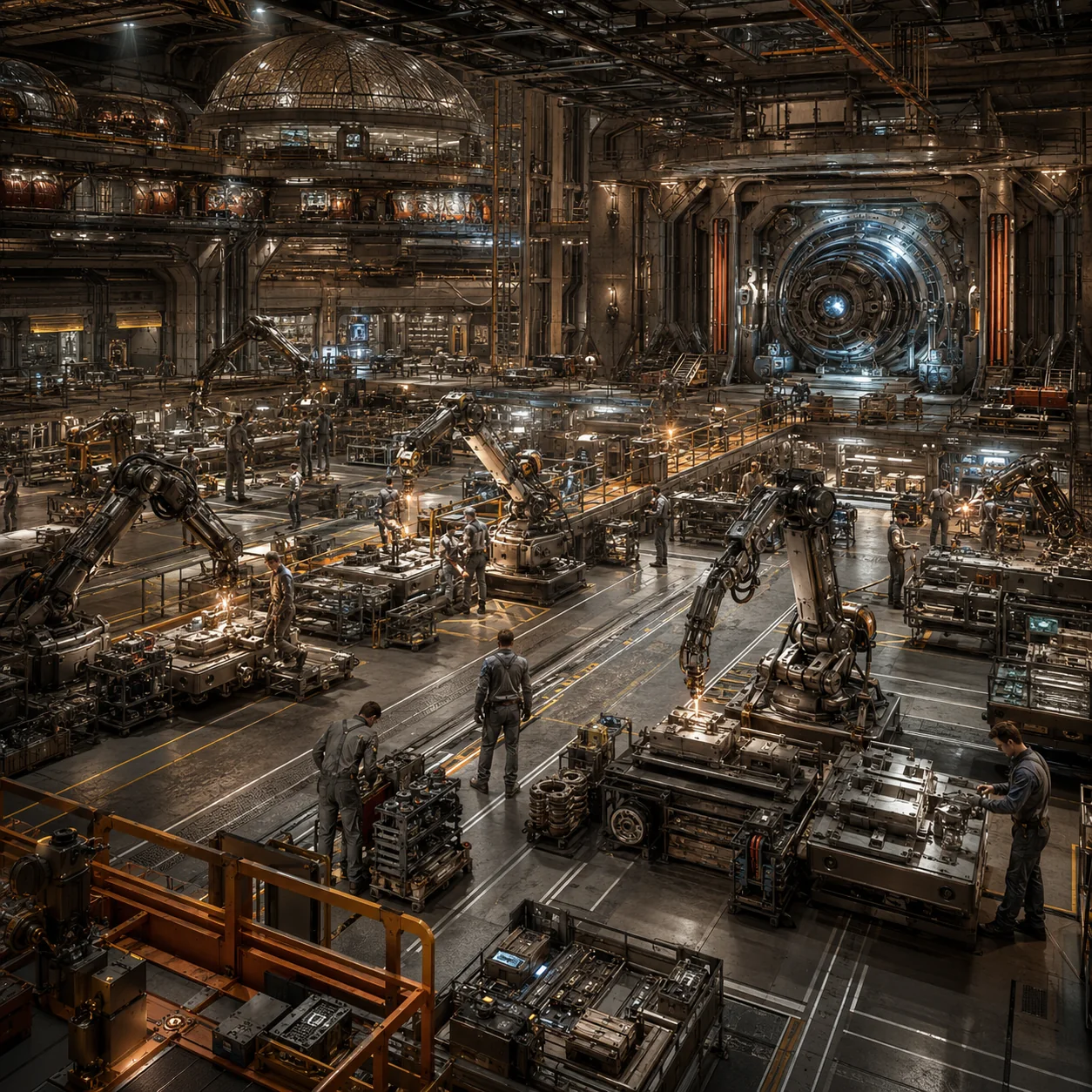
Local industry does not mean immediate self-sufficiency. It can begin with repair, simple machining, refurbishment and production of components with high logistical value. Later processes may use more local material, but every industrial chain consumes energy, machinery, quality control and skilled labour. ARCADIA therefore argues for priorities: manufacture first what reduces the city’s vulnerability most, and document processes well enough that knowledge can survive staff changes and generational turnover.
Fire and depressurisation require compartments, refuges, sensors, procedures and evacuation routes. Safety has to be designed before failure, not improvised during the emergency.
Redundancy does not mean blindly duplicating every component. It means identifying life-critical functions, common-mode failures, required reserves and ways to continue at reduced capability.
ARCADIA is presented not as a science-fiction backdrop but as a system of systems. A Martian city has to breathe, drink, eat, generate power, manufacture, repair, store, heal, move, decide and survive failures.
Resilience requires distinguishing useful redundancy from expensive duplication. Two identical machines may share the same defect, power source or rare spare and fail together. The manual instead reasons in vital functions, common-mode failures, degraded operation and repair time. Refuges, buffers, alternate routes and emergency procedures matter only when they are tested, maintained and understood by the people who will actually use them rather than existing solely as lines in a plan.
On Mars, governance begins with operations: who can shut down a system, order an evacuation, allocate a scarce resource or decide during a crisis? Over time those technical powers become institutional questions.
When children are born or raised on Mars, a settlement symbolically stops being a temporary mission. Education, health, development, partial gravity and cultural transmission become permanent functions.
Energy is not just installed generating capacity. It has to be considered as generation, storage, distribution, maintenance and load shedding: which systems stay powered when generation falls?
Radiation protection affects habitat design, outside work, planning and temporary shelters. Chronic exposure has to be distinguished from solar-event risk, with activities adapted accordingly.
This chapter can be extended with operational governance and legitimacy of decisions · children, education and Martian demography
Growth changes every earlier assumption. A base designed for dozens can become inefficient or dangerous if flows increase without new organization. Districts, services, education, medical capacity, expansion rules and governance have to evolve with population. This is where ARCADIA connects most directly with the novels: technology makes the city possible, but duration turns the city into a society with interests, conflicts, institutions and choices that cannot be solved by engineering alone.
Choose the language and format directly. When an ASIN is confirmed, the button opens the exact Amazon listing. When a format is published but the ASIN still needs to be copied from KDP, a clearly labelled Amazon search link is provided instead of inventing an identifier.
English / United States — Amazon.com
Paperback
Arcadia — Manual of the First Martian City
French — Amazon.fr
Broché
ARCADIA — Dossier technique d’ingénierie urbaine martienne, compagnon de J’ai marché sur Mars
Direct links use confirmed ASINs only. Other published formats are listed without inventing identifiers.
No. It is a technical and educational companion to the fictional universe.
No. The book aims to explain systems and dependencies to interested general readers while preserving technical seriousness.
No. It is a prospective design exercise that makes assumptions explicit and explores a coherent architecture.
Either is possible. Reading it after one or more novels reveals the infrastructure behind the story; reading it first provides a technical map of the universe.