Measure 21 / 155

02 — Administration · Measure 2.01 · 21 / 155

Abolish the regional tier without losing essential capabilities

Separate the elected regional authority, the State’s regional administration and functions that genuinely require a supra-departmental scale before any transfer.

Bible France · documentary chapterUpdated : 12 August 2026Primary sources prioritised
Measure 2.01 — Abolish the regional tier without losing essential capabilities
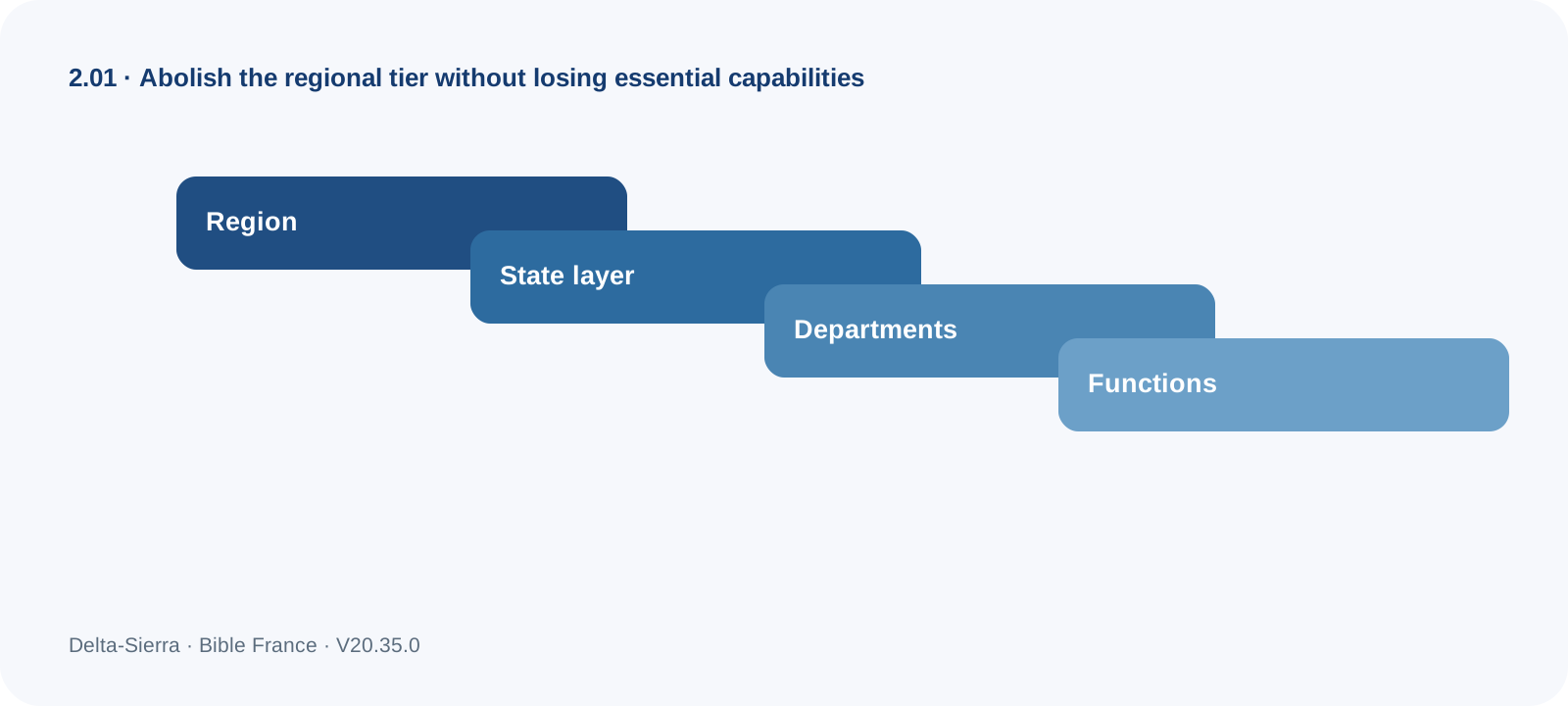
Measure-specific visual explanation 2.01

In 30 seconds

Current positionSeparate the elected regional authority, the State’s regional administration and functions that genuinely require a supra-departmental scale before any transfer.
ProposalAbolish the regional tier without losing essential capabilities
Legal routeConstitutional amendment for the regional authority category, followed by transfer statutes and regulatory reorganisation of State services.
Financial effectNet savings cannot be inferred from abolished headquarters: functions, staff and contracts transferred elsewhere must be deducted.
ConfidenceHigh on legal framing and method; financial estimates require consolidation before booking.
Main riskPrevent the abolished layer from quietly reappearing as informal supra-departmental structures.

Two different regional layers must be disentangled

The word “region” covers two legally different systems. Regions are territorial authorities expressly named by Article 72 of the Constitution, with elected councils and statutory responsibilities. Abolishing that category therefore requires constitutional change; it cannot be achieved by a ministerial reorganisation alone.

Separately, the State has a regional administrative chain led by regional prefects and regional directorates. A credible reform must decide which powers move to departments, which return to central government and which still require supra-departmental coordination. The organisation chart cannot disappear before the mission map exists.

Transfer functions before counting savings

Regional spending finances policies as well as administration. Transport contracts, secondary schools, economic-development programmes and planning responsibilities do not become savings if they continue under another authority. The financial model must distinguish policy expenditure transferred elsewhere from administrative overhead that genuinely disappears.

The transition dossier should publish owner-by-owner transfers of staff, contracts, systems, assets and liabilities. A two-year audit should compare decision times and administrative costs before and after reform, ensuring that a new informal regional layer has not quietly been recreated.

Costing and legal delivery

Constitutional amendment for the regional authority category, followed by transfer statutes and regulatory reorganisation of State services.

Net savings cannot be inferred from abolished headquarters: functions, staff and contracts transferred elsewhere must be deducted.

Transition expenditure is reported separately from recurring savings, and transferred activity remains public expenditure unless the policy itself is discontinued.

What must be proved before implementation

Prevent the abolished layer from quietly reappearing as informal supra-departmental structures.

The implementation file must separate the elected regional authority from the State's regional administration. For each function it should name the destination authority, transferred staff, budget and contracts, then identify the remaining cross-department coordination mechanism. Savings can only be calculated after these destinations are known.

Notes and sources

  1. Constitution du 4 octobre 1958 — article 72 — primary/institutional source used for the measure framework.
  2. Décret n°2004-374 relatif aux pouvoirs des préfets — primary/institutional source used for the measure framework.
  3. Arrêté du 20 août 2025 sur la déconcentration de la gestion des agents — primary/institutional source used for the measure framework.
  4. CGCT — compétences du conseil régional — primary/institutional source used for the measure framework.


Further reading

The author’s books extend the programme but do not replace the primary sources cited in this chapter.

Réforme de l’État book cover

Réforme de l’État — Plan de Rupture

The architecture of the 155-measure programme.

IA : comment transformer la France book cover

IA : comment transformer la France

AI use cases, automation and human oversight in public services.

What must be proved before abolishing the regional tier

The reform needs a destination matrix before any institutional closure: each regional responsibility should be matched with its future authority, budget, staff, contracts and dispute-resolution mechanism. The Constitution expressly lists regions among territorial authorities, while the State's regional administration is governed by a separate legal framework. [1] [2] A single political objective therefore entails several distinct legal operations.

A second test concerns functions that genuinely cross departmental borders. Current law already gives the regional prefect a coordination role over State action. [2] The question is not whether a supra-departmental scale will ever be needed, but whether it requires an elected region, a permanent State layer, temporary coordination or contractual cooperation. Human-resource decentralisation rules and the statutory responsibilities of regional councils complete the map that must be transferred. [3] [4]

Two years after implementation, Parliament should compare administrative cost, decision times, number of cross-department agreements and service outcomes with the baseline. If the same teams and committees reappear under new names, the reform has shifted an organisation chart rather than simplified government.

Implementation evidence to publish

Before Parliament votes, the transition file should contain a line-by-line destination for regional responsibilities and a map of functions that still require cross-department coordination. The purpose is to make institutional simplification testable before it becomes irreversible, and to expose any hidden recreation of a regional layer under another name.

The post-reform comparison should therefore focus on decision time, administrative cost and whether a shadow regional structure has re-emerged.

Failure modes to test before national rollout

Before national rollout, the test must show that abolishing the regional tier does not recreate the same coordination layer elsewhere.