Read the build as a chain of decisions, not as a playlist
The autonomous A-frame series becomes more useful when it is treated as a project record. Individual episodes do not merely show what happened on a particular day. They reveal dependencies between site access, water systems, concrete work, structural decisions, materials, logistics and later maintenance. This hub links the episodes that have already been converted into full documentary dossiers and makes those dependencies easier to follow.
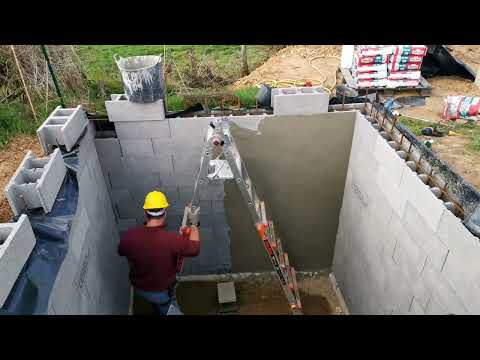
The currently materialised sequence covers the start of construction, a difficult concrete pour, assembly of the water tank and its supporting elements, closure of the tank, and delivery of straw for insulation. That is already enough to trace a coherent chain: prepare the site, execute work that becomes expensive to change once buried or hardened, organise water storage, and then protect materials that will later disappear inside the envelope. Other episodes in the 69-video inventory will join the path only when their bilingual documentary pages have actually been completed.
Three evidence layers are deliberately kept separate
Each dossier distinguishes the primary video, external documentary sources, and Delta-Sierra analysis. The distinction prevents a common error. Seeing a method used on screen does not prove that it is optimal, universally compliant or transferable to another building. Conversely, a technical guide may explain good practice without proving what happened on this particular site.
The useful method is to cross-check the layers. Footage records the sequence. External sources provide technical or regulatory context. The dossier then develops first-order calculations, failure modes, verification questions and explicit limits. If a fact cannot be verified, a plausible value is not substituted. This rule is especially strict for publication dates and timestamps: only source-backed dates and author-published or otherwise verified chapter points are represented as exact.
Five technical threads are already visible
Site organisation. The start-of-work and concrete dossiers show that access, labour, lighting, pump reach, storage and contingency planning are part of technical quality. Correct materials cannot compensate for a workflow that has no margin when something goes wrong.
Water. The tank dossiers do not equate autonomy with litres of storage. They introduce water mass, hydrostatic pressure, catchment, overflow, network separation, inspection and maintainability. A useful system must remain understandable and serviceable after the dramatic construction phase has ended.
Structure. Photographs of concrete, columns or a roof cannot certify structural adequacy. The pages instead explain load paths, geometry, interfaces, irreversible operations and the value of an as-built record. They mark the boundary between what footage can document and what requires project-specific engineering.
Envelope and bio-based materials. Straw delivery opens a different risk chain: moisture during transport and storage, batch traceability, thermal continuity, detailing, fire performance of the complete assembly and protection from biological damage.
Maintenance. This is the thread linking the whole path. A tank, hatch, pipe penetration, pump or insulation layer is not only something to install. Future access, diagnosis and repair should influence the decision made while the component is still visible.
How to use this hub
For a quick visit, the cards below open the available dossiers. For a project-oriented reading, follow them chronologically and ask three questions at every stage: what becomes difficult to change after this operation, what evidence should be recorded now, and which future maintenance task is being made easier or harder by the present choice? That turns a construction vlog into a structured learning record.
The five dossiers displayed here are not presented as a complete account of the A-frame build. They are the subset already raised to the bilingual documentary standard. The remaining episodes will be added progressively, without creating thin placeholder pages and without putting non-existent dossiers into the video sitemap merely to make the catalogue look complete.
A cumulative record across a long build
As more episodes are transformed, this hub should preserve the already verified dossiers and extend the sequence rather than overwrite earlier stages. That matters on a multi-year build because a small early decision may explain a constraint that becomes visible much later. A useful archive lets the reader travel backwards from an observed effect to the stage where access, geometry, material protection or maintenance was decided.
Documentary priority therefore does not follow video numbers alone. Episodes are selected when they add a distinct piece of the technical story: water, structure, envelope, energy, site logistics, an error, a maintenance issue or a later assessment. This prevents the collection from becoming dozens of near-duplicate pages and gives each completed dossier a clear role in the learning path.
The same rule supports bilingual parity. A new French dossier is not counted as a completed pair until its English twin carries the same reasoning, sources, calculations, limitations and structured video data. The goal is not a decorative language switch but two usable reference pages that can be audited independently.