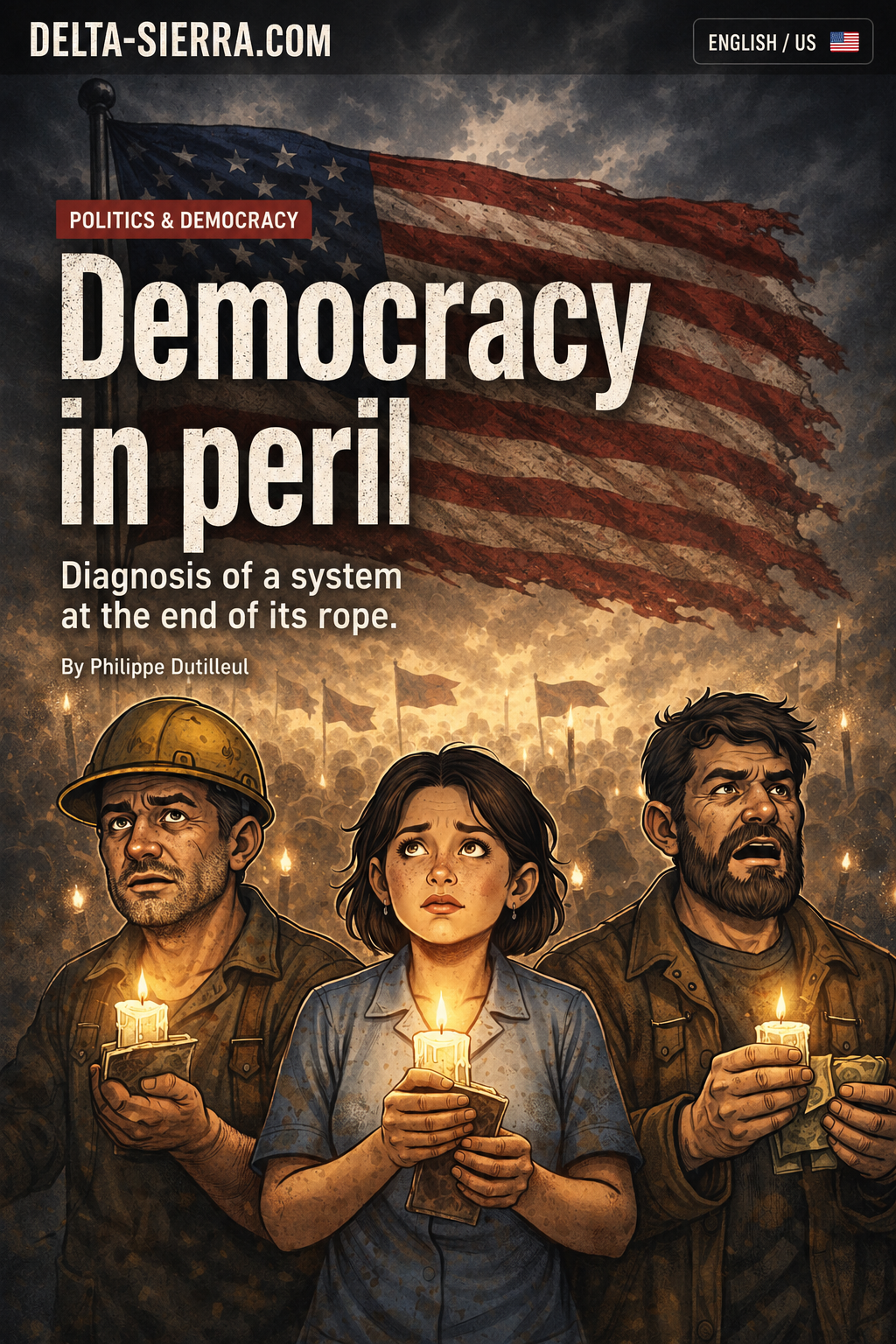
Democracy in peril? Democracy, born of the ideals of equality, liberty and collective decision-making, has historically been a beacon of hope for many nations. Yet recent events in our own political landscape reveal troubling deviations from these founding principles, suggesting that our democratic system may be drifting toward self-destruction. The recent legislative elections triggered a series of events that call into question the integrity and durability of our democracy. We have witnessed demonstrations sowing chaos and destruction, supposedly to oppose the rise of opposing ideologies. These actions, while claiming to defend democratic values, paradoxically undermine the very fabric of our democratic society. The violence and destruction inflicted on our cities, along with the exorbitant costs associated with these demonstrations, pose a serious threat to public order and to an economic stability already sorely tested by fiscal pressure and the loss of energy sovereignty. This raises two crucial questions: the acceptance of the verdict of the ballot box, and whether the tolerance inherent in democracy has reached its limits. The practice of candidates withdrawing from the second round to support opponents against an adversary designated as a common enemy raises, moreover, serious ethical concerns. This strategy, however politically expedient, betrays the trust of the voters who supported those candidates for their distinct programmes. Manipulating electoral outcomes in this way erodes the integrity of the democratic process and disrespects the will of the electorate, reinforcing a distrust of politics among our fellow citizens that we were already struggling to contain. To make matters worse, the defacement of French historical monuments with politicised graffiti is the sign of a worrying contempt for our national heritage. These symbols of our history and culture are being desecrated, reflecting a broader societal erosion of respect for our shared past. Such acts of vandalism not only damage physical structures; they also inflict lasting harm on the collective memory and identity of our nation. They deepen a fracture within it, between those who identify with its history or accept it, and those for whom it means nothing. The philosopher Karl Popper set out the paradox of tolerance, which highlights the limits of democracy. According to him, unlimited tolerance can lead to the disappearance of tolerance itself. If we extend tolerance even to

the intolerant, and are not prepared to defend a tolerant society against the assault of the intolerant, then the tolerant will be destroyed, and tolerance with them. In a more insidious form of subversion, we have also watched in astonishment instances where ballot papers for certain candidates were simply not available in polling stations. This deliberate suppression of voters' choice, to the advantage of one or more candidates, violates the fundamental democratic principle of free and fair elections; if one rejects democracy and wants to impose a person, why in that case take part in an election at all? It demonstrates an alarming willingness to compromise democratic norms in the pursuit of political objectives. These phenomena illustrate a broader crisis within our democratic system. The mechanisms that once protected our collective decision-making are now being exploited in ways that threaten the stability and coherence of our nation. The founding ideals of democracy were meant to foster a just and equitable society, yet the current trajectory suggests a distortion of those values. Faced with these challenges, it is imperative to reflect on the original principles of democracy and to consider reforms capable of restoring its integrity. Ensuring that democracy serves the common good, rather than becoming a vector of discord and division, is essential to the preservation of our national unity and our historical heritage. The problem of the individual in the equation of democracy. Democracy rests on the fundamental principle that every citizen has the right to take part in the decision-making process, regardless of social, economic or educational status. However, the viability of this democratic model is being put to the test by a present-day reality in which a part of the population, living on social benefits and often on the margins of society, also influences the political choices of the nation. In its origins, democracy was a system in which citizens, though relatively few in number, had a basic education and shared common values that reflected the interests of the nation. Today the situation is more complex. Electoral participation now includes individuals with little or no education, sometimes involved in illicit activities and making no productive contribution to society. These circumstances raise crucial questions

about the capacity of such individuals to make informed choices on matters of State as sensitive as the command of the armed forces or legislation. It is legitimate to ask whether the participation of these people, often disconnected from the economic and social realities of the country, is beneficial to a healthy democracy. How can part of our population accept that those who reject our laws and institutions, and who are sometimes dealers, traffickers, con men, thieves or rioters, should be able to choose the man who will hold the nuclear codes and become commander-in-chief of the armed forces, or the deputies of the nation? How can individuals without education, rejecting the society in which they live, with no grasp of sovereign matters, and known to the police and intelligence services for offences, be in a position to choose those who will govern us? Must the system accept that convicts, dealers, mobsters, people "outside the system", revolutionaries or anarchists can be elected by those who identify with them, in the name of democracy, even at the risk of a loss of sovereignty, the economic bankruptcy of the country, an external war or a civil war? Who should have the capacity to determine the limits of democracy, and can those limits themselves be considered democratic? On one side, restricting the right to vote could be perceived as antidemocratic and discriminatory. On the other, allowing everyone to vote, without regard to their involvement in society or their understanding of national issues, could compromise the quality of the decisions taken for the country's future. The question then arises: can and should a democracy select its voters in order to preserve the quality of its decisions? This question touches the very heart of what a democracy really means. Historically, some democracies restricted the right to vote to citizens meeting certain criteria of property, education or military service. Such restrictions, however, run counter to modern principles of universal rights. To go further, let us question ourselves: can democracy survive and prosper if a significant portion of its voters is perceived as not contributing positively to the general well-being of society? This amounts to asking whether the democratic system is scuttling itself by allowing everyone, without distinction, to take part in crucial choices.

In parallel, it is increasingly common to see the flags of other nations flying alongside, or even in place of, the French flag during demonstrations. In many countries this would be unthinkable and regarded as a grave attack on national sovereignty. This situation raises questions about citizens' attachment to their own nation and its values, and about how this influences their participation in the democratic process. Another worrying dimension is the absence of any legal obligation to vote. This absence produces high abstention rates, meaning that the country's strategic decisions can be taken by individuals elected by a minority of the population. When only a few tens of percent of voters take part in elections, the representativeness and legitimacy of those elected is called into question. Clearly, the solution is not simple. On one hand, we must preserve inclusiveness and equality, core values of democracy. On the other, we must guarantee that the decisions taken reflect an informed understanding and a genuine concern for the common good. A democracy that selects its voters risks losing its essence. Yet ignoring the need for informed and engaged electoral participation could lead to decisions that are harmful to society. A thorough reflection is therefore needed to balance these contradictory imperatives. Potential reforms could include strengthened civic-education initiatives, stricter conditions for exercising the right to vote, or hybrid models that take account of both inclusiveness and the quality of electoral decisions. In conclusion, questioning the capacity of certain people to vote raises complex and fundamental debates about the very nature of democracy. It is a matter of finding a delicate balance between the ideals of inclusion and the demands of enlightened, responsible governance. To that, my answer is: good luck — recalling that history teaches us that empires rise and fall, that nations are made and unmade. This recurring observation in the study of history reflects the cyclical and changing nature of political and social structures through time.

To go further, here are the books that deal most deeply with the limits and potential problems of democratic systems:

"How Democracies Die" by Steven Levitsky and Daniel Ziblatt. This book examines how democracies can erode from within, often by legal means. It highlights the weaknesses of democratic systems when confronted with populist or authoritarian leaders. "The Dictator's Handbook" by Bruce Bueno de Mesquita and Alastair Smith. Although not explicitly anti-democratic, this book shows how political incentives can lead to similar behaviour in democracies and autocracies. "Political Order and Political Decay" by Francis Fukuyama. Fukuyama discusses how democratic institutions can deteriorate over time, leading to inefficiency and corruption. "Democracy and Its Critics" by Robert Dahl. Although Dahl is generally favourable to democracy, his book offers a nuanced analysis that acknowledges the challenges inherent in democratic systems. These works do not reject democracy as a non-viable system; they offer constructive criticism and identify areas where modern democracies can fail or deteriorate. They generally suggest reforms or adjustments rather than a complete abandonment of the democratic system.

Regarding works that specifically criticise the viability of French democracy and propose alternatives, one could cite: "La France en crise - Ces intellectuels qui pensent la démocratie jusqu'à son abolition" by Pascal Riché and Nicolas Truong. This book examines the ideas of contemporary French thinkers critical of the current democratic system. "La Démocratie représentative est-elle en crise ?" edited by Dominique Rousseau. While this book does not entirely reject democracy, it offers a critical analysis of the French representative system. "L'État profond en France" by Alexandre Gerbi and Olivier Rouquan. This work explores the controversial idea of a "deep state" undermining French democracy from within. "Le nouveau pouvoir" by Hervé Juvin. The author criticises the current democratic system and offers reflections on alternative forms of governance. "La Tyrannie de la majorité" by Tocqueville (re-edited and annotated). Though a classic, this work remains relevant for understanding the potential limits of democracy.

Works on regimes categorised as extreme: finally, if we want to push things a little too far — though for our general culture it can be instructive — here are a few works that explore concepts rejecting democracy and proposing alternative systems. These works present extreme and potentially dangerous ideas. I strongly recommend reading them in a historical and critical context, confronting them with more balanced analyses of political systems. It is crucial to bear in mind the disastrous historical consequences of such ideologies: "La Nouvelle Droite" by Alain de Benoist. De Benoist criticises liberal democracy and proposes alternative nationalist ideas. "Le Coup d'État permanent" by François Mitterrand. Although Mitterrand does not defend authoritarian nationalism, this book criticises the Fifth Republic in a way that may interest those who question the current system. "The Doctrine of Fascism" by Benito Mussolini. A historical text presenting the arguments in favour of fascism. "La Révolution conservatrice allemande" by Armin Mohler. A study of the intellectual movement that preceded Nazism in Germany. "Le Capital" by Karl Marx. The foundational work setting out the economic and political theory of communism. Though dense, it is essential for understanding the ideological foundations of the communist system. "Le Manifeste du Parti communiste" by Karl Marx and Friedrich Engels. Shorter and more accessible than "Le Capital", this text presents the fundamental principles of communism and its political programme.