Umbrella dossier, a map of the 1,153 national public bodies listed within the studied scope of the French state
📅 May 2026
An opaque web of 1,153 national public bodies listed within the studied scope, methodically screened
France has about 1,153 national public bodies listed within the studied scope of the state: 1,153 national public bodies listed by the Budget Directorate in 2025 (excluding Social Security), to which must be added 317 advisory bodies identified by the Senate commission of inquiry of July 3, 2025, and 24 independent authorities. This opaque web concentrates tens of billions of euros in public-service grants, hundreds of thousands of public employees and a host of documented institutional duplications.
This dossier offers an exhaustive panoramic map and a rigorous classification into four operational categories: keep, merge, reintegrate or abolish. It comes with a 24-month plan de rupture (break-away plan) organized in three waves (decrees, mergers, laws). Its methodology is explicitly comparable to that of the Court of Audit’s formal observations: reproducible, verifiable and documentable case by case. The main sources are public: the Senate (report no. 807 of July 3, 2025), the Budget Directorate (the budget annex “Opérateurs de l'État” attached to the 2026 finance bill), the Court of Audit (2018-2026) and studies by the IFRAP Foundation.
Read the dossier directly online
You can read the entire dossier below without downloading it. Use the tabs to switch between the presentation brochure (4 pages) and the complete umbrella dossier. Downloading remains possible via the backup buttons at the bottom of the viewer.
📱 On mobile, choose the document to read below. It will open in a new view for better readability.
The 4 operational categories, a rigorous classification
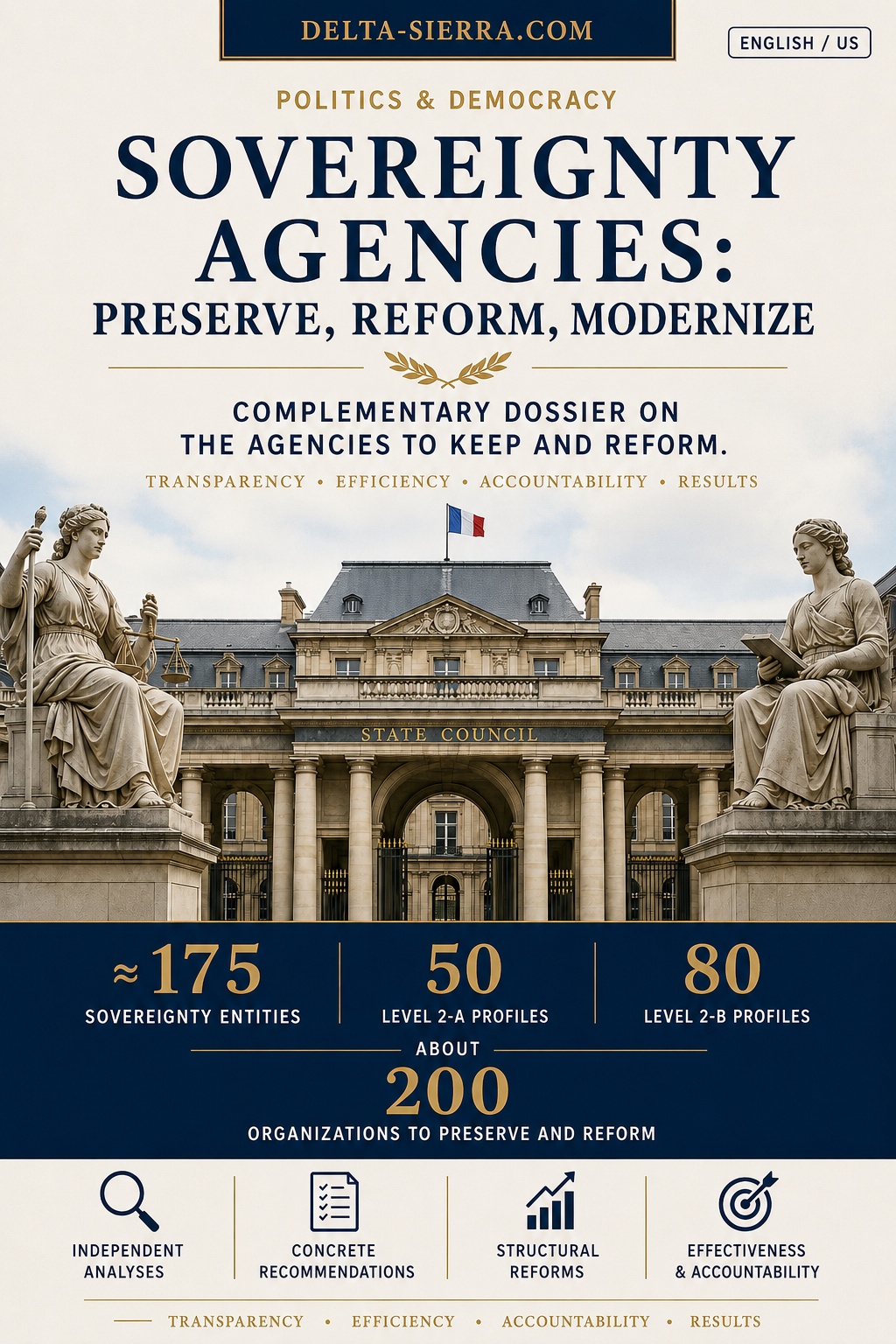
Each entity is classified according to a strict logic, justified and costed individually. Category A (≈ 175 entities) brings together the indispensable sovereign or technical missions, which deserve to be kept while being screened against a cross-cutting audit grid (capped pay, company cars, entertainment expenses, travel, dormant cash balances, real estate, pooling of support functions). Category B (≈ 280 entities grouped into 6 strategic merger blocks) pools support functions and brings out a more readable institutional architecture.
In turn, Category C (≈ 400 entities) covers the bodies to be reintegrated into their supervising ministry, with detailed HR arrangements. Category D (≈ 745 entities) gathers the obvious duplications, exhausted missions and dormant structures: observatories that have not met for five years, ad hoc missions kept active long after their purpose was achieved, committees for events that ended in 2018 still alive administratively, sectoral strategic councils that perfectly duplicate the central administrations. In total, the savings mapped amount to €17 to €31 billion a year, and a maximum annual potential of up to €350 billion with the extensions, according to the author’s scenario and subject to a measure-by-measure audit (related reforms).