



One human adventure in four stages
The first strength of the four-book architecture is continuity. Book One does not begin on Mars because a credible settlement does not begin on landing day; it begins when someone decides who will leave, with which skills, weaknesses and capacity to live together. Book Two turns intention into physical constraints: breathe, drink, eat, generate power, repair, build and prioritise. Book Three asks what happens when survival is no longer the only horizon and a society begins to take shape. Book Four follows the logic to autonomy and sovereignty. That progression lets the same problem be observed at several scales. A choice that appears purely technical in the first camp can become social when population grows, economic when resources are exchanged, and political when groups claim different priorities. The series is therefore not four unrelated adventures; it follows a mission becoming a settlement, a settlement becoming a city and a city becoming a community able to think about itself.
Readers can enter I Walked on Mars through people and relationships, through settlement engineering, or through social questions. The paths converge. Selection and psychology point most strongly to Book One; readers asking how a base could function will naturally move toward Book Two and ARCADIA; demography, economy and geopolitics become central in Book Three; governance, law and autonomy structure Book Four.
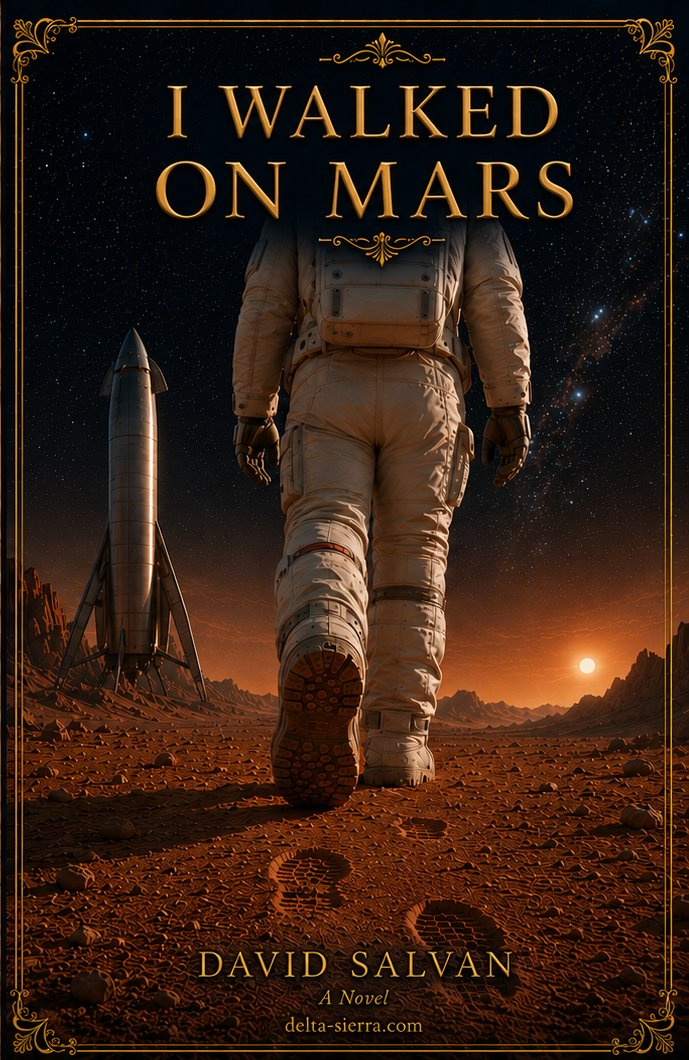
Book One deliberately refuses to begin with people already walking on a red landscape. A credible settlement begins with selection: physical health, psychological stability, practical competence, learning capacity and the ability to live inside a small group for a very long time. The story follows the transition from individual candidates to a crew whose members understand that expertise alone is not enough. Cross-training, degraded-mode exercises, shared decisions and HERMES as an assisting intelligence all belong to that transformation.
Four stages, one continuous transformation
This makes the first book a natural entry point for questions such as who might be selected as an early Mars settler, what kind of training a Mars crew would need, how psychological readiness could be evaluated and which skills require redundancy. The Great Departure is therefore not only the final launch scene. It begins much earlier, when leaving stops being an inspiring abstraction and becomes a concrete personal commitment with no simple promise of rapid return. Mars settlement would not be conducted by machines alone. The four novels therefore focus on people who have to learn, cooperate, accept constraint, resolve conflict and keep making decisions in an environment where small mistakes can cost far more than they do on Earth. Selection and training in Book One are not an interchangeable prologue; they shape the way characters later react to failures, scarcity, confinement and disagreement.
As the series advances, the human question changes. The issue is no longer only whether one crew can remain coherent during a mission, but whether several generations, cultures and waves of newcomers can build a society. Children, education, memory of the founders and the growing difference between people who knew Earth and people raised on Mars give Arcadia a historical depth. The technical cycle begins with life-critical functions: air, water, power, food, pressure, radiation protection and fire safety. A city, however, cannot remain forever an assembly of imported consumables. Books Two and Three therefore give increasing importance to maintenance, spares, workshops, ISRU, local manufacturing, inventories and logistics. Autonomy is not a slogan; it depends on what a settlement can actually diagnose, make, repair and replace.
ARCADIA, the associated technical manual, extends those questions without confusing fiction and documentation. The Mars portal documents real systems while the series shows how systems interact with human decisions. That circulation between fiction and documentation is a central Delta-Sierra principle: someone may arrive through a question about water, ECLSS, agriculture or maintenance and then discover the book that places those constraints inside a lived situation.
When a base becomes a society
A base of a few dozen people can operate like a mission with a clear command chain. A city of hundreds or thousands cannot remain in that model indefinitely. The series therefore explores the gradual transition from operational authority to representation, legitimacy, shared rules, access to resources and accountability.
The final book does not claim to predict the future law of Mars. Fiction is used to ask questions that already exist in embryo: how much can a distant society decide for itself? What does Earth authority mean when communications are delayed and survival depends on local decisions? How might existing space law, state interests, companies, settlers and a population that begins to think of itself as Martian interact?
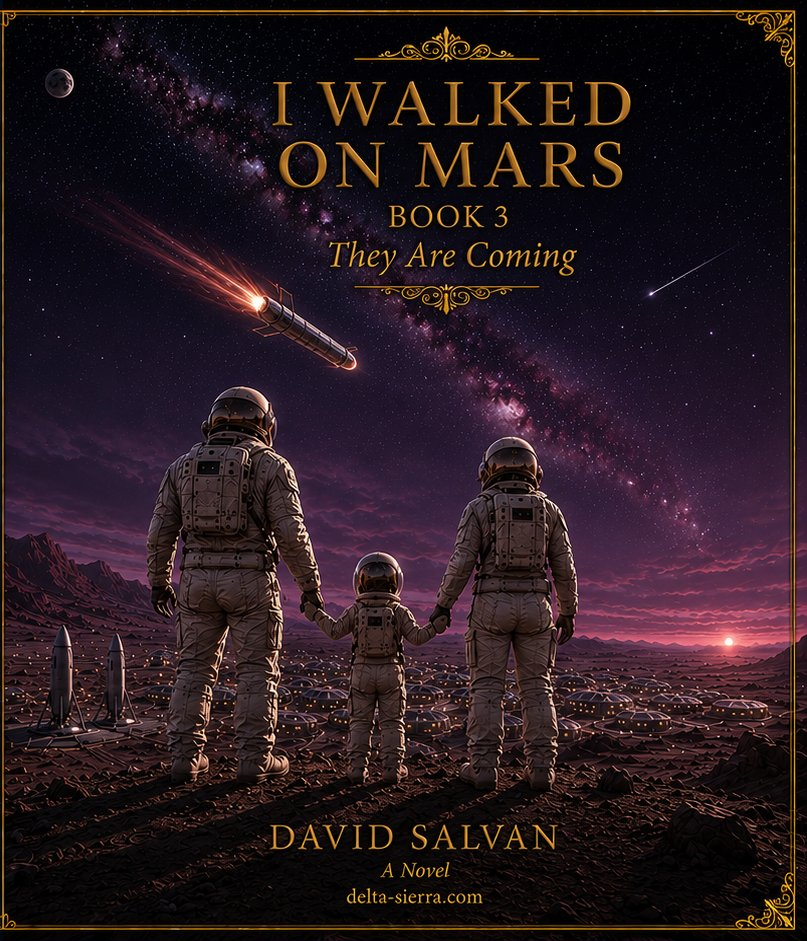
By Book Three, the most interesting problems are no longer limited to immediate survival. New settlers arrive with different experiences; several settlements can develop different priorities; children grow up; industrial capacity increases; transport and exchange begin to resemble an economy. The founding crew no longer represents the whole population, and Arcadia has to absorb people who did not share the original selection process or the same sacrifices.
From the first settlers to a Martian society
That demographic change produces culture and geopolitics. Who controls a scarce resource? How do settlements with different capabilities trade? What standards allow equipment and infrastructure to remain compatible? How do people born on Mars relate to institutions on Earth? The novel uses these questions to show the transition from mission logic to the beginnings of civilization.
The final book follows the political consequence of distance and maturity. The more Arcadia can maintain critical infrastructure, produce locally and make decisions without immediate Earth intervention, the harder it becomes to avoid the question of authority. The story separates practical autonomy from formal sovereignty: a city may operate independently in many everyday matters while remaining tied to contracts, companies, Earth governments and international space law.
The conflict therefore concerns legitimacy as much as independence. Who may control life-critical infrastructure? How should representation work? What does resource use mean under existing space law? The novel does not present fictional outcomes as legal conclusions. It uses fiction to make visible the tensions that could arise if rules written before a permanent Martian population had to govern people whose entire daily reality exists on another planet.
Three ways into the same universe
The four Author’s Vision books provide another entrance into the same universe. They show selection interfaces, training spaces, habitats, workshops, vehicles, districts, public places and political symbols. Image does not replace text; it tests coherence. A room, suit, rover or public square already tells us something about how people work, move, decide and live together. ARCADIA gathers the technical material dispersed through the fiction: habitat architecture, air, water, energy, agriculture, industry, mobility, maintenance, health, storage, safety, redundancy and operational governance. It is the natural companion to Books Two and Three, but also a standalone entry point for readers who are not primarily looking for fiction and want to understand the constraints of a first large human settlement on Mars.
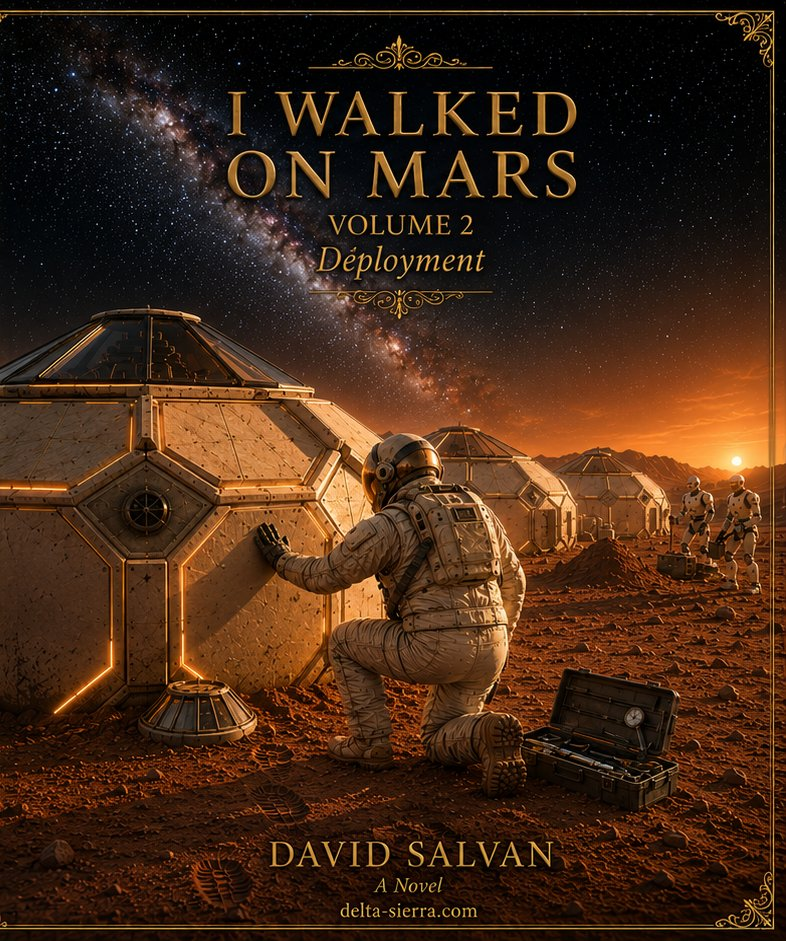
Book Two moves from training to a world where every dependency is real. Air, water, power, food, pressure, communications, mobility, maintenance and storage form a tightly coupled system. The first challenge is not to build everything at once but to establish the right order: secure life-critical functions, verify people and cargo, create safe working volumes, introduce redundancy, open workshops and then increase productive capacity without losing control of risk. This is the volume most directly connected to searches about how to build a Mars base, make oxygen, recycle water, grow food, manage spare parts or survive the first year of a settlement. It also draws a sharp distinction between surviving because Earth keeps sending consumables and becoming resilient because an outpost can diagnose, repair and increasingly manufacture what it needs locally.
Readers interested in selection, psychology and training can begin with Book One. Those asking about life support, water, power, agriculture, construction, industry and maintenance will find Book Two and ARCADIA the strongest entry points. Demography, children, economics, culture and relations between multiple settlements lead toward Book Three. Governance, space law and autonomy naturally lead toward Book Four. The site is deliberately structured so that a person can discover a book while researching a real Mars question without knowing the title in advance. The reverse path matters just as much: every book page points back toward technical Mars dossiers so the fictional model never replaces documented science and engineering. It gives those constraints a human situation in which they can interact.
Continue through Delta-Sierra
Open the detailed page for each book, then compare the fictional situations with Delta-Sierra’s documented Mars dossiers.