


Debt, public services, international aid, China, Côte d’Ivoire and political responsibility: finally asking how national priorities are set
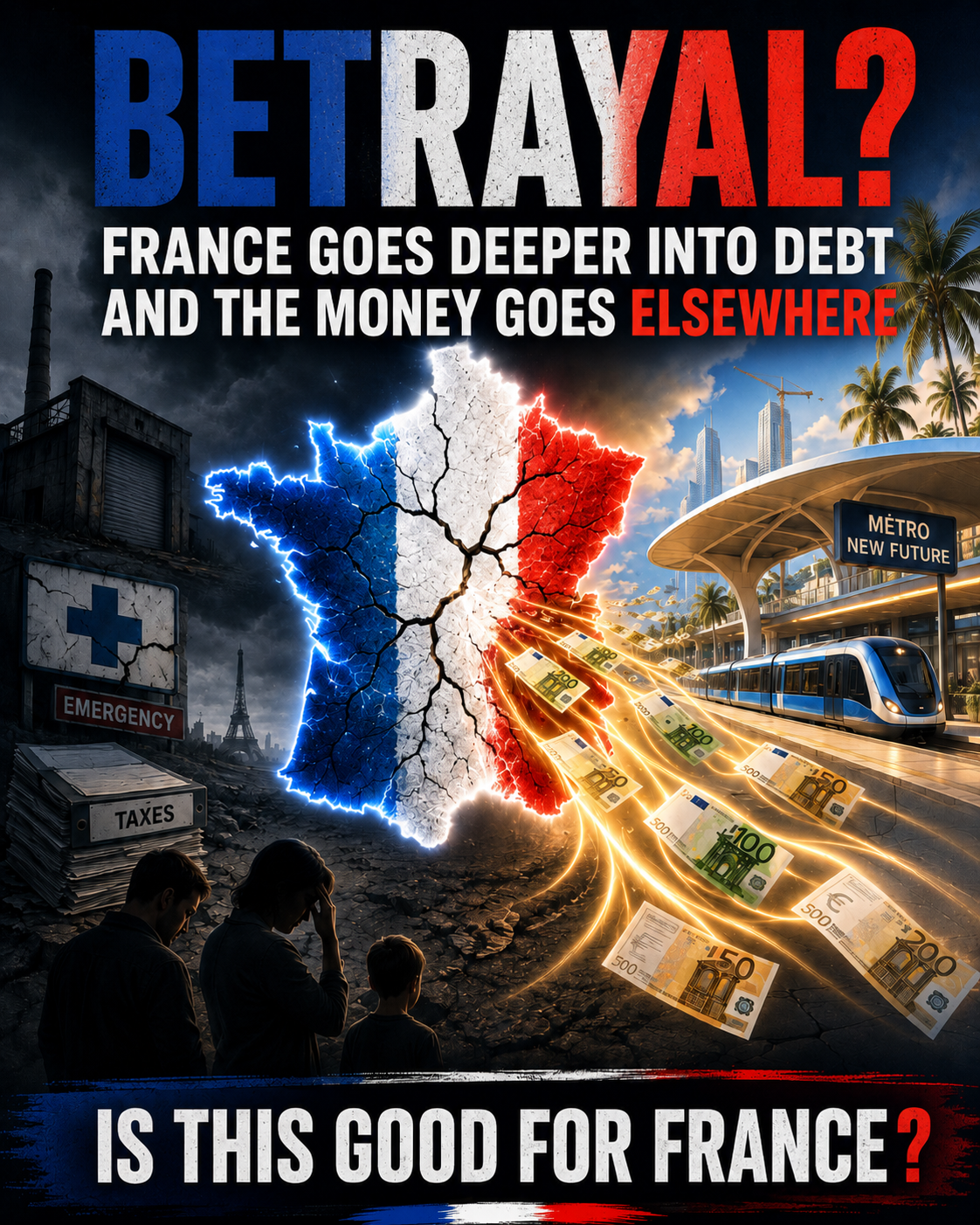
The visual accompanying this article deliberately asks a brutal question: “BETRAYAL?” The question mark is not decorative; it is indispensable. This article does not claim that a development-aid policy legally constitutes treason. It asks a much simpler political question: when a heavily indebted state tells its own population that it can no longer finance certain essential priorities, by what criteria does it nevertheless decide to mobilise resources, guarantees, loans or grants abroad?
That question deserves more than a slogan. It requires us to distinguish grants, loans, guarantees, debt conversions, multilateral financing and expenditure actually borne by the French budget. It also requires us not to portray every foreign project as a “gift”. Conversely, financial complexity must not be used to prevent any discussion of priorities.
France is in an objectively strained fiscal position. At the end of the first quarter of 2026, Maastricht public debt reached €3,536.1 billion, or 117.5% of GDP. In 2025, the public deficit stood at €152.5 billion, or 5.1% of GDP, while compulsory levies represented 43.6% of GDP. [Insee — dette] · [Insee — comptes 2025]
At the same time, the OECD estimates French official development assistance at USD 14.5 billion in 2025, or 0.42% of gross national income. This is an international grant-equivalent measure; it does not mean that USD 14.5 billion in cash was simply handed to foreign governments. In 2024, according to the OECD, 73.9% of France’s ODA portfolio was provided as grants and 26.1% as loans. That distinction matters. [OCDE]
But the fact that financing is a loan rather than a grant does not make the political question illegitimate. A public loan mobilises financing capacity, carries risk, commits a public institution and reflects a priority. A grant is expenditure. A guarantee mobilises the public signature. A debt conversion gives up or redirects a claim under an agreed mechanism. In every case, a choice is being made.
First rule: stop calling every instrument “aid” as if they were identical
The debate quickly becomes caricatural if every instrument is mixed together. A serious policy should distinguish at least five categories.
A grant transfers resources without repayment of principal. It is the form most directly comparable to budget expenditure.
A concessional loan is repayable but offered on terms more favourable than the market; its public cost lies in the advantage granted relative to commercial financing and in the risk borne.
A market-rate loan is different again. It may be profitable or financially neutral for the lender, while still mobilising public financing capacity and implementing a public strategy.
A guarantee is not necessarily an immediate cash outflow but a contingent commitment: if the risk materialises, the public authority can be called upon.
Debt conversion is not the same thing as a conventional new budget grant. Under the Debt Reduction and Development Contract (C2D) with Côte d’Ivoire, the country continues to repay its debt at each due date; once the repayment is recorded, France transfers the corresponding amount to a dedicated account used for jointly agreed projects. [C2D mechanism]
This distinction allows a much stronger debate: what does each policy truly cost France, what risk does it carry, what counterpart does France receive, and what national interest can be demonstrated?
Côte d’Ivoire: CFAF 23 billion, about €35 million — but through what mechanism?
A frequently cited example shows why the financial instrument must always accompany the headline number.
In 2018, under the second C2D with Côte d’Ivoire, a convention for the ECOTER project involved CFAF 23 billion, about €35 million, to support the economic and ecological development of rural territories. The Ivorian institutional source describes a project targeting eight pilot regions through territorial planning, productive investment and natural-resource management. [C2D]
The number is therefore real. But presenting it without stating that it falls within a Debt Reduction and Development Contract would be misleading.
The serious question is not: “Did France simply throw away €35 million?” There is no basis for saying that. The question is: when France agrees not to retain a financial resource or redirects it toward a foreign project, what tests of national interest, effectiveness, reciprocity and evaluation are applied?
That test should be applied project by project, not only through an aggregate annual number.
China: an example that forces us to correct easy slogans
China is often cited as proof that France is “giving money to the world’s second-largest economy”. Data from the French Development Agency require an important correction.
AFD says it has financed 48 projects in China since 2004, totalling €2.2 billion. But it also states that it now intervenes only through market-rate loans. Since 2011, those loans have received no French state interest subsidy. Small accompanying grants were used occasionally between 2015 and 2022 for a total of €1.7 million, implemented entirely by French actors. Most importantly, since 2022 France has declared no financial flow benefiting China as official development assistance. [AFD]
This case shows why a serious article cannot stop at a shocking image. Saying today that “France gives China €2.2 billion in aid” would be false. The €2.2 billion is a cumulative financing figure since 2004, largely made up of loans, while the current framework is market-rate lending. [AFD]
That does not end the debate. It remains legitimate to ask why a French public bank mobilises capacity in China, which French companies or know-how benefit, what risks are taken and what strategic counterparts exist. But criticism must address the mechanism that actually exists.
Meanwhile at home: the firefighters example
The political contrast becomes sensitive when international commitments are compared with equipment constraints in French public services.
As of 31 December 2025, France’s civil-security authority counted 258,641 firefighters. The French Senate documented the difficulty of deploying a new filtering protective hood intended to improve protection against fine particles. In 2024 the expected unit cost was €40 to €50, compared with about €15 for the previous model, at a time when fire and rescue services faced tight finances. [Sécurité civile] · [Sénat]
As a purely theoretical order of magnitude — not a procurement budget, because stocks, replacement cycles, sizes, allocations and operational needs vary — one €50 hood for 258,641 firefighters would represent: [Sécurité civile] · [Sénat]
258,641 × €50 = €12,932,050.
At €15:
258,641 × €15 = €3,879,615.
The theoretical difference would therefore be:
€12,932,050 − €3,879,615 = €9,052,435.
This multiplication must not be mistaken for a national tender estimate. Not every firefighter necessarily receives one hood at the same time, purchases are phased and procurement prices vary. But the scale illustrates a political reality: a few million euros can be a very concrete obstacle when equipping a domestic public service, while tens or hundreds of millions are committed through other policies.
This does not prove that international aid should be abolished to buy firefighter equipment. It proves that a government cannot credibly claim its choices are merely technical. A budget is a hierarchy of priorities.
International assistance can serve the national interest — if that interest is demonstrated
There are sound reasons for a state to finance actions beyond its borders. Stopping an epidemic at source can protect France. Stabilising a region can reduce security and migration risks. Infrastructure can open markets for French companies. Climate investment can reduce cross-border externalities. University cooperation can build scientific networks. Development diplomacy can reinforce alliances.
But such benefits must be demonstrated, not merely asserted.
For every major programme, taxpayers should be able to know: what is the gross amount? What share is a grant? What share is a loan? On what financial terms? What risk is borne? Who are the final beneficiaries? What share returns to French companies or operators? What measurable objectives exist? What results after three, five or ten years? What diplomatic, economic, environmental or security interest does France obtain? What suspension mechanism applies in the event of failure, corruption or regime change?
A country carrying more than €3.5 trillion of public debt cannot afford policies it is unable to explain.
Responsibility is primarily political
This is where responsibility can no longer be hidden behind administrations.
Civil servants implement policy, assess files and produce analyses. Agencies execute mandates. Diplomats defend the positions entrusted to them. Public financial institutions operate within frameworks set or voted by public authorities.
But major budget priorities are political.
Governments arbitrate. Parliamentary majorities vote appropriations. Political leaders decide whether a programme continues, expands, contracts, changes or ends. They must answer when French public services report shortages, debt rises, taxation is heavy and external commitments are nevertheless maintained.
It is therefore not enough to say: “that is AFD”, “that is Europe”, “that is an old commitment” or “that is a convention”. Long-running mechanisms survive because decisions are repeatedly made to maintain, renew, finance and supervise them.
When budget warnings accumulate, domestic needs are documented and the same policies are renewed without a clear explanation of their national benefit, responsibility can no longer be diluted inside the administrative machine. It becomes political responsibility.
That does not mean an elected official commits an offence by preferring an international programme. In a democracy, a choice can be lawful and still be disputable, poor, expensive or contrary to the interest one claims to defend. That is exactly why the debate must focus on arbitration.
“BETRAYAL?” — a word that must retain its full weight
The word used on the visual is deliberately severe. It should therefore not be trivialised.
Under French criminal law, treason is not a synonym for bad policy, incompetence, waste, or even a decision gravely contrary to the national interest.
Article 410-1 of the French Criminal Code defines the fundamental interests of the Nation, including independence, security, means of defence and diplomacy, protection of the population, and essential elements of the country’s scientific and economic potential. [Légifrance 410-1] · [Légifrance 411-1]
Article 411-1 states that the acts defined in Articles 411-2 to 411-11 constitute treason when committed by a French national or a member of the French armed forces, and espionage when committed by another person. [Légifrance 410-1] · [Légifrance 411-1]
In other words, criminal law reserves the term for specifically defined conduct. Nothing presented in this article establishes that a development-aid policy legally constitutes treason.
The question mark is therefore essential. It turns the word into a political and moral question: how far can a government continue to mobilise resources abroad while simultaneously telling its own population that money is lacking for public services, infrastructure, security or industry?
The legal answer and the political answer are not the same.
What a mature doctrine should look like
France should choose neither isolation nor automatic financing.
It should apply a simple doctrine: no major external commitment without an explicit national interest, full costing, measurable results, transparency about the instrument and a review clause.
A grant should be called a grant. A loan should state its rate, maturity and risk. A debt conversion should be described as such. A guarantee should disclose potential exposure. A multilateral contribution should explain what France gains in influence and results. A programme that fails should be capable of being stopped.
Such a doctrine would not be hostile to development. It would be hostile to opacity.
It would not be hostile to other countries. It would be favourable to accountability to French citizens.
It would not pretend that every euro used abroad is lost. It would simply require that every euro, guarantee and financing capacity be justified.
And one further question deserves to be asked outside France. In your own country, would you accept being told that the money needed to develop your companies, infrastructure and society is unavailable, while scarce public resources or state-backed financing are committed abroad without a clearly demonstrated national interest? That is the standard France should also be prepared to apply to itself.
IS THIS GOOD FOR FRANCE?
That is the question that should precede every decision.
Is it good for France’s security?
Is it good for its economy?
Is it good for its industry?
Is it good for its influence?
Is it good for its ability to protect its population?
Is it good over ten or twenty years, not merely for today’s announcement?
If the answer is yes, explain it, quantify it and accept responsibility for it.
IF NOT, WHY ARE WE FINANCING IT?