Measure 28 / 155

02 — Administration · Measure 2.08 · 28 / 155

Create a departmental one-stop shop without duplicating France services

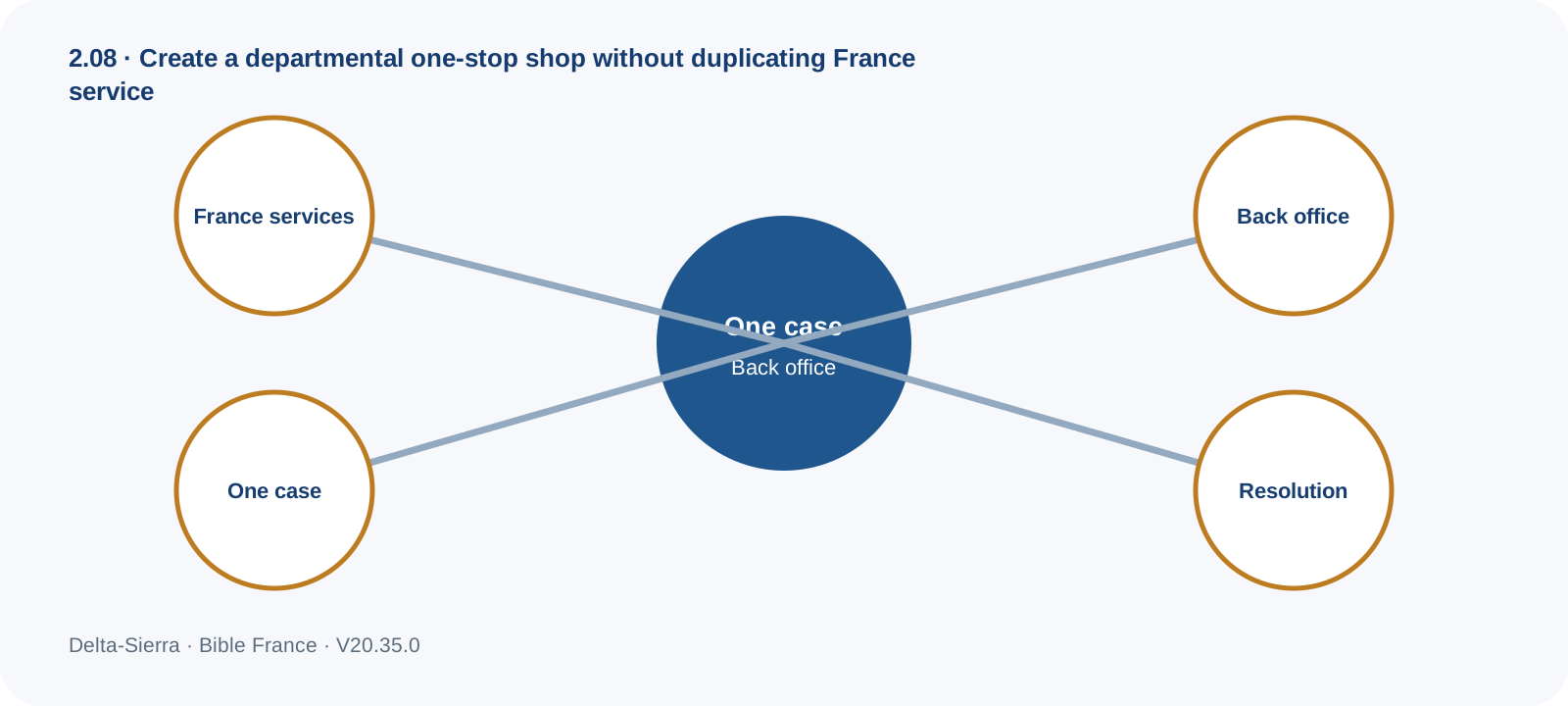
Turn the one-stop shop into a resolution system: one entry point, one tracked case and a back office able to coordinate several administrations.

Bible France · documentary chapterUpdated : 12 August 2026Primary sources prioritised
Measure 2.08 — Create a departmental one-stop shop without duplicating France services
Measure-specific visual explanation 2.08

In 30 seconds

Current positionTurn the one-stop shop into a resolution system: one entry point, one tracked case and a back office able to coordinate several administrations.
ProposalCreate a departmental one-stop shop without duplicating France services
Legal routeLegislation and organisational decree, operator agreements and data-exchange standards, explicitly integrated with France services.
Financial effectStructural effect: gains come from fewer referrals, incomplete cases and duplicated front-office networks.
ConfidenceHigh on legal framing and method; financial estimates require consolidation before booking.
Main riskA “one-stop shop” that merely redirects people adds another layer instead of removing one.

Use France services as the front door, not as a competitor

The existing France services network already brings together twelve national operators in more than 2,800 locations. A departmental one-stop shop should therefore become a resolution back office and common case tracker, not a new branded estate of offices.

Users should be able to enter through a local France services desk, phone or online channel and receive one case identifier. The departmental layer coordinates the responsible administrations until the case is resolved.

Measure resolution, not footfall

Useful metrics include first-contact resolution, number of hand-offs, missing-document rates, escalation time and abandonment. Repeated questions should feed back into process simplification rather than simply generating more scripts for advisers.

Data access must remain purpose-limited. A one-stop shop cannot become a universal window into every government database; legal basis, permissions and audit logs remain essential.

Costing and legal delivery

Legislation and organisational decree, operator agreements and data-exchange standards, explicitly integrated with France services.

Structural effect: gains come from fewer referrals, incomplete cases and duplicated front-office networks.

Transition expenditure is reported separately from recurring savings, and transferred activity remains public expenditure unless the policy itself is discontinued.

What must be proved before implementation

A “one-stop shop” that merely redirects people adds another layer instead of removing one.

The implementation file should define which cases remain at local France Services level and which are escalated to the departmental desk. It must assign accountable case ownership, shared digital records and measurable resolution deadlines instead of adding another referral layer.

Notes and sources

  1. ANCT — France services — primary/institutional source used for the measure framework.

  2. Service-Public.fr — accès France services — primary/institutional source used for the measure framework.
  3. DINUM — Démarches simplifiées — primary/institutional source used for the measure framework.
  4. ANCT — Baromètre du numérique 2026 — primary/institutional source used for the measure framework.


Further reading

The author’s books extend the programme but do not replace the primary sources cited in this chapter.

Réforme de l’État book cover

Réforme de l’État — Plan de Rupture

The architecture of the 155-measure programme.

IA : comment transformer la France book cover

IA : comment transformer la France

AI use cases, automation and human oversight in public services.

Make the departmental desk an escalation layer

France Services already provides a large physical network close to users. [1] [2] A departmental one-stop shop should therefore handle complex multi-agency cases that the local desk cannot resolve, rather than duplicate the same front-office function.

The local and departmental levels should share one digital case file so that documents and explanations are not repeatedly requested. Existing digital workflow tools show how that common record can be built. [3]

Performance should focus on first-contact resolution, number of hand-offs, time to decision and outcomes for people with limited digital skills. The Digital Barometer helps prevent the design from assuming universal online autonomy. [4]

Implementation evidence to publish

The departmental one-stop shop should be judged by its ability to resolve complex cases that existing local access points cannot close. It should never become an additional transfer stage in which users repeat their story without a decision-maker taking responsibility.

The post-reform comparison should focus on first-contact resolution, hand-offs, accountable ownership and outcomes for complex cases.

Failure modes to test before national rollout

The one-stop shop must be tested against unresolved back-office fragmentation, duplicated case files and responsibility gaps between partner services.