Measure 27 / 155

02 — Administration · Measure 2.07 · 27 / 155

Digitise administration end to end without turning public service into digital-only service

Move from online forms to genuinely integrated journeys: identity, once-only data, case handling, payments, notifications, accessibility and human support.

Bible France · documentary chapterUpdated : 12 August 2026Primary sources prioritised
Measure 2.07 — Digitise administration end to end without turning public service into digital-only service
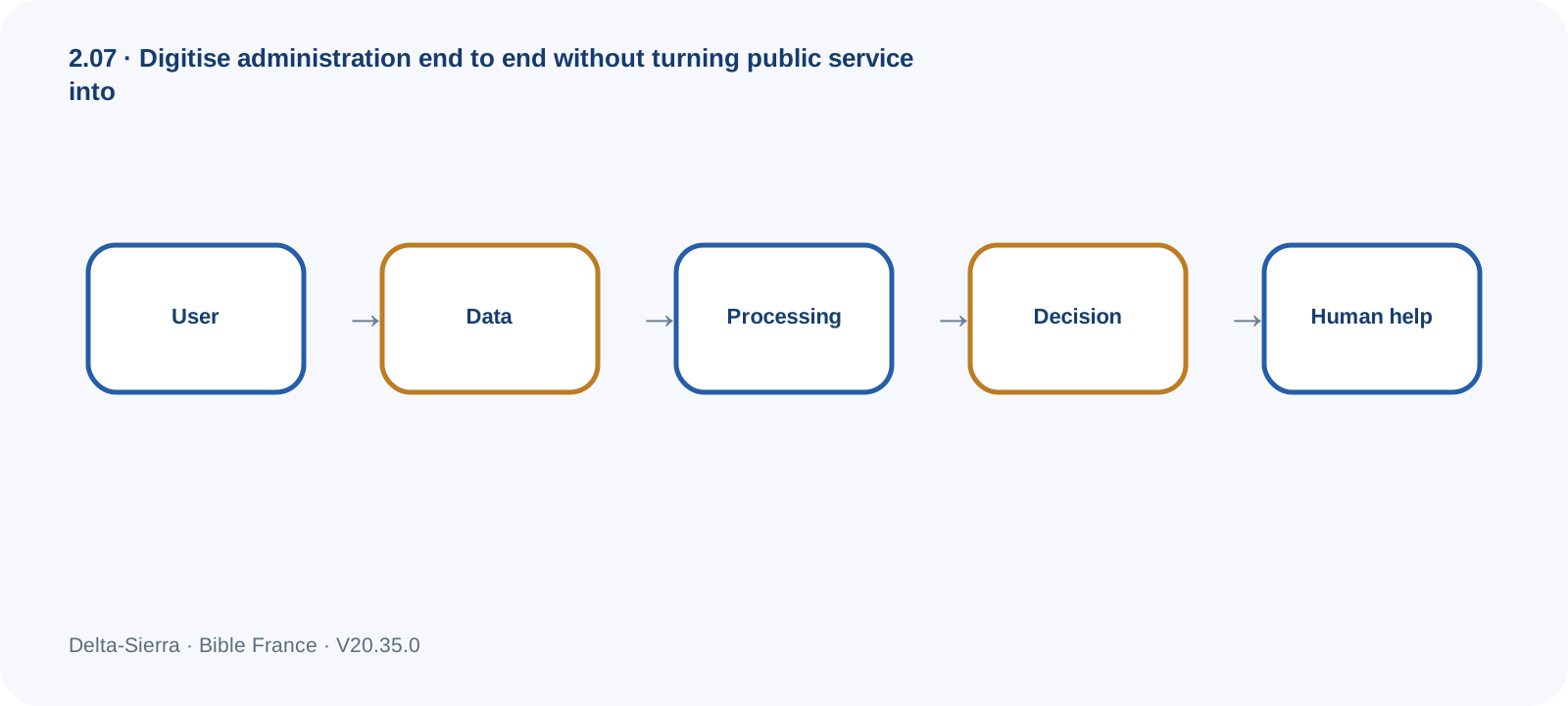
Measure-specific visual explanation 2.07

In 30 seconds

Current positionMove from online forms to genuinely integrated journeys: identity, once-only data, case handling, payments, notifications, accessibility and human support.
ProposalDigitise administration end to end without turning public service into digital-only service
Legal routeFive-year programme legislation, DINUM standards, multi-year IT budgets and accessibility/interoperability requirements.
Financial effectThe Plan’s €10–15bn annual target remains a target and must be rebuilt service by service from observed productivity gains.
ConfidenceHigh on legal framing and method; financial estimates require consolidation before booking.
Main riskDigitising a bad process can automate complexity; inclusion also requires a human channel.

France already has reusable digital building blocks

DINUM operates common services such as Démarches simplifiées and ProConnect. The reform should industrialise reliable shared components rather than make every ministry build its own identity, form, case-management and document services.

Digitisation must redesign the whole journey: authentication, once-only data, case processing, controls, payment, notification and appeal. Copying a paper form onto a screen merely digitises complexity.

Digital by default must not mean digital only

France services already provides more than 2,800 local access points, and the 2026 Digital Barometer continues to measure gaps in digital skills. The target architecture should therefore combine a strong online route with guaranteed human assistance.

The Plan’s €10–15 billion annual saving target should be rebuilt product by product from observed handling time, retired systems and avoided manual work, net of hosting, cybersecurity and support. Productivity redeployed to better service should not be presented as cash saving.

Costing and legal delivery

Five-year programme legislation, DINUM standards, multi-year IT budgets and accessibility/interoperability requirements.

The Plan’s €10–15bn annual target remains a target and must be rebuilt service by service from observed productivity gains.

Transition expenditure is reported separately from recurring savings, and transferred activity remains public expenditure unless the policy itself is discontinued.

What must be proved before implementation

Digitising a bad process can automate complexity; inclusion also requires a human channel.

The implementation file should catalogue high-volume user journeys rather than websites. For each procedure it must record data re-entry, interfaces, abandonment, processing time, assisted access and full unit cost before and after end-to-end digitisation.

Notes and sources

  1. DINUM — Démarches simplifiées — primary/institutional source used for the measure framework.
  2. DINUM — ProConnect — primary/institutional source used for the measure framework.
  3. ANCT — Baromètre du numérique 2026 — primary/institutional source used for the measure framework.
  4. ANCT — France services — primary/institutional source used for the measure framework.
  5. DINUM — missions et stratégie numérique de l’État — primary/institutional source used for the measure framework.


Further reading

The author’s books extend the programme but do not replace the primary sources cited in this chapter.

Réforme de l’État book cover

Réforme de l’État — Plan de Rupture

The architecture of the 155-measure programme.

IA : comment transformer la France book cover

IA : comment transformer la France

AI use cases, automation and human oversight in public services.

Define digitisation by the complete user journey

France already has reusable national components such as Démarches simplifiées and ProConnect. [1] [2] The target should be zero unnecessary re-entry: data lawfully held by government should not repeatedly be requested, and users should be able to follow the entire case from submission to decision.

A downloadable PDF is not end-to-end digitisation. Each high-volume service should publish completion time, abandonment, error and unit-cost metrics and align with the State digital strategy. [5]

Digital access cannot become a condition for exercising rights. The Digital Barometer and the France Services network show why assisted, telephone and in-person channels remain necessary. [3] [4] Full-cost savings must include those human channels.

Implementation evidence to publish

End-to-end digitisation should be measured from the user's first action to the final administrative decision. The programme should therefore publish outcome data for each high-volume procedure and identify where manual re-entry, paper evidence or incompatible systems remain.

The post-reform comparison should focus on end-to-end completion, abandonment, unit processing cost and equitable access through assisted channels.

Failure modes to test before national rollout

Full digitisation must be tested against exclusion, service outages, identity failures and administrative processes that are merely digitised unchanged.