Measure 33 / 155

02 — Administration · Measure 2.13 · 33 / 155

Train 400,000 public employees in AI through a real certified pathway

Move from awareness to a skills architecture: common core, job-specific use cases, sensitive data, human oversight, specialisation and measurable certification.

Bible France · documentary chapterUpdated : 12 August 2026Primary sources prioritised
Measure 2.13 — Train 400,000 public employees in AI through a real certified pathway
Measure-specific visual explanation 2.13

In 30 seconds

Current positionMove from awareness to a skills architecture: common core, job-specific use cases, sensitive data, human oversight, specialisation and measurable certification.
ProposalTrain 400,000 public employees in AI through a real certified pathway
Legal routeProgramme legislation and training budget, interministerial competency framework, university partnerships and certified learning paths.
Financial effectInvestment. Benefits count only after use cases, time saved and tool/inference costs are measured.
ConfidenceHigh on legal framing and method; financial estimates require consolidation before booking.
Main riskTraining 400,000 people without targeting can produce certificates without changing work; training must connect to real use cases.

The 2026 AI strategy provides a real foundation

DINUM, DITP and DGAFP published a common AI-use guide in June 2026, while the State is deploying shared AI infrastructure and negotiating a public-service framework. The Plan’s 400,000 figure remains its own training target and should not be presented as an official needs estimate.

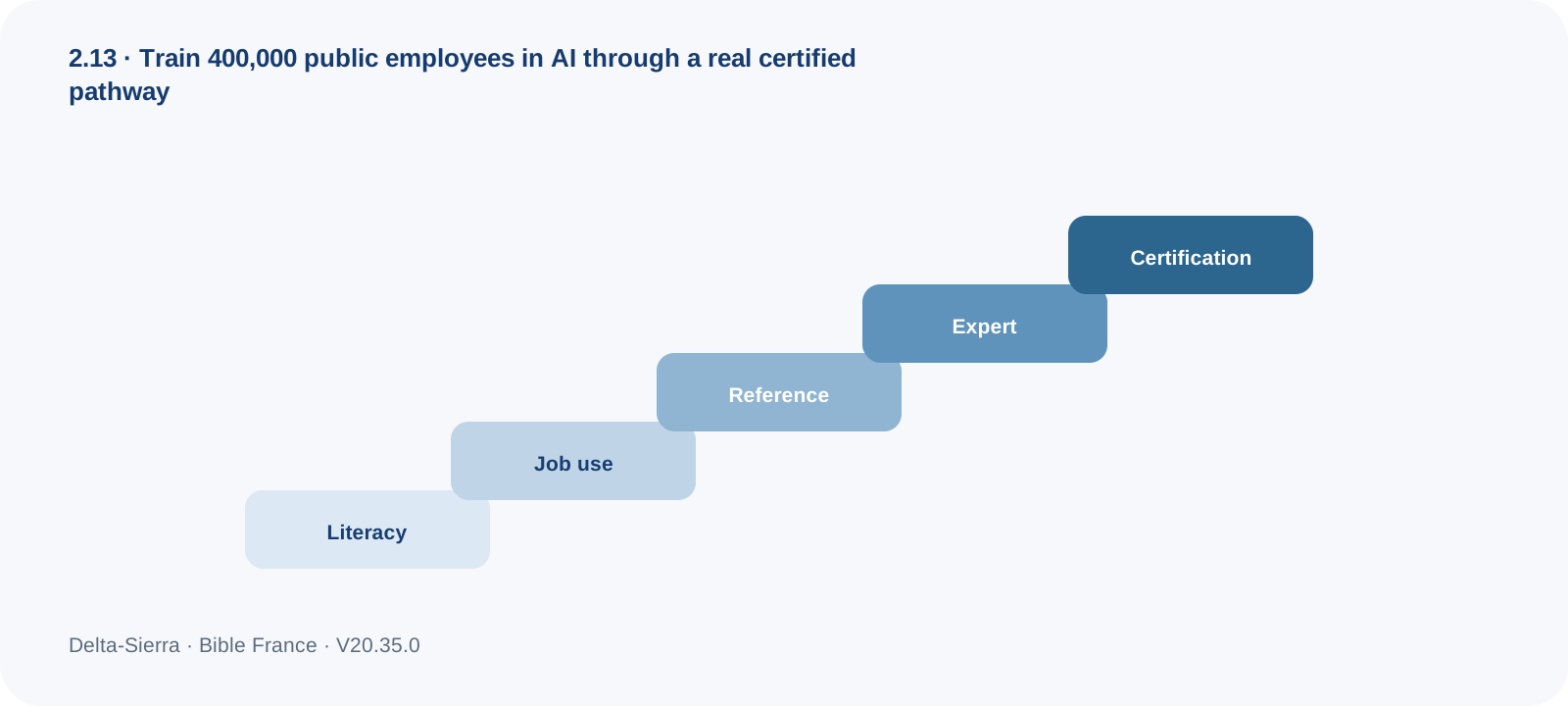
A four-level skills model is more useful than a single course: basic literacy, job-specific use, AI project/reference capability and specialist design/audit skills. Certification can be broad at the first levels while degree-level routes are reserved for deeper roles.

Training must connect to real use cases and measured outcomes

Mentor already offers AI learning content. Each job pathway should include practical exercises, sensitive-data rules, human oversight and evaluation of hallucinations and source verification. High-impact domains such as justice, health, HR and enforcement need reinforced safeguards.

The investment should report certified skills, observed productivity and cash savings separately. Time freed and reinvested in better service is valuable, but it must not be counted again as a headcount saving under other measures.

Costing and legal delivery

Programme legislation and training budget, interministerial competency framework, university partnerships and certified learning paths.

Investment. Benefits count only after use cases, time saved and tool/inference costs are measured.

Transition expenditure is reported separately from recurring savings, and transferred activity remains public expenditure unless the policy itself is discontinued.

What must be proved before implementation

Training 400,000 people without targeting can produce certificates without changing work; training must connect to real use cases.

The implementation file should link every training pathway to authorised AI tools, job capabilities, safeguards and a measurable use case. It must report capability after training, real adoption after six months and operational outcomes rather than attendance alone.

Notes and sources

  1. DINUM — Guide d’usage de l’IA pour les agents de l’État — primary/institutional source used for the measure framework.

  2. IA dans l’État — stratégie et socle interministériel — primary/institutional source used for the measure framework.

  3. DGAFP — négociation de l’accord-cadre IA, juin 2026 — primary/institutional source used for the measure framework.
  4. DGAFP — Accompagner et former les agents publics à l’IA — primary/institutional source used for the measure framework.
  5. Mentor — formations IA et données — primary/institutional source used for the measure framework.

Further reading

The author’s books extend the programme but do not replace the primary sources cited in this chapter.

Réforme de l’État book cover

Réforme de l’État — Plan de Rupture

The architecture of the 155-measure programme.

IA : comment transformer la France book cover

IA : comment transformer la France

AI use cases, automation and human oversight in public services.

Turn 400,000 courses into measurable operational capability

The 2026 context is concrete: the State has published common AI-use guidance and is developing an interministerial AI framework. [1] [2] The 400,000 target remains the Plan's target, however, not an officially established workforce requirement.

Training must combine use cases, data protection, security, verification and human accountability. The launch of national negotiations on an AI framework for the civil service shows that organisation of work and safeguards are policy issues, not just software training. [3]

DGAFP resources and the Mentor platform can support tiered certified pathways. [4] [5] Every cohort should be linked to a measurable work outcome—processing time, error rate, drafting quality or anomaly detection—so that the programme measures capability rather than attendance.

Implementation evidence to publish

Training hundreds of thousands of employees is meaningful only if the programme measures what they can safely do afterwards. Certification should therefore be linked to defined job capabilities, authorised tools and a small set of operational metrics rather than attendance alone.

The post-reform comparison should focus on safe real-world use, measured productivity or quality gains, incidents and the persistence of capability after training.

Failure modes to test before national rollout

The AI training programme must be tested against superficial completion metrics, unsafe tool use and training that fails to change real work practices.