


MARS BIBLE — REFERENCE GUIDE
Antennas and the Earth–Mars link budget: why every decibel matters
From transmitted watts to received bits: gain, aperture, beamwidth, free-space loss, noise, margin, pointing and data-rate tradeoffs over hundreds of millions of kilometres.

A signal crossing hundreds of millions of kilometres
A Mars antenna does not put a message into an invisible pipe. It radiates a wave whose energy spreads with distance. As the wavefront grows, the same transmitted power is distributed over an enormous area. That geometry explains why tens or hundreds of watts can be strong nearby and extraordinarily weak after an interplanetary path.
Free-space path loss is often written FSPL = 92.45 + 20 log₁₀(d) + 20 log₁₀(f), with d in kilometres and f in gigahertz. At 8.4 GHz, a simplified 0.5 AU case gives about 268.4 dB of path loss; 1.5 AU about 278.0 dB; 2.5 AU about 282.4 dB. From 0.5 to 2.5 AU the difference is almost 14 dB, equivalent to roughly a factor of 25 in power.
Decibels make this accounting manageable. Gains and losses that multiply in linear units become additions and subtractions. Physics is not simplified; bookkeeping is. Every line remains traceable: transmitter power, cable losses, antenna gain, pointing, path, atmosphere, receive antenna, noise temperature, coding and margin.
A Martian city will have many budgets at once: sensor to habitat, rover to relay, habitat to orbiter, orbiter to Earth, emergency direct-to-Earth, optical links and local surface networks. A single advertised “Mars–Earth data rate” is meaningless without path, geometry, availability and operating mode.
In ideal free space, received power falls mainly because energy spreads over an ever-larger area, not because empty space behaves like an absorbing fog. This is why path loss is expressed conveniently in decibels and grows with both distance and frequency. Between a favorable Earth–Mars geometry and a distance several times larger, the difference can exceed ten decibels. Ten decibels is not ten percent: on a power scale it is a factor of ten.
A link budget should therefore be read as accounting. Antenna gains, cable losses, pointing error, atmospheric attenuation and design reserves enter the same ledger. This common language makes it possible to compare architectures without being misled by transmitter power alone.
Link margin should be traced to an operational decision
A link budget becomes useful when each decibel is tied to hardware, geometry or an operating choice. Free-space loss rises with distance and frequency; antenna gain depends on aperture, efficiency and wavelength; pointing error consumes part of that gain. Receiver performance is not captured by received power alone, because data rate and coding determine the required energy per bit relative to noise. During a Mars campaign, range and solar geometry change continuously, so margin should be evaluated over mission phases rather than at one convenient distance. The operational result may be a lower data rate, a larger coding margin, longer contact time or a different antenna-pointing schedule. This makes communications degradation predictable instead of turning a weak link into an unexpected emergency.
Antenna temperature belongs in the receiving-side budget
Receiver sensitivity depends on noise as well as signal. Antenna noise temperature, receiver noise figure and bandwidth determine the noise floor against which carrier or coded data must be detected. A wider bandwidth can support more information but also admits more noise power. This is why link design connects RF hardware to waveform, coding and data rate rather than treating antenna gain as the whole communications problem.
Antenna gain: concentrating energy without creating power
A high-gain antenna creates no watts. It concentrates radiation in selected directions, much as a reflector concentrates light. The result is reach, but the beam becomes narrower and the antenna must know where to point. Performance therefore creates mechanical and navigation requirements: pointing, stability, calibration, structure and accurate attitude knowledge.
Diameter interacts with wavelength. For a given dish, higher frequency can provide greater gain and a narrower beam, while demanding better surface accuracy and pointing. Ka-band can offer capability advantages over X-band; optical communications extend the same idea into far narrower beams.
An emergency low-gain antenna deliberately gives up data rate for broad coverage. It can be invaluable after an attitude-control failure or during recovery. The best architecture is therefore not the one with the highest nominal rate. It combines a performance channel with a survival channel robust enough to regain control.
That diversity already appears in deep-space missions: high-gain dishes for science, broader antennas for selected phases and UHF proximity relays at Mars. Human infrastructure will need even more deliberate diversity so that one pointing mechanism can never become the single point of loss for all communications.
A high-gain antenna creates no additional energy. It concentrates radiation into selected directions and removes it from others. That explains both the large apertures of deep-space antennas and their demanding pointing: a narrower beam buys gain but makes angular error more expensive. A mobile rover may value broad coverage; an interplanetary terminal values directionality and therefore needs attitude knowledge and pointing mechanisms.
dBi compares directional gain with an ideal isotropic radiator. It is not an absolute power unit. A 40 dBi antenna does not consume forty times more power; the scale is logarithmic and directional. This distinction is essential to reading almost every deep-space communications specification correctly.
Why Deep Space Network antennas are enormous
The Deep Space Network operates complexes at Goldstone, Madrid and Canberra so Earth rotation does not permanently hide distant spacecraft. NASA lists 34-metre and 70-metre dishes. Their size is functional: a larger collecting aperture raises receive gain and helps detect extremely weak signals.
A large terrestrial antenna can be powered, cooled and maintained far more easily than an equivalent structure carried to Mars. Deep-space architecture exploits that asymmetry by investing heavily in the ground segment. The trade is dependence on terrestrial infrastructure shared by many missions.
NASA and le JPL note that DSN supports many missions and demand continues to rise. Human Mars operations would require more data and stronger availability guarantees than a rover. Future architectures therefore explore more relays, Ka-band, optical communications and new ground capabilities rather than assuming every Martian bit can monopolize a giant Earth dish.
The systems lesson is that a link budget never ends at the spacecraft radio. It includes ground networks, scheduling, outages, weather for optical links, competing users and fallback paths. The “ground segment” remains part of the Mars system even when it is millions of kilometres away.
The Deep Space Network's 34- and 70-metre antennas do more than 'talk far away'. Large aperture provides high gain and the sensitivity required to recover extremely weak signals. Size then creates new engineering problems: structural deformation, servo pointing, maintenance, weather effects, receiver performance and the scheduling of a limited number of facilities shared by many missions.
A permanent settlement cannot simply assume that existing DSN capacity will absorb unlimited future traffic. Human operations would create different volumes and availability requirements from a robotic probe. Partner networks, optical terminals, dedicated relays and greater local autonomy would all reduce pressure on the terrestrial segment. Network capacity must be budgeted like power or propellant.
X, Ka, UHF and optical: different tools for different jobs
At Mars, UHF is especially useful for surface-to-orbiter proximity links and Electra radios have built an inter-agency relay practice. X-band remains major deep-space heritage; Ka-band can offer higher capability with tighter requirements; optical systems add very high potential throughput with different pointing and availability constraints.
New technology should not automatically erase the old. Low-rate radio remains valuable for survival; Ka can increase science throughput; optical can move bulk data; local networks can use fiber and several radio families. Architecture is a portfolio of media.
DSOC demonstrated why laser communication is so attractive: NASA/JPL reports data rates at least ten times higher than comparable radio systems and set interplanetary distance records. Yet a settlement should not make one optical path its only life-critical channel. Capacity is valuable only when paired with resilience.
Frequency choice also has an industrial cost. Amplifiers, filters, waveguides, radomes, pointing mechanisms, optics, detectors and calibration equipment do not require the same workshops. Long-term maintainability can therefore influence band choices as much as pure performance.
UHF has a strong role in proximity relay between surface assets and orbiters, with compact hardware and extensive Mars heritage. X-band remains a mature deep-space workhorse. Ka-band can support more bandwidth but usually brings tighter pointing and stronger sensitivity to Earth's atmosphere. Optical links change the achievable-rate scale again, at the cost of precise pointing and weather-dependent ground sites.
A good architecture does not assign one band to the entire mission. Emergency command, vital telemetry, local voice, navigation, bulk science and backups can use different media. Matching the medium to the function avoids sizing every terminal for the hardest case and creates more credible degraded modes.
Working a link budget line by line
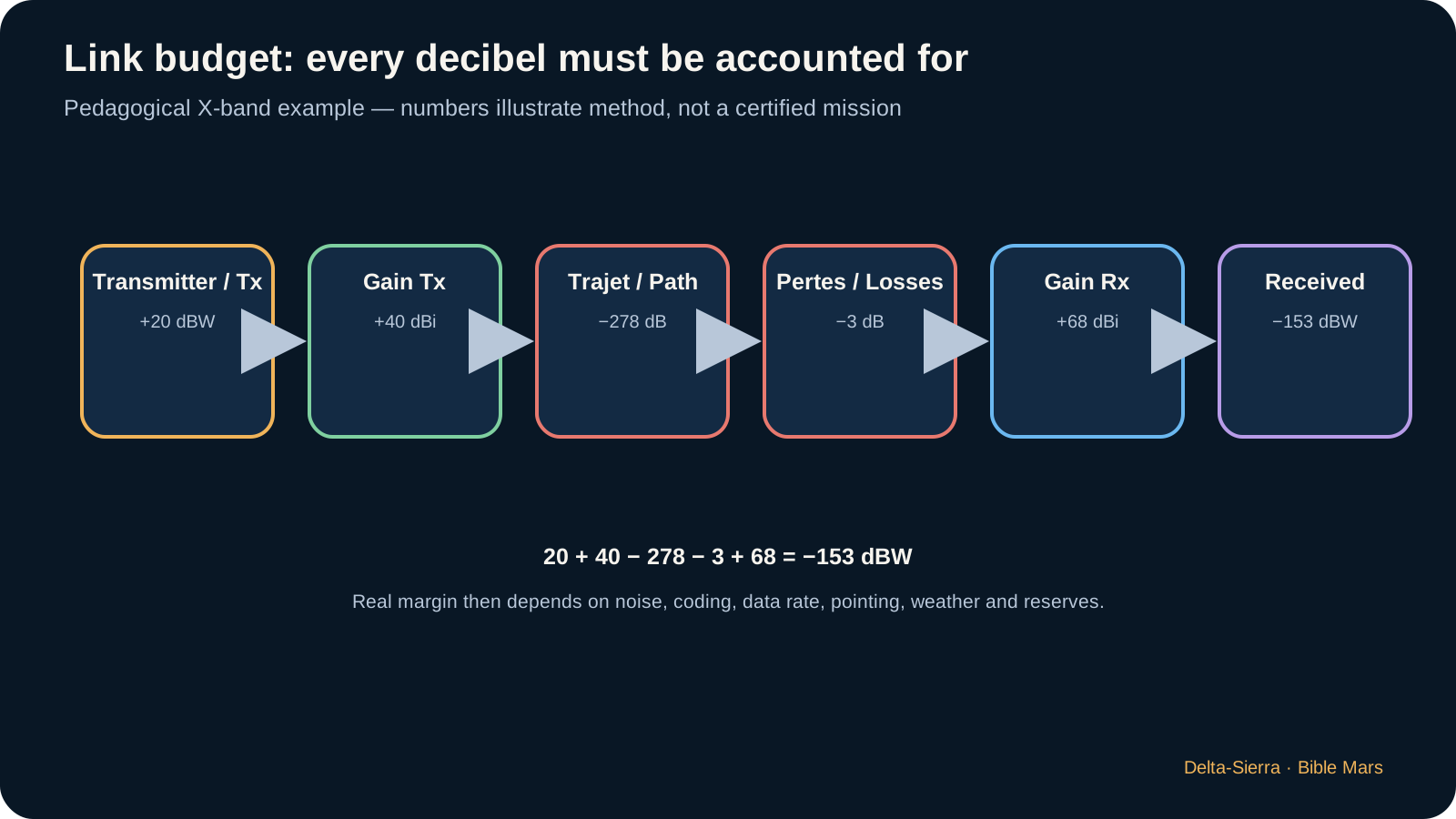
Consider a deliberately simplified pedagogical X-band example. Assume 20 dBW transmitted power, or 100 W; 40 dBi transmit antenna gain; 278 dB path loss representing a distant case around 1.5 AU at 8.4 GHz; 3 dB miscellaneous losses; and 68 dBi receive gain. Received power is 20 + 40 − 278 − 3 + 68 = −153 dBW, or −123 dBm.
That number alone does not tell us whether data are decodable. It must be compared with noise and data rate. A wider receiver bandwidth collects more thermal noise; at fixed power a higher bit rate gives less energy per bit. Serious budgets therefore use quantities such as C/N₀ and E_b/N₀, then account for coding and target error rate.
Channel coding buys reliability with mathematics and overhead. Adding controlled redundancy and sometimes accepting a lower useful rate can reconstruct bits from a degraded signal. Coding creates no energy; it uses available information more efficiently. The final margin must remain positive under the design case.
The discipline is to expose every assumption. If 40 dBi gain assumes perfect pointing but the mechanism can drift by 0.2°, pointing loss belongs in the budget. If an optical ground station has limited weather availability, that availability belongs in the architecture. A good budget is as much an uncertainty register as an addition of decibels.
In the pedagogical example, 20 dBW of transmitter power combined with 40 dBi of antenna gain gives 60 dBW EIRP. With 278 dB of path loss, 3 dB of additional losses and 68 dBi of receive gain, the received power is 20 + 40 − 278 − 3 + 68 = −153 dBW, or −123 dBm. That number still does not say whether the link closes: receiver noise, bandwidth, coding and data rate remain to be included.
The transition from C/N0 to Eb/N0 connects the analogue world of received signal with the digital world of useful bits. At fixed received power, increasing data rate reduces energy per bit. Better coding can lower the required threshold but typically trades rate, latency or complexity. A link budget is therefore a negotiation among energy, antenna aperture, transmission time and information volume.
An Earth–Mars example: free-space loss is enormous
Free-space path loss can be written:
FSPL = 20 log10(4πd/λ)
where d is distance and λ wavelength. Consider an illustrative distance of 225 million kilometres. At roughly 8.4 GHz, representative of deep-space X band, ideal free-space loss is about 278 dB. At 32 GHz, a Ka-band order of magnitude, it is about 289.6 dB. A decibel is logarithmic: another 10 dB of loss means one tenth the received power.
Those values seem to condemn higher frequencies, but a fixed physical aperture gains more at higher frequency because its diameter spans more wavelengths. For a 3 m dish with an illustrative 60% efficiency, ideal gain is about 46.2 dBi at 8.4 GHz and 57.8 dBi at 32 GHz. The roughly 11.6 dB increase almost offsets the FSPL difference in this idealized comparison. That is why X and Ka cannot be compared by path loss alone.
From received power to a decodable bit
Received power is only the first line. The receiver has noise temperature, the antenna sees sky noise and sometimes the Sun, amplifiers add imperfections, coding requires a certain signal quality, and mission design retains margin. This is where C/N₀ and then Eb/N₀ become more informative than a raw signal level.
At constant received power, increasing bit rate reduces energy available per bit. A mission can transmit slowly with strong robustness or trade margin for speed. “Maximum data rate” is therefore never independent of distance, antennas, weather, coding and tolerated error rate.
Peak rate, availability and degraded mode are three different performances
A link can advertise a spectacular nominal rate and still be poor for safety if it disappears after one failure. Conversely a slow radio may become the most valuable channel after loss of attitude because it works through a broad-beam antenna. Engineers must separate throughput, availability and recoverability.
A Mars installation can be designed around three states: high-rate nominal, reduced nominal and survival. High rate moves science, video and backups. Reduced mode carries telemetry, priority messages and selected medical data. Survival mode carries only basic health, simple commands, time and position. Each state needs its own link budget.
This prevents a common mistake: designing only for the best beam and discovering that no usable channel remains when an antenna actuator fails. Emergency antenna, minimum transmitter power, robust coding and recovery time belong in the architecture from the beginning.
At city scale degraded modes also apply to local networks. A fiber cut must not isolate the refuge. Loss of an orbital relay must not stop surface rescue coordination. Resilience begins long before the Earth–Mars link.
A system can advertise a record data rate under favorable geometry and still be poor daily infrastructure. Availability includes occultations, pointing error, weather at Earth stations, maintenance and shared-resource scheduling. Degraded mode asks a third question: what remains after losing an antenna, band or relay? A resilient design drops video and bulk science before alarms and life-critical commands.
These priorities can become service levels: nominal supports science, video and full backup; constrained supports telemetry, voice and essential data; survival mode preserves commands, alarms, text and minimum state. Defining those levels before a crisis allows coding, buffers and procedures to be designed around them.
A Martian city will have thousands of small link budgets
In a robotic base an engineer may draw a few principal links. In a city every door, sensor, vehicle, drone, hospital, workshop, habitat and relay becomes a wired or wireless user. The problem becomes critical-network engineering: coverage, interference, priorities, spectrum, maintenance and growth.
Martian terrain complicates line of sight. A ridge can hide a convoy, a canyon can require a relay, dust can affect some optical paths and new construction can create radio shadows. Coverage mapping therefore changes with the city. Mobile beacons and relays can accompany expanding operations.
The outside network must survive node loss. Mesh paths, onboard storage and recovery procedures limit the effect of one failure. Robots may temporarily serve as relays if power and mission planning account for that role.
Maturity is not a record-breaking Earth downlink. It is infrastructure in which the city keeps breathing, moving and repairing while several links are unavailable, then exploits high capacity when it returns.
The spectacular interplanetary path should not hide thousands of links spanning metres or kilometres: sensors, suits, rovers, construction robots, greenhouses, workshops, beacons and drones. Many will be limited more by dust, terrain, obstruction and available power than by Earth–Mars distance. Frequency and antenna choices should therefore be distributed according to local function and environment.
Fixed infrastructure also restores the value of wire and fiber. Buried fiber can provide high rate, low latency and predictable behavior between permanent buildings, while radio provides mobility and backup. Once again the strongest architecture is hybrid: multiple media, multiple paths and explicit priority for vital functions.
From transmitted watts to decoded bits: follow the entire chain
A link budget is an energy ledger written in decibels. It begins with transmitter power, adds transmit antenna gain, subtracts propagation loss, adds receive antenna gain, and subtracts pointing, polarization, atmospheric, cable and implementation losses. The resulting received power is still not a data rate: receiver noise, bandwidth, modulation and coding determine whether bits can be recovered at an acceptable error probability.
A compact first layer is P_r = P_t + G_t + G_r − L_fs − L_misc when values are expressed in decibel form. P_r is received power, P_t transmitted power, G_t and G_r antenna gains, L_fs free-space loss and L_misc other losses. Decibels turn a chain of ratios into additions and subtractions, exposing where margin is gained or spent.
Free-space path loss can be related to FSPL = 20 log10(4πd/λ). Distance d is punishing; shorter wavelength λ can increase antenna gain for a given aperture but usually tightens pointing demands. Earth-Mars range changes enormously during the synodic cycle, so a design that works near a favourable geometry may fail badly at a more distant one.
JPL's DSN Telecommunications Link Design Handbook extends this ledger into system noise, atmospheric loss, solar corona effects, X and Ka band, Doppler, ranging and Delta-DOR. The purpose here is not to reproduce a professional handbook but to make every decibel traceable to a physical choice in power, mass, aperture, temperature or availability.
Why C/N0 and Eb/N0 matter more than signal strength alone
A carrier can be detectable while still being too noisy for the desired data rate. C/N0 compares carrier power with noise spectral density. Eb/N0 compares received energy per information bit with noise spectral density. These quantities connect the analogue world of antennas to the digital world of coding, modulation and bit errors.
Error-correcting codes illustrate the trade. Adding redundant symbols consumes capacity, but lets a receiver reconstruct data that would otherwise be lost. When Mars is distant or a link is degraded, the system can lower information rate and increase robustness. A life-critical network often prefers a complete file delivered slowly to a fast transfer that cannot be trusted.
Link margin is the difference between available performance and required performance. It covers pointing errors, amplifier ageing, dust or contamination, temperature shifts and weather effects at Earth terminals. Too little margin creates fragility; excessive margin may indicate wasted mass or power. The right number is therefore tied to mission risk, not prestige.
A useful analogy is a conversation across an enormous valley: speaking louder helps, a directional megaphone helps, a larger listening dish helps, a quieter receiver helps, and speaking more slowly helps. Engineering chooses the most efficient combination for distance, availability and message criticality.
Surface, orbit and Earth: three different link-budget worlds
A habitat-to-rover link at one hundred kilometres is not the same problem as surface-to-orbiter, and neither resembles orbiter-to-Earth. Terrain blocks surface radio and creates short horizons. Orbital passes are brief but ranges are moderate. Earth links span huge distances but can use very directional spacecraft antennas and giant ground systems.
This naturally creates tiers. Small devices talk to local access points; more capable nodes aggregate traffic; relay orbiters provide visibility and interplanetary backhaul. A city gains little by placing an Earth-pointing deep-space terminal on every rover. Shared scarce infrastructure plus multiple backup paths is more efficient.
A practical architecture can define nominal, degraded and survival modes. Nominal service supports video, science and software. Degraded mode postpones bulk transfers and reserves capacity for command, health and critical telemetry. Survival mode preserves position, status and a small set of commands through a simple robust radio. Availability of that last mode may matter more than the peak data rate of the first.
As the city grows, each service will have its own budget and availability requirement. Those budgets must be living configuration documents, recalculated when antennas move, buildings appear, relays age or equipment changes. Communications engineering becomes continuous infrastructure management.
Surface-to-orbit: a different operational problem
At 437 MHz, an illustrative UHF proximity-link frequency, ideal FSPL over 100 km is about 125.3 dB, and over 400 km about 137.3 dB. That is dramatically less than the nearly 278 dB of an interplanetary X-band link at 225 million kilometres. Surface vehicles can therefore use modest antennas and move data quickly during a short orbital pass.
Short range does not make the system trivial. The orbiter moves rapidly, visibility changes, terrain can block the horizon, multiple users compete for service, and antennas must survive dust, cold and mobility. A local link budget is therefore a scheduling problem as well as a radio-frequency problem.
From the DSN Handbook to a real calculation: design margin, not a magic number
The Deep Space Network Telecommunications Link Design Handbook 810-005 is an antidote to oversimplified link budgets. It does not provide one universal “Mars data rate”; it documents station performance, bands, geometry, noise, losses and interfaces from which a designer must build a case. A link is not one number but a chain of transformations and uncertainties. The goal is not to obtain an impressive nominal result but to show that the receiver retains adequate signal quality when distance, pointing, terrestrial weather and real hardware depart from ideal values.
In decibels, a useful educational form is Pr = Pt + Gt + Gr − Lfs − Lmisc. Received power Pr depends on transmitted power Pt, transmit and receive gains Gt and Gr, free-space loss Lfs, and miscellaneous losses Lmisc. Logarithmic notation turns gains and losses into additions and subtractions, but it can hide the physical meaning of each term if the reader is not careful.
Distance enters free-space path loss directly
The relation FSPL = 20 log₁₀(4πd/λ) shows that geometric loss depends on distance d and wavelength λ. Doubling distance therefore does not merely halve useful data rate. With unchanged hardware, received energy density falls sharply and the system must compensate through gain, power, coding, lower throughput or combined ground assets. As Earth–Mars geometry moves from relatively close to far separation, service capability can change by orders of magnitude.
Frequency creates another trade. For a fixed antenna diameter, higher frequency can provide a narrower beam and higher gain, while demanding more accurate pointing and sometimes becoming more vulnerable to terrestrial atmospheric effects. “Ka is better than X” is therefore not a universal rule. X-band brings heritage and robustness; Ka can bring capacity; optical links can add another large step if clouds, optical ground stations and pointing are managed.
C/N₀ and then Eb/N₀: from received carrier to a bit that can actually be decoded
Received power alone is not enough. C/N₀ compares carrier power with noise spectral density. Eb/N₀ compares energy available per bit with the same noise density. The latter therefore depends on data rate: if received power stays constant while the system pushes more bits per second, each bit receives less energy. This explains a practical network behavior: as a link degrades, the system can lower throughput and select stronger coding rather than switching abruptly from “connected” to “dead.”
Link margin is the reserve between available performance and required performance. Positive margin is not free capacity; it is insurance against uncertainty. A Martian city will need to decide where small margins are acceptable for non-critical traffic and where commands, alarms and medical communications deserve larger reserves.
Three nested budgets for one piece of data
An image created by an industrial rover may cross three very different links: rover to access point or orbiter, orbiter to Earth, then terrestrial networks to the user. The first may cover hundreds or thousands of kilometers at modest power; the second spans tens or hundreds of millions of kilometers; the third resembles conventional terrestrial infrastructure. Optimizing all three with one formula and one antenna would be an architectural mistake.
The same logic applies inside a settlement. A greenhouse sensor does not need an interplanetary dish. It needs to reach a local controller, which exports only the trends, alarms or summaries that matter. Network hierarchy therefore becomes a hierarchy of computation and decision: process locally what can be processed locally, transport over long distance only what needs to travel.
Radio and optical links: the strongest architecture is probably hybrid
DSOC demonstrated that deep-space optical communications can deliver remarkable throughput: the experiment reached 267 Mbit/s from roughly 31 million kilometers and continued communicating from several hundred million kilometers. That result should not be turned into an operational promise. A technology demonstration using dedicated terminals is not the daily network of a Martian city.
An idealized calculation makes the scale tangible. One hundred gigabytes is about 800 gigabits. At 267 Mbit/s, or 0.267 Gbit/s, the theoretical minimum is 800 ÷ 0.267 ≈ 2,996 seconds, about 50 minutes. At 2 Mbit/s, the same volume requires more than 111 hours. These numbers do not describe the same distance, hardware or availability; they simply show why a step in throughput changes which applications become practical — rich medical imaging, science video, digital twins or large database replication.
Optical does not make radio obsolete. Terrestrial clouds can interrupt laser links, pointing is demanding and optical ground stations are not distributed like DSN radio antennas. A resilient architecture can therefore use optical links for bulk transport when available while retaining radio for telemetry, commanding and contingency. Redundancy is not always two identical boxes; it can be two physical media with different failure modes.
An optical link adds terrestrial weather to the budget
Laser communications concentrate energy into a narrow beam but demand extremely precise pointing. Clouds can close an optical Earth station while radio remains available. The network therefore needs geographically separated optical sites or a radio fallback. “Availability” becomes a weather probability as well as a hardware-reliability number.
A serious architecture does not search for one universal “best technology.” It combines robust local links, orbital relays, interplanetary radio and optical communications when conditions permit. Resilience comes partly from physical diversity: one failure mode should not remove every channel at once.
Link budgets are stories about where every decibel goes
A link budget becomes intuitive when it is treated as an accounting exercise. Transmitter power and antenna gains enter as positive terms; free-space loss, pointing error, atmospheric loss, hardware loss and implementation margin consume them. At interplanetary distance the free-space term is immense, which is why large ground antennas, accurate pointing, low-noise receivers and coding all matter simultaneously. No single “powerful antenna” solves the problem.
The X-band and Ka-band comparison is particularly instructive. At the same distance a higher frequency produces more free-space path loss when written in the usual form, but a dish of fixed physical diameter also produces greater antenna gain because its aperture is many wavelengths across. The system engineer therefore compares the complete link, including atmospheric sensitivity, pointing, hardware efficiency and available bandwidth, rather than deciding from the path-loss equation alone.
Availability is as important as peak throughput
An optical link can deliver spectacular rates when pointing and ground weather cooperate, yet a cloud over one receiving site can remove the path entirely. A high-performance Martian architecture is therefore likely to combine media rather than declare radio obsolete. Radio provides robust lower-rate service; optical terminals can move bulk data; several terrestrial stations reduce weather correlation; local caching allows both to fail temporarily without stopping the settlement.
This is why a link design should report more than a headline data rate. It should state geometry, modulation and coding assumptions, required Eb/N0, margin, antenna size, transmitter power and expected availability. For a hospital or emergency channel, a lower nominal rate with stronger availability may be more valuable than a record-setting peak.
Surface links have a different physics problem from Mars-to-Earth
A rover one hundred kilometres from a base is not a miniature deep-space link. Terrain can block line of sight; antennas sit near the ground; multipath and local obstructions matter; mobile pointing may be crude. Relay towers, elevated sites or orbital relays can therefore be more important than raw transmitter power. This creates an urban planning connection: landing sites, mines, habitats and roads influence the communications network because geography determines coverage.
A mature settlement will consequently need several link budgets at once: spacesuit to rover, rover to local relay, habitat to regional infrastructure, surface to orbiter, orbiter to Earth and perhaps optical high-capacity trunks. The useful engineering question is not “what is the range of the radio?” but “which chain of links still carries the required service after one component is lost?”
Worked intuition: why 6 dB can change the service completely
Decibels make gains and losses additive but are not intuitive. A 3 dB change is roughly a factor of two in power; 6 dB is roughly a factor of four. Losing 6 dB because distance increases or pointing worsens is therefore not “a little less signal.” It may require a lower data rate, stronger coding or reduced availability.
Earth-Mars distance varies dramatically. In the FSPL equation, if distance is multiplied by four, loss rises by about 20 log10(4), roughly 12 dB. A single margin quoted without geometry can therefore be misleading. Serious architectures define favorable, nominal and adverse cases.
The same trade applies locally. A larger dish provides gain but costs structure, pointing accuracy and maintenance. Every decibel has a physical price, even when the arithmetic is simple.
A mature city will manage many links as infrastructure assets. Link budgets will be configuration-controlled documents that evolve with hardware, orbit, coding, frequency and ground networks, including explicitly documented degraded modes.
A real link budget: connect every decibel to physics and an architectural decision
A link budget is not a formula filled in once. It is an account of gains and losses that changes with distance, frequency, antenna size, pointing, system temperature, Earth's atmosphere, the Sun and the desired data rate. A Martian city will contain radically different links: local sensors, rovers, surface-to-orbit relays, Mars-to-Earth radio and perhaps interplanetary optical channels.
Distance and frequency: why free-space loss grows so quickly
Free-space path loss can be written FSPL = 20 log10(4πd/λ), where d is distance and λ wavelength. In decibels, doubling distance adds roughly 6 dB of loss. An Earth-Mars link that is comfortable at favorable geometry can therefore lose many decibels as the planets separate. More transmitter power alone becomes expensive; antenna gain, coding and data rate must move together.
Frequency also enters through wavelength. Higher frequencies can provide more antenna gain for a comparable physical aperture but often demand tighter pointing and can be more sensitive to terrestrial atmospheric conditions. X-band, Ka-band and optical links are therefore complementary engineering choices rather than a simple ladder of 'better' technologies.
C/N0, Eb/N0 and data rate: received power is not yet reliable information
Received signal level alone does not determine whether a digital link works. C/N0 compares carrier power with noise spectral density; Eb/N0 compares energy per bit with noise. If data rate increases while received power remains fixed, each bit receives less energy. Error-correcting codes can recover part of the margin, but with overhead and complexity.
That relationship explains degraded modes. A link may remain available at a much lower rate: housekeeping, medical messages and essential commands still pass while high-definition video stops. Designing those service levels can be more important than advertising a peak throughput.
Radio and optical: redundancy matters more than a technology contest
DSOC demonstrated 267 Mbit/s from about 31 million kilometers and communication at much greater distances, showing the potential of optical links. Yet laser links demand precise pointing and terrestrial receiving sites can be affected by clouds and weather. Critical infrastructure will therefore likely benefit from optical high throughput plus robust radio rather than a single winner.
The same hierarchy applies around Mars. Proximity UHF-class links may remain practical for rovers and surface assets while orbiters use higher-performance links to Earth. A link budget becomes a tool for designing a layered network, not merely for proving that one radio works.
A link budget is a decibel ledger that decides whether bits can cross interplanetary space
An Earth–Mars radio link turns transmitted power into an acceptable bit-error probability after tens or hundreds of millions of kilometres. The budget tracks transmitter power, antenna gain, pointing loss, free-space loss, Earth atmosphere, receive gain, system noise, data rate, and coding. “A large antenna” is not a quantitative design until each term has a unit and assumption.
Free-space path loss can be written Lfs = 20 log₁₀(4πR/λ) in decibels, with range R and wavelength λ in consistent units. Because range sits inside a logarithm multiplied by 20, doubling range adds about 6.02 dB of loss. Mars communications margin can therefore change substantially across planetary geometry.
Calculation — the cost of doubling distance
ΔL = 20 log₁₀(2) ≈ 6.02 dB. Six decibels corresponds to approximately a factor of four in power. Compensation can come from more transmit power, more antenna gain, lower data rate, better coding, or lower availability. Real systems combine those levers.
A decibel is a logarithmic ratio, not a power unit. dBW references one watt; dBi references the gain of an ideal isotropic antenna. Adding dBW and dBi inside a link budget is valid because the calculation uses logarithmic ratios, but a “dBi” is not a watt.
From received carrier to C/N₀ and Eb/N₀: connect radio physics to bits
Received signal power alone does not define a data rate. It must be compared with noise. C/N₀, carrier-to-noise-density ratio, is expressed in dB-Hz. Eb/N₀ compares energy per bit with noise density. In a simplified decibel relation, Eb/N₀ = C/N₀ − 10 log₁₀(Rb). Increasing bit rate tenfold therefore costs 10 dB of Eb/N₀ at fixed C/N₀.
Error-correcting coding allows a target error rate at lower Eb/N₀ by adding redundancy and processing. Coding does not create energy; it uses received information more efficiently. Architecture should separate coding gain, implementation loss, and operational link margin.
Pointing becomes critical for high-gain antennas. Larger apertures narrow the beam. Gain improves, but attitude error or thermal distortion can move the target out of the useful lobe. GNC and thermal stability therefore become direct communications dependencies.
Mars surface systems use relays because a rover cannot carry the Deep Space Network
NASA currently describes the Mars Relay Network as four orbiters that relay data for Curiosity and Perseverance. Surface-to-orbiter links can reach about 2 Mbit/s in some cases, avoiding the need for a rover to carry the power and antenna size required for a high-rate direct Earth link.
Relay splits the problem into surface-to-orbit and orbit-to-Earth links. It adds storage and failure modes but improves local data rate and flexibility. An orbiter can collect data and forward it later when Earth geometry is favourable.
The network is evolving. On May 14, 2026, NASA issued a request for proposals for a Mars Telecommunications Network using high-performance telecom orbiters and seeking Mars availability no later than 2030. That is an active acquisition and architecture effort, not an already deployed network.
A settlement turns communications into survival infrastructure
Human operations add software loads, procedures, telemedicine, time transfer, navigation data, maintenance logs, and safety traffic. Traffic classes need priorities. A large video file should not block a short emergency message on a degraded link.
DTN — Delay/Disruption Tolerant Networking — treats interruption as normal. Data can be stored, forwarded in stages, and resumed later. That model fits Mars naturally because occultation, planetary rotation, relay outages, and long delays make continuous connectivity a weak assumption.
A settlement must also operate locally when Earth connectivity is gone. Internal communications, navigation beacons, emergency commands, and procedures still need service. Network resilience is therefore measured by services preserved after a relay or ground-station failure, not only by peak throughput.
Four network scenarios
Earth–Mars range increases significantly
Free-space loss rises and data rate may have to fall. Large science transfers can be scheduled for better geometry while difficult periods are reserved for priority traffic.
One relay orbiter is lost
Coverage and pass opportunities fall. Surface systems need more storage and may use low-rate direct links. The loss of MAVEN in 2026 is a real reminder that relay architectures need diversity.
The base high-gain antenna loses fine pointing
A lower-gain antenna can preserve a degraded command channel. “No broadband” should not automatically mean “no communications.” Safe-mode radio can trade data rate for wider beamwidth.
The physical link works but the queue is saturated
The failure is operational and software-defined. Scheduling must prioritise traffic, defer non-critical data, and reserve emergency capacity. High nominal bandwidth does not prevent poorly controlled congestion.
Current primary sources: NASA Science Mars Relay Network, updated in June 2026; NASA Mars Telecommunications Network RFP, May 14, 2026. The former describes the operational relay network; the latter describes a future industry-supported infrastructure.
Antenna gain trades beamwidth against pointing burden
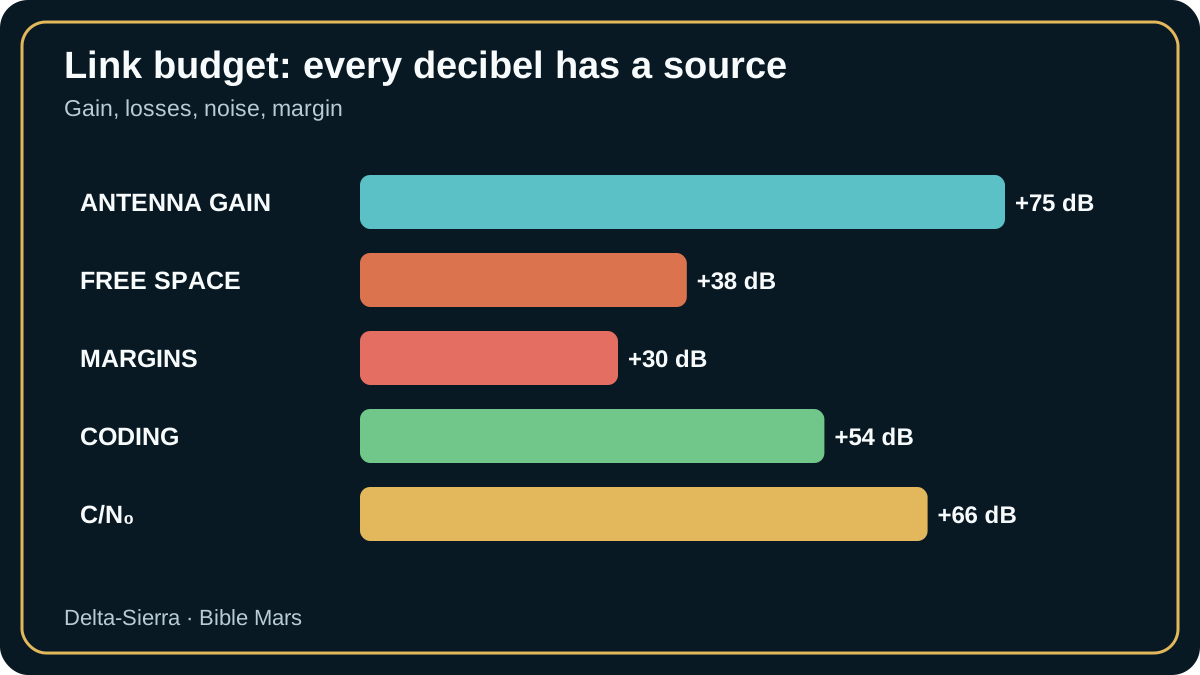
Higher gain generally comes with a narrower beam. That helps a deep-space link budget but makes attitude knowledge, structural alignment and pointing more demanding. A Mars system therefore benefits from layered radios: high gain for capacity, wider-beam alternatives for acquisition and degraded command.
Noise temperature belongs in the receive chain
Carrier-to-noise density C/N₀ depends not only on received carrier power but on receiver/system noise density. Link design therefore includes antenna noise, receiver noise figure, bandwidth and coding assumptions rather than treating “signal strength” as the entire problem.
Operational availability also matters. A relay pass can offer a high data rate but only for a limited geometry window. Daily information return is data rate multiplied by usable contact time and adjusted for protocol overhead, retransmission and scheduling.
Case study — distance consumes link margin
If Earth–Mars range doubles, free-space path loss rises by ΔL = 20 log10(2) ≈ 6.02 dB. Here ΔL is the change in loss expressed in decibels and log10 is the base-ten logarithm. An initial 8 dB margin therefore falls to about 1.98 dB before terrestrial weather, pointing error, ageing or loss of a large antenna is included.
Degraded operation should lower rate, strengthen coding and reserve the first contact minutes for commands and vital telemetry. Local storage covering several missed windows turns an outage into delay rather than loss.
Qualification replays maximum range, pointing error, reduced amplifier power and loss of one DSN complex; acceptance concerns delivery of priority messages, not merely detection of a carrier.
Availability belongs in the link budget even when the arithmetic closes
A positive instantaneous link margin does not guarantee a useful service. Earth station weather, antenna maintenance, occultation, pointing restrictions, relay geometry and competing users all remove contact time. A communications architecture therefore needs both a power margin and an availability model. Losing half the scheduled contact hours can be more damaging than losing a few decibels if the data queue is already near saturation.
For a settlement, the operational question is often backlog rather than signal detection. If instruments and public services generate 300 GB during a period when only 180 GB can be returned, the queue grows by 120 GB even though every individual pass “closes.” Storage, priority rules, compression and deletion policy become part of the same budget. That is why throughput should be integrated over time, not judged from peak bit rate alone.
A link budget is useful only if it remains meaningful as geometry and service change
A radio calculation performed for one distance and one data rate can be numerically correct yet operationally useless. Earth–Mars distance changes greatly, antenna elevation varies, the Sun can degrade or interrupt some links, ground stations have finite schedules, and a surface vehicle can be shadowed by terrain. A mission budget should therefore be evaluated as a family of cases: favourable geometry, long range, low elevation, emergency mode, relay mode, direct-to-Earth mode and degraded hardware. “Margin” has meaning only when the condition to which it belongs is named.
The decibel path should remain auditable term by term
A link budget can be read as accounting. Start with transmitted power, add transmit-antenna gain, subtract hardware and propagation losses, add receive gain, then compare the resulting carrier with noise and required data service. Every term should have an origin: frequency, distance, antenna diameter, efficiency, system noise temperature, pointing loss, atmosphere, polarization or cabling. A catch-all line such as “miscellaneous loss” may be convenient, but it prevents the reader from understanding which physical change would recover the missing performance.
G/T combines two properties of the receive system
The gain-to-system-noise-temperature ratio brings together antenna gain and receive-system noise. A large dish can produce high gain, yet a warm or noisy receive chain reduces sensitivity. Better low-noise electronics can improve performance without changing reflector diameter. This makes G/T especially useful when comparing unlike nodes such as a large Earth station, a Mars orbiter and a surface terminal. They trade antenna size, pointing, thermal design, mass and electrical power differently even when they are serving the same network.
C/N0 separates received radio quality from the chosen bit rate
Carrier-to-noise-density ratio expresses carrier quality against noise normalized to bandwidth. To reason about digital service, the bit rate is then introduced to obtain energy per bit relative to noise. This is why a link that can no longer support video may still carry essential telemetry: reducing bit rate increases the energy available per information bit, assuming the rest of the modulation and coding chain is appropriate. The concept should be explained before the symbols because it connects a radio number directly to what users can still send.
Coding gain is not free power
Error-correcting codes can allow useful communication at lower raw signal quality by adding structured redundancy and processing. The gain should not be described as if the transmitter suddenly became more powerful. Coding consumes bandwidth, processing and sometimes latency, and its performance depends on the selected code, block length and target error probability. A settlement network can exploit several coding and data-rate modes, but each mode needs a defined operating region and a tested transition strategy so that a weak link degrades gracefully rather than falling off a cliff.
Margin should be tied to physical uncertainty
Link margin is not a generic percentage of caution. It absorbs pointing error, transmitter variation, receiver noise, propagation loss, weather at Earth terminals, ageing, model uncertainty and other effects. Designers should identify which uncertainties are bounded, which are statistical and which can be measured in flight. Excessive unexplained margin can hide an inefficient architecture; inadequate margin creates a brittle service. The useful objective is a known risk distribution with explicit degraded modes.
A settlement network needs traffic classes
Not all bits have equal urgency. Safety commands, life-support telemetry, voice, medical data, navigation, science files, software updates and entertainment can compete for the same radio capacity. A mature network assigns priority and queueing rules. During degraded operation, bulk data can wait while control messages and health indicators keep a path. These policies have to survive relay loss and intermittent Earth connectivity; otherwise the network can be technically connected while operationally unable to carry the information that matters most.
Orbiting relays reduce surface burden but create dependency
A rover or habitat can often communicate much more easily with a nearby Mars orbiter than directly with an Earth station tens or hundreds of millions of kilometres away. Relays divide one hard link into more favourable segments and can also provide store-and-forward service. The settlement then depends on relay coverage, capacity and health. A survival architecture should avoid one orbiter becoming the only path for critical command. Diversity can include multiple relays, a low-rate direct-to-Earth fallback and local networks able to buffer information until a path returns.
Optical communication can raise capacity without eliminating radio
Deep-space optical demonstrations show the value of narrow optical beams for high data rates. Optical terminals also demand precise pointing, and Earth reception is affected by clouds and atmospheric conditions. A robust Mars architecture is therefore likely to treat optical and radio links as complementary rather than ideological alternatives. Optical paths can move large datasets when conditions permit; radio remains valuable for acquisition, telemetry, robust low-rate modes and situations in which an optical ground terminal is unavailable.
Local Mars communications must survive loss of Earth connectivity
A settlement cannot treat Earth as a continuously reachable server. Habitat, vehicles, power systems, robots, emergency teams and local navigation services must keep communicating even when the interplanetary link is unavailable. This requires local timing, routing, authentication, storage and offline procedures. Earth–Mars communication then connects two autonomous operational networks rather than functioning as the remote-control cable of a dependent outpost.
Network planning is also maintenance planning
Antennas, amplifiers, pointing drives, oscillators, timing sources, cables, optical terminals and relay spacecraft all age or fail. Link analysis should include the state after one high-gain antenna becomes unavailable, after transmit power is reduced, or after a relay loses an attitude actuator. The question is not merely whether nominal capacity meets demand but which services survive the first hardware loss and how long the network can operate before repair or replacement. Communication resilience therefore belongs in the same spare-parts and configuration-control system as life support and power.
Measure delivered service, not only RF performance
A network can have excellent carrier margin while users experience poor service because schedules, queues, routing or ground availability are badly managed. Operational metrics should therefore include delivered latency, contact availability, packet loss, backlog age and the fraction of critical messages completed within their required time. Those measures connect the physical link budget to settlement operations and reveal when a bottleneck has moved from radio physics into network management.
Primary engineering anchors: the JPL DSN Telecommunications Link Design Handbook provides the link-budget method; NASA documents the Deep Space Network, the Mars relay architecture and deep-space optical communications. Those resources establish proven techniques and interfaces, while a settlement-scale Mars network remains an architecture to be designed, qualified and maintained.
A 6 dB difference has a physical scale
In a power ratio, about 3 dB corresponds to a factor of two and 6 dB to a factor of four. That does not automatically mean four times the usable data rate because modulation, coding, noise and receiver thresholds intervene. The scale is still useful: two modest improvements such as better pointing and lower hardware loss can change a marginal link materially. Decibels let engineers add gains and losses without repeatedly multiplying very large or very small ratios.
Acquisition, nominal and emergency states need separate budgets
A high-gain antenna can provide excellent data performance once it is precisely pointed, yet be difficult to acquire after an attitude failure. Robust spacecraft often preserve a wider, lower-rate path for initial contact or contingency telemetry. A Mars network should therefore budget the condition in which nominal pointing or power is unavailable. If the emergency path can carry only a few measurements and commands, those items must be selected before the emergency rather than negotiated after contact has already degraded.
Ground-station availability is a mission resource
A link can be physically possible and still unavailable because no compatible ground antenna is scheduled or able to see the spacecraft. The Deep Space Network supports many missions and antenna time is planned. A high-traffic Mars campaign should therefore treat ground coverage, geographic diversity and relay capacity as finite resources. This encourages local autonomy and store-and-forward operations for information that does not require immediate transmission.
Conjunction should be treated as a network operating mode
When Mars lies close to the Sun as seen from Earth, radio propagation and geometry can make communications much less reliable. Operations should prepare a conjunction mode with reduced command activity, larger onboard command queues, conservative autonomy and enough local information to operate without frequent Earth updates. The network design then has a graceful state for predictable poor connectivity rather than discovering the problem as a surprise outage.
Security consumes bandwidth and operational attention too
Authentication, integrity checks, key management and safe software update procedures are part of a real communications service. They add headers, processing and procedures, although usually far less than the physical link losses themselves. More importantly, the settlement must be able to authenticate local commands during periods without Earth contact. Communications architecture therefore connects radio engineering with cybersecurity and governance.
Store-and-forward should be a normal operating mode
Many terrestrial networks assume an almost continuous path. A Mars network should treat path interruption as ordinary. Nodes store data with priority and expiration information, then forward it when a contact becomes available. Time-sensitive commands need validity windows so that an instruction delayed for hours is not executed simply because the network eventually delivered it. This makes delay-tolerant behavior part of operational safety rather than only a networking optimization.
Pointing accuracy is a physical resource
Higher-gain antennas usually produce narrower beams and therefore demand better pointing. Structural flexibility, attitude error or vibration can become a communications loss. Link budgets should include those pointing losses and connect radio design to GNC and mechanisms. A lower-gain contingency antenna may be preferable when attitude knowledge is degraded because it preserves acquisition even at much lower data rate.
Surface terminals need an environmental maintenance concept
Reflectors, connectors, radomes where used, pointing drives and exposed structures remain in the Martian dust and thermal environment. The design needs inspection, calibration, compatible cleaning and replaceable accessible parts. An antenna with excellent nominal gain but no maintainable mechanism is not durable infrastructure. Maintenance time and spare-part demand therefore belong beside RF performance in the architecture trade.
Relay orbits shape latency and coverage
Different Mars orbits provide different contact durations, geometry and revisit patterns. A low orbiter can provide a strong short-range link but moves rapidly across the sky; a higher or differently shaped orbit can extend visibility at the cost of distance and radiation or propulsion considerations. Network design should model coverage over time rather than quoting one range. Surface operations care about how long they may wait for the next path, not only the best-case received power.
Clock quality affects both radio and navigation services
Frequency references and time synchronization influence coherent communications, ranging, scheduling and local PNT. A network that also supports navigation must therefore track clock error and holdover performance during disconnection. Timing becomes another shared service that needs redundancy and calibration, linking communications hardware with settlement operations and GNC.
Capacity planning should include growth from outpost to town
A four-person mission can schedule science files around a few critical links. A community of one thousand residents creates routine operational traffic, education, medicine, software distribution, personal communications, mapping and industrial data. Growth planning should model both peak and average traffic and identify when new relays, ground terminals or optical capacity must be installed. Otherwise the first successful network architecture can become the bottleneck that prevents the settlement from scaling.
Emergency communications need independent power assumptions
A link budget normally assumes the radio has electrical power. Emergency design asks whether that assumption survives the event that created the message. At least some communications paths should have protected power, local energy storage or independent feeds so that a major microgrid fault does not simultaneously remove the ability to coordinate response. This is another example of common-cause analysis crossing subsystem boundaries.
Network configuration must be versioned
Frequencies, coding modes, routing tables, cryptographic material, pointing schedules and terminal capabilities will change over years. Every node should know which configuration is current and how to recover after receiving a partial update. A mismatched table can make healthy hardware appear disconnected. Configuration management should therefore provide signed versions, compatibility rules, staged rollout and rollback just as flight software does.
Contact plans should include uncertainty
Predicted passes and antenna schedules depend on orbit knowledge, station availability and hardware readiness. Network planning should include tolerance around acquisition and handover rather than assuming every contact begins exactly on time. That buffer is especially important when a surface node depends on a relay for a time-critical transfer.
Emergency traffic needs predefined minimal messages
When only a very low-rate path survives, the network should already know the compact message set needed to coordinate safety: identity, location, crew state, life-support state, power, requested action and acknowledgement. Designing those messages before an emergency avoids wasting scarce bits on verbose formats and gives operators a common grammar across vehicles.
Data compression changes the service trade
Compression can reduce required transmitted volume, but it costs computation and can remove detail. Lossless methods suit telemetry or scientific data where exact values matter; lossy methods may be appropriate for some images or video. The system should preserve original critical evidence where necessary and mark transformed products clearly. A lower data volume is useful only if the information needed for decisions remains intact.
Optical ground diversity matters
Clouds can block an optical ground terminal even when the spacecraft link itself is healthy. High-capacity optical service therefore benefits from geographically diverse receiving sites and a radio fallback. The network should measure delivered availability across the whole Earth segment rather than quoting only the terminal performance under clear sky.
Relay capacity needs scheduling policy
Several rovers, habitats and landers can request the same relay at once. The orbiter becomes a shared resource with finite storage, radio time and energy. Scheduling policy should reserve capacity for safety traffic, allocate routine windows and handle backlog after an outage. Without such rules, network congestion can mimic a physical link failure.
Diagnostics should distinguish RF loss from network loss
A failed packet can result from weak signal, interference, coding failure, routing, queue overflow, authentication or a software problem. Operations need observability at several layers so maintenance does not replace antennas when the bottleneck is a router. This layered diagnosis becomes increasingly important as the settlement network grows beyond a few point-to-point links.
Local links may use different technologies for different environments
Inside habitats, around surface infrastructure, across long rover traverses and between orbit and surface, one radio solution is unlikely to be optimal everywhere. The architecture can use different bands, antennas or optical links while keeping common routing and security principles. Diversity improves performance but increases maintenance and configuration burden, so each added technology needs a clear reason.
Network resilience should be tested by service loss, not component loss alone
Rather than asking only what happens when “relay A fails,” exercises should remove a service: no direct Earth link for 24 hours, half the relay capacity, failed timing source, power-limited surface station or unavailable ground complex. The response then reveals whether traffic priorities, local autonomy, buffering and alternate paths preserve operations.
Four link budgets should be shown together
Nominal direct-to-Earth: expected service with the primary antenna and reasonable geometry. Direct contingency: degraded antenna or power, with very low rate but essential command and health telemetry. Orbital relay: surface-to-orbit and orbit-to-Earth segments with their own windows and capacity. Local network: habitat, vehicles and robots able to function independently of Earth. This prevents one headline “Mars data rate” from hiding four physically different services.
Each budget should expose frequency, transmit power, antenna gains, losses, system noise, bit rate, coding and margin together with the distance assumption. A reader can then reproduce the accounting and understand which term changes when an antenna is replaced, bit rate is reduced or a relay is lost.
Link adaptation should be controlled, not improvised
When conditions worsen, the network may lower data rate, change coding or move to a different antenna. Those transitions need tested thresholds and hysteresis so the system does not oscillate between modes near a boundary. Operators should also see why a mode changed and which services were dropped. A graceful link is one that sheds capacity predictably before it loses command and telemetry entirely.
Backlog age is a safety metric
Stored data are not equally patient. A scientific image can wait days; a maintenance warning may become dangerous if it waits hours. Queue management should track age and deadline, not only bytes. This allows the network to discard or defer stale low-priority data while protecting information whose operational value decays quickly.
Relay failure should trigger a known routing plan
If one Mars orbiter disappears, surface terminals should know which remaining relay or direct path becomes preferred, what contact delay to expect and which data rates are still realistic. Routing plans can be precomputed for major failure combinations and then updated as the orbital constellation evolves. This reduces the need for emergency manual configuration across every surface node.
Ground weather affects optical service availability
For optical links, a healthy spacecraft and perfect pointing cannot overcome opaque cloud above the receiving terminal. Operational availability must therefore include terrestrial weather and site diversity. A network can route optical sessions among ground sites while retaining radio for lower-rate continuity, making the Earth segment part of end-to-end resilience.
Radio-frequency coordination matters as the settlement grows
More transmitters create the possibility of self-interference. Frequency planning, power control, antenna placement and scheduling should protect critical services from local industrial or vehicle emissions. Electromagnetic compatibility becomes a settlement infrastructure discipline rather than a one-time spacecraft test.
Maintenance telemetry can predict radio degradation
Slow increases in amplifier current, pointing error, noise temperature or packet retransmission can reveal degradation before a hard outage. Trend monitoring allows inspection and replacement to be scheduled while alternate links still exist. Communications data thus become evidence for preventive maintenance.
Service-level objectives should match mission consequence
A network can define required availability and latency by traffic class rather than claiming one universal reliability number. Life-safety alerts need a much stronger delivery objective than bulk science archives. The architecture can then allocate redundancy and reserved capacity where consequence justifies the cost.
The ultimate test is loss of convenience, not loss of safety
A resilient Mars network should degrade first in entertainment, bulk transfer or low-priority science, while preserving local control, health telemetry, emergency voice or text and authenticated commands. If the first relay failure removes basic coordination, nominal bandwidth figures have hidden an architectural weakness. Degraded-mode exercises should therefore measure which human and robotic operations can still be performed, not only how many bits per second remain.
Closure: publish assumptions and degraded services with the budget
A reader should be able to answer three questions: what service is achieved nominally, which term dominates margin and which service survives the first failure. That requires showing distance, frequency, power, gains, losses, noise, bit rate and coding, then repeating the calculation for at least one degraded case.
This transparency turns link accounting into a design tool. If margin is weak, engineers can see whether the best lever is antenna gain, transmitter power, data rate, coding, pointing, relay support or scheduling. The result is no longer a decorative decibel number but a traceable connection between physical architecture and delivered service.
For a settlement the ultimate criterion is continuity of essential functions. Failure should first remove convenience and bulk capacity before it threatens authenticated commands, emergency coordination, medical exchange or life-support telemetry. That hierarchy distinguishes a high-performance network from a resilient one.
Practical consequence: the network should prove one combined-failure case in which relay capacity and surface transmit power are both reduced. Critical traffic must continue while bulk data are buffered and operators receive a clear statement of the degraded service.
The network should also expose a simple health state: nominal capacity, current available capacity, dominant limiting factor, next expected contact and any critical backlog.
Sources and references
Specialized bibliography — communications, navigation and autonomy
- JPL — DSN Telecommunications Link Design Handbook 810-005 — Référence de conception pour pertes, bruit, fréquences, ranging et budgets de liaison.
- NASA — Deep Space Network — Architecture du réseau terrestre de communications et navigation en espace lointain.
- NASA/JPL — DSOC — Cas réel pour comparer radio et optique.
- CCSDS — Space Link Services — Standards de lien, modulation, codage et ranging.
Specialized sources — antennas, link budgets and optical communications
- JPL — DSN Telecommunications Link Design Handbook 810-005 — Deep Space Network link-design reference
- JPL — DSOC — demonstrated deep-space optical performance
- NASA Science — Mars Relay Network — surface-orbit relay architecture