


MARS BIBLE — REFERENCE GUIDE
Guidance, navigation and control: the nervous system of a Mars vehicle
From the first sensor measurement to an engine command, understand the architecture that lets a vehicle know, decide, act, and verify without waiting for Earth.

Guidance, navigation and control are three jobs that must not be confused
The acronym GNC groups three functions because they cooperate, but merging them conceptually hides responsibility. Navigation estimates vehicle state: position, velocity, attitude, biases and uncertainty. Guidance decides where to go and turns mission intent into an admissible trajectory. Control compares that trajectory with estimated reality and commands actuators.
This separation helps diagnose failures. If the vehicle believes it is somewhere else, look at state estimation and sensors. If state is correct but the objective becomes a bad trajectory, guidance is suspect. If the command is correct but motion does not follow it, investigate control and actuators.
A good GNC system is therefore not one monolithic “autopilot.” It is a chain of models, measurements, decisions and actions with verifiable interfaces. Modularity also helps degraded operation: a navigation source can change without rewriting all guidance logic.
On Mars GNC extends beyond spacecraft. Fast rovers, cranes, aircraft, conveyors, robot arms and construction machines all contain loops in which bad estimation can become a physical accident.
Navigation asks 'where am I and how am I moving?'. Guidance asks 'where should I go and what path respects the constraints?'. Control asks 'what command should I apply now to follow that path?'. Mixing these functions makes failures hard to diagnose. A vehicle can know its state perfectly and still receive an impossible goal, or have excellent guidance while an actuator can no longer deliver the required command.
The separation also clarifies software responsibilities. State estimation can publish position and covariance; guidance can produce a reference trajectory; control can check saturation and physical limits before commanding actuators. Clear interfaces allow each layer to be tested and degraded independently.
Estimation error and control authority should be budgeted together
Guidance can only command a trajectory that control can physically achieve, and control can only act on the state that navigation estimates. A position error is therefore not just a navigation metric: it can become additional propellant, time or landing dispersion. Similarly, an actuator saturation can make an otherwise accurate state estimate operationally useless. GNC review should connect covariance, update rate, sensor outages and actuator authority to mission events. When a critical sensor is lost, the question is not whether another sensor exists but whether the remaining set keeps the necessary state observable with enough accuracy for the available control authority. This coupling is especially important during short irreversible phases such as entry, landing and docking.
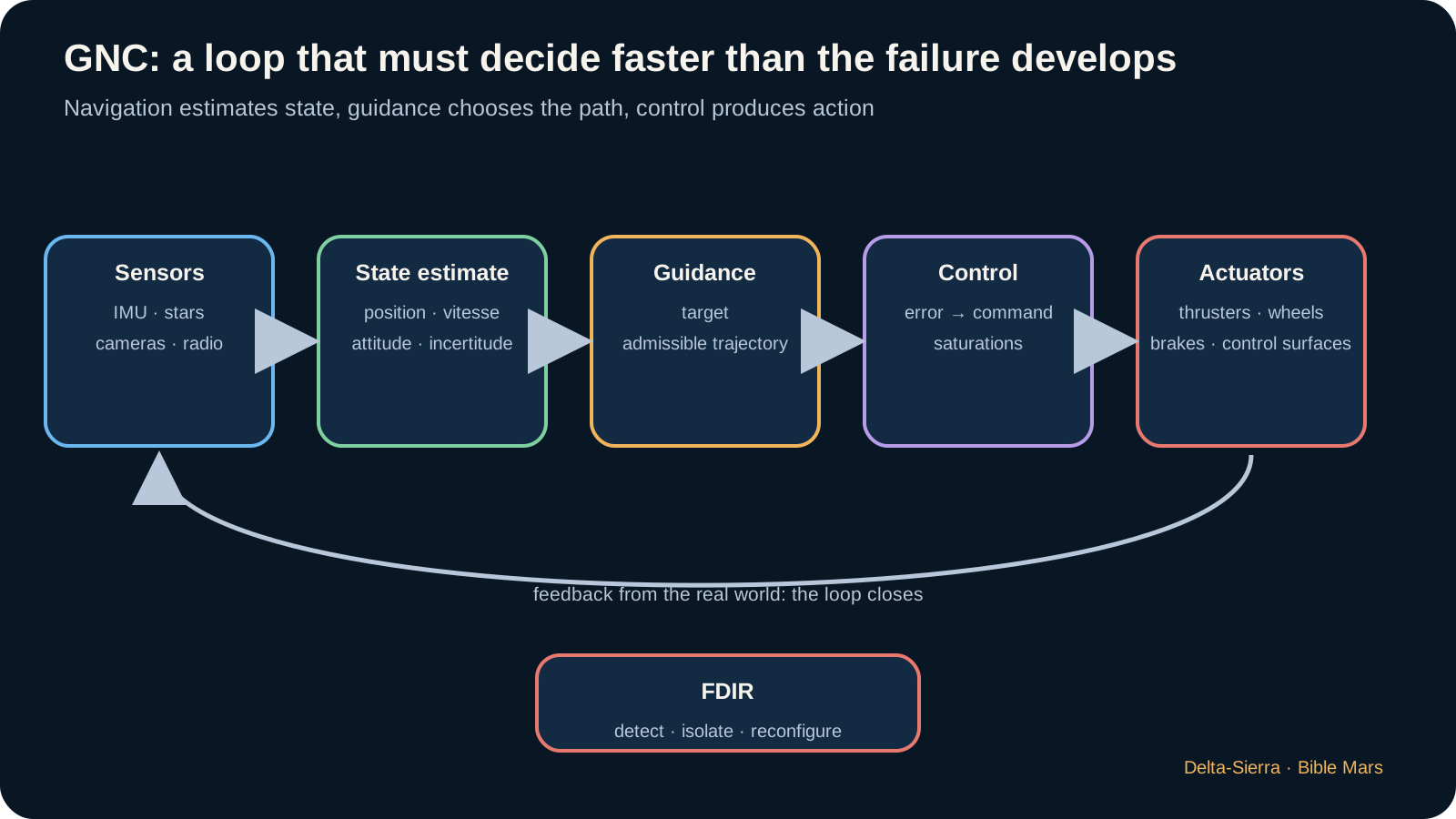
Vehicle state: a calculated truth built from imperfect measurements
An onboard computer never directly knows position or orientation. It receives accelerations, rotations, stars, images, altitude, radio velocity, pressures and mechanism positions. Measurements contain noise, bias and sometimes faults. State estimation fuses them with a dynamic model.
Uncertainty must travel with the state. A displayed position of 100.0 m is misleading if the real uncertainty is ±200 m. Kalman filters and related methods propagate uncertainty and correct predictions as new observations arrive.
Cross-sensor consistency is a defense. When sources disagree, majority voting is not automatically correct. The system considers expected dynamics, history, measurement quality and known fault modes. A precise but wrong value can be more dangerous than an honestly uncertain one.
This motivates FDIR — Fault Detection, Isolation and Recovery. Detecting an anomaly is only the first step; the system attempts to identify the faulty source, isolate its influence and rebuild an acceptable function with remaining resources.
State is not a single sensor reading. Position, velocity, attitude, angular rates, mass and sometimes environmental parameters are estimated from measurements containing noise, bias and delay. Navigation creates an operational truth from imperfect evidence. Covariance describes how uncertain that truth is and how errors are related.
Values also need trustworthy timestamps. A position that is two seconds old is not the current position of a fast vehicle. PNT, networking and GNC therefore meet at a common interface: measurement, measurement time and measurement quality must travel together. Data without uncertainty metadata can be more dangerous than missing data.
An estimator may also include parameters that are not directly observed: friction coefficient, effective wind, remaining mass or sensor bias. These augmented states allow the model to adapt to reality, but too many parameters can make the system poorly observable, meaning several causes can produce nearly the same measurements. Engineering therefore includes deciding what should be estimated and what should instead be bounded by design.
Observability reminds us that a sensor is useful only in relation to a question. An altimeter measures distance to the ground but not horizontal position by itself; a star tracker measures attitude, not velocity. Robustness comes from complementary information rather than sensor count alone.
Guidance: turning intent into a physically possible path
“Go to that point” is not directly a motor command. Guidance creates a path compatible with energy, speed, terrain, loads, reserves and forbidden zones. A lander must respect corridor, propellant and thrust capability; a rover must respect slopes, traction, obstacles and energy.
Guidance therefore works with constraints. A mathematically optimal path can be rejected because it leaves too little sensor margin or crosses an area with no rescue communications. “Optimal” has meaning only after the objective and constraints are declared.
In degraded conditions the objective changes. Guidance may abandon the destination and prefer a safe zone, beacon, stop or return. This reconfiguration should be designed before failure rather than improvised by nominal software.
At city scale guidance layers may eventually include traffic rules, emergency priority, dust zones and corridors reserved for heavy machinery. GNC then becomes part of urban infrastructure.
A human objective may sound simple — land near the base, reach a rover, keep an antenna pointed to Earth. Guidance has to turn it into a path compatible with propellant, speed, slope, obstacles, heating, acceleration and exclusion zones. It solves a constraint problem rather than drawing a straight line between two points.
When the environment changes, guidance may replan. But replanning is not always allowed: late changes during some phases can create more risk than they remove. Serious architectures define decision windows, abort criteria and fallback goals so autonomy knows when to change the mission and when to preserve a robust plan.
Control: closing the loop before physics has already won
Control receives a command and estimated state, computes error and demands action. Loop frequency depends on the phenomenon. Thermal processes can be slow; attitude, propulsion and aircraft may need rapid updates. Sensor, computation and actuator delay are part of stability.
A 10 Hz loop has a 0.1 s period. Even the smallest Earth–Mars delay spans thousands of such periods, so the control loop cannot run through Earth. Terrestrial operators define goals and limits while feedback remains local.
Actuators saturate. An engine has finite thrust, a reaction wheel stores finite momentum and a brake has a thermal limit. A controller ignoring saturation can command the impossible and accumulate dangerous error.
Validation therefore includes nonlinearity, delay, saturation, noise and off-nominal cases. Convergence in an ideal simulation is only the beginning of evidence.
The controller compares a reference with estimated state and produces an actuator command. Required frequency depends on dynamics: stabilizing a vehicle in flight demands far faster decisions than regulating a tank temperature. A loop that is too slow lets error grow; one that is too aggressive can excite structure, saturate actuators or become unstable.
Physical limits have to be explicit. A reaction wheel saturates, an engine may not throttle to zero, a valve takes time to move and a rover cannot change direction instantaneously on slippery ground. A controller that ignores these constraints can be mathematically elegant and operationally wrong.
Space and industrial control often use hierarchies. A fast inner loop stabilizes attitude or motor current, a slower loop follows velocity or trajectory, and an even slower supervisor changes goals. This respects the different time scales of the physics and mirrors the Earth–Mars latency problem: the fastest loops must close locally.
Actuator saturation deserves explicit treatment. Once an actuator reaches its limit, the controller no longer has the authority assumed by its equations. If software continues integrating error as though the command were achievable, it can build an excessive correction. Anti-windup logic, command limits and explicit control-authority margins are therefore practical safety features, not mathematical decoration.
FDIR and safe mode: surviving misleading data, not only clean failures
Easy failures are those that clearly announce disappearance. Hard failures continue to produce plausible values. A stuck altimeter, a camera matching the wrong terrain or a partially degraded actuator can mislead logic through critical seconds.
FDIR structures response: detect inconsistent behavior, isolate the suspicious equipment or measurement, reconfigure to a backup path, then verify that the recovered function is sufficient. The right decision may also be to slow down or abandon a maneuver.
Safe mode does not always mean “switch everything off.” In space, stopping heaters can kill electronics; during landing, stopping engines is impossible. Safe state depends on mission phase and time available. A rover can freeze; a lander must continue acting.
The same philosophy applies to Martian industrial systems. Conveyors, power systems and maintenance robots need local states that limit damage without waiting for Earth diagnosis.
A clean dead sensor can be easier than a sensor that continues transmitting plausible but false values. FDIR compares sensors, models and physical limits to detect inconsistency, isolate the suspected source and choose a fallback configuration. Redundancy only helps if redundant paths do not share the same common cause.
Safe mode must be designed before the failure. It does not necessarily mean stopping everything. A spacecraft can preserve thermal control, power and communications while reducing ambition; a habitat can isolate a loop and preserve minimum life support. Safety is the ability to reduce mission goals while protecting essentials.
The hardest failure is plausible but false data
A sensor that goes silent is easy to detect. A sensor that returns plausible but biased values is more dangerous. Imagine an inertial axis drifting slowly or a position measurement using the wrong time reference. The system can continue generating a clean-looking trajectory while reality diverges.
FDIR therefore compares independent sources and monitors residuals — the difference between model predictions and observations. Persistent anomalies can cause a sensor to be isolated, uncertainty to be increased or the system to enter safe mode. The correct response is not always to continue with the best available estimate; sometimes the safest decision is to stop.
Safe mode is not a button; it is a survival philosophy
A safe mode should reduce the number of things that can get worse. For an orbiter: stabilize attitude, protect power and thermal conditions, preserve communications. For a rover: stop on acceptable terrain, conserve energy, protect batteries and wait for a better navigation solution. For urban infrastructure: isolate a valve, disable autonomous commands and preserve life-support functions.
Safe modes must themselves be tested as real systems. Backup logic that is rarely used can contain latent defects. Hardware-in-the-loop testing is therefore essential because it confronts software with real timing, hardware limits and imperfect sensor behaviour.
Testing GNC: from mathematics to hardware that heats, vibrates and ages
Progressive validation prevents late discovery that a correct algorithm depends on an unrealistic sensor. Engineers move from analytical models to software-in-the-loop, hardware-in-the-loop, component tests, integration, environmental campaigns and injected anomalies. Each level hunts a different family of errors.
Hardware-in-the-loop connects flight software to real or representative hardware while a simulator supplies the outside world. Delay, sensor loss, saturation and faults can be imposed without sacrificing a vehicle.
Configuration must be controlled: software version, tables, calibration, filter parameters, firmware, sensors and actuators. A success with configuration A does not automatically qualify configuration B. This becomes even more important once locally repaired or manufactured parts appear on Mars.
Long-term autonomy therefore requires local test capability. Repairing an actuator without being able to measure its dynamic response is not true industrial independence. GNC connects software, metrology and manufacturing.
Pure simulation can explore thousands of cases, but it does not automatically reproduce bus delays, quantization, actuator saturation, wiring faults and thermal behavior. Hardware-in-the-loop testing replaces part of the model with real hardware while simulating the rest of the vehicle, revealing interface failures that do not exist in an ideal mathematical world.
Validation also needs degraded cases: intermittent sensors, delayed data, underperforming actuators, mass uncertainty, blinded cameras and congested networks. A robust architecture proves more than nominal success; it maps the region in which confidence breaks down and defines what the system does near those boundaries.
Testing builds a chain of confidence: Monte Carlo simulation explores dispersions, software-in-the-loop checks algorithms, hardware-in-the-loop tests interfaces, benches exercise actuators and integrated demonstrations bring subsystems together. Each level reveals a different family of defects; none alone qualifies the whole behavior.
Post-arrival software maintenance raises another question: how do you change a system whose safety depends on exactly what was validated? Updates need version control, testing on a reference representation, staged deployment and rollback. A settlement cannot treat flight software like a consumer application that silently updates overnight.
Testing autonomy means searching for cases where it succeeds for the wrong reason
A conventional test checks that a command produces the expected trajectory. Autonomy adds another question: did the system choose the action for the correct reason? An algorithm can reach its objective despite a calibration error because another error accidentally compensates for it. Testing must inject failures, plausible false values, delays, conflicting messages and mission changes.
The most valuable scenarios are those that require the algorithm to refuse action. Credible autonomy recognizes when information quality is no longer sufficient. Demonstrating that refusal behaviour can be harder than demonstrating nominal performance.
Decision autonomy: moving intelligence without blindly moving authority
Interplanetary delay forces some decisions onboard but does not justify unbounded autonomy. Architecture can separate reflex, tactical and strategic decisions. Reflexes live inside control loops; tactical choices can belong to vehicle or crew; strategic choices can be shared with Earth when time permits.
This hierarchy makes autonomy testable. Engineers define what a robot may do alone, which resources it may commit, which thresholds force a stop and which situations require human authority. Logs then explain why an action was chosen.
NASA has experimented with autonomous operations for years because communication delay grows with distance. The objective is not simply to replace people; it is to preserve mission capability when people cannot intervene quickly enough.
For a city the question becomes political: which decisions may be automated, which must remain human, and which can be made locally without Earth? Technical GNC naturally opens into governance.
Mars requires many decisions to move toward the vehicle or crew, but decisions do not all carry the same consequence. Perception autonomy can be broad: detect obstacles, diagnose sensors, estimate routes. Action autonomy can be bounded: avoid within a corridor, reduce power, enter safe mode. Irreversible actions or those consuming strategic reserves may remain human decisions.
This layered authority avoids two caricatures: the passive robot waiting for Earth and the sovereign AI running a colony alone. A credible architecture assigns each function a decision domain, boundaries, explainability and a human recovery path. Latency forces autonomy; it does not abolish responsibility.
AutoNGC: from autonomous navigation to autonomous execution
NASA now describes autoNGC as a software suite providing onboard navigation, autonomous maneuver planning, executive decision-making and control functions when reliance on the ground becomes too slow or unavailable. The important point is not vague “intelligence.” It is moving selected decision loops closer to the physics.
A vehicle that detects trajectory drift can compute a correction, verify constraints, schedule a burn and execute it without waiting for several radio exchanges. But that capability requires an authority hierarchy: which maneuvers may be executed automatically? Which limits force a stop? When is human approval required? Safe autonomy is autonomy whose boundaries are explicit.
Software has to distinguish “possible,” “permitted” and “desirable”
A trajectory can be physically possible but prohibited because it crosses a safety zone. A maneuver can be permitted but unnecessary. An optimizer can save propellant while increasing operational risk. Autonomy therefore has to manage several constraint layers: physics, mission, safety, traffic rules and human intent.
This becomes even more important in a city. A rescue rover may be allowed into an area normally closed to traffic; a delivery vehicle may not. Emergencies can relax some rules and tighten others. Authority has to be encoded in an auditable form rather than hidden inside an opaque objective function.
AutoNGC: onboard autonomy moves beyond science-fiction vocabulary
Guidance, navigation and control can be separated conceptually. Navigation estimates state: position, velocity, attitude and uncertainty. Guidance chooses a feasible path toward an objective. Control converts that path into commands for thrusters, wheels or other actuators. Mars delay adds a fourth concept: executive autonomy, the ability to replan without waiting for Earth.
NASA describes autoNGC in 2026 as combining autonomous navigation, manoeuvre planning, executive decision-making and control. The goal is not to remove humans but to move the timing boundary. A vehicle can handle an urgent correction, verify constraints and prepare a new plan before ground operators could respond.
Autonomy requires limits. Software may adjust a trajectory inside a permitted envelope but not consume a strategic reserve without authorization; it may shut a pump on overpressure but not abandon an occupied habitat; it may avoid an obstacle but not enter a protected zone. Safety rules become formal guidance constraints.
For a city, the question scales from one autonomous vehicle to many. Nobody can teleoperate every decision made by rovers, drones and industrial robots. The challenge is proving that a population of machines follows rules compatible with collective safety.
State estimation, covariance and confidence: know what the system does not know
The word 'position' sounds exact. In practice a navigation system has an estimate and uncertainty. The same is true for velocity, attitude, battery state or sensor health. GNC therefore tracks confidence as well as values. Covariance is one way of representing how errors evolve and how measurements constrain them.
That uncertainty changes behaviour. A rover localized to one metre can enter a narrow corridor; at fifty metres of uncertainty the same command is unsafe. A lander must know not only that it is aimed at a safe region but that navigation uncertainty fits inside that region.
Hard cases appear when sensors disagree. An IMU sees motion, imagery does not, and a radio measurement arrives late. The system must diagnose likely faults, isolate data when justified and increase uncertainty rather than invent certainty. The right response may be to slow, enter safe mode or request an additional observation.
This is a central lesson for autonomy: a reliable machine is not one that claims to know everything. It is one that recognizes when its model of the world is too uncertain for nominal operation.
FDIR, safe modes and local authority: contain errors before they cascade
FDIR means Fault Detection, Isolation and Recovery. A vehicle monitors sensors, computers, actuators and power, detects anomalies, isolates their domain and recovers an acceptable function. At city scale the same philosophy applies to networks, pumps, rovers and energy systems.
Safe mode does not always mean shutdown. A rover far from the base may need heaters and communications; a drone may need to land; a power system may reduce output rather than go dark. The refuge state depends on context, resources and time to assistance.
Validation is difficult because combined faults grow combinatorially. Sensor freeze, noise, latency, clock loss, map disagreement, weak actuators and software errors must be exercised in simulation and hardware-in-the-loop testing. No campaign proves every case, so conservative envelopes and simple recovery paths remain essential.
A command from Earth can arrive after the vehicle has already entered a safe configuration. The local system must decide whether the command is still valid. The ability to reject an obsolete but correctly formatted command is one of the most revealing features of interplanetary autonomy: authority is partly a problem of time.
AutoNGC and machine authority: automate the loop without abandoning responsibility
NASA describes autoNGC as an architecture bringing together autonomous navigation, maneuver planning, executive decision-making and control. The relevance to Mars is immediate: if a correction must be chosen in seconds or a failure occurs while Earth is several light-minutes away, the chain cannot wait for a ground operator to review telemetry. Yet “more autonomous” does not mean “free to decide everything.”
A safe architecture separates levels of authority. Attitude control may continuously correct tiny errors without consulting anyone. Guidance may choose a trajectory inside an approved envelope. An executive can replan selected activities when a resource disappears. An irreversible decision — abandoning a habitat, destroying equipment or radically changing the mission — may remain with the crew or require narrow predefined conditions. Autonomy therefore needs boundaries, not only capabilities.
The hard case is not a dead sensor but a plausible, wrong one
A sensor that stops responding is often easier to manage than one producing a credible but false value. If an IMU drifts slowly, a camera misidentifies terrain, or a pressure sensor freezes at a normal-looking value, the system can make a confident bad decision. FDIR therefore looks for inconsistency: flow that no longer matches tank level, position that contradicts star observations, or acceleration inconsistent with the command that was sent.
Sensor diversity becomes a form of argument. The system does not always “vote three to one”; it builds a hypothesis about what remains trustworthy. Two identical sensors may share one design defect. An independent source that is less precise but uses a different physical phenomenon may be more valuable for detecting common cause.
Stale command: latency turns control into a time problem
On Earth, a command sent seconds ago is often still relevant. Between Earth and Mars, an instruction may arrive after the system state has changed fundamentally. Important commands should therefore carry context: expected state, validity period, preconditions and behavior when those preconditions no longer hold. A vehicle must be able to reject an authentic command if that command has become unsafe.
This rule connects GNC, cybersecurity and time. Verifying a digital signature is not enough; the system must also verify that the command still applies to the physical world. An autonomous Martian city will contain many systems with explicit authority to say “no” to a correct but obsolete instruction.
Testing autonomy: search for cases where software is right for the wrong reason
Nominal simulations show that a system can succeed. The most valuable validation campaigns instead hunt ambiguity: sensors that agree while sharing bias, correlated failures, incomplete terrain models, unexpected delay, duplicated messages, clock offsets or partial actuator response. Validation should examine not only the final trajectory but why the algorithm selected an action.
Operational explainability matters for human settlement. After an anomaly, the crew should be able to reconstruct which data were available, what uncertainty was estimated, which authority rule was invoked and which alternative was rejected. That log is not merely for engineers on Earth; it enables the local community to learn and change procedures.
In a settlement, machine authority should trace back to a human governance decision
An autonomous system can choose a trajectory, but society should be able to answer “who gave it permission to do that?” Authority may come from a procedure, an operations manager, an emergency state or an approved technical policy. It should be versioned and logged.
Traceability also protects operators. If a person follows a recommendation that was correct under the rules in force, the organization should be able to demonstrate that. If an update silently changes priorities, the audit trail should reveal it. Martian autonomy therefore becomes a problem of software governance as well as control theory.
Autonomy needs an authority envelope, not a vague instruction to “use AI”
A safe autonomous vehicle should know which actions it is allowed to take without confirmation. Some decisions may be routine: stop before an obstacle, reject an implausible sensor, switch to a redundant unit. Others may be bounded by explicit limits: reroute within a safe corridor, consume no more than a specified reserve, enter safe mode when state uncertainty crosses a threshold. High-consequence irreversible actions may require a different authority rule.
This authority envelope makes autonomy testable. Engineers can ask whether every command lies inside a certified domain, whether the software recognises when its assumptions fail and whether a human can reconstruct why a decision was taken. The objective is not to make the system “independent” in a philosophical sense; it is to move time-critical decisions on board while preserving understandable constraints.
FDIR is the bridge between sensing a problem and surviving it
Fault Detection, Isolation and Recovery begins with a simple problem: a bad measurement may look physically plausible. Redundant sensors can disagree, but redundancy alone does not reveal which one is wrong. Models, cross-checks, temporal consistency and dissimilar sensors can help isolate the fault. Recovery may mean reconfiguration, reduced performance, a safe mode or a controlled stop.
The key design lesson is that graceful degradation must be planned before the fault. A rover that loses one navigation source should know which routes remain safe with larger uncertainty. A habitat control system that loses a sensor should know which operating envelope can still be defended. Autonomy is therefore inseparable from fault management.
The hardest test is not whether autonomy succeeds, but whether it fails legibly
A system can produce the right answer for the wrong reason. That is dangerous because conventional testing may reward the output without revealing the fragile logic underneath. Validation should therefore include adversarial sensor combinations, stale data, delayed messages, clock errors, conflicting goals and conditions just outside the training or modelling domain.
For a Martian city, the final requirement is institutional as well as technical: decisions that affect life support, traffic, medical priorities or industrial hazards need logs, authority rules and recovery paths. Autonomy reduces dependence on Earth only if local people can understand, constrain and repair the systems making those decisions.
From one vehicle to a fleet: GNC becomes traffic and coordination
Early missions can treat each rover or vehicle almost independently. A city of one hundred or one thousand residents will operate a fleet: pressurized rovers, construction machines, science vehicles and logistics robots. GNC must then avoid not only terrain but other vehicles and active work zones.
Coordination does not require centralized control. Each vehicle can retain local autonomy while sharing plans, positions, priorities and exclusion zones. If the network fails, local safety rules should prevent immediate collision. This is distributed autonomy used to protect system-level resilience.
Software updates become another hazard. A new GNC release may improve performance while introducing regression. Fleet operations therefore need configuration management, compatibility control, rollback and staged deployment. Software maintenance becomes as important as mechanical maintenance.
Accountability must remain possible. When an autonomous vehicle rejects a command or chooses an avoidance path, the system should preserve enough data to explain why. Opaque autonomy is difficult to certify, repair and govern. Trust comes from operational explainability as well as nominal performance.
Machine authority: useful autonomy without invisible responsibility
Martian GNC is no longer only a control loop. At deep-space distances software may need to estimate, plan and act before anyone on Earth can respond. That autonomy is necessary for landing, navigation and vehicle protection, but it creates a governance question: which decisions may the machine take alone, which require a local human, and which can wait for Earth?
AutoNGC: autonomy demonstrated in layers, not magic intelligence
NASA develops autoNGC as a suite that includes autonomous navigation, maneuver planning, executive decision-making and control. Elements have been demonstrated on Starling and CAPSTONE. The important Mars lesson is not that software can 'do everything.' It is that autonomous capability is matured through simulation, hardware-in-the-loop and processor-in-the-loop testing before flight demonstration.
The same discipline is required for Martian vehicles. An autonomous function is not accepted because it works in a nominal scenario. It must show behavior under bad measurements, failed sensors, saturated actuators, resets and cases in which the correct action is to refuse a command.
FDIR and safe mode: survival may require stopping
Fault Detection, Isolation and Recovery means detecting abnormal behavior, identifying the source as far as possible and reconfiguring the system. Safe mode is often misunderstood. It is not a clever mode that continues the mission; it is a deliberately conservative configuration that protects essential functions while information is incomplete.
For a rover near a settlement, safe mode may stop propulsion while preserving thermal control and communications. A flight vehicle has different priorities. A serious GNC doctrine therefore defines safe states by mission phase instead of imagining one universal emergency mode.
Who has the final word? Define the authority hierarchy before the crisis
A settlement must avoid two extremes: a machine with unlimited authority and a human forced to approve every micro-decision despite communication delay. Authority can be layered into immediate safety actions, local operational decisions and strategic objectives. Software receives an explicit envelope in which it can protect the vehicle and continue selected tasks but cannot change fundamental constraints without authorization.
This is also a cybersecurity problem. The more authority a machine holds, the more command authentication, audit logging and restoration to known configurations matter. Autonomy does not eliminate governance; it requires governance to be encoded, testable and understandable.
Guidance, navigation, and control are three different verbs that must remain connected
Navigation asks “where am I, how am I moving, and how uncertain is that estimate?” Guidance asks “what state or trajectory should I target now?” Control asks “what actuator commands will produce that change without violating limits?” The three functions exchange information continuously, but keeping their roles separate is essential for fault diagnosis.
A navigation error can make guidance believe the spacecraft is somewhere else. Perfectly calculated guidance based on a false state then produces the wrong target. Conversely, navigation can be accurate while a saturated actuator prevents control from following the command. Flight software should distinguish uncertain state, infeasible target, and insufficient control authority.
The separation matters especially on a Mars mission because phases change: interplanetary cruise, approach, entry, descent, surface operations, and mobility. Available sensors and useful reference frames change with phase, while communications delay prevents Earth from making rapid terminal decisions.
An estimator should carry uncertainty together with the state
An inertial measurement unit propagates position, velocity, and attitude rapidly, but biases accumulate. A star tracker provides absolute attitude information but may be blinded or lose stars at high angular rates. Optical navigation contributes line-of-sight angles to Mars or terrain features; radar and lidar provide range or velocity in particular phases. Fusion uses each measurement to correct only the errors it can actually observe.
The Kalman filter is a common framework: it combines model propagation with measurements and covariances. The important learning principle is not the matrix algebra alone. A highly precise measurement should influence the state more than a noisy one. If software assigns excessive confidence to a degraded sensor, fusion can produce a worse estimate than the sensor it was intended to improve.
Simple example — gyro bias becomes angle error
If gyro bias is 0.01°/h and no absolute measurement corrects it for 20 h, the integrated attitude error can reach roughly 0.2°. The simplified relation is Δθ = b × t, where Δθ is angular error, b is bias in degrees per hour, and t is time in hours. A real estimator models bias and other errors; the example shows why inertial navigation needs external references.
Guidance must know the limits of control
A mathematically optimal trajectory can be physically impossible. Engines have minimum and maximum thrust, reaction wheels saturate, aerodynamic control has authority only within defined regimes, and gimbal angles are finite. Guidance therefore needs a controllability envelope; it should not demand lateral acceleration the vehicle cannot produce.
The constraint is most important during handovers. In entry, bank angle changes the lift vector. In powered descent, engines provide the dominant authority. The transition should not introduce a command discontinuity. Robust architecture uses overlap regions and physical transition criteria.
Control also rejects disturbances: wind, thrust error, propellant slosh, structural flexibility, crew motion, or mechanism deployment. Fast and slow loops must not fight each other or excite structural modes. Six-degree-of-freedom simulation and hardware testing are intended to expose those couplings.
FDIR and GNC should share the same evidence history
Fault Detection, Isolation and Recovery should not be only a list of thresholds. Each item of information needs provenance: sensor, timestamp, transformation, and consistency with independent measurements. Two sensors sharing a power rail or common processing algorithm are not necessarily independent evidence just because they agree.
When a measurement becomes suspect, navigation can reject it or increase its uncertainty. Guidance can choose a more conservative target. Control can limit aggressive commands. Those responses should be coordinated; otherwise one subsystem may continue high-authority action after the estimator has already lost confidence.
Four scenarios that exercise the complete chain
The star tracker loses solution during a maneuver
The IMU continues attitude propagation while uncertainty grows. The spacecraft can reduce angular rate, protect the optical field from bright sources, and attempt reacquisition. The design question is how long inertial propagation remains adequate for the current mission phase.
A thruster delivers 15% less thrust than expected
Control observes a weaker response. FDIR has to isolate the fault, guidance must reshape the trajectory, and control redistributes commands. A “low thrust” alarm has limited value if no feasible recovery target is available.
Two altitude sensors agree on the same wrong value
If they share software or are both obscured by dust, agreement is a common-cause failure. A different modality — inertial, radar, lidar, or terrain geometry — may add more resilience than a third copy of the same sensor.
Guidance requests a state outside the controllable envelope
An extreme dispersion or bad target can produce an impossible command. Software should saturate predictably, declare loss of feasibility, and move to a survival-oriented strategy rather than continuing to chase an unreachable reference.
NASA’s 2026 State-of-the-Art of Small Spacecraft Technology — GNC survey anchors the available sensing toolbox—star tracking, inertial measurement, optical navigation, clocks and lidar—rather than certifying a Mars design. The engineering question is how those measurements close a control loop under delay, sensor disagreement and actuator limits; qualification must therefore be demonstrated at the integrated estimation-and-control level.
GNC is not three boxes: it is a closed evidence-and-action loop
Guidance answers “where should we go?”, navigation answers “where are we and how uncertain are we?”, and control answers “what command should move us toward the target?”. The three close a loop. Commands change the true state, sensors observe the result, estimation updates state, and guidance recomputes. Interface consistency matters as much as any one algorithm.
A modern estimator maintains uncertainty as well as state. If a filter claims high precision while sensors disagree, autonomy should question the confidence rather than blindly average values. Innovation residuals—the difference between predicted and observed measurements—are important clues for sensor bias or a failed model.
Reference frames and time are system components
A position is meaningless without a frame, attitude without two frames, and a measurement without a defined time. Coordinate-transform or timestamp errors can be more dangerous than a noisy sensor because they can produce internally consistent but wrong values.
Software therefore manages inertial, body, planetary and local navigation frames explicitly. Transformations use matrices or quaternions; sign and ordering conventions must be fixed and tested. When several teams integrate a vehicle, those conventions are critical interfaces.
Quaternion example — why normalize?
An attitude quaternion q = [q₀,q₁,q₂,q₃] should have norm 1. Repeated numerical integration can drift away from that constraint. Renormalising q ← q/‖q‖ prevents numerical drift from becoming an attitude error. It does not remove gyro bias; it preserves the geometry of the representation.
A good degraded mode knows what information it lost
Losing a star tracker does not instantly remove all attitude knowledge: gyros can propagate an estimate for a while, with growing uncertainty. Losing an IMU can leave stellar attitude information while removing fast dynamic observability. Degraded modes should therefore express remaining quality and reduce manoeuvre aggressiveness or precision demands accordingly.
Redundancy also has to address common causes. Two computers running identical code on the same corrupted input can agree on the same wrong answer. Measurement diversity, cross-checks and plausibility envelopes provide evidence different from hardware duplication.
Loop rate changes by orders of magnitude from cruise to EDL
During cruise, a correction can be prepared over hours. Fine attitude loops run much faster. During EDL, decisions can be seconds apart. GNC architecture therefore separates hard real-time work, periodic estimation/control tasks and slower planning. Putting everything on one scheduling loop and processor creates a saturation risk at the worst possible time.
NASA’s 2026 Small Spacecraft report surveys star trackers, inertial sensing, deep-space navigation, atomic clocks and lidar. That source describes components and trends; it does not qualify a human Mars architecture. The vehicle must prove the full chain from measurement to estimation, decision, action and recovery.
Sources: NASA, 2026 State-of-the-Art — GNC; NASA NTRS — Astrodynamics Convention and Modeling Reference for Lunar, Cislunar, and Libration Point Orbits.
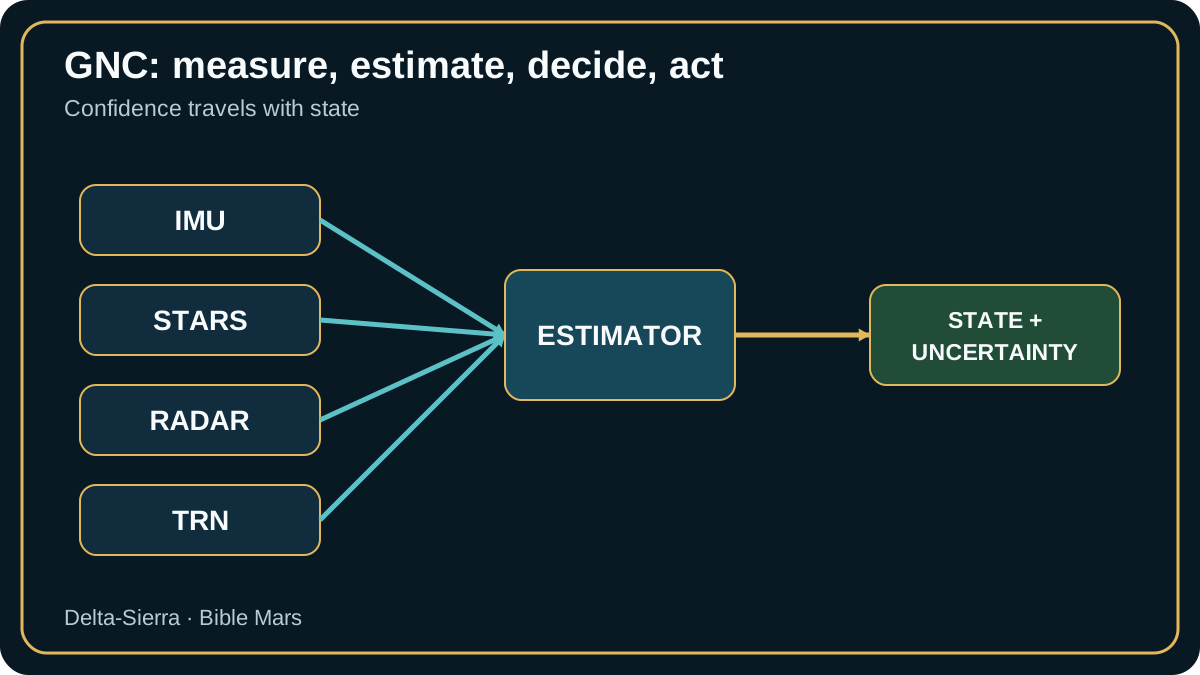
Case study — convert a small angular error into position error
For small angles, x ≈ Rθ. At R = 10 km and θ = 0.1° = 0.001745 rad, x ≈ 17.5 m. R is range, θ angular error in radians and x lateral error. An apparently excellent attitude estimate can therefore remain insufficient for precision landing.
If uncertainty grows, guidance may reduce aggressiveness, widen hazard clearance or delay a manoeuvre. Continuing to optimise with a poorly observable state can be dangerous.
The full sensor–estimator–guidance–actuator loop is tested with bias, delay, saturation and map error; extreme cases must remain safe or be detected early enough.
Observability can fail while every sensor remains healthy
A navigation filter may receive clean measurements and still be unable to estimate the state that matters. Two sensors that respond to the same geometric direction can leave another direction weakly observed; a slowly changing bias can masquerade as real motion; a star tracker can be accurate yet unavailable during a manoeuvre. The question is therefore not only “is the sensor working?” but “does the current measurement geometry constrain the states required for control?”
A robust design watches the innovation sequence, covariance growth and consistency between independent measurement families. When geometry becomes poor, the correct response may be to change attitude, wait for a different landmark, reduce control authority or accept a larger uncertainty envelope. GNC resilience comes from managing information quality, not from simply counting sensors.
Design GNC as a chain of trust: sense, estimate, decide, act and verify
Guidance, navigation and control are often drawn as three boxes. That diagram hides the most important question: how does the system know that the commanded action produced the expected physical result? A robust loop starts with sensors, builds an estimated state with uncertainty, compares that state with a target, generates a command consistent with physical limits, actuates the vehicle and then observes the response. The final observation closes the loop. Without it, the software is issuing instructions rather than demonstrating control.
Navigation must carry uncertainty with the state
An estimator should not report only “position equals X” or “attitude equals Y.” It should represent confidence and the relationship among errors. A camera may constrain lateral position while leaving range uncertain; an inertial unit can be excellent over short intervals while accumulating drift; Earth-based radiometric data can have direction-dependent geometry. Decisions should therefore use the shape of the uncertainty, not only the best point estimate. This matters most near boundaries such as an entry corridor, a landing ellipse or a collision-avoidance threshold, where a small uncertainty can change which action remains safe.
Sensor fusion must survive a persuasive liar
More sensors do not automatically make navigation safer. If several measurements share a calibration error, or if the filter accepts a corrupted observation with excessive confidence, fusion can produce a more confidently wrong answer. Robust architectures monitor residuals, compare independent information, limit the influence of suspect measurements and preserve degraded solutions using a subset of sensors. The engineering question is explicit: if this sensor disappears, which dimensions of knowledge become weak, how fast does uncertainty grow, and which manoeuvres remain acceptable before another source of information is acquired?
Guidance converts mission intent into a physically reachable target
An instruction such as “enter the corridor,” “reach the capture point” or “land near the site” must become states and constraints that the vehicle can actually follow. Guidance considers available propellant, required orientation, thermal boundaries, exclusion zones, actuator authority and time remaining. A mathematically attractive path can be impossible if it demands an acceleration, angular rate or thrust transition the control system cannot produce. Guidance therefore needs a model of the controlled vehicle and must expose when the requested objective has become infeasible rather than continuing to chase it silently.
Control is bounded by actuators and dynamics
Reaction wheels, thrusters, aerodynamic control surfaces or gimballed engines have range limits, delays, saturation, quantization and failure modes. A controller that assumes perfect authority can accumulate error while requesting an impossible response, then react aggressively when authority returns. Simulation and hardware testing should therefore include actuator limits, timing, noise, mass-property dispersion and failures. The ideal-actuator case is useful for understanding an algorithm; qualification requires showing how the closed loop behaves when the physical plant refuses to match the mathematical abstraction.
EDL compresses the decision time by orders of magnitude
During interplanetary cruise, trajectory decisions can be separated by days. During entry, descent and landing, critical updates occur in seconds or fractions of a second. The conceptual loop is the same but the timing and autonomy are radically different. Earth cannot fly the vehicle through that phase because the communications delay is far longer than the available response time. Terrain Relative Navigation demonstrates one form of local autonomy: observations of the surface can be compared with onboard maps so the vehicle can improve its knowledge of position and avoid hazardous terrain without waiting for a distant command.
Degraded mode must state what the system no longer knows
A label such as “safe mode” is not sufficient if the crew cannot see which capability was lost. A useful degraded GNC state reports unavailable sensors, remaining uncertainty, usable actuators, prohibited manoeuvres and how long the state is expected to remain acceptable. This allows crew and fault-management logic to choose rationally among waiting, reconfiguration, repair and continuation. It also prevents a dangerous form of automation theatre in which a display still shows precise numbers even though the underlying information has become weak.
Reference frames and time are software components
A frame error can be as destructive as a failed sensor. State vectors need an origin, orientation, epoch and units; transformations among inertial, planet-fixed and local frames must be verified like any other critical algorithm. Time requires the same discipline. Clock offsets, synchronization, latency and event ordering directly affect estimation. A physically correct measurement attached to the wrong timestamp can create an incorrect state and therefore an incorrect command. Configuration management must include coordinate and time conventions, not only executable code.
Fault injection should be part of GNC qualification
A credible campaign deliberately introduces inertial drift, blinded cameras, delayed observations, saturated wheels, under-performing thrusters, mass-property error, map error, lost synchronization and contradictory sensors. Engineers then inspect more than final trajectory error. Did the system recognize inconsistent evidence? Did covariance or another uncertainty representation expand? Was an unsafe command prevented? Did recovery preserve enough authority for the next phase? This joins GNC, FDIR and software assurance into one evidence chain instead of validating each discipline in isolation.
Local PNT becomes settlement infrastructure
Guidance and navigation do not end when the interplanetary vehicle lands. Rovers, mining machines, pressurized transports, construction robots and scientific assets need positioning, navigation and time around the settlement. Mars has no operational equivalent of Earth GPS. A local architecture could combine inertial navigation, vision, radio beacons, orbital relays, mapping and cooperative ranging among vehicles. Required precision should drive the design: returning to a visible habitat is not the same problem as aligning heavy machinery beside a pressure system during poor visibility.
Autonomy should move decision speed without hiding authority
Deep-space delay means some decisions must move onboard, but that does not mean every decision should become opaque machine authority. Mission rules can define which actions autonomy may take immediately, which require crew confirmation, which must preserve a reversible state and which are never delegated. The vehicle should also explain the evidence behind high-consequence actions. This makes autonomy auditable: after an event, engineers and crew can reconstruct what the system believed, which alternatives it rejected and why it consumed a particular resource.
Primary engineering anchors: NASA material on guidance, navigation and control, Terrain Relative Navigation, autonomous navigation and space PNT provides demonstrated techniques and active development work. Those sources should be read as building blocks and evidence of maturity, not as proof that one final Mars-settlement GNC/PNT architecture has been selected.
A simple timing calculation explains why loop rate matters
If a vehicle is moving at 100 metres per second, an additional 0.1-second decision delay corresponds to 10 metres of travel before actuator dynamics are even considered. At 1,000 metres per second, the same tenth of a second corresponds to 100 metres. This is not a full EDL model, but it makes the timing problem concrete. Latency should be decomposed into sensor acquisition, transport, estimation, guidance computation, control computation, actuator command and physical response. Optimizing only one stage can leave the end-to-end loop too slow.
Acceptance criteria should be mission based, not only average-error based
An algorithm can show excellent mean error while producing a few catastrophic cases. Monte Carlo and dispersion campaigns should inspect distribution tails: missed entry corridor, actuator saturation, thermal-limit violation, terrain collision or excessive reserve consumption. Robust design asks which rare combinations dominate risk and then changes sensors, architecture, control limits or abort rules to contain them. The objective is not to make the average simulation attractive but to bound the consequences of the difficult cases.
Surface navigation needs map configuration control
A map is not the terrain. Resolution changes which hazards exist, lighting changes appearance, dust hides landmarks and settlement construction modifies routes. Local PNT must therefore manage map versions, confidence, temporary exclusion zones and updates from vehicles. A robot using an obsolete map can be dangerous even when its mathematical position estimate is precise. Map data become operational configuration, with provenance and update rules.
Human interfaces should display uncertainty and authority
Crew displays should make it clear whether a position comes from fused navigation, dead reckoning or a degraded fallback, and whether the next command is advisory or will be executed automatically. Showing an exact-looking number without confidence can encourage over-trust. Good human-machine design exposes the state of the estimator, the reason for a mode change and the options still available so the crew can intervene at the right level rather than fighting the automation.
GNC and power are coupled during off-nominal events
Safe attitude may be chosen to protect power generation, thermal control or communications rather than to minimize trajectory error. A failed actuator can also increase power demand as surviving hardware works harder. Fault scenarios should therefore include the spacecraft energy state. A recovery that is dynamically stable but drains the remaining battery before communications are restored is not a safe recovery.
The navigation filter must not forget its assumptions
Every estimator depends on a model: forces, sensor noise, bias evolution and vehicle dynamics. If the model understates a disturbance, the filter can become overconfident and reject a measurement that is actually revealing a real problem. Teams should monitor residual consistency and multiple statistical indicators. A covariance that continuously shrinks is not proof of truth; it can also mean the filter believes its own model too strongly.
Landing guidance should trade precision against safety
Reaching the centre of an ellipse is not always the correct objective if a hazard lies along the path. Guidance may prefer a slightly less precise but safer point, preserve divert authority and enforce slope or velocity limits. Terrain Relative Navigation is valuable because it converts surface observations into localization and hazard information, but the architecture still has to decide how that information changes the target and what map errors are tolerable.
Attitude control protects several spacecraft functions at once
Pointing is not merely choosing the “correct direction.” Attitude can optimize solar power, communications, thermal control, sensor protection or propulsion. During a failure those objectives can conflict. Safe mode needs a priority: avoid dangerous temperature, preserve positive power, maintain a minimum link or prepare a maneuver. The hierarchy should be decided before the event and tested with realistic energy and thermal states.
Local PNT should survive relay loss
A settlement-navigation service that depends completely on one orbiter is vulnerable to spacecraft failure or simple geometry. Surface vehicles should preserve a degraded local capability using inertial navigation, odometry, vision, surface beacons or cooperative ranging. Precision may fall, but operating rules can reduce speed, accessible zones and maximum travel distance. Resilience does not require identical performance after failure; it requires a safe mission with less information.
Hazard maps need date, resolution and provenance
A rock visible at centimetre-scale resolution may not exist in a coarse orbital map. Construction work, dust movement and new infrastructure can also change local terrain. A map used for landing or autonomous driving should therefore carry provenance, resolution, date and version. Software should reject an incompatible map rather than silently treating every map as equally current and precise.
Crew need an explanation of sensor disagreement
A useful display does not merely show three conflicting values. It exposes which sources are independent, which measurement the estimator down-weighted or rejected and why. In degraded conditions the crew can then request another observation, change attitude, acquire a beacon or limit motion. This reduces the risk of operators fighting automation without understanding the evidence on which it is acting.
Qualification should target mode transitions
Many failures emerge when software moves from cruise to approach, changes sensor sets, transfers from reaction-wheel control to thrusters or switches processors. Tests should target synchronization, filter initialization, state handover, integrator reset and activation of new limits. A mode can be perfectly stable once established and still be dangerous if the transition into it is poorly controlled.
GNC success should be written as verifiable constraints
Position knowledge, attitude error, touchdown velocity, actuator margin, probability of remaining inside a corridor and recovery time after a fault are more useful than the phrase “robust navigation.” Each requirement should state context and evidence. This lets simulation, hardware testing and mission performance connect through one verification matrix.
Navigation and FDIR should share causal timelines
When a guidance event and a fault-management event happen together, separate logs can make reconstruction difficult. A shared time base and causal event timeline should show sensor anomaly, estimator response, mode transition, command, actuator feedback and resulting trajectory change. That history supports both immediate crew understanding and later engineering analysis, and it prevents teams from diagnosing the same event from incompatible clocks.
Autonomy must expose the boundary between estimate and command
A spacecraft can know it is uncertain without immediately acting. The logic should preserve a distinction between “I no longer trust this state,” “I need another measurement,” and “I must change the vehicle now.” Collapsing those stages encourages unnecessary reconfiguration. Explicit boundaries make the autonomy easier to verify because engineers can test which evidence is sufficient to promote a concern into a high-consequence action.
The system must distinguish “physically impossible” from “not yet certain”
When an objective becomes difficult, guidance may lack information or the vehicle may genuinely lack control authority. Those conditions require different responses. In the first case another observation may restore the solution; in the second, waiting only consumes time. Internal states and crew displays should therefore separate estimation uncertainty from control infeasibility.
Robustness should be measured after actuator loss
A vehicle can be fully controllable with all thrusters and marginal after one failure. Analysis should recompute torque authority, degraded axes, propellant consumption and prohibited manoeuvres. If one failure state requires a special attitude or burn sequence, that response belongs in mission rules and qualification rather than being invented after the fault occurs.
Optical navigation depends on image and model quality
A camera does not directly output position. Software must detect objects or terrain, associate them with a reference and convert measurements into state information. Blur, dust, lighting, saturation, occlusion and map error can degrade each stage. Tests should include realistic imagery and cases where the algorithm honestly rejects an observation instead of forcing a false match.
Startup behavior is part of navigation safety
After a processor reset, the estimator may lack history, some sensors may not yet be valid and actuators may retain a previous physical state. Initialization procedures should define how attitude, position and confidence are rebuilt before normal commands resume. A fast recovery with a false state can be more dangerous than a slower, clearly bounded safe mode.
Settlement GNC can publish zones of navigation confidence
Not every surface region requires the same precision. Corridors near habitats, tanks or power facilities may require high-quality positioning and low speed, while remote traverses can tolerate larger uncertainty. A local PNT service can publish quality by area and vehicles can adapt behavior. This treats precision as a shared resource rather than an expensive uniform requirement.
Communications loss should not automatically become navigation loss
If updates or maps normally arrive through the network, vehicles should know how long they can continue on local information. Uncertainty may grow and force reduced speed or range, but navigation need not fail instantly while inertial, visual or beacon sources remain. Degraded rules should make that progression predictable.
Requirements should change with mission phase
A position error of kilometres can be acceptable months before Mars and catastrophic minutes before entry. Navigation requirements therefore tighten by phase. Attitude error that is harmless during quiet cruise may break optical pointing or a critical burn. Verification matrices should identify when each threshold applies so one context-free number does not masquerade as a complete requirement.
Configuration control includes parameters, not just executable code
Controller gains, filter covariances, rejection thresholds, maps, mass estimates and actuator limits can change behaviour without changing the binary. Those parameters should be versioned, authenticated and verified like software. A wrong parameter table can produce unsafe control even when the executable itself passed qualification.
End-to-end demonstration should tell a complete mission story
A strong system test can begin with imperfect navigation, inject a sensor fault, force degraded estimation, execute a maneuver with reduced actuator authority, then verify recovery and event reconstruction. Such a scenario is more informative than isolated tests because it exposes the real interaction among estimation, guidance, control, FDIR, power, communications and crew.
Surface PNT needs service monitoring
A local positioning service should report its own health: beacon availability, clock quality, map currency, relay geometry and expected accuracy. Vehicles can then decide whether a route is allowed before departing. This is analogous to checking weather and road conditions on Earth, except the service quality directly controls whether autonomous navigation can meet safety constraints.
GNC performance should feed maintenance
Increasing control effort, growing sensor residuals or repeated recalibration can be early signs of actuator, alignment or sensor degradation. Trend monitoring lets maintenance intervene before a hard failure. Guidance data therefore become maintenance evidence, linking software telemetry to mechanical and electrical health.
Autonomy should fail toward a known safe envelope
When information collapses, the correct response is not always to continue pursuing the nominal target. The vehicle may need to hold attitude, stop a rover, climb away from terrain or preserve energy. Safe envelopes should be defined per mission phase and tested with missing or contradictory information. This gives autonomy a defensible stopping rule rather than an obligation to keep optimizing under uncertainty.
Four acceptance scenarios for the complete GNC chain
1. Cruise: an inertial sensor develops slow drift while independent observations remain healthy. The estimator should reduce trust in the source without creating unnecessary trajectory activity. 2. Approach: an optical-navigation camera becomes unavailable. Uncertainty must increase visibly and correction strategy should adapt. 3. EDL: one actuator under-performs. Guidance must preserve a physically reachable safe region rather than continuing to demand the original target. 4. Surface: a local PNT relay disappears. The rover reduces speed and permitted range while retaining a safe return capability.
Each scenario should be repeated with multiple initial states and dispersions. Acceptance is not “zero error.” It is that uncertainty remains explicit, physical limits are protected, unjustified irreversible actions are prevented and the vehicle retains a path toward a known safe state.
Measurement quality should have operational labels
Instead of exposing only covariance numbers or abstract filter status, operational interfaces can classify navigation service for the current task: nominal for precision landing, adequate for safe cruise, degraded for low-speed surface motion, or insufficient for maneuver. The thresholds behind those labels remain quantitative and testable, but the crew also receives a direct statement of what the present information permits.
Safe states need exit conditions
A safe mode that can be entered but not left confidently can trap a mission. Each degraded state should define what evidence allows recovery: restored sensor consistency, stable attitude for a period, successful actuator test, verified map match or crew confirmation. Exit criteria prevent repeated oscillation between modes and make return to nominal operation a verifiable event.
Guidance needs explicit no-go regions
Some states should be rejected even if they move toward the nominal target: thermal limits, terrain hazards, insufficient braking margin or actuator saturation. Encoding these as constraints makes the optimizer or guidance law prefer a less ambitious but safer objective. This is especially important when autonomy is operating faster than crew or Earth can intervene.
Navigation data should support post-mission science and engineering
High-quality trajectories, residuals, atmospheric observations and landmark matches can improve future Mars models and site maps. The operational system should preserve data with enough provenance to be reused after the immediate mission. This turns every landing and traverse into a measurement campaign while keeping safety data and scientific data clearly distinguished.
Closure: degraded GNC must remain understandable
Nominal precision is impressive, but trust comes from behavior after information or authority is lost. The system should state what it knows, what it no longer knows, what it can still command and which path leads toward a safe state. This transparency joins mathematics, software, sensors, actuators and crew into one discipline of controlled motion.
For a Mars settlement the same principle scales from an interplanetary vehicle to local rovers and robots. High autonomy is valuable when it preserves evidence and safe options; it is dangerous when it hides uncertainty behind a confident interface.
Practical consequence: GNC verification should always report both achieved accuracy and remaining control authority. A precise state with saturated actuators is not safe, and ample actuator authority with an untrustworthy state estimate is not controllable.
Every major mode should therefore have a measurable entry condition, an observable state and a tested exit condition.
That discipline turns autonomy into a verifiable flight capability rather than a slogan.
Sources and references
Specialized bibliography — communications, navigation and autonomy
- NASA — autoNGC — Autonomie de navigation, planification, décision et contrôle.
- NASA — CAPSTONE extended mission technologies — Essais de technologies autonomes et DTN en environnement lunaire.
- JPL IPN — PNT at the Moon and Mars — Positionnement, navigation et temps pour exploration planétaire.
Specialized sources — GNC, autonomy and validation
- NASA — autoNGC — autonomous navigation, executive decision-making and control
- NASA — CAPSTONE 2026 — autoNGC and DTN demonstration