


MARS BIBLE — HISTORY
NASA: the history of human Mars mission projects
From post-Apollo studies to the Moon to Mars Architecture: six decades of technical, political and budget choices required to turn Mars into a credible crewed mission.
BEFORE MARS — HOW THE ORGANIZATION WAS BORN
Before Mars: how NASA came into being
Before becoming the agency of Mars probes, astronauts and Apollo, NASA was first the heir to a much older institution: the National Advisory Committee for Aeronautics, or NACA, created in 1915 to organize American aeronautical research. For more than four decades, NACA built laboratories, wind tunnels, test methods and an experimental engineering culture that would form a major part of NASA’s human and technical foundation.
The shift toward space accelerated in the Cold War context, especially after the Soviet Union launched Sputnik in October 1957. The United States then sought a civilian agency able to coordinate research, scientific satellites, human flight and robotic programs. President Dwight D. Eisenhower signed the National Aeronautics and Space Act on July 29, 1958; NASA formally began operations on October 1, 1958, absorbing NACA, its facilities, personnel and several programs already underway.
That origin explains why NASA has never been merely a “rocket agency.” Its institutional DNA combines aeronautics, basic research, systems engineering, operations, planetary science and human spaceflight. Mercury, Gemini and Apollo rapidly built the ability to manage immense programs, while the first interplanetary probes learned how to navigate far from Earth. By the time Mars became a major scientific target, it entered an organization that already possessed centers, procedures, communications networks and a culture of qualification at scale.
This genealogy changes the way the Mars program should be read: Mariner, Viking, Pathfinder, Curiosity and Perseverance are not isolated episodes. They are descendants of an institutional architecture born before the space age itself. NASA was created to give continuity to the United States’ civilian space effort; Mars later became one of the most demanding laboratories of that continuity.
Founding sources: NASA History · National Aeronautics and Space Act

1 — Mariner 4: the first close-up correction
Mariner 4 flew past Mars in July 1965 and returned the first close images. The cratered terrain and measurements of a very thin atmosphere challenged popular expectations of a near-Earthlike world. Settlement history therefore includes a recurring process of robotic missions invalidating assumptions before human hardware is committed.
2 — Mariner 9: complexity returns
Mariner 9 entered orbit in 1971 and eventually mapped most of the planet, revealing immense volcanoes, Valles Marineris and channels associated with ancient water. Mars did not become easier, but it became scientifically richer. A permanent human presence would inherit that tension: a hostile environment and an extraordinary scientific archive in the same place.
3 — Viking and surface operations
Viking 1 and 2 demonstrated controlled landing, long-duration surface power, meteorology, imaging and biology experiments. For settlement engineering, this is more than mission history. It is the beginning of Mars as an operational environment with real thermal cycles, dust, communications constraints and surface procedures.
4 — Pathfinder, rovers and distributed learning
Pathfinder and Sojourner showed a lower-cost approach to surface mobility. Later rovers extended operational lifetime and scientific autonomy dramatically. Each mission adds a layer to the future human knowledge base: route planning, hazard avoidance, autonomous decisions, surface maintenance, local geology and remote science operations.
5 — 1969 And the post-Apollo Mars question
After Apollo 11, NASA and the Space Task Group examined future directions including human Mars missions. Concepts existed, but national priorities shifted toward the Space Shuttle and other goals. The episode demonstrates that “NASA had a Mars plan” and “the United States had an approved Mars program” are not the same statement.
The Space Exploration Initiative. President George H. W. Bush announced the Space Exploration Initiative in 1989, linking a return to the Moon with eventual human Mars exploration. The resulting architecture encountered severe budget and political resistance. This makes SEI a useful case study in how cost estimates can dominate technically imaginative plans.
1958–1964 — NASA learns human spaceflight before it can define a Mars program
When NASA formally opened on 1 October 1958, it did not inherit a crewed Mars program waiting for execution. It first inherited the NACA laboratories and test culture, then absorbed space activities and expertise scattered across military organizations, the Jet Propulsion Laboratory and industry. The urgent institutional problem was to build a civilian agency able to manage launch vehicles, satellites, probes and human missions at the same time. Mars already existed in scientific and popular imagination, but it was not a funded human program. The later Mars story therefore begins with a more basic transformation: NASA had to learn how to place a person in space, monitor that person, recover the spacecraft and assign responsibility across a system in which a single small failure could become fatal.
Mercury became the first operational school. It taught that a human mission architecture is not merely a trajectory plus a rocket. Medicine, flight control, communications, abort logic, suits, qualification, recovery and crew procedures are all parts of the vehicle in a broader sense. Gemini then added rendezvous, docking, extravehicular activity and missions lasting many days. Those capabilities would eventually matter to assembly and operations for interplanetary flight, but they were still far removed from the autonomy required for Mars. At this stage, Mars studies could use very large vehicles and optimistic schedules because they were concept studies rather than approved programs constrained by a real production line and annual appropriations.
President Kennedy's lunar objective in 1961 changed the scale of the agency. Apollo forced NASA to manage thousands of interfaces, multiple centers and an industrial network while preserving a disciplined configuration of the overall system. For Mars, that organizational legacy would prove more durable than any individual 1960s spacecraft sketch. The fundamental question shifted from whether a very large vehicle could be drawn to whether an Apollo-style organization could keep a crew alive for years, with no rapid abort to Earth and with systems that had to be repaired rather than replaced by a launch from home.
Early human-Mars studies explored Saturn-derived launchers, nuclear stages and orbital assembly. They already contained variables that would recur for six decades: mass in Earth orbit, departure energy, transit time, habitation, reliability, Mars entry, surface stay and ascent. Their historical value is not that NASA possessed a secret ready-to-fly Mars plan. They show how engineers translated the tools of their own period to a more distant destination and discovered that the destination changes the problem. A technology that looks decisive in isolation alters power, shielding, launch count, cost and operations elsewhere in the architecture.
Robotic Mars exploration became essential to this human history because an architecture cannot be credible when its destination is poorly measured. Atmospheric density, temperature, topography, soil properties, dust and water availability directly affect vehicles and surface systems. The robotic missions therefore belong in this book as a source of constraints, not as a replacement for the human-program narrative. They turn unknowns into engineering inputs; the human studies must then decide how those inputs alter mass, risk and operations.
By the time Mariner 4 was approaching Mars, NASA contained a productive asymmetry. It was rapidly becoming the world's most capable organization for short-duration human missions around Earth and toward the Moon, yet it still knew relatively little about the true Martian environment. Human capability and planetary knowledge grew in parallel. They would only become a common political question when Washington began asking what should follow Apollo.
1965–1968 — Martian data begin to discipline human-mission concepts
Mariner 4's 1965 flyby changed more than the visual image of Mars. A thin atmosphere and a cratered landscape made it harder to treat the planet as an almost-Earth waiting for a larger Apollo. For a human system, the thin atmosphere is especially awkward: it is too insubstantial to provide the easy aerodynamic braking available at Earth, yet substantial enough to create heating and aerodynamic loads. Entry, descent and landing became a Mars-specific problem. The techniques that could deliver a lightweight probe could not simply be scaled to a habitat, ascent vehicle and power system weighing tens of tonnes.
Apollo was advancing at extraordinary speed at the same time. That simultaneity encouraged a plausible intuition: if Saturn V, lunar navigation and a crewed lander could be created in one decade, Mars could be the next step. Engineering studies explored exactly that path. Yet the comparison concealed a change of regime. Lunar missions offered relatively rapid return, near-real-time communications and durations measured in days. Mars imposed launch windows, months of transit, long communication delays and total missions that could approach several years. Consumables, repair and crew health changed from margins into architecture-driving functions.
Nuclear thermal propulsion, particularly the NERVA work, gained attention because higher performance appeared capable of reducing transit time or increasing delivered mass. But every local improvement generated system consequences: reactor development, shielding, thermal management, ground testing, political acceptance and a different industrial base. This is a recurring lesson in NASA Mars architecture. A propulsion technology does not solve Mars by itself; it changes the balance among multiple constraints. The same would later be true of in-situ resource utilization, aerocapture, fission surface power and very large launch vehicles.
Space medicine added a second boundary. Gemini demonstrated that crews could remain in weightlessness for days, not that they could arrive fit after months in deep space. Radiation outside the principal protection of Earth's magnetosphere, psychological isolation and the absence of medical evacuation could not be validated by a short orbital mission. Mars therefore required a tighter link between biomedical knowledge and vehicle design. Shielding, exercise, habitat volume, workload, medical capability and transit time became connected decisions rather than separate specialties.
Apollo's budget created another misleading precedent. The lunar program succeeded under an exceptional national priority and a peak NASA budget that could not be assumed to continue after the political objective was achieved. Late-1960s Mars studies could reuse Apollo industrial capabilities on paper, but only if the United States chose to sustain a comparable mobilization. That condition was not technical. It was political, and it set up the decisive post-Apollo debate of 1969.
Between Mariner 4 and Apollo 8, then, human Mars planning became more disciplined even as public confidence in spaceflight grew. 'Possible' split into several meanings: physically possible, technically credible, industrially developable, financially supportable and politically durable. Much of the subsequent history can be read as repeated attempts to make those five conditions overlap at the same time.
1969–1972 — The post-Apollo crossroads: Mars becomes a policy option and is then deferred
The year 1969 was the great crossroads. Apollo 11 showed that a national space objective of extraordinary difficulty could be achieved, but the Nixon administration immediately faced a different question from the one Kennedy had posed: what should the country do with this capability after the geopolitical milestone was reached? President Richard Nixon created a Space Task Group chaired by Vice President Spiro Agnew. NASA, the Department of Defense and science-policy leadership participated. Its September 1969 report explicitly placed human Mars exploration among possible long-term goals. NASA History: The Post-Apollo Space Program.
The report's options expose the relationship between ambition and resources. The most aggressive option required more than doubling NASA's budget by 1980 and supported stations, a lunar base and preparations for a human Mars mission in the 1980s. A middle option stretched the sequence while developing a space station and reusable Earth-to-orbit transportation. A third retained much of the infrastructure logic but deferred the human Mars mission indefinitely. These were not three versions of a flight program already approved. They were policy choices showing how the Mars date moved when the assumed national investment changed. NASA historical summary of the Space Task Group.
Administrator Thomas Paine favored an ambitious future, and Wernher von Braun and other planners presented large integrated scenarios involving reusable shuttles, stations, nuclear stages and Mars expeditions. Their scale reflected an Apollo culture in which extraordinary industrial mobilization had been used to compress schedule. But the political environment had changed. War spending, domestic priorities and the declining urgency of the lunar race made continuation of the Apollo peak budget unlikely.
The decision that emerged in the early 1970s was therefore not a scientific rejection of Mars. It was a change in national space strategy. The Space Shuttle became the major new human-spaceflight development while Skylab made use of hardware already rooted in Apollo. Large space stations, a lunar base and a crewed Mars expedition disappeared from the funded sequence. This is one of the most important institutional lessons in the Mars story: a technically detailed architecture can have senior sponsorship and still never cross the budgetary threshold that turns study work into a program of record.
Apollo expertise did not vanish. Guidance, mission control, propulsion, human systems, materials and certification became lasting institutional capital. But people and production lines did not remain frozen while waiting for Mars. Teams retired or moved to Shuttle, science missions and other work. When Mars returned to the policy foreground years later, NASA could reuse knowledge but had to rebuild program coherence around a different workforce, industrial base and set of vehicles.
The post-Apollo episode also warns against treating dates in historical concept art as launch commitments. A 1969 illustration showing astronauts on Mars in the 1980s was a way to size development and compare program options. A date becomes operationally meaningful only when budgets, contracts, governance and program milestones support it. Distinguishing a reference study from a program of record is essential to interpreting every later NASA Mars architecture.
Meanwhile Mariner 9 and Viking would make the robotic program increasingly valuable to human planners. Their maps, atmospheric measurements and surface operations would become inputs for future crewed architectures. They belong to the human story as an expanding knowledge infrastructure, not because the robotic program itself was a human Mars program.
The post-Apollo turn created a pattern that repeated for decades: a political window stimulates ambitious studies; centers build architectures; budgets and national objectives change; some technical elements survive while others disappear; a later generation inherits the evidence and revisits the trade space. Mars was not forgotten. It became a recurring objective whose form depended on the surrounding national space program.
1973–1988 — Mars survives through studies, data and institutional memory
The 1970s and early 1980s are sometimes reduced to a gap between Apollo and the Space Exploration Initiative. In institutional terms they were more complex. NASA operated Skylab, developed and flew the Space Shuttle, conducted Viking and maintained technical work on planetary exploration, propulsion and human systems. Mars remained present in reports, academic work and mission studies without being a funded human flight program. That distinction matters because a large organization can preserve an objective as knowledge even when it cannot preserve a dedicated program office or production line.
Viking had direct importance for later human systems. Its orbiters and landers demonstrated controlled entry and long surface operations while measuring atmosphere, weather, chemistry and terrain more precisely than previous missions. Those observations affected landing analysis, surface materials and planetary-protection debates. Sending humans to a scientifically sensitive world raises a different contamination problem from sending sterilized robotic hardware; as life-detection questions became more sophisticated, human exploration architectures had to include how science and contamination control could coexist.
The Shuttle did not bring astronauts physically closer to Mars in terms of destination. It did, however, create decades of operational experience with a complicated, partially reusable system, extravehicular activity, payload deployment and on-orbit repair. The comparison also revealed what Mars would lack. Shuttle missions operated within a huge terrestrial support network and could return relatively quickly. A Mars crew would need to carry much more diagnostic and repair capability with it. Low-Earth-orbit operations were therefore a school for complexity, not a full demonstration of interplanetary autonomy.
Technical studies continued to compare conjunction and opposition mission classes, chemical and nuclear propulsion, assembly strategies and the possibility of local resource use. The vocabulary shifted, but the underlying trade remained. A long-stay conjunction mission accepts a long surface interval in exchange for more favorable interplanetary energetics; a shorter surface strategy can demand different trajectories and greater propulsion. The choice affects radiation exposure, science time, surface infrastructure and mass. Later Design Reference Missions would make these relationships explicit and traceable.
Long-duration human physiology also became a more serious research field. NASA could learn from Soviet station experience and its own programs, eventually feeding the science base that would support the International Space Station. Yet living for months in low Earth orbit is not equivalent to Mars: resupply, medical evacuation and communication are fundamentally different. The real value of long-duration orbital experience is to expose degradation mechanisms, maintenance burdens and human-performance issues that short missions simply cannot reveal.
A new generation of engineers and scientists entered the problem during these years. They had not necessarily built Apollo. They came from Shuttle, planetary science, life sciences and systems analysis. Institutional continuity therefore did not consist of handing the same blueprint from one unchanged team to another. It consisted of retaining reports, methods, test data, standards and enough expertise for new teams to understand why earlier choices had been made.
By the late 1980s Mars was better known, but that did not make human exploration obviously easier. Better data removed uncertainties and exposed constraints. Mission duration, mass, reliability, crew health and cost could no longer be buried inside optimistic drawings. That maturation explains why the 1989 political revival generated both detailed architectures and an immediate argument about resources.
1989–1993 — The Space Exploration Initiative returns Mars to policy and exposes the cost problem
On 20 July 1989, the twentieth anniversary of Apollo 11, President George H. W. Bush announced the Space Exploration Initiative, linking a sustained return to the Moon with eventual human exploration of Mars. NASA suddenly had to translate presidential direction into a sequence of programs, technologies and budgets. Its November 1989 '90-Day Study on Human Exploration of the Moon and Mars' laid out a progression from Space Station Freedom to sustained lunar operations and then Mars, and it compared five reference approaches. NASA TM-102999, Report of the 90-Day Study.
The study was important because it treated Mars as the end of a campaign rather than a single heroic departure. Earth-orbit infrastructure, lunar capability, propulsion, habitation, assembly and logistics were tied together. That coherence produced a very large resource requirement. Estimates associated with the initiative became politically damaging and reinforced the perception that NASA was proposing an Apollo-scale system expanded across several destinations rather than a sustainable program.
Congress and the executive branch challenged both cost and schedule. No appropriation remotely comparable to the Apollo mobilization followed. The episode again showed the institutional filters between a national goal and flight hardware: objectives must become an architecture, then authorized programs, then sustained appropriations and contracts. The 90-Day Study remained valuable even as the initiative weakened because it made dependencies and cost drivers visible for later teams.
Alternative approaches consequently gained influence. Robert Zubrin and David Baker developed Mars Direct, centered on reducing system size and producing return propellant from Martian resources. In-situ resource utilization had antecedents, but Mars Direct made it a central architecture lever rather than a peripheral technology. The proposal forced a useful question into NASA studies: should the agency build a large ladder of intermediate infrastructure before Mars, or design an architecture more directly around what the Martian environment could provide?
NASA did not simply adopt Mars Direct as an official program. Engineers evaluated, modified and incorporated ideas such as pre-deployment, local propellant production and reduced system mass. This is how technical influence often works: an external architecture becomes an input to institutional trade studies without becoming the agency plan. Recognizing that distinction gives proper weight to the proposal while avoiding the opposite error of labeling Mars Direct a NASA flight program.
SEI also sharpened the debate about the Moon as an intermediate step. Lunar activity can demonstrate operations, power, surface mobility and some human systems, but lunar technologies are not automatically optimal for Mars. Atmosphere, gravity, trip duration and resource environment differ. Later architectures would increasingly ask which capabilities are truly common and which must remain Mars-specific.
When SEI faded in the early 1990s, NASA did not return to its 1988 state. The study base was larger, the cost problem was more explicit and simplification had become a serious design objective. The agency increasingly shifted toward 'reference missions': sufficiently detailed architectures to compare choices without pretending that a funded flight date already existed.
That change in status was a major intellectual gain. A reference mission can specify crew size, surface stay, propulsion and cargo sequencing in great detail while remaining a benchmark. Its purpose is to expose consequences: if six people stay for roughly five hundred days and return propellant is made locally, what technologies and masses follow? Making assumptions explicit allowed NASA to convert part of SEI's political disappointment into a more durable engineering method.
1994–2000 — Mars Reference Missions turn ambition into a benchmark engineers can challenge
By the mid-1990s teams spanning NASA centers developed a new family of Mars Reference Missions. The 1997 publication led by Stephen Hoffman and David Kaplan was not a presidential timetable. It was a working model detailed enough to compare alternatives, identify enabling technologies and trace the consequences of decisions through the overall system. NASA SP-6107, Human Exploration of Mars Reference Mission. Politically it was more modest than SEI; technically it was often more useful.
One important feature was a split-mission strategy. Cargo and surface infrastructure would depart ahead of the crew. The human vehicle would leave Earth only after critical assets had been placed and, in some cases, verified. This reduces the amount of hardware that has to travel together and turns waiting time into an operational margin. It also introduces a new dependency: if a cargo mission fails or a local production plant does not perform, the architecture needs explicit rules for delaying or canceling crew departure.
In-situ resource utilization became structural. Producing ascent propellant from Martian material can eliminate the need to launch all return propellant from Earth. The mass saving is potentially enormous, but it trades launch mass for autonomous-system reliability, power and resource characterization. A plant that must work before the crew arrives becomes a safety-critical element even though no human is present when it begins operating.
The reference mission favored long-stay conjunction-class missions. A crew of six could spend roughly five hundred days on the surface, improving scientific return and benefiting from interplanetary energetics. The price is a habitat, logistics system, medical plan and maintenance regime that must function for a very long time. Surface mobility, power and spare parts become as central to mission success as the interplanetary transfer stage.
The Martian site itself became an architecture. Engineers had to define habitats, power, rovers, extravehicular activity, consumable production, maintenance and failure recovery. This was a conceptual shift from studies dominated by the transfer vehicle. A crewed Mars program would not merely touch down; it would have to establish a temporary working settlement able to survive months of dust, thermal cycles and isolation.
Science also shaped the design. Geologists and astrobiologists wanted crews able to reach multiple sites, operate laboratories and choose samples intelligently. Engineering had to translate those objectives into mass, power, crew time, contamination controls and mobility range. This interaction remains central to current architecture: science helps define what makes the mission worthwhile, while engineering determines what can be supported within risk and resource limits.
The Reference Mission intentionally did not close every question. Propulsion, crew size, transit method and surface systems remained open to alternatives. That openness is what made it a benchmark. A new concept could be evaluated against a common reference in terms of mass, risk, cost, schedule and scientific performance rather than defended only through rhetoric.
By the end of the 1990s NASA therefore possessed something it had lacked in 1969: a formal tradition of Mars reference architectures. This did not mean a crewed launch was politically imminent. It meant the agency was becoming better at documenting assumptions, comparing alternatives and preserving the rationale for choices so that a later generation did not have to restart every calculation from first principles.
2001–2010 — Vision for Space Exploration and DRA 5.0 connect lunar systems to Mars without pretending they are identical
After the Columbia accident in 2003, U.S. human spaceflight again required a strategic reset. On 14 January 2004 President George W. Bush announced the Vision for Space Exploration: return the Shuttle to flight, complete the ISS, return humans to the Moon and move outward toward destinations including Mars. NASA History, Vision for Space Exploration. Constellation followed with Orion, Ares and lunar systems. Mars was an explicit long-term destination, but not yet a separate funded flight program; lunar capabilities were expected to be extensible where that made engineering sense.
The period revived an old question: how much does lunar infrastructure really buy for Mars? Some functions are clearly transferable — long-duration life support, cryogenic management, deep-space operations, power, autonomy and reliability. Others are destination-specific. A lunar lander never has to survive atmospheric entry, whereas a heavy Mars lander must manage both hypersonic heating and an atmosphere too thin for easy parachute scaling. NASA therefore had to avoid treating the Moon as a small Mars test site in every respect.
In 2007 multiple working groups revisited human-Mars science, systems and technology. The effort culminated in Human Exploration of Mars Design Reference Architecture 5.0 around 2009. The document makes a distinction that is often lost in public discussion: DRA 5.0 was not a formal approved mission plan. It was a reference architecture tying candidate systems and technologies to human-Mars scenarios and providing a benchmark for alternatives. NASA/NTRS, Design Reference Architecture 5.0.
DRA 5.0 retained a preference for long-stay conjunction missions, pre-deployed cargo and a six-person crew concept. It examined propulsion options, local resource use, surface mobility, power and planetary protection, and it considered how Constellation elements might contribute. The result was not one 'Mars rocket' but a network of dependencies. Changing transportation affected launch count; changing surface power affected resource production; changing crew duration affected logistics and health.
Entry, descent and landing emerged as a particularly severe technology gap. Robotic systems of the era delivered payloads measured around a tonne, while human systems could require tens of tonnes per landed element. A larger parachute is not a sufficient answer. Mars has enough atmosphere to create heating and dynamic pressure but too little to provide straightforward braking for very heavy vehicles. DRA 5.0 therefore elevated heavy-Mars EDL from a downstream detail to an enabling architecture problem.
Human health produced a similar clarification. ISS data could inform long-duration microgravity, but interplanetary flight leaves the crew outside most of Earth's magnetospheric protection. Radiation, isolation, communication delay and the absence of medical evacuation create a different risk portfolio. A Mars system must not simply keep people alive; it must deliver them to the surface capable of performing demanding operations and return them after a mission measured in years.
Surface power remained a system-level trade. Solar arrays use mature technology but face distance from the Sun, dust and operational storage needs. Fission systems promise more illumination-independent power but add deployment, mass and safety constraints. DRA 5.0 did not eliminate these choices. It showed why energy architecture changes the design of resource production, habitats, mobility and redundancy.
Constellation eventually encountered major cost and schedule pressure and was cancelled in its original form. The human-Mars knowledge did not become invalid. Orion survived in a different program context; new launch systems and lunar strategies appeared; DRA studies continued to inform technology discussion. Again, institutional continuity lived more in knowledge and selected capabilities than in preserving one frozen architecture.
DRA 5.0 remains a major documentary milestone because it records a detailed, internally coherent view of human Mars exploration and labels its assumptions. Its value in 2026 is not that it predicts the exact first mission. It lets engineers and historians see which constraints persist, which technologies matured and which program assumptions were later replaced.
2010–2016 — Flexible Path, Journey to Mars and the Evolvable Mars Campaign recast Mars as a campaign
The cancellation of Constellation at the start of the 2010s forced NASA to redefine human exploration beyond low Earth orbit. Orion continued, the Space Launch System was developed and the agency explored a more flexible sequence of capabilities in cislunar and deep space. Mars remained the horizon, but the path became less tied to one predetermined ladder of vehicles and destinations.
The public 'Journey to Mars' framing emphasized capability accumulation. The ISS served as a laboratory for long-duration human performance and environmental-control systems; deep-space missions were expected to exercise operations farther from Earth; robotic Mars missions continued to improve environmental knowledge. NASA also sought partnerships in advanced propulsion, habitation and small spacecraft. The institutional message was that a Mars expedition depends on a portfolio of functions maturing together rather than one spectacular vehicle.
The Evolvable Mars Campaign studies of roughly 2014–2016 made that logic more explicit. Teams considered sequences of missions, Mars-orbit operations, surface campaigns and sometimes Phobos or Deimos as intermediate operational venues. NASA/NTRS, Evolvable Mars Campaign surface studies. 'Evolvable' mattered because the architecture was intended to absorb technology and objective changes rather than require every element to be fixed in a single decision.
Mars's moons illustrate the trade method. A human mission to Phobos or Deimos could exercise interplanetary transportation, Mars-orbit operations and teleoperation without immediately requiring a heavy human lander on the Martian surface. NASA studies also examined robotic precursor data needed for such missions. NASA/NTRS, Mars Moons Robotic Precursor. These studies did not create a funded Phobos program; they separated risks to see whether an intermediate mission could have enough value to justify its cost.
On the surface, the Evolvable Mars Campaign advanced the Exploration Zone concept: a region containing multiple science or resource targets around a central landing and habitation area that could support several crews. NASA/NTRS, Human Mars Landing Site and Surface Operations. This moved the discussion away from a one-time landing toward cumulative operations in which mobility, infrastructure and site selection are planned across a campaign.
Site selection therefore became multidisciplinary. Scientists wanted access to terrain that could answer high-priority questions about water and habitability; engineers needed acceptable elevation, slope and landing safety; resource specialists cared about accessible water; planetary-protection experts had to consider sensitive regions. A good human landing zone became a negotiated system requirement rather than simply an attractive point on a map.
The campaign continued to expose the dominant mass drivers: transit habitat, propulsion, consumables, radiation protection, heavy landing, surface power, ascent and Earth return. Lower launch costs or larger commercial vehicles can change assumptions about getting mass to orbit, but they do not remove the need to decide what flies, how many launches are required, how elements are assembled and what must be operational before a crew is committed.
Robotic missions also gained a more explicitly architectural role. Human studies requested data about landing sites, resources, dust, communications and environmental hazards. That is why robotic history remains relevant in this page, but as evidence that closes or opens human options rather than as a second general history of Mars exploration.
By the end of this period, NASA's Mars architecture looked less like a single frozen vehicle and more like a map of uncertainties and capabilities. That can look less dramatic in illustrations, but it is often more mature engineering. The agency was increasingly separating what had been demonstrated, what was being developed and what remained a trade.
2017–2022 — Artemis and Moon to Mars make the Moon a demonstration environment, not a substitute for Mars
The renewed U.S. lunar policy beginning in 2017 and the growth of Artemis placed the Moon at the foreground of human spaceflight. That was sometimes interpreted as Mars being displaced. NASA's emerging 'Moon to Mars' logic instead treated lunar missions as part of a progression intended to develop systems, operations and partnerships for farther destinations. The claim has to be tested function by function; it does not mean every lunar element will later be flown to Mars.
SLS and Orion are the visible core, but the broader architecture includes lunar landers, Gateway, suits, communications, mobility, logistics and surface power. The relevant Mars question is which risks these elements actually retire. Orion can demonstrate deep-space crew operations and high-energy Earth return; lunar infrastructure can exercise maintenance and autonomy away from low Earth orbit. It cannot by itself reproduce years-long transit, galactic radiation exposure or heavy atmospheric entry at Mars.
NASA increasingly formalized an objectives-based approach. In 2022 it published Moon to Mars Objectives after consultation with industry, academia, international partners and the NASA workforce. NASA, Moon to Mars Strategy and Objectives. The method starts with what exploration should accomplish before locking every implementation choice. Historically, that is a response to architectures that could become captive to a preferred vehicle or sequence before the mission purpose had been fully prioritized.
For Mars, objectives help preserve continuity when programs change. Political administrations can alter the pace or shape of lunar activity, but the need for autonomy, power, logistics, mobility, crew health and transportation remains. Writing those needs as functions makes it easier to identify which capabilities survive a program transition and which were only features of a particular implementation.
Commercial industry also became more deeply embedded in NASA human exploration. Commercial cargo and crew services had already changed low Earth orbit; Human Landing System procurement extended the model to lunar exploration. The effect on Mars could be substantial through competition, launch cadence and different ownership models, but a lunar contract is not yet a qualified Mars capability. The proper historical conclusion is that the industrial assumptions used in Mars studies are changing, not that the Mars system has already been built commercially.
Robotic Mars science continued to refine human inputs. Maps of subsurface ice, atmospheric profiles, dust behavior and terrain can have a larger architecture effect than a spectacular photograph because they change where a crew can land, how much water must be transported or how much margin an entry system requires. Human architecture increasingly treats planetary science products as engineering data as well as scientific discoveries.
Major gaps remained. Life-support systems had not demonstrated years of operation at the desired closure and repairability; radiation remained mass-intensive; tens-of-tonnes Mars landing had not been demonstrated; crews had not operated with Mars-like communication delay; and no ascent vehicle had ever launched from Mars. Moon to Mars therefore described a process for closing gaps, not a fully qualified chain waiting for a date.
By 2022 NASA still did not have a program of record sending a crew to Mars on a contracted launch date. It did have objectives, lunar systems in development, a changing commercial ecosystem, decades of Mars reference studies and a more formal process for architecture. The challenge was to connect those layers without turning every lunar milestone into an unsupported promise about Mars.
2023–2026 — Moon to Mars becomes a recurring architecture process and Mars becomes an explicit trade space
In the first half of the 2020s NASA turned Moon to Mars into a more formal iterative architecture process. The agency describes architecture as the set of elements and capabilities required to achieve human exploration objectives, not as a single mission or launch manifest. Annual architecture reviews update the blueprint as programs advance, data improve and decisions mature. NASA, Moon to Mars Architecture. That definition deliberately avoids pretending that a decades-long Mars campaign can be frozen while its technologies and political environment are still changing.
By 2026 the architecture is organized into evolutionary segments: Human Lunar Return, Foundational Exploration, Sustained Lunar Evolution and Humans to Mars. NASA, Moon to Mars Architecture Components. The Mars segment is intended to inherit capabilities from earlier segments while retaining Mars-specific functions. This structure makes inheritance visible and provides a way to challenge claims that a lunar system contributes to Mars when no functional relationship has been established.
Current Mars work is explicitly described as a trade space. NASA discusses surface operations, ascent, landing, mobility, power and other sub-architectures without asserting that every implementation has already been selected. NASA, Mars Architecture Trade Space. A lander and ascent vehicle could be separate or integrated; ascent propellant could be carried or produced locally; crew size, pre-deployment and energy strategy can vary. Each choice changes the rest of the architecture.
Keeping a trade open is not the same as having no plan. It means the agency has identified a decision that cannot yet be closed rationally because another technology or requirement remains uncertain. The Mars ascent system is a good example. Its mass depends on crew size, sample return objectives, propellant choice and rendezvous architecture. Selecting it too early could lock in a poor solution; leaving it open forever would prevent qualification. Architecture management is partly the discipline of knowing when evidence is sufficient to close a trade.
Heavy entry, descent and landing remains a defining discontinuity. NASA has unmatched robotic Mars landing experience, but human payload masses move the system into different physical and safety regimes. A crew vehicle must not only survive; it must reach a site close enough to pre-deployed assets for a campaign to function. Landing accuracy, cargo sequencing and site reuse therefore become connected system requirements.
Mars ascent is another first-of-a-kind operation. NASA has launched humans from the Moon, but no vehicle has ever carried a crew off Mars. Architecture studies must decide whether an ascent system waits on the surface, whether it is fueled before crew arrival, and how readiness is verified. A conservative campaign may require return capability to be demonstrated or propellant to be produced before astronauts leave Earth, echoing the pre-deployment logic of 1990s reference missions.
Crew autonomy must also grow far beyond ISS practice. At Mars distances, a fault cannot wait for detailed real-time instructions from mission control. Crew and onboard software must diagnose, isolate and repair locally. That changes hardware design: component access, spares, onboard documentation, fault management and potentially local manufacturing become part of safety rather than convenience.
Radiation remains a system trade without a single elegant solution. Water and consumables can provide shielding and storm shelters can protect against solar events, but galactic cosmic radiation over long missions is difficult to reduce without substantial mass. Faster propulsion can reduce exposure but may increase power, development complexity or propellant mass. This is exactly the type of cross-coupled trade that prevents one technology from 'solving Mars'.
Logistics is equally unforgiving. Several people living for years consume food, filters, clothing, medical supplies and replacement parts. Every kilogram not recycled or made locally must be launched, stored and protected. Failure rates over such duration remain uncertain. Modern architectures therefore have to examine campaign resilience: cargo cadence, stock margins, reuse, critical spares and what happens after the loss of a launch.
A serious 2026 description of NASA's human-Mars status is therefore less dramatic than a landing date but more informative. Human Mars exploration is an explicit segment of the agency's architecture, many required technologies and systems are being matured, and multiple critical decisions remain open because the evidence needed to close them is incomplete. Distinguishing demonstrated capability, active development, architecture study and aspiration is the only reliable way to read the program.
What six decades of NASA human-Mars studies actually demonstrate
NASA's human-Mars history is not a single plan continuously delayed since the 1960s. It is a succession of architecture families created under different political, budgetary and technological conditions. The 1969 Space Task Group, the 1989 Space Exploration Initiative, the 1990s Reference Missions, DRA 5.0, the Evolvable Mars Campaign and today's Moon to Mars Architecture share constraints and institutional memory, but they are not numbered revisions of one program of record.
The most persistent features are the problems. Mass dominates because everything that protects, feeds, propels or repairs a crew must be launched or produced. Time dominates because interplanetary trajectories impose long transits and launch windows. Reliability dominates because Earth cannot provide rapid rescue. Power dominates because habitats, mobility and resource production must continue through a harsh environment. Human performance dominates because a technically healthy spacecraft is useless if its crew cannot function effectively after months in transit.
The proposed answers have changed. Early studies often compensated for uncertainty with very large systems and assumed high national spending. Later architectures rely more heavily on pre-deployment, modularity, autonomy, local resources, evolutionary capability and mixed government-commercial systems. None of these automatically makes Mars inexpensive. A mass saving may shift risk into an autonomous plant; a launch-cost reduction may require more launches and more complex assembly. Campaign-level accounting remains essential.
Robotic Mars exploration has been indispensable but distinct. Mariner, Viking, Pathfinder, rovers and orbiters supplied the atmospheric models, terrain knowledge, dust data, resource clues and operational experience that human architects need. That is why the older robotic passages retained later in this page still have value. They should be read as the knowledge infrastructure supporting crewed planning, not as the main subject of a human-project history.
The Moon likewise has several roles. It can be an intermediate political objective, an operational training environment and an industrial market. It can test power, mobility, logistics and human systems away from Earth. Mars still demands capabilities the Moon cannot directly demonstrate, especially heavy atmospheric entry and years-long interplanetary missions. Moon to Mars is technically meaningful only when lunar tests are tied to measurable Mars requirements rather than invoked as a generic stepping stone.
No reference architecture should be confused with a launch commitment. DRA 5.0 can specify a six-person crew, long surface stay and pre-deployed cargo in substantial engineering detail while remaining a benchmark. Conversely, the absence of one landing date does not mean the agency is doing no Mars work. The current architecture process documents trades that must be closed before a mission can responsibly become a program.
The strongest conclusion is institutional. NASA's Mars capability has accumulated through human-spaceflight operations, robotic data, systems studies, space medicine, station experience, reference architectures, lunar programs and industrial partnerships. Some pieces are demonstrated, some are in active development and others remain prospective. A real crewed mission will exist only when those categories converge into a funded, qualified architecture robust enough to accept the central fact of Mars: after departure, Earth can no longer support the crew in the way it supports missions in low Earth orbit.
Robotic evidence and technical dossiers that constrain human mission design
A long interruption shows that Mars is never an automatic priority
After the Viking spacecraft fell silent, Mars exploration entered a long hiatus. NASA History notes a nearly fifteen-year gap in sustained robotic exploration, interrupted by unsuccessful or incomplete attempts including Phobos missions and the loss of Mars Observer. [S64] Scientific interest alone does not guarantee continuity; budgets and institutional priorities decide which worlds receive hardware.
Pathfinder and Sojourner: make Mars mobile. Pathfinder's 1997 landing and the Sojourner rover proved a new operational idea: the instrument could move. That small rover opened a lineage that led to Spirit, Opportunity, Curiosity and Perseverance. Mobility changed planetary geology because a mission could compare rocks, cross terrain and select new targets rather than waiting for the most interesting sample to lie beside the lander.
Orbiters create a permanent reconnaissance infrastructure
Mars Global Surveyor, Odyssey, ESA's Mars Express and Mars Reconnaissance Orbiter built layered maps of topography, mineralogy, ice, atmosphere and high-resolution surface detail. JPL notes that Mars Global Surveyor operated for more than nine years, mapping topography and monitoring weather while transforming the understanding of the planet. [S64]
For eventual human exploration, these are more than science missions. They are reconnaissance: site selection, hazard mapping, resource identification, seasonal monitoring and communications relay.
Curiosity, MAVEN, InSight and Perseverance: Mars becomes a permanent laboratory. Curiosity explores ancient habitability in Gale Crater. MAVEN studies atmospheric escape. InSight measured marsquakes and the interior. Perseverance investigates Jezero Crater and the record of an ancient delta. The modern change is therefore not simply better instruments; it is an ecosystem of complementary missions.
Human mission studies keep returning because the inputs keep changing
Von Braun's fleets, the 1989 Space Exploration Initiative, Mars Direct, NASA Design Reference Missions and today's Moon to Mars architecture answer similar questions with different launch vehicles, technologies, budgets and knowledge of the planet. Repeating the architecture studies is not evidence that nothing was learned. It is how engineering adapts to a changing problem.
From early failures to Mariner 4: Mars corrects the imagination
Robotic Mars exploration is often told from Mariner 4 onward, as though humanity succeeded as soon as it seriously tried. The NSSDC chronology tells a harsher story: launch failures, upper-stage failures, lost communications and missed trajectories. Early Soviet and American attempts demonstrated that another planet requires the reliability of an entire chain — launch, navigation, telecommunications, power and spacecraft survival for months. [S60]
That sequence matters for human exploration. Mars does not tolerate a test culture in which a crew on the ground can repair every fault. The 1965 success is meaningful precisely because even a simple flyby had required years of learning through losses.
Mariner 4: when twenty-one pictures outweighed decades of drawings
Mariner 4's July 1965 flyby returned a small set of close images. Their resolution looks primitive today, yet their cultural impact was immense. The imaged regions were heavily cratered and contained nothing resembling the engineered canal networks of popular imagination. Radio measurements also pointed to a much thinner atmosphere than many earlier visions assumed. Mars suddenly became less Earth-like. [S25]
The episode is epistemology in real time: a small number of measurements, obtained in the right place, can destroy an attractive model. But the reverse warning matters too. Mariner 4 imaged only part of a vast planet. Treating those few landscapes as the whole of Mars would have been another mistake. Global orbital reconnaissance would restore complexity.
Mariner 9 and Viking: from surprise to sustained planetary operations
Mariner 9 arrived in 1971 during a global dust storm. As the atmosphere cleared, the orbiter revealed enormous volcanoes, a vast canyon system and landforms pointing toward a much richer history of water. Mars did not become the Earth-like world imagined in the nineteenth century, but neither was it simply a cold copy of the Moon. [S04] [S62]
Viking crossed another threshold in 1976: two orbiters, two landers, imagery, weather observations, chemistry and life-detection experiments. The biological results would be debated for decades, but the operational achievement was unambiguous. Humanity could land a complex laboratory, keep it working and conduct a scientific campaign on the surface. [S63]
Why Mars nearly disappears from the launch manifest
After Viking, successful American Mars missions became sparse for a long period. The gap is a reminder that scientific importance does not automatically produce a continuous program. Budgets change, national priorities shift, the Space Shuttle consumed enormous American attention and every interplanetary mission had to rebuild a coalition for funding.
That discontinuity matters when discussing settlement. A permanent outpost cannot depend on an institutional culture that rediscovers Mars every fifteen years. By definition it requires industrial, logistical and political chains that survive changes of administration and public attention.
Pathfinder and the rovers: learning to work on Mars rather than simply survive landing
Pathfinder and Sojourner changed mission culture in 1997. The small rover was nothing like a crew vehicle, but it demonstrated a new pattern: surface science could become mobile. Teams learned to plan movement across a communications delay, choose routes from imagery and command a robot in terrain where every rock could become an obstacle. [S28]
Spirit, Opportunity, Curiosity and Perseverance turned mobility into itinerant geology. Long mission durations, partial autonomy and local target selection foreshadow some problems of a human base: planning, energy, dust, wear, telecommunications and the need to make local decisions when Earth cannot provide immediate answers.
Orbiters become the invisible infrastructure of future human missions
Mars Global Surveyor, Mars Odyssey, Mars Express and Mars Reconnaissance Orbiter gradually created a permanent reconnaissance layer. They map topography, minerals, ice and atmosphere and can provide communication relay. A future crew will therefore not select a landing region from the crude maps available to von Braun; it will inherit decades of orbital data. [S64]
That archive changes settlement engineering. Candidate sites can be compared by elevation, latitude, water-ice resources, slope, landing risk, solar conditions and scientific value. Robotic exploration is not merely the chapter before humans arrive. It becomes the information infrastructure that makes a defensible arrival plan possible.

Why human Mars studies keep returning without ever being identical
From post-Apollo studies through NASA Design Reference Missions and modern architecture work, Mars repeatedly returns as a human destination. Yet every generation recalculates because the inputs change: launch capability, propulsion, life-support mass, atmospheric knowledge, ISRU options, autonomous robotics and political objectives. A 1969 architecture is therefore not simply an obsolete version of a modern mission; it answers a different technological world. [S31] [S32]
The fact that no crewed Mars program has yet been executed does not mean the problem has gone unstudied. Decades of work have produced mass budgets, EDL models, surface strategies and a large body of risk analysis. The harder problem is converting that library of concepts into a funded, stable and industrialized program.
Why every robotic generation changes the human mission
A human Mars architecture is built on planetary assumptions: atmospheric density determines entry and descent, surface pressure affects habitat interfaces, water-ice distribution changes where an outpost might be located, dust affects power and machinery, and terrain determines whether a heavy lander can survive touchdown. Robotic exploration therefore reduces human-mission uncertainty even when a mission was designed for pure science.
That relationship is easy to miss because spacecraft programs are often presented as separate chapters. In practice, the data accumulate. Viking weather measurements constrain atmosphere models; orbital laser altimetry improves elevation maps; mineral spectrometers identify materials; neutron measurements help infer subsurface hydrogen; high-resolution cameras examine landing hazards; rovers test mobility and operations. A future crewed mission inherits all of it.
From one mission to an ecosystem around Mars
Modern Mars exploration is no longer a single probe talking directly to Earth. Orbiters can relay data for surface spacecraft, missions reuse maps and atmospheric models built by predecessors, and landing-site selection draws on datasets produced by many instruments. The result is the beginning of an infrastructure — not yet a settlement infrastructure, but an information and communications layer that makes later operations safer and more capable.
That distinction matters when comparing the present with von Braun's era. His planners had to imagine a Mars mission while basic properties of the planet remained poorly known. Today's planners inherit a planet surveyed from orbit, traversed by multiple rovers and monitored across seasons. The remaining difficulty is not simply “knowing Mars”; it is converting that knowledge into reliable human systems, heavy landing capability, long-duration life support and a political program able to sustain the work.
Why early Mars exploration was mostly a history of failure
Mars became an engineering teacher because launch windows are unforgiving and interplanetary spacecraft fail in many different ways.
Early Soviet and American attempts faced launch-vehicle failures, upper-stage problems, communications losses and navigation uncertainty before any close-range success.
A Mars launch opportunity occurs only at favorable intervals, so a failure can delay the next comparable attempt by years rather than weeks.
Interplanetary navigation requires small trajectory errors to be detected and corrected long before arrival, when the target is still millions of kilometers away.
Power, thermal control and communications must remain reliable through months of cruise before the scientifically interesting phase even begins. For Mars, consequences propagate.
Each failed mission contributed operational knowledge even when it returned little or no Mars science.
The first success therefore mattered not only as a photograph but as proof that an interplanetary mission chain could survive from launch through encounter.
Mariner 4 and the shock of sparse evidence
A small set of close-up images could outweigh decades of confident drawings because direct measurement changes the hierarchy of evidence.
Mariner 4 photographed only a limited fraction of the surface, yet cratered terrain immediately challenged popular expectations of canals and an Earthlike environment.
Radio occultation measurements constrained atmospheric pressure and made several earlier landing and habitability assumptions harder to sustain.
The mission did not prove that all of Mars was geologically dead; it showed how dangerous it was to generalize from telescopic imagination.
Public reaction illustrates a recurrent problem in planetary science: a small but direct dataset can be overextended just as earlier indirect evidence had been overextended. For Mars, consequences propagate.
Mariner 9 later corrected the correction by revealing volcanoes, canyon systems and channels on a global scale.
Together the missions demonstrate why exploration advances through successive revisions rather than one definitive picture.
Viking turns Mars into an operating environment
Landing a sophisticated laboratory required Mars to be treated as weather, terrain, communications and contamination-control problems at once.
Viking orbiters mapped candidate sites before the landers committed to descent, linking orbital reconnaissance to surface risk reduction.
The landers operated for long periods and returned panoramic imagery, meteorology, chemistry and biological-experiment results.
The biology experiments became famous precisely because their interpretation was not simple; instrument response, chemistry and assumptions about life all mattered.
Long-lived surface operations shifted Mars engineering from surviving arrival toward managing a remote laboratory through seasons and changing conditions. For Mars, consequences propagate.
The mission also created a benchmark against which later landing systems, communications architectures and planetary-protection practices could be compared.
For human exploration, Viking helped replace generic terrain with operational constraints that future vehicles and crews would need to respect.
From Pathfinder to a distributed Mars infrastructure
Modern Mars exploration became powerful because spacecraft increasingly worked as a system rather than isolated heroic missions.
Pathfinder demonstrated a relatively low-cost lander and the Sojourner rover, proving that mobile surface investigation could be conducted with modest vehicles.
Mars Global Surveyor, Odyssey, Mars Express and Mars Reconnaissance Orbiter built layers of mapping, mineralogical and atmospheric context.
Orbiters also became communications relays, an infrastructure role that dramatically improves the data return of landed missions.
Spirit, Opportunity and Curiosity extended mobility from meters to kilometers and learned to conduct field geology through remote operations. For Mars, consequences propagate.
MAVEN studied atmospheric escape, InSight examined the interior and Perseverance combined advanced landing navigation with a campaign centered on ancient environments and sample caching.
A future human program inherits this accumulated map of hazards, resources and communications experience rather than arriving at an unknown world.
Why human Mars studies keep restarting
Every generation of mission architecture solves a different version of the same problem because technologies, budgets and political objectives change.
Post-Apollo studies could imagine using Saturn-derived capability, but the industrial and political conditions that sustained Apollo did not persist.
The Space Exploration Initiative tried to connect the Moon and Mars within a large national exploration strategy and became associated with daunting long-term cost estimates.
Mars Direct challenged high-mass architectures by using local production of return propellant and emphasizing a smaller set of systems.
NASA Design Reference Missions were created as common reference cases for analysis, not binding promises that a particular configuration would fly. For Mars, consequences propagate.
Modern Moon-to-Mars architecture work treats capabilities and decisions as an evolving sequence rather than a single immutable Mars vehicle.
The recurring studies are not proof that agencies cannot decide; they show that responsible engineering must recalculate when the assumptions change.
The robotic program also explains why human planning cannot simply be separated into a different chapter of history. Every orbiter and lander changes the inputs used by human-mission studies. Better atmospheric profiles change entry calculations. Better terrain maps change landing-site selection. Measurements of radiation, dust, water-related minerals and seasonal conditions change surface-system assumptions. Communications relays demonstrate operational patterns that crews could inherit. Even failures contribute by revealing weak interfaces and environmental sensitivities. Human Mars architecture is therefore downstream of robotic exploration in a very literal engineering sense: the robots do not merely prepare public opinion, they progressively replace uncertain parameters with measured ones.
That is why NASA reference missions should be read as snapshots of an evolving design space rather than failed promises. A reference architecture gives analysts a common set of assumptions so that propulsion, life support, surface power, entry systems and mission duration can be compared consistently. When a technology matures or a new constraint appears, the reference may change. The history is not a sequence of agencies drawing the same mission over and over; it is a sequence of attempts to solve a moving systems problem with the best information and institutional priorities available at the time.
The accumulated robotic record has another consequence for human exploration: it creates geography. Early proposals could speak of 'landing on Mars' almost as if the surface were one generic destination. Modern planning can compare latitudes, elevations, slopes, thermal environments, communication geometry, scientifically valuable terrain and potential resource access. Landing-site choice therefore becomes a systems trade rather than a point on a map. A site attractive for water ice may impose thermal or power penalties; a low elevation may help entry performance but complicate other objectives; a scientifically exceptional region may be difficult for heavy cargo. Robotic reconnaissance turns the planet into a set of differentiated operating regions, which is exactly what human architecture needs.
This is also why the history of Mars missions should include infrastructure that is almost invisible to the public. Deep-space tracking, navigation networks, relay orbiters, planetary ephemerides, mapping standards and long-lived operations teams are not as visually dramatic as a rover landing, yet future crews would depend on the capabilities they created. The Mars program gradually became an ecosystem in which one spacecraft can support another. That institutional memory matters for human exploration because a crewed mission will require not one heroic vehicle but a dependable network of communications, reconnaissance, logistics and decision support spanning two planets.
Mars reconnaissance also gradually changed from mission-specific science into strategic knowledge that can be reused by future missions. Global topography from orbital laser altimetry, high-resolution imaging, mineral maps and seasonal atmospheric observations create reference layers that did not exist for Viking planners. A landing ellipse can now be evaluated against slopes, rocks, elevation and nearby scientific targets with a level of detail impossible in the 1970s. Human mission studies benefit even when their vehicles have not been selected, because the planet itself is becoming less uncertain. That accumulated environmental database is one of NASA's most durable contributions to eventual human exploration: it persists across changing political programs and vehicle architectures.
Sample return illustrates how robotic and human strategies can also converge. Perseverance's caching campaign is scientifically motivated, but the operational logic — selecting samples, documenting context, preserving materials and planning later retrieval — resembles the staged logistics required in more complex surface programs. A human crew could collect far more material and make decisions on site, yet would inherit decades of robotic lessons about contamination control, documentation and geological context. The boundary between robotic precursor and human mission is therefore not a competition between two modes of exploration; it is a transfer of capability in which robots map risks and procedures that later crews may scale up.
The repeated postponement of human Mars missions also has a positive historical interpretation. It prevented a single early architecture from becoming institutional dogma before the environment and technology were understood. Over the decades, life-support experience accumulated on space stations, entry guidance improved, nuclear and solar power studies evolved, autonomy software matured and robotic data transformed site knowledge. Delay is costly in momentum, but it also changes the design space. The challenge for a future program is to recognize when enough enabling capability has matured that continued redesign yields diminishing returns and a politically sustainable architecture can finally be frozen for implementation.
For crews, this accumulated robotic infrastructure changes risk in a concrete way. Better maps reduce uncertainty before landing, long-lived orbiters show how communications networks can be maintained, and decades of atmospheric monitoring reveal seasonal variability that a single reconnaissance mission could miss. Human exploration would still face new hazards, but it would begin from a planet already observed as a dynamic operating environment rather than from a largely unknown target.
The most important inheritance is therefore not one vehicle design but a mature practice of exploration: observe, model, test, revise and preserve the data so that the next mission begins from a higher level of certainty. Human Mars planning depends on that institutional memory as much as on any single rocket.
That cumulative approach is the foundation on which any crewed campaign would stand. Human exploration would add presence and adaptability, but it would begin by inheriting the maps, environmental records, navigation experience and operational lessons created by decades of robotic work.
Sample return illustrates how robotic and human strategies can also converge.
Why decades of robotic Mars exploration matter to human mission design
A human Mars program is sometimes presented as if robotic exploration and crewed exploration were competing branches. Historically they are deeply entangled. Every successful orbiter, lander and rover reduces a different category of uncertainty that human planners would otherwise have to carry as mass, margin or risk. Atmospheric density affects entry design. Topography affects landing-site elevation. Rock abundance and slopes affect surface mobility. Mineralogy and subsurface ice affect resource strategies. Dust and temperature cycles affect mechanisms and thermal control. The value of robotic exploration is therefore not merely that robots perform science before people arrive; they convert unknown environmental conditions into engineering boundary conditions.
This cumulative character explains why the Mars program is larger than any single flagship mission. Mariner flybys established first-order physical reality. Mariner 9 transformed the global view. Viking combined orbital reconnaissance with long-lived surface laboratories. Later orbiters built increasingly precise maps and acted as communication relays. Rovers added ground truth, mobility and long-duration operational experience. Each mission inherits infrastructure and knowledge from predecessors while producing datasets useful to missions that had not yet been approved when the instrument was designed.
Human architecture studies move differently because they are often interrupted by policy changes before hardware reaches flight. Yet those studies still have historical value. They expose recurring trade-offs: conjunction-class versus shorter-stay profiles, pre-deployment versus all-up delivery, nuclear versus solar surface power, direct entry versus orbital staging, local propellant production versus imported return propellant. When similar choices reappear decades apart, the recurrence suggests that the underlying physics has not changed even though available technologies and costs have.
The gap between study and program is important. A Design Reference Mission can be technically detailed without possessing a funded launch date, certified vehicle or political commitment. Conversely, hardware developed for the Moon or low Earth orbit can later become relevant to Mars even if Mars was not its immediate justification. Historical writing should preserve that distinction. Calling every serious study a “Mars program” exaggerates political commitment; ignoring studies because they never flew discards decades of engineering analysis.
NASA's long Mars record therefore teaches a practical lesson about continuity. Political strategies change, but well-curated data, standards, test results and mission experience can outlast a specific initiative. A future crewed mission would inherit not a blank planet but an environment described by generations of measurements. That inheritance is one of the strongest arguments for treating robotic science, technology demonstrations and human architecture work as parts of the same long history rather than as rival narratives.
The recurring lesson is institutional as much as technical: a Mars architecture survives only when scientific goals, launch systems, budgets, schedules and political support remain aligned long enough to turn studies into hardware. That alignment has repeatedly proved harder than drawing the mission itself.
2026: NASA describes Mars less as one vehicle concept and more as a trade space
NASA's current language belongs in the historical record because it differs from many monolithic Mars architectures of the twentieth century. Moon to Mars material updated in 2026 explicitly describes a “Mars Architecture Trade Space.” Transportation to Mars, entry and landing, crew systems, surface systems and ascent remain coupled decisions. NASA is therefore not presenting a frozen Martian settlement blueprint. It is organizing the decisions needed before an initial human Mars campaign can be defined.
NASA’s 2026 Mars Architecture Trade Space makes that evolution explicit. The agency still describes many approaches for crew and cargo transportation, ascent, surface operations and resource use, and notes that future architecture work will narrow the space as decisions are made. This is historically different from treating one illustrated stack as the Mars plan. The architecture is a living decision framework: its maturity lies partly in knowing which choices are still open, which interfaces connect them and which evidence must be gathered before they can be closed.
This method continues decades of doctrinal change. Post-Apollo Mars studies were often shaped by the launch vehicles, nuclear stages or space stations imagined at the time. Later Design Reference Missions created common comparison points. The modern objectives-based architecture tries to keep the “what and why” distinct from a prematurely fixed “how.” That shift is historically important because it is an institutional response to a recurring problem: allowing one attractive technology to determine an entire exploration program before the broader system closes.
The 2026 architecture material also makes clear that “living on Mars” and “working on Mars” are separate design domains. Crew systems include food, water, clothing, communications and human-centered equipment; surface systems include habitats, mobility, robotics and science equipment. Ascent is another trade space because no spacecraft has yet performed orbital ascent from the Martian surface. These statements are valuable precisely because they expose what is not yet decided.
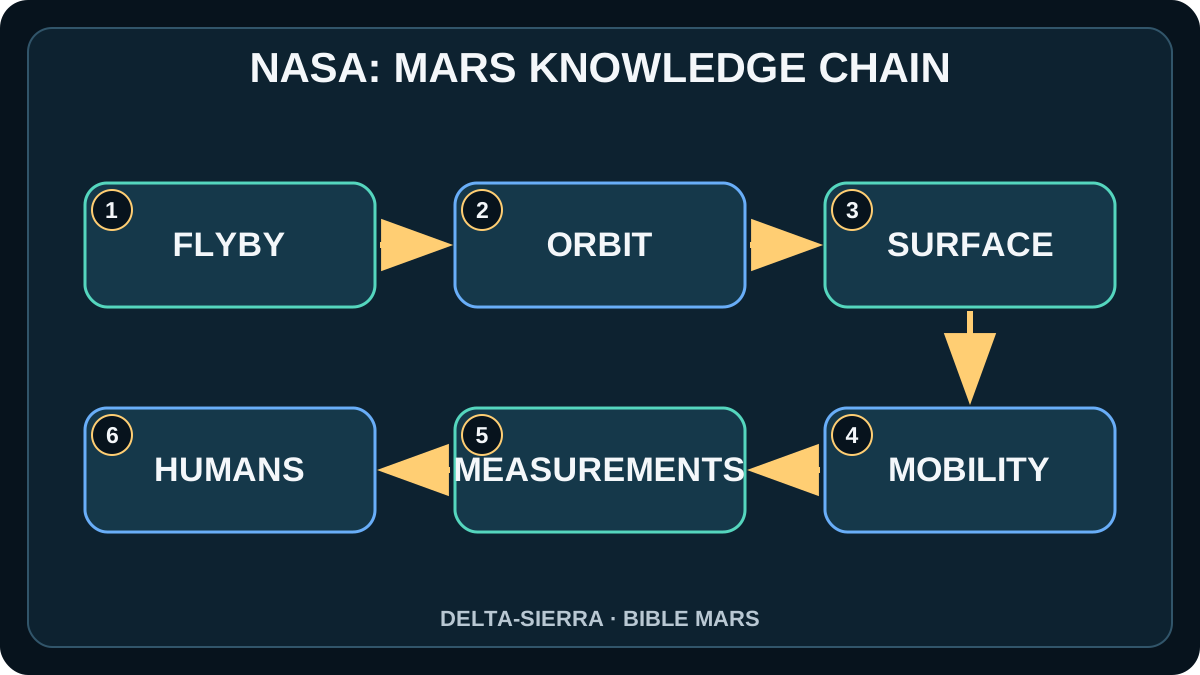
Viking at fifty: why 1976 still sits inside the human-Mars story
NASA's 2026 commemoration of Viking's fiftieth anniversary provides a useful historical anchor. Viking 1 landed on 20 July 1976 and Viking 2 on 3 September. Their significance for human exploration is not that the spacecraft were prototypes for human systems. It is that surface operations stopped being hypothetical. Mars had weather, soil chemistry, communications delays, landing-site hazards, thermal cycles and an atmosphere that instruments could measure continuously from the ground.
The Viking results also demonstrate how a mission can outlive its original conceptual frame. Mariner 4's narrow 1965 view had made Mars appear starkly lunar in places. Mariner 9 restored global geological complexity. Viking then added local ground truth and long-duration operations. The knowledge chain matters to human planning because every new measurement changes engineering priors: atmospheric density affects entry; dust affects mechanisms and power; surface chemistry affects ISRU and contamination control; terrain affects mobility and landing.
Human Mars architectures therefore sit on top of robotic history rather than beside it. A future crew would inherit landing statistics, mineral maps, weather records, radiation measurements, navigation experience and communications infrastructure built by missions that were never themselves “settlement” missions. The history of NASA and Mars is best understood as cumulative constraint reduction.
From Mariner to human architecture: every robotic mission removes an unknown and adds a constraint
Mariner 4 reduced uncertainty about close-range geology while revealing a harsher world than many had expected. Mariner 9 expanded coverage and showed that the earlier sample was incomplete. Viking added chemistry, weather and sustained surface operations. Later missions measured ancient water environments, mineralogy, radiation, dust and entry conditions. Each step removes an unknown while making human architecture more precise — and sometimes more difficult.
That is the productive paradox of exploration. Better knowledge does not guarantee an easier mission. A measurement can reveal a resource and also a contaminant. A site can be attractive for water and difficult for landing. Better atmospheric models improve entry prediction while confirming the challenge of slowing heavy payloads. Knowledge turns general dreams into quantifiable tradeoffs.
The history of NASA Mars planning therefore should not be read as a sequence of plans that “failed to happen.” Many studies served another role: they exposed technology gaps, compared assumptions and preserved common reference cases. In systems engineering, an architecture study can be valuable even when no vehicle is built, because it identifies which variables dominate the decision.
NASA’s human-Mars history is less a straight march than a succession of architectures shaped by the political, budgetary and technical constraints of their time. Propulsion, vehicle count, lunar role and ISRU change, while the same functions recur: move the crew, protect them, land heavy systems, work on the surface and return.
NASA’s 2026 Moon to Mars material makes that openness explicit: the Mars trade space remains broad and major decisions are still ahead. Historically, a published architecture is a dated snapshot of institutional reasoning, not evidence that one exact vehicle set will be built.
NASA’s Mars Architecture Trade Space page, updated March 17, 2026, explicitly describes the trade space as relatively open and identifies forward work. This page therefore treats current architecture products as dated institutional evidence rather than a completed Mars mission design.
A “reference mission” is not a flight promise
NASA Design Reference Missions build a common case detailed enough to calculate mass, duration, propulsion, logistics and risk. Their value is not that they predict the exact future vehicle. They provide a reference against which new technology or another architecture can be compared. A reference mission can therefore be technically important even when no hardware is built to its exact drawing.
This distinction changes how the archive should be read. Not every study is a “cancelled plan.” Some close questions; others make questions measurable. The current move toward a Mars trade space continues the same institutional function: organize decisions and expose unknowns before prematurely fixing elements.
Mariner and Viking transformed human mission design even though they were not human-program hardware
Mariner flybys constrained the atmosphere and surface. Mariner 9 revealed global geology. Viking measured entry, landing, local weather and surface chemistry. These missions did not demonstrate habitats or crew systems, yet they changed the boundary conditions those systems would face. Robotic science became engineering input.
This transfer is one reason Mars mission history cannot be separated into “robotic” and “human” books with no bridge. Entry density models, dust behaviour, terrain maps, radiation measurements and resource observations all feed human architecture. A human program inherits decades of robotic measurement before its first dedicated crew vehicle exists.
The 2026 trade-space language is historically cautious — and that caution is informative
NASA's current Mars pages explicitly leave multiple options open for transportation, landing and ascent. The agency notes that Mars ascent has never been attempted from the surface, and that ascent architecture could depend on whether propellant is delivered or produced locally. Those statements expose uncertainty rather than hiding it.
Historians of a future Mars program may eventually know which option won. A 2026 reader should not. The correct historical record is therefore a map of active decisions, technology gaps and demonstrated precursors. Preserving uncertainty now is what will later allow readers to see which decisions genuinely changed.
NASA human-Mars history is full of architectures that were useful without becoming programs of record
Studies can mature technology and decision methods even when no launch follows. Mission analyses define mass drivers; habitat studies reveal crew-volume and shielding trades; entry studies expose the difficulty of landing heavy payloads; ISRU work quantifies how local production could move propellant mass between Earth and Mars. Those results can survive the exact architecture that produced them.
This is why the archive should resist a binary classification of “flown” versus “failed.” A study can be institutionally valuable if it creates models, standards, test hardware or measurements later reused elsewhere. The question is what knowledge crossed into the next architecture.
Robotic precursor data are part of the human program's invisible inheritance
Surface pressure, atmospheric density, dust, mineralogy, terrain roughness, radiation and water evidence all affect human-system design. The people who develop a lander or habitat may never have worked on the spacecraft that measured those quantities, yet their requirements depend on that robotic history.
A useful human-Mars chronology should therefore include selected robotic milestones whenever they change a boundary condition. This avoids telling two disconnected histories — science on one side and human architecture on the other — when the engineering actually links them.
Open trade spaces are evidence of maturity when the missing evidence is identified
Keeping several options alive can look like indecision. In early architecture work it can be the opposite: a disciplined refusal to freeze a choice before the discriminating evidence exists. NASA's current Mars trade-space material leaves major transportation, landing and ascent choices open while identifying the questions that separate them.
The historical value of those documents is that they preserve the decision before hindsight. If one architecture eventually flies, future summaries will be tempted to make it look inevitable. The 2026 record shows that it was not.
Human architecture repeatedly returns to the same stubborn mass drivers
Across decades of studies, certain functions keep reappearing because physics does not negotiate: crew consumables, shielding, habitat volume, power, propulsion, entry mass, ascent propellant, spares and margins. Technologies can move those terms, but rarely eliminate the need to account for them.
This recurrence is valuable when reading new proposals. A genuinely new architecture should be able to identify which old mass driver it changes and by what demonstrated mechanism. If local oxygen reduces imported propellant, the analysis should show production rate, energy and storage. If reuse reduces hardware demand, it should show inspection and turnaround. Historical comparison becomes a tool for testing novelty.
NASA's evolving architecture documents preserve decisions as living engineering rather than a single frozen Mars plan
The Moon to Mars framework deliberately separates objectives, architecture components, decision documents and trade spaces. That structure makes it possible to update a choice without pretending every previous analysis was worthless. It is a different historical object from one definitive mission plan.
For a reader, this means dates and revision status matter. A 2026 architecture page describes the questions open in 2026; it should not be silently rewritten in historical prose as if later decisions were already known. Preserving that chronology is essential if Delta-Sierra is to remain useful years after the decisions change.
Technology readiness and architecture readiness are different histories
A component can mature without the mission architecture around it being ready. Oxygen production, habitat structures, autonomous navigation or life-support subsystems may each reach convincing test states while transportation, landing mass, surface power or logistics still prevent a complete campaign. Human-Mars history therefore needs two timelines: the maturity of individual technologies and the maturity of the integrated mission decisions that would use them. Confusing the two makes every promising demonstration look like an imminent flight program. Integration maturity also depends on interfaces, operating margins, verification evidence and an acceptable residual-risk posture.
Why Apollo did not automatically lead to Mars
The success of Apollo did not create an automatic staircase to Mars. Post-Apollo studies demonstrated that a human Mars mission could be described, but the cost and institutional commitment were far larger than the political appetite of the 1970s. The Space Task Group considered several futures, and the more ambitious paths implied major funding increases. [S39] The United States instead pursued the Space Shuttle, space stations and a long sequence of robotic planetary missions. Mars remained in studies because a destination can be technically attractive without becoming the highest national priority.
Mars Direct and NASA reference missions
Mars Direct proposed a leaner architecture with local propellant production, influencing debate about ISRU and mission simplification. NASA reference missions then created repeatable points of comparison rather than a single immutable design. Modern architecture work continues this systems approach: missions are campaigns with logistics, interfaces and evolving capabilities.
NASA design reference missions were created to make trade studies comparable. DRA 5.0, for example, was explicitly a reference architecture rather than a formal flight plan: it linked transportation, pre-deployment, surface stay, ascent, logistics and technology choices so that alternatives could be evaluated against a common case. That status matters historically. A reference architecture can influence technology investment and engineering language even if the agency never turns it into a program of record. It is part of the history of how Mars was made calculable inside an institution.
The reference-mission tradition also shows why robotic exploration and human planning cannot be separated. Better maps, atmospheric measurements, radiation data, landing performance and knowledge of surface materials change the assumptions that a human architecture must carry. Each robotic generation can therefore remove one uncertainty while revealing another. Human-Mars studies recur not because earlier work was useless, but because the boundary conditions keep moving as vehicles, science objectives, budgets and evidence change.
Mariner 4 changed the mental model
The 1965 flyby delivered close-up images of a cratered surface and forced planners to confront a harsher Mars than many popular visions had assumed. Robotic reconnaissance can therefore invalidate a human architecture before it is built; that is one of its highest-value functions.
Mariner 9 restored complexity
The first Mars orbiter revealed a much richer planetary geography, including enormous volcanoes, canyons and channels. Mars history repeatedly alternates between simplification and rediscovery. Robust settlement planning must remain adaptable to new observations.
Viking turned Mars into an operating environment
Viking demonstrated interplanetary navigation, entry, descent, landing, power generation and long-duration surface operations. Every robotic mission can be read as a partial test of functions future human systems will also require.
Mars Direct reframed the mass problem
Mars Direct became influential because it argued for a leaner architecture and local resource use. Its broader lesson is methodological: when a system becomes too large, redesign the scenario itself instead of only making each component larger.
Robots replace speculation with constraints
Mariner 4 changed the terms of the Mars debate because it supplied close-range evidence instead of telescopic inference. The first images showed a cratered terrain and atmospheric measurements pointed to a much thinner atmosphere than optimistic mid-century landing concepts had assumed. [S03][S25] Mariner 9 then arrived during a planet-encircling dust storm and, as conditions cleared, mapped enormous volcanoes, Valles Marineris and channels that suggested a complex environmental past. [S04][S26] Every robotic mission tightened the engineering boundary conditions for a future human mission.
Viking 1 and Viking 2 brought that transition to the surface in 1976. Their landers operated directly in the Martian environment while orbiters provided global context. The biology experiments did not establish the presence of life, but the mission created an enduring body of atmospheric, chemical and imaging data. [S05][S27] Later missions would add mineralogy, high-resolution topography, subsurface clues, weather records and increasingly sophisticated rover operations.
Mars Direct and reference missions: attacking mass and complexity
By the late twentieth century, Mars mission design increasingly focused on reducing the mass that had made earlier architectures daunting. Mars Direct proposed using local Martian resources to manufacture return propellant and separating cargo deployment from crew arrival. [S30] NASA design reference missions then provided repeatable frameworks for comparing launch vehicles, habitats, transit vehicles, surface systems and mission sequences. [S31][S32] The details changed across versions, but the discipline mattered: Mars planning became a living architecture process rather than one canonical design.
1969: When Mars might have become the post-Apollo destination
After Apollo 11 the question was not only technical. The Space Task Group examined several post-Apollo program options, including paths toward a human Mars mission before the end of the twentieth century. Some options required a major increase in NASA funding; others delayed Mars or left it without a firm date. [S39] The episode shows why a credible architecture alone does not create a program: it also needs political support, schedule, industry and sustained budget.
1965: Before success, Mars exploration was mostly a history of failure
The early chronology is brutal. Soviet attempts in 1960 failed at launch. Mars 1 lost communications. The United States lost Mariner 3 when its launch shroud failed to release. NASA's National Space Science Data Center chronology lists failure after failure before the first successful flyby. [S60]
This matters because interplanetary exploration is not merely a spacecraft problem. The mission has to launch in a narrow window, navigate for months, preserve power and communications, then encounter a moving planet tens of millions of kilometers away. Each failure exposed another part of the system.
Mariner 4: a handful of images rewrites a world. Mariner 4 returned the first close-up views of Mars and of any planet beyond Earth. [S25] The cratered terrain and thin atmosphere demolished many popular images of a near-Earthlike world. Yet Mariner 4 saw only part of the planet. Mariner 9 would later demonstrate how dangerous it was to turn a first glimpse into a global conclusion.
1971: Orbit changes the scale of knowledge. Mars 2, Mars 3 and Mariner 9 reached Mars during a remarkable campaign. Mariner 9 became the first spacecraft to orbit another planet. A global dust storm initially hid much of the surface; when it cleared, enormous volcanoes, Valles Marineris and ancient channels revealed a planet far more geologically diverse than the Mariner 4 strip had suggested.
Viking: put a laboratory on the surface and ask about life. Viking 1 and Viking 2 combined orbiters and landers. NASA describes Viking as the first fully successful U.S. landing program on Mars and the first NASA mission designed to search directly for evidence of life. [S63] The biology results did not provide a generally accepted detection of life, but they changed the question itself by forcing scientists to understand the chemistry of the soil and the limits of the experiments.
Direct answer: why NASA matters to the story of Mars
NASA deserves its own dossier because established in 1958. [1] The goal is not to rank organizations but to understand one as a system: history, decision centers, infrastructure, technologies, successes, failures and the capabilities it contributes — directly or indirectly — to Mars exploration.
From Mariner and Viking to rovers, global science infrastructure and Moon to Mars architectures. This dossier separates demonstrated achievements, formally committed programs and prospective concepts. Institutional sources are preferred; where an outside assessment is used, its origin is labelled explicitly.
GO FURTHER
Mars Library
This book extends the page with a complete settlement architecture. The dossier above remains deliberately self-contained: Arcadia is optional further reading, not a prerequisite for understanding it.

Essential timeline
- 19581958
- 19651965 Mariner 4
- 19761976 Viking 1
- 19971997 Pathfinder/Sojourner
- 20042004 Spirit/Opportunity
- 20122012 Curiosity
- 20212021 Perseverance/Ingenuity
- 2030s2030s human-Mars enabling technologies
Understand the organisation before looking at its rockets
A space organisation is never just a logo, a launch vehicle or a spectacular mission. To understand NASA, one must separate political goal-setting, program management, engineering centers, industrial manufacturing, science teams and mission operations. This matters especially for Mars because a successful interplanetary mission requires many chains to remain coherent for years, across institutions that do not always share the same incentives or vocabulary. In this case, one useful anchor is that established in 1958. [1] Another is that Mariner 4 completed the first successful Mars flyby in 1965. [2] These are verifiable facts; by themselves they do not guarantee success of any future program.
For Mars the useful question is: what dependency does this subsystem create? Even if NASA masters one capability, it must still interface with transportation, power, communications, navigation and science operations. Real maturity lives at that boundary between local expertise and global architecture.
Institutional schedules must also be separated from physical constraints. Announcements can move; planetary geometry, mass, power and the speed of light do not negotiate. The dossier therefore gives priority to material evidence — tests, integrated hardware, launches and returned data — where available.
Why Mars exposes the true maturity of a space program
Mars is an unforgiving maturity test. Communications are delayed, launch windows are infrequent, mass and energy margins are tight, atmospheric entry is difficult and onboard autonomy matters more than in near-Earth operations. Looking at NASA through Mars therefore reveals not only what it announces but which capabilities it can actually integrate, test and operate. In this case, one useful anchor is that Mariner 4 completed the first successful Mars flyby in 1965. [2] Another is that Viking 1 landed successfully in 1976. [3] These are verifiable facts; by themselves they do not guarantee success of any future program.
The technical chain from Earth to the Martian system
For the public a mission may seem to start at launch. For engineers it starts far earlier with requirements, interfaces, verification, margins, software, navigation, thermal control and communications. The theme of surface robotics illustrates this systems view. Each subsystem has its own physics, yet a mission can still fail at the interfaces. Integration is therefore a capability in its own right. In this case, one useful anchor is that Viking 1 landed successfully in 1976. [3] Another is that NASA operates a continuing robotic Mars program and develops technologies for future human missions. [4] These are verifiable facts; by themselves they do not guarantee success of any future program.
Why failures often teach more than success releases
Space history is full of failures, anomalies and redesigns. They do not automatically diminish an organisation; they reveal whether it can learn. A failure becomes useful when its cause is understood, procedures change and the next design absorbs the lesson. On Mars, where another attempt may wait for a new planetary window, institutional learning is an engineering asset. In this case, one useful anchor is that NASA operates a continuing robotic Mars program and develops technologies for future human missions. [4] Another is that Mars remains a horizon goal in Moon to Mars planning. [5] These are verifiable facts; by themselves they do not guarantee success of any future program.
Communications: commanding a machine that is no longer “live”
At interplanetary distance the word remote control changes meaning. Light-time delay cannot be negotiated away. Spacecraft must protect themselves, wait, diagnose some conditions and execute sequences without asking Earth for permission every second. The theme of planetary science therefore combines ground antennas, radio power, coding, onboard storage, mission planning and autonomous software. In this case, one useful anchor is that Mars remains a horizon goal in Moon to Mars planning. [5] Another is that established in 1958. [1] These are verifiable facts; by themselves they do not guarantee success of any future program.
Why mass governs almost everything
Every kilogram sent to Mars propagates through the design: structure, propulsion, thermal needs, power, atmospheric entry and surface logistics. Mass discipline is not simply about making hardware light; it is about knowing where an extra kilogram buys robustness or science. The architectures of NASA can therefore be read as repeated trades among mass, energy, risk, cost and schedule. In this case, one useful anchor is that established in 1958. [1] Another is that Mariner 4 completed the first successful Mars flyby in 1965. [2] These are verifiable facts; by themselves they do not guarantee success of any future program.
Science and engineering must learn each other’s language
A science instrument may demand stability, temperature control or viewing geometry that complicates the spacecraft. A systems team may simplify the vehicle so aggressively that scientific value is lost. Strong missions make these communities converge early. The theme of sample return shows how a scientific question becomes a requirement, an instrument, an interface, an operations sequence and finally interpretable data. In this case, one useful anchor is that Mariner 4 completed the first successful Mars flyby in 1965. [2] Another is that Viking 1 landed successfully in 1976. [3] These are verifiable facts; by themselves they do not guarantee success of any future program.
From one-off missions to infrastructure
A program becomes more powerful when it stops rebuilding every capability from zero. Reusable software, standards, test facilities, ground networks, teams and interfaces lower the cognitive cost of the next mission. This is why the history of NASA is more interesting than a list of launches: the key question is which capabilities persist across generations. In this case, one useful anchor is that Viking 1 landed successfully in 1976. [3] Another is that NASA operates a continuing robotic Mars program and develops technologies for future human missions. [4] These are verifiable facts; by themselves they do not guarantee success of any future program.
Partners: autonomy does not mean isolation
Even major space powers depend on partners for instruments, ground stations, launch services, laboratories, components or science expertise. Cooperation can accelerate a mission but also creates dependencies. A Mars architecture therefore needs to decide what may be shared, what should be redundant and which strategic capabilities an actor wants to control directly. In this case, one useful anchor is that NASA operates a continuing robotic Mars program and develops technologies for future human missions. [4] Another is that Mars remains a horizon goal in Moon to Mars planning. [5] These are verifiable facts; by themselves they do not guarantee success of any future program.
Technical data explained in plain language
A technical number matters only if its consequence is understood. Thrust tells us how much mass can be accelerated; electrical power determines what computers and instruments can do; data rate constrains how many images and spectra can be returned; navigation accuracy shapes the arrival corridor. This dossier keeps sourced numbers but always links them to mission consequences. In this case, one useful anchor is that Mars remains a horizon goal in Moon to Mars planning. [5] Another is that established in 1958. [1] These are verifiable facts; by themselves they do not guarantee success of any future program.
Maturity: demonstrated, qualified, planned or merely studied
Space programs use words that may sound similar but are not equivalent. A studied technology is not built hardware; a ground prototype is not flight-qualified equipment; an approved mission is not a launched mission. For NASA, this dossier separates achievements, committed programs, announced schedules and prospective concepts so that ambition is not silently converted into fact. In this case, one useful anchor is that established in 1958. [1] Another is that Mariner 4 completed the first successful Mars flyby in 1965. [2] These are verifiable facts; by themselves they do not guarantee success of any future program.
What this organisation contributes specifically to Mars
The Mars relevance of NASA is better measured through transferable capabilities — entry, descent and landing, deep-space navigation, autonomy, sample return, surface operations, instrumentation or transportation — than by counting how often the word Mars appears in public messaging. An organisation can matter greatly to Mars without currently running a human settlement program. In this case, one useful anchor is that Mariner 4 completed the first successful Mars flyby in 1965. [2] Another is that Viking 1 landed successfully in 1976. [3] These are verifiable facts; by themselves they do not guarantee success of any future program.
NASA as an institution: why Mars is a continuity problem before it is a vehicle problem
NASA often appears in Mars history through successive spacecraft, but the agency itself is an architecture: centers, mission directorates, partner laboratories, industrial contracts, communication networks, safety processes and science communities. Mariner, Viking, the rovers and orbiters did more than add machines; they built chains of competence that make the next mission possible. That institutional continuity explains how an agency can learn over decades even while vehicles and teams change. [institutional source]
For a future human mission, continuity matters even more. Transport, atmospheric entry, habitat, health, communications, power and surface operations belong to different organizations and still have to function as one system. Mars-program maturity is therefore measured less by a spacecraft illustration than by the ability to close interfaces, fund intermediate demonstrations, preserve lessons learned and distinguish a reference study from a funded program commitment. [institutional source]