


Durability, sealing, electronics and FDIR on Mars

A Mars base ages even when it appears motionless
“Durability, sealing, electronics and FDIR on Mars” addresses durability as accumulated mechanical, thermal, dust, radiation and electronics degradation.
The central observables are leak rate, cycles, temperature, dose, memory errors, sensor drift, FDIR events and vibration trend.
Those omissions are engineering information.
NASA reliability and systems practice treats detection/recovery as complementary to understanding the physical aging mechanism
This evidence is used only for what it demonstrates.
Recompute time-dependent margin = limit - measured_value(t) with units visible. The result is not accepted in isolation: then check whether the change also modifies leak rate, cycles, temperature, dose, memory errors, sensor drift, FDIR events and vibration trend.
Slow degradation is often harder than a clean failure
Many Mars failures will begin as trends: a seal leaks a little more after every pressure cycle, a dusty connector gains resistance, a battery loses usable capacity or a sensor zero drifts. FDIR therefore has to compare histories rather than wait for one threshold crossing. In a pressurised volume, for example, pressure rate must be interpreted with temperature, volume and operating state; otherwise cooling can be misdiagnosed as leakage. Critical electronics need enough independent telemetry to separate physical ageing, measurement error and a corrupted computed state.
Durability then becomes a maintainability design problem. Seals, boards, harnesses and sensors do not age by the same mechanism and cannot be checked with the same tool. A robust base provides measurement points, replaceable units, fallback configurations and inspection triggers that act before loss of function. Recovery is complete only when the system has returned to a verified envelope with an understood cause; clearing an alarm without explaining the trend is not a return to nominal operation.
Leakage and ageing need trend limits as well as alarm limits
A pressure system can remain above its low-pressure alarm while its leak rate is already worsening. One useful derived quantity is a pressure-loss rate corrected for temperature and known operating events. The same idea applies to electrical health: battery internal resistance, connector voltage drop, sensor bias and memory-error rate can reveal degradation before a hard failure. Trend thresholds should be connected to inspection or replacement actions with enough lead time for logistics. The diagnostic system also needs a baseline after every repair, because a changed seal, cable or software filter can shift normal behaviour. Long-duration reliability comes from recognising these slow changes early enough that the crew still has several recovery options.
Environmental coupling should be recorded in the maintenance history
A seal leak, connector fault or sensor drift can depend strongly on temperature, dust exposure, pressure cycles and recent maintenance. Recording the environmental context of each anomaly allows later failures to be compared on more than a component name. Over years, the settlement can distinguish random faults from repeatable degradation mechanisms and can change inspection intervals before the same mechanism becomes a fleet-wide problem.
Fault isolation should preserve evidence before reset
Automatic recovery can destroy the evidence needed to understand a slow fault. Before a controller resets a channel, switches to a spare or clears an alarm, it should preserve the relevant state history when memory and safety permit. That snapshot can include temperatures, supply voltages, pressure trends, error counters and recent commands. The crew then has a record of the pre-failure condition even if the backup restores service immediately. This is especially valuable for intermittent electronics and leakage problems that disappear after cycling power or changing pressure. The recovery logic therefore balances two goals: restore a safe function quickly and retain enough evidence to prevent the same hidden mechanism from recurring.
Redundancy, electronics and sealing: avoiding false security
choosing inspection, preventive replacement or run-to-limit based on criticality and observability
cycle testing, justified accelerated aging, trend monitoring, fault injection and periodic inspection
Verification asks whether the requirement is met;
From a new system to infrastructure maintained for decades
Deepening — from mission reliability to long-term technical asset management
A permanent base must know the real age of its systems
Short missions can be built around relatively new, qualified hardware operated for a bounded duration. A settlement has equipment of different ages, histories and environments. Two identical pumps can carry very different risk if one has seen more starts, dust, thermal cycles or temporary repairs. Maintenance therefore needs a measure of consumed life rather than manufacture date alone.
This leads to an equipment life record: operating hours, cycles, temperatures, vibration, incidents, replaced parts, software versions and inspection results. The purpose is not infinite telemetry. It is to explain why the equipment is considered fit for service. A life-extension decision should be traceable: which margins remain, which inspection was completed and which additional risk is being accepted?
At a population of one thousand, this starts to resemble terrestrial rail, power or industrial asset management. The difference is that replacing an entire infrastructure from Earth may take years. Durability becomes policy: prioritize, refurbish, standardize, sometimes cannibalize, manufacture locally and identify items that must never exceed a hard qualified life.
Leak integrity should be monitored as a trend, not only an alarm threshold
A slow leak may remain below an instantaneous alarm while consuming reserves for weeks. Operators should therefore examine the derivative — how pressure or gas inventory changes with time. A loss rate rising from 0.1 to 0.3 units per day is more informative than either value alone even if both remain “green.” Predictive maintenance often begins with simple trend awareness.
Localization requires isolatable volumes, valves and circuits. Tracers, ultrasound, differential pressure or targeted inspection may be used depending on the leak type. Access to seals and penetrations must be designed in. A fitting buried behind inaccessible structure becomes maintenance debt. On Mars, maintainability must be a real design requirement alongside mass.
Sealing also applies outside pressure vessels. Connectors, electronics boxes, bearings and optics must manage dust and thermal cycling. “Sealed” is never absolute; it should always mean sealed against something, at a stated pressure or particle environment, for a stated duration and cycle count.
Ageing electronics require us to distinguish hard failures from drift
Electronics can fail abruptly, but they can also drift: sensor offset, rising noise, declining capacitor performance or increasing connector resistance. Drift is dangerous because it can remain plausible. A completely dead sensor is easy to flag; one that is wrong by three percent can steer decisions for months.
Redundancy should therefore compare measurement quality, not merely count channels. Three identical sensors exposed to the same environment may age together. Diversity — different technologies, locations or measurement principles — reduces some common causes but complicates calibration and spares. The right balance depends on function and dominant failure modes.
Radiation adds transient and cumulative effects. Memory correction, watchdogs, reconfiguration and safe modes can survive some events, but they do not make electronics immortal. A Mars town needs stock, test benches and eventually repair or manufacturing capacity for the components that truly govern survival.
FDIR: detect, isolate and recover without creating a worse failure
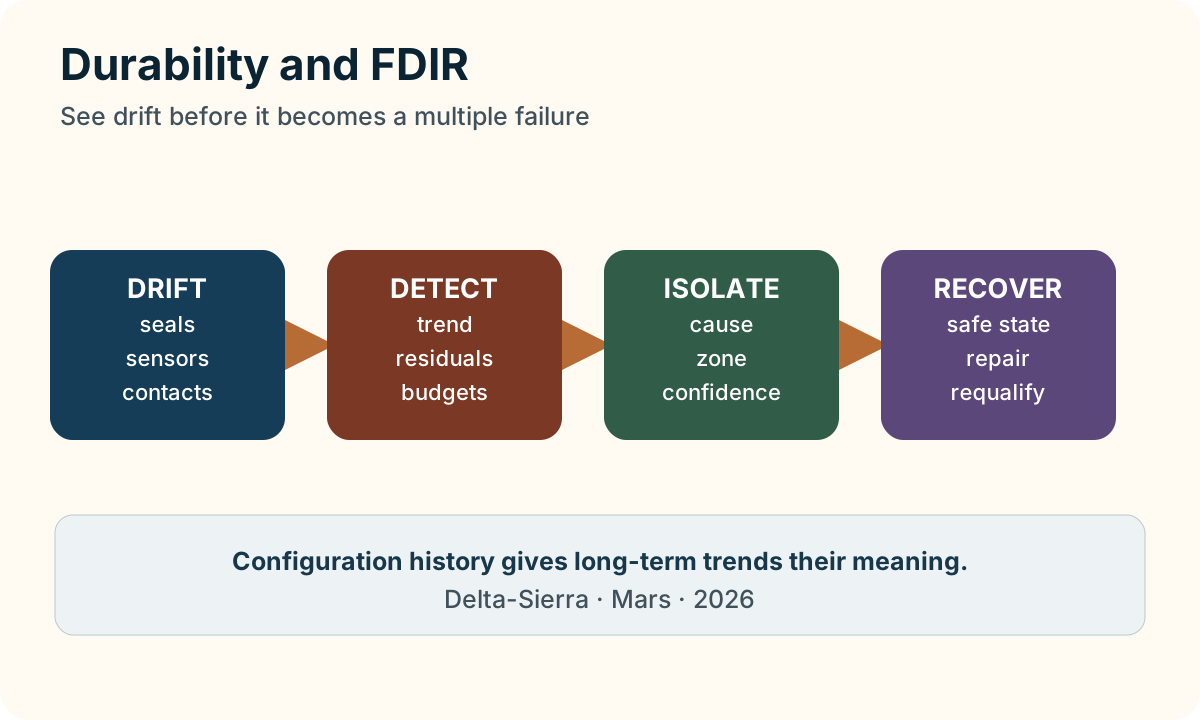
FDIR means Fault Detection, Isolation and Recovery. The three steps should remain separate. An abnormal value can establish that something is wrong without identifying where. Isolation narrows the probable component or function. Recovery then selects an action: switch redundancy, restart, shed load, close a valve or enter safe mode. Treating detection as diagnosis encourages premature action.
The system must understand the cost of its own recovery actions. Restarting a computer may clear a transient fault while interrupting critical control. Closing a valve may isolate a leak but remove cooling from another subsystem. FDIR rules therefore need dependency knowledge and graded responses. Millisecond instabilities may require automatic protection; a slow ambiguous fault can justify human confirmation.
Testing should inject both single and combined faults. A system that handles “sensor A dead” can still fail when sensor A drifts while communications are lost. Rare combinations expose hidden assumptions. A Martian systems test bench should therefore become permanent infrastructure, not merely a pre-launch activity.
Durability ultimately depends on upgrading without rebuilding everything
A thirty-year settlement cannot remain frozen at its founding technology. It must replace computers, change protocols, modernize sensors and add modules without breaking all existing interfaces. Internal standards for voltage, connectors, mechanics, data and safety extend the life of the whole system. Yet a standard that never evolves can block innovation, so versioning and gateways matter.
Configuration management then becomes a civic function. Who authorizes firmware? How is the installed version of every module known? What rollback exists? Which parts are obsolete? Aerospace configuration discipline has to expand into infrastructure shared by different services and companies.
The ultimate question is therefore not “how many years can this part theoretically last?” but “can the function be sustained for decades despite wear, obsolescence and mistakes?” A durable Martian society is not a museum of space hardware. It is an infrastructure capable of repairing and transforming itself without losing life-critical functions.
Moving from reliability to multi-decade ageing management
Track degradation before it crosses the failure threshold
A Mars installation must distinguish sudden failure from progressive ageing. A pump may stop abruptly, while a seal slowly increases its leak rate, a converter runs progressively hotter, a sensor loses calibration or connector resistance rises. If data are reduced to a simple good/bad state, the system sees the problem too late. Condition-based maintenance follows trends: initial value, normal dispersion, drift rate, measurement uncertainty and the threshold at which action becomes necessary.
That requires history by serial number and configuration. Nominally identical units can experience very different lives because of dust, thermal cycling, vibration, radiation and maintenance. An ageing record should link anomalies to environment and operations so that maintenance intervals can gradually be adapted to Mars instead of copying Earth schedules forever.
Treat tightness as a permanent budget
A pressurized architecture has a leakage budget just as it has mass and power budgets. Seals, valves, airlocks, penetrations and fittings all contribute. Small degradation distributed over a hundred interfaces can matter even if no single interface exceeds its local limit. Monitoring therefore needs both local component qualification and a global balance of make-up gas consumption.
The same principle applies to electronics. FDIR means Fault Detection, Isolation and Recovery. Useful FDIR does more than raise an alarm; it connects symptoms to hypotheses, discriminating tests, safe configuration and recovery strategy. As hardware ages, diagnosis has to allow for several weak degradations combining into one system-level problem.
Upgrade equipment without losing qualification
A twenty-year settlement cannot retain the same computers, sensors and software indefinitely. Generations of components have to be replaced while the wider system keeps operating. Every modernization is therefore an interface problem: electrical characteristics, protocols, mechanical fit, data, tools and procedures. A part that is “better” on paper can be unusable if it requires an unavailable power rail, connector or software version.
Durability needs an obsolescence policy: monitored components, strategic stocks, validated substitutes, test benches and local ability to manufacture selected interfaces. At a thousand residents the objective is no longer merely extending the original equipment; it is configuration engineering capable of introducing new generations without turning every change into a hazardous experiment.
Verification cases and operational margin
Create measurable health indicators for every critical function
A durability program does not need to predict the exact date of every failure; it needs to detect loss of margin early enough to act. For a pump, useful indicators may include current, vibration, temperature and flow. For a pressure vessel, make-up gas use and pressure-decay rate can become health metrics. Electronics can expose reference voltages, memory error rates and junction temperatures. Each indicator needs a nominal value, acceptable range, measurement uncertainty and escalation rule; otherwise “monitor the trend” remains vague.
Over decades, reference parts and calibration benches also matter. Comparing a new sensor with one that has ten years of service helps distinguish actual ageing from drift in the measurement method itself. This metrology of durability prevents a settlement from gradually normalizing degradation simply because all of its instruments have aged in the same direction.
Case study — distinguish leakage, temperature and sensor drift
In 500 m³ at 70 kPa and 295 K, a true 1% drop gives Δp = 700 Pa. Using Δn = ΔpV/(RT), with R = 8.314 J/mol/K, loss is about 143 mol. At roughly 29 g/mol molar mass, that is approximately 4.1 kg of gas.
Cooling can lower pressure without leakage; a sensor can drift; a seal can degrade gradually. Diagnosis needs pressure, temperature, make-up flow and an independent measurement.
Coupons, accelerated cycling and field history must connect leak rate, contact resistance and electronic drift to measurable maintenance thresholds.
Age without going blind: turn durability into a monitored system
Mars infrastructure can remain operational while moving slowly toward a limit. A seal loses elasticity, a connector gains a few milliohms, a sensor drifts, insulation accumulates thermal-cycle damage or electronics experience radiation effects. Ageing is not automatically catastrophic. The dangerous condition is ageing that is invisible until several margins are consumed together. Durability therefore needs measurements, trends, intervention criteria and configuration history from the beginning.
A leak is a logistics rate as well as a pressure defect
Suppose a pressurised volume has an equivalent gas-loss rate ṁ = 0.20 kg/day. The symbol ṁ (“m-dot”) denotes mass flow rate. Over Δt = 30 days, lost mass is m = ṁ × Δt = 6 kg. If only 60 kg of make-up gas is allocated to that function, one month of seemingly small leakage consumes ten percent of the reserve. The numbers are illustrative; the useful insight is that a chronic leak converts directly into resupply and maintenance demand.
Finding the leak is a system operation. Isolation valves, pressure trends, acoustic methods or tracers can narrow the location, but isolating a section may also change ventilation, cooling or emergency access. Procedures need to state which services are sacrificed and how long the diagnostic configuration is acceptable.
Thermal cycling attacks interfaces
Boards, solder joints, connectors and housings do not necessarily expand at the same rate. Repeated hot–cold cycles load those interfaces. Calendar age alone is therefore a poor descriptor. Useful life data can include cycle count, temperature amplitude, dwell, ramp rate and electrical contact resistance. A part that has lived gently for six years may be in better condition than a younger part repeatedly exposed to severe cycles.
FDIR separates fault, symptom and consequence
FDIR means Fault Detection, Isolation and Recovery. Detection asks whether observed behaviour is abnormal. Isolation asks which cause best explains the evidence. Recovery chooses a configuration that keeps required functions with acceptable risk. A current increase, for example, may come from a bearing, wiring resistance, mechanical load or an erroneous sensor. Replacing the motor immediately can spend a scarce spare while leaving the actual cause untouched.
Redundancy does not defeat a common cause
Two channels may share the same design defect, software, connector, power source, calibration process or environment. The important question is not “How many boxes?” but “Which causal resources are independent?” FMECA—Failure Modes, Effects and Criticality Analysis—systematically examines failure modes and consequences. Fault-tree reasoning starts from an unwanted event and asks what combinations can create it. These methods are valuable because they expose dependence; merely completing a worksheet does not make the system reliable.
Example: two computers agree on the same wrong truth
Two controllers report identical temperature because both consume the same miscalibrated sensor. Voting gives no independence. A stronger architecture may compare a second physical measurement, a thermal model or a sensor based on a different principle. Diversity has value only when its failure causes are genuinely separated.
A failure rate is not an individual countdown clock
Under a simplified exponential model, reliability can be written R(t) = e−λt. R(t) is probability of no failure through time t, λ is a constant failure rate and e is the base of natural logarithms. With λ = 2 × 10⁻⁵ h⁻¹ and t = 10,000 h, R ≈ e−0.2 ≈ 0.819. This does not predict that a particular unit will fail at a specific hour. It is a population model under assumptions and may be inappropriate for infant mortality, wear-out or changing environmental stress.
Manage a thirty-year technical asset, not merely a replaceable component
A durable settlement needs configuration history that follows the physical item: lot, firmware, repairs, calibration, cycle exposure, incidents and substituted parts. Without that chain, two externally identical devices can carry different risk. Predictive maintenance is useful only when the data is attached to the correct hardware and the as-maintained configuration matches what operators think exists.
Slow-fault scenario: seal leakage hidden by automatic compensation
Imagine a seal whose leak grows slowly. Pressure regulation adds gas, so the habitat never crosses an urgent pressure threshold. A slightly drifting flow sensor hides part of the change. The anomaly becomes visible only when gas inventory, injection mass, pressure and temperature are reconciled over time. Long-horizon FDIR must therefore detect budget inconsistency, not just instantaneous out-of-limit measurements.
Degraded modes should tolerate uncertainty
When diagnosis remains ambiguous, the system needs a safe condition that limits consequence without pretending to know the cause. Isolating a compartment, reducing bus voltage, disabling a secondary actuator or requiring manual inspection can be better than aggressive automatic reconfiguration. This “right to uncertainty” matters on Mars because some faults will not exactly match prelaunch models.
A maturity test for every vital function
A review should be able to state what degrades, how degradation is observed, which threshold triggers intervention, which degraded state keeps the function safe, and how restoration is performed. If restoration depends only on a quick Earth resupply, the design has not yet achieved Mars-level maintainability.
Slow degradation needs trend detection before it becomes a fault
Many deep-space failures do not begin as a clean binary event. A seal can leak slightly more after each thermal cycle; connector resistance can creep upward; a sensor bias can drift as radiation dose accumulates. If FDIR waits for a hard threshold, the system may discover the problem only after redundancy or repair time has already been consumed. Durability therefore requires trend monitoring as well as fault detection.
Leakage offers a concrete example. A pressure vessel can be checked by tracking pressure and temperature together, because pressure naturally changes when gas temperature changes. A pressure fall that appears alarming by itself may be consistent with cooling; conversely, a small pressure loss at constant temperature can reveal a real mass leak. The diagnostic model should therefore normalize the measurement for temperature, estimate the leak rate over several intervals and compare the result with sensor uncertainty. A rising trend can trigger inspection while the system is still fully functional.
Electronics require a similar distinction between transient and cumulative effects. A single-event upset may corrupt one memory cell and disappear after correction, while total ionizing dose and repeated thermal cycling progressively change component behavior. Recovery logic that simply reboots after every anomaly can hide a deteriorating component. Event counters, error location, temperature history and configuration records should be correlated so that repeated “recoverable” events can be promoted to a maintenance action. The durable system is the one that recognizes deterioration early enough to choose when and how to intervene.
Pressure integrity: design barriers, sectors and leak search that can actually be performed
Habitat integrity is not simply “a strong shell.” It depends on pressure walls, penetrations, hatches, seals, valves, pipes and maintenance interfaces. A durable architecture divides the volume into sectors that can be isolated without simultaneously removing ventilation, emergency egress or access to vital functions. Fine segmentation improves localisation but adds valves, sensors and interfaces that can themselves fail.
Pressure decay is useful evidence, yet temperature and volume matter. For an ideal gas, PV = nRT. P is pressure in pascals, V volume in cubic metres, n amount of substance in moles, R the gas constant and T absolute temperature in kelvins. A pressure change is therefore not automatically a leak. Diagnostics reconcile pressure with temperature, make-up gas, valve position and system state.
Sector tests can create their own hazards
Leak isolation may close sections sequentially and observe the response. That procedure changes airflow and access. Closing the wrong ventilation path or trapping a crew member behind a barrier can turn diagnosis into a new emergency. Leak-search procedures need integrated rehearsal with actual layout and occupancy cases.
Replaceable seals need repairable interfaces
Stocking seals is not enough. The mating surface must remain clean and inspectable; fasteners must be serviceable; required torque and lubrication need controlled procedures; and the repaired joint needs a leak test. A spare cannot restore function if the flange is warped or no post-repair verification method exists.
Electronics ageing combines radiation, thermal environment, dust and software configuration
External electronics experience radiation, thermal cycling and dust; internal hardware sees a gentler environment but still accumulates heat exposure, operating hours and software change. A circuit board can be physically healthy while incompatible firmware makes it unsafe, or the opposite. Long-duration configuration therefore treats hardware and software as one maintained asset.
Derating keeps components away from known limits
Derating uses electrical, thermal or mechanical components below rated limits to preserve margin. If a 100 V-rated capacitor is limited to 60 V nominal use, its simple utilisation ratio is 60/100 = 0.60. That ratio is not a universal reliability law; acceptable derating depends on technology, temperature, mission class and applicable standards.
Nominal derating is meaningless if degraded configurations routinely drive the same component to 95 V. Failure and recovery modes must therefore be included in the stress ledger.
Transient electronic faults require careful classification
A radiation-induced bit upset may be transient while a memory cell, sensor or software defect can be persistent. Error-correcting memory, scrubbing, restart, cross-checks and protected state can all help. Automatically rebooting everything on every inconsistency can itself become a common-cause failure if channels share the same boot image or lose valuable diagnostic evidence.
Condition-based inspection: replace when evidence justifies it, not only when a calendar says so
An isolated settlement cannot afford to replace every component on conservative terrestrial intervals if that consumes inventory unnecessarily. It needs indicators that actually track degradation: contact resistance, motor current, vibration, gas loss, calibration drift, cycle count, signal noise or memory error rate. Some maintenance can then shift from fixed calendar intervals toward observed condition.
Condition data needs action thresholds. A sensor stream without a threshold or decision rule becomes an archive rather than maintenance support. Thresholds may be absolute, relative to a baseline or based on rate of change. Measurement uncertainty matters: responding to every normal fluctuation can waste spares as effectively as responding too late.
Combined drift scenario
A pump draws eight percent more current, measured flow is four percent lower and bearing temperature rises slowly. No single value crosses a hard alarm. Together, the trends suggest increasing mechanical resistance. A mature health-monitoring system can correlate them and schedule inspection before a hard failure consumes redundancy.
Equipment history must survive generations of operators
After twenty years, the original installers may no longer be present. Records need to explain modifications, expected trends, previous faults and unsuccessful repairs. Durable information is part of durable hardware: without it, future crews repeatedly rediscover the same failure mechanisms and may apply obsolete procedures to modified equipment.
Trend leakage before it becomes a depressurization event
A pressure vessel or fluid loop rarely needs to jump directly from “sealed” to “failed.” Small changes in make-up flow, valve duty cycle, pressure decay and acoustic signatures can reveal a growing leak. The difficulty is separating real degradation from temperature-driven pressure changes and sensor drift. Cross-checks using independent measurements and controlled isolation tests make the trend actionable.
FDIR should therefore retain history rather than only threshold crossings. A slow increase that remains below an alarm limit can still be significant over hundreds of cycles. Maintenance planning benefits when the system can estimate whether the margin is stable, deteriorating or recovering after an intervention.
Primary sources to read
- NASA Safety and Mission Assurance — Reliability and Maintainability
- NASA — Systems Engineering Handbook
- NASA-STD-8729.1 — Reliability and Maintainability Standard
- NASA NTRS — Utilizing Gaps and Key Performance Parameters to Inform NASA Environmental Control and Life Support Systems and Human Health and Performance Capability Technology Decisions — technology gaps and critical elements
- NASA NTRS — Gateway Program Safety and Mission Assurance Integration - the Future of Safe Deep Space Human Exploration — reliability, maintainability and mission assurance