


Terminal descent, engine plumes and the Martian landing zone
Terminal descent connects physical phenomena, sensors, guidance and braking systems while consistently distinguishing three levels: what has already flown on Mars, what is studied for heavy human payloads, and what remains a prospective choice.

The final seconds: from terminal guidance to ground contact
The problem addressed here concerns the final tens of metres where propulsion, dust, visibility, stability and surface geometry become coupled.
The central observables are altitude, vertical and horizontal velocity, thrust, propellant margin, ground slope, obscuration and plume pressure.
NASA plume–surface interaction studies show that soil and exhaust become an architecture issue for large landers
The surface enters the control loop during the final seconds
At low altitude, engine plumes can loft dust and grains, erode the surface locally and degrade the view of landing sensors. Terminal descent therefore cannot be sized independently of terrain. Ignition height, engine cant angle, thrust per engine and distance to surface infrastructure all affect the jet environment at the ground and the material that can be mobilised. At an occupied settlement, the landing zone has to protect habitats, solar arrays, radiators, antennas and vehicles from accelerated particles, not merely avoid a crater beneath the lander.
Terminal control must remain robust as visual quality degrades close to the ground. Radar, lidar, inertial data and velocity estimation can complement one another, but their errors are not independent if the plume obscures the scene or creates spurious returns. A human-capable architecture needs a height or state beyond which divert is no longer credible and touchdown stability becomes the priority. Landing-zone safety is therefore a shared property of vehicle geometry, guidance software and base layout.
The final twenty metres: when the engines begin to move Mars
For most of descent, the ground is a geometric target. In the final seconds it becomes matter with which the vehicle exchanges energy. High-speed exhaust strikes regolith, turns outward, applies pressure and shear, removes grains, excavates cavities and accelerates particles. Dust can recirculate toward the vehicle, obscure sensors, contaminate mechanisms and settle on nearby equipment. Larger grains can become projectiles. Plume-surface interaction is therefore simultaneously a fluid-dynamics, granular-mechanics, visibility, contamination and site-architecture problem.
Mars already provides direct evidence at robotic scale. After InSight landed, its Instrument Deployment Camera imaged pits excavated by the thrusters. Orbital imagery also showed a darkened zone altered by retrorocket activity. These observations do not tell us directly how deep a 50-tonne lander would excavate; they prove that comparatively small robotic propulsion systems physically modify Martian soil. Ignoring PSI at human scale would be like designing a port without studying what ship propellers and jets do to the dock.
NASA treats PSI as a multiphase discipline. Gas accelerates a distribution of particles with different sizes, shapes and densities. Fine dust follows the flow more readily; larger grains carry more inertia. Low Martian density introduces rarefaction, making continuum assumptions less reliable in some regions. Coupled CFD and granular-flow models therefore attempt to predict erosion, cratering and ejecta while low-pressure chamber experiments provide validation points.
Terminal guidance must decide not only where the feet will touch but how high the engines are, how much thrust they produce, how many nozzles are firing, where they point and how long a patch of ground remains under severe loading. A layout that is excellent for control can be poor for the surface. Moving engines outward or canting jets changes structural loads and moments. Vehicle geometry and landing-site geometry become one architecture.

At low altitude a plume evolves from a relatively free jet into one strongly influenced by the nearby ground. Chamber pressure is far above Martian ambient pressure; exhaust expands through the nozzle, forms shock structures and reaches the surface at high speed and temperature. Part of that flow is turned radially into a wall jet. The near-horizontal jet applies shear stress to the regolith and can mobilize grains well beyond the area directly below the nozzle.
Mars’ low ambient pressure also makes gas rarefaction more important than at Earth sea level. Where molecular mean free path is no longer negligible compared with relevant flow or particle scales, conventional continuum assumptions become less reliable in some regions. This does not mean the entire descent requires molecular simulation. It means qualification must identify where ordinary CFD assumptions stop being trustworthy and where hybrid methods or tests at relevant pressure are needed.
The ground adds another layer. Cohesion, grain size, angularity, cementation, ice, slope and rocks change the erosion threshold. Two zones that look similar in orbital imagery can react differently to the same jet. For a permanent base, geotechnical characterization of the landing area becomes as important as mapping: ground suitable for supporting a habitat is not automatically ground suitable for hundreds of powered descents.
Engine height above the ground is therefore a first-order design variable. Raising engines can allow the plume to spread before impingement and reduce some local concentrations, but can increase structural moments, plumbing mass and integration difficulty. Moving engines outward may protect the centre beneath the vehicle while bringing jets closer to landing legs or nearby equipment. Canting them changes lateral loads again. There is no intrinsically ‘clean’ geometry: every arrangement redistributes pressure, heat, dust and control authority. PSI must be studied while vehicle architecture is still flexible, not discovered after propulsion and structure are frozen.
The problem is also coupled to vehicle attitude control. A small attitude correction changes the direction of one or more plumes and can move the highest ground load laterally. Near touchdown, guidance commands that are trivial from the vehicle’s point of view can therefore change where dust and ejecta are sent. PSI analysis needs representative control histories rather than a perfectly symmetric steady hover, because real vehicles continuously correct position, attitude and vertical speed.
From free jet to wall jet: the physics hidden by a dust cloud
Rocket exhaust leaves a nozzle at a state set by chamber conditions, nozzle geometry and ambient pressure. In the thin Martian atmosphere it expands strongly and can form shock structures before striking the surface. Impingement creates a stagnation region, after which gas turns into a high-speed radial wall jet. That near-surface flow applies shear to grains and can initiate motion. Multiple engines add interacting wall jets and shocks, making the environment three-dimensional and unsteady.
Cratering is not a simple pneumatic shovel. Depending on material, erosion may begin by mobilizing loose grains, then expose a different layer, change the local incidence angle and accelerate or reduce excavation. Cohesive crust, loose sand, cemented soil and blocky ground respond differently. Orbital geology tells a mission a great deal, but not necessarily the mechanical properties of the first centimetres exactly beneath a nozzle. Landing-site design therefore carries geotechnical uncertainty.
Ejecta introduce a separate hazard. Ignoring atmosphere, the ideal ballistic range of a particle launched at speed u and angle θ is R = u² sin(2θ)/g. At θ = 45°, sin(90°)=1. With Martian g ≈ 3.71 m/s², a 30 m/s particle would have ideal range R ≈ 900/3.71 ≈ 243 m; at 100 m/s the ideal value is about 2.70 km. This is intentionally simplified: atmospheric drag strongly affects fine dust, topography matters and actual ejecta have a distribution of speeds. It nevertheless shows why a hazard zone can extend far beyond the lander footprint.
Particle energy matters as much as range. Kinetic energy E = ½mv² also grows with speed squared. A modest fragment at high velocity can damage a radiator, antenna, window, suit or tank. Site models should therefore produce mass-flux, velocity and energy maps rather than a single crater depth. For a settlement, the real question is what impact probability each class of nearby asset can tolerate.
A lifted grain becomes a hazard only once its trajectory is understood. In the simplest drag-free ballistic model, range on level ground is R = u² sin(2θ)/g. On Mars, with g ≈ 3.71 m/s², a fragment launched at 30 m/s and 45° would have a theoretical range of about 900/3.71 ≈ 243 m. At 100 m/s the same formula gives roughly 10,000/3.71 ≈ 2.70 km. These are not predictions of real ejecta; drag, terrain, velocity distributions and grain size alter trajectories. They simply show why high ejection speed can create a hazard zone far larger than the plume footprint.
Risk is not limited to large fragments. Dust can obscure cameras and lidar exactly when the vehicle needs velocity and altitude measurements; grains can contaminate mechanisms, radiators, panels and seals; faster particles can strike nearby equipment. NASA therefore treats obscuration, contamination, energetic ejecta and cratering as plume-surface-interaction hazards. Settlement design must convert those physical phenomena into exclusion distances, equipment orientation and operating rules.
The crater itself can affect vehicle stability. Asymmetric erosion may place a leg near an unstable edge, change engine-ground clearance, or promote re-ingestion and structural impacts. Reusable vehicles also require post-landing inspection of engines and protection. The cost of landing is therefore not only propellant; it includes restoring the site and the vehicle.
R: range (m); u: initial particle speed (m/s); θ: ejection angle; g: Mars gravity ≈ 3.71 m/s². This neglects atmospheric drag and is only an order-of-magnitude model.
Particle size matters because gas and solids do not respond identically. Fine dust can be accelerated rapidly and remain suspended or transported downwind; larger fragments may follow shorter, more ballistic trajectories while carrying far more kinetic energy per particle. A single exclusion radius therefore cannot be inferred from one representative grain. Engineers need distributions: how much material is mobilized, at what sizes and velocities, in which directions, and under which engine settings. Those distributions then become inputs to contamination and impact assessments for the rest of the base.
Wind further separates dust from rocks. Fine particles accelerated by the plume can remain airborne and be transported toward assets that were never inside the ballistic ejecta envelope. Larger particles are less affected by wind but may carry damaging kinetic energy. A base therefore needs both a near-field impact model and a far-field contamination model; protecting a habitat from centimetre-scale fragments does not automatically protect radiators, optics or seals from fine dust.
What Curiosity, Perseverance and InSight teach—and what they do not prove
InSight provides direct evidence of excavation from engines close to the surface. Curiosity and Perseverance embody a different architectural choice: sky crane. Their powered descent stages slowed the system, then held propulsion above the rover while lowering it on bridles. JPL describes Perseverance powered descent beginning near 2.1 km altitude and slowing to about 2.7 km/h by roughly 20 m above the surface before the sky-crane maneuver. This geometry keeps engines away from the science vehicle at contact, but it does not eliminate plumes; descent imagery shows sand moving under exhaust.
The lesson is not that a sky crane scales directly to a human lander. Its geometry, mass and requirements are rover-specific. The broader lesson is that EDL architecture can deliberately separate propulsion from payload contact to manage contamination and interfaces. Future cargo designs could similarly use peripheral engines, a departing propulsion stage or another geometry. Every option moves risk among mass, complexity, stability and PSI.
Recent NASA PSI work is intended to bridge the gap between robotic observation and large-scale prediction. Low-pressure chambers drive jets into simulants; diagnostics visualize flow; Loci/CHEM and granular models attempt to reproduce erosion. Work published in 2024 at Mars-relevant ambient pressure underscores that validation is still active research. A model that reproduces one experiment does not automatically become predictive for a lander an order of magnitude larger; multiple flow regimes and materials have to be bounded.
This caution is essential for vehicles of tens of tonnes. Higher thrust can increase affected area and mobilized mass. Multiple engines can make surface jets converge. Cutoff height, terminal acceleration and lateral translation change how long a patch of regolith experiences high shear. Guidance and control decisions therefore have geotechnical consequences.
InSight provides a concrete reminder. After landing, camera images showed two pits excavated by its thrusters. The scale is robotic and the geometry differs from a future human lander, but the observation proves that rocket jets physically remodel Martian soil. The hazard is not purely theoretical. What remains uncertain is the scaling law for very different vehicle mass, thrust, engine height and terrain.
Curiosity and Perseverance used a sky-crane architecture that kept the powered descent stage above the rover while lowering it on cables. This addresses rover-specific constraints and avoids placing the descent stage itself with engines immediately around the science vehicle. It is not directly transferable to a tens-of-tonnes habitat. The useful lesson is methodological: propulsion geometry and engine height can themselves be design variables for managing terrain interaction.
Mars flight evidence must therefore be connected to ground testing. NASA campaigns use cold-gas jets, low-pressure chambers, imaging and soil-displacement measurements to study relevant environments. Other work instruments or models future systems to measure pressure, erosion and ejecta. The goal is not one perfect test that reproduces Mars, but a chain of models in which each piece is confronted with observable data.
Mission comparison also reveals a time-scale effect. A thruster acting briefly may lift dust without excavating like an engine holding high thrust over one location for several seconds. Throttle history, horizontal translation and attitude-control motion cause the impingement point to sweep across the surface. Models therefore need the time history of thrust rather than a single maximum-thrust snapshot. A heavy lander that translates during final descent may spread erosion over a wider area; holding position may concentrate excavation. Guidance and geotechnics remain coupled all the way to touchdown.
Flight heritage should also be archived quantitatively. Images of pits and darkened zones are valuable, but engineering maturity grows when they are linked to known thrust histories, engine height, local terrain properties and measured vehicle motion. Future Mars landers can carry dedicated PSI sensors precisely so that every landing becomes an experiment. Settlement operations would then build a site-specific database rather than relying forever on extrapolation from unrelated robotic vehicles.
That database should preserve negative evidence as well: cases where little erosion occurred are useful if thrust, height and soil properties are known. They help identify combinations that are benign rather than focusing only on spectacular damage. A mature model needs both high-erosion and low-erosion cases so that conservative limits do not become unnecessarily restrictive for every vehicle and every site.
Designing a real Martian spaceport
A settlement receiving vehicles repeatedly cannot treat each landing as an isolated event in an infinite desert. It needs a spaceport. The first trade is distance. A remote landing zone protects habitats but demands roads, heavy rovers, pipelines or cargo transfer over kilometres. A nearby zone reduces logistics but increases ejecta, overpressure, propulsion-accident and contamination risk. The optimum is an operational compromise rather than a purely geometric one.
The second trade is surface preparation. Compaction, sintering or paving can reduce erosion, but each option consumes energy, machinery, material and maintenance. Pads can crack under thermal cycles and loads; joints can become debris sources. Berms may intercept some ejecta while changing the flow. A sacrificial unpaved zone is simple but must be surveyed after every flight. Landing-pad infrastructure needs its own qualification program much like a terrestrial runway.
The third trade is functional separation. Early cargo landers can arrive far away and deliver the machines that construct later pads. Reusable vehicles may use one dedicated complex while small science landers use another. Propellant handling, batteries, pyrotechnics and crew movement need not share the same corridors. Site planning should consider fire, explosion, short crash, long crash, toxic release, dust transport and emergency access.
TRN has to be coupled to that infrastructure. A safe-target map should mean not merely 'flat terrain' but 'prepared, inspected, clear, structurally adequate and certified on this date.' Local beacons can improve precision, but an arriving vehicle needs alternatives if the pad or beacon is unavailable. The spaceport must be able to say no: bad weather, damaged pad, unexpected obstacle, sensor disagreement or human activity in the exclusion zone should trigger divert or delay.
A mature Martian spaceport can reduce risk by design. A hardened pad limits erosion if its material survives thermal flux and shear. Berms can intercept some ejecta, provided their geometry does not create dangerous recirculation or redirect debris toward the vehicle. Separation distances protect habitats, tanks and arrays. Approach corridors avoid overflight of occupied zones. Every measure, however, consumes mass, energy, robotic time and maintenance.
Local manufacture is attractive. Compacted, sintered or otherwise processed regolith might avoid shipping an entire pavement from Earth. But ‘use the soil’ is not a specification. Mechanical strength, jet erosion, thermal cycling, dust production, cracking, repairability and contamination all need requirements. A process adequate for a slow road may fail under a rocket plume. Pad-material qualification therefore becomes its own discipline, linked to ISRU but governed by propulsion loads.
The first mission still faces the bootstrap problem: no perfect pad exists before the first heavy landing. A realistic sequence can begin with smaller cargo and earthmoving robots, create a coarsely stabilized area, install sensors and beacons, and only then accept larger vehicles. A spaceport grows in layers. This predeployment logic directly connects EDL, autonomous construction, power and settlement strategy.
Pad distance from the settlement cannot be selected by one equation. Greater separation protects people and equipment from ejecta and propulsion accidents but lengthens roads, power distribution, communications, rescue response and cargo transfer. Short separation simplifies logistics while increasing consequences. Design must combine ejecta envelopes, credible propulsion failures, prevailing winds, terrain, rescue capability and future growth. A four-person outpost and a thousand-person settlement cannot indefinitely share the same spaceport geometry. The landing zone must be expandable infrastructure.
At that scale, pad maintenance becomes a standing operational function. After each descent, crews or robots must inspect cracking, vitrified regions, deposits and material loss, then decide whether local repair is sufficient or part of the surface must be rebuilt. Construction robots can do much of this work, but they also consume power, spares and time. A spaceport is therefore never passive ground; it is maintained infrastructure whose availability must match the logistics cadence.
Emergency planning belongs in the geometry as well. A disabled vehicle on the pad can block the nominal arrival zone for months unless there is a second usable area or equipment capable of moving it. Fire, propellant leakage or structural collapse can turn the closest route into an exclusion zone. A settlement-scale spaceport therefore needs alternates and recovery access, not one perfect circle on a map.
Recovery vehicles, firefighting resources and safe access routes must remain usable even when the primary pad is unavailable, otherwise one landing accident can also remove the means to respond to it.
From dust to certification: proving that touchdown is acceptable
Credible PSI qualification starts with observables. Ground pressure, wall shear, erosion depth and rate, ejecta mass, particle-size distribution, particle velocity, cloud opacity, temperature, deposits and sensor loads must be measured or bounded. Without them, 'a lot of dust' remains a visual impression instead of an engineering requirement.
Scaling is the experimental core. An Earth chamber cannot simultaneously reproduce a 50-tonne vehicle, a full plume field, hundreds of metres of terrain and the whole Martian atmosphere. Experiments isolate sub-problems: one nozzle or cluster, relevant ambient pressure, selected simulants and selected stand-off distances. Dimensionless parameters and physical models connect test to flight. Uncertainty in that extrapolation must remain visible all the way to the system decision.
The vehicle can itself become a qualification instrument. Down-looking cameras, pressure sensors, lidar, microphones, particle sensors and engine telemetry can record each touchdown. Protected ground cameras and seismometers can observe from known locations. Early cargo missions can therefore be designed as full-scale experiments that recalibrate exclusion zones before crews rely on the site.
Operational certification of a pad should have a date, configuration and limits: maximum vehicle mass, engine family, thrust and stand-off constraints, weather envelope, surface condition, obstacle state and cleared zones. Inspection after each arrival can maintain, reduce or suspend that capability. A Martian spaceport becomes managed infrastructure rather than a dot on a map.
This closes the specialized EDL chain that began with parachutes and supersonic retropropulsion and continued through terrain-relative navigation. The thread is now visible end to end: remove energy, know the state, select a reachable safe target, then make sure the thrust required to survive does not destroy the place where people intend to live. That coupling is what turns a one-off mission into settlement architecture.
Proving that a site is acceptable requires measuring more than whether the vehicle survived. Instruments can track ground pressure, gas velocity, dust concentration, ejecta size and speed, crater depth, temperature, vibration and visibility. After flight, photogrammetry and lidar can map erosion. As rotations accumulate, the base can compare each event with previous ones and detect ground degradation before it becomes critical.
The numerical model must also be falsifiable. CFD that produces an attractive plume image but predicts no measurable quantity is not enough to certify a site. Researchers instead compare pressure, jet structures, particle motion and erosion shape with tests. The problem is coupled: gas moves the soil, changing soil shape alters the gas, and entrained grains can modify exchange again. Every feedback loop adds uncertainty.
Final certification will therefore combine engine envelopes, geotechnics, local weather, terminal navigation and operating rules. A zone may be safe for one vehicle but not for two closely spaced arrivals; safe in calm conditions but not with wind carrying dust toward the habitat; safe on the first landing but degraded after ten cycles. Treating the plume as infrastructure rather than a fluid-dynamics curiosity is what turns a spectacular landing into a durable spaceport.
Operations also need stop criteria. If inspection finds a pad crack, erosion beyond a limit, a failed pressure sensor or an unusual ejecta pattern, the next rotation should not be authorized by habit. A return-to-service process links measurement, diagnosis, repair and decision authority. That may sound procedural, but it marks the difference between a demonstration and an operating transportation system: an industrial system must know not only how to succeed, but when the preconditions for success are no longer present.
This feedback loop is crucial for a reusable fleet. Measurements from flight N should change models or limits for flight N+1 when needed. If observations repeatedly remain inside margin, uncertainty can narrow; if they diverge, investigation must take precedence over schedule. A settlement far from Earth cannot afford to trade that discipline for cadence, because losing one heavy vehicle can remove people, cargo and an irreplaceable transport capability for an entire launch opportunity.
The same logic applies to weather limits. Wind that is harmless for guidance may still transport dust toward solar arrays, radiators or an air intake. Operations need criteria that combine vehicle controllability with consequences to the base. A landing can be dynamically feasible and operationally unacceptable at the same time; settlement safety is a wider envelope than vehicle survival alone.
Case study — couple terminal braking with ground risk
At 60 m/s with 300 m available, a = v²/(2s) = 6 m/s² before gravity. For a 25 t vehicle, ideal vertical thrust exceeds T = m(a+g) = 25,000×(6+3.71) ≈ 243 kN. The calculation must then preserve authority for horizontal control and dispersions.
A degraded engine can force the vehicle to tilt, moving both touchdown point and plume footprint. Saving vehicle dynamics can increase risk to nearby infrastructure.
Acceptance combines six-degree-of-freedom dynamics, plume tests, soil models and forbidden zones; it checks touchdown speed, attitude, reserve and ground-equipment exposure.
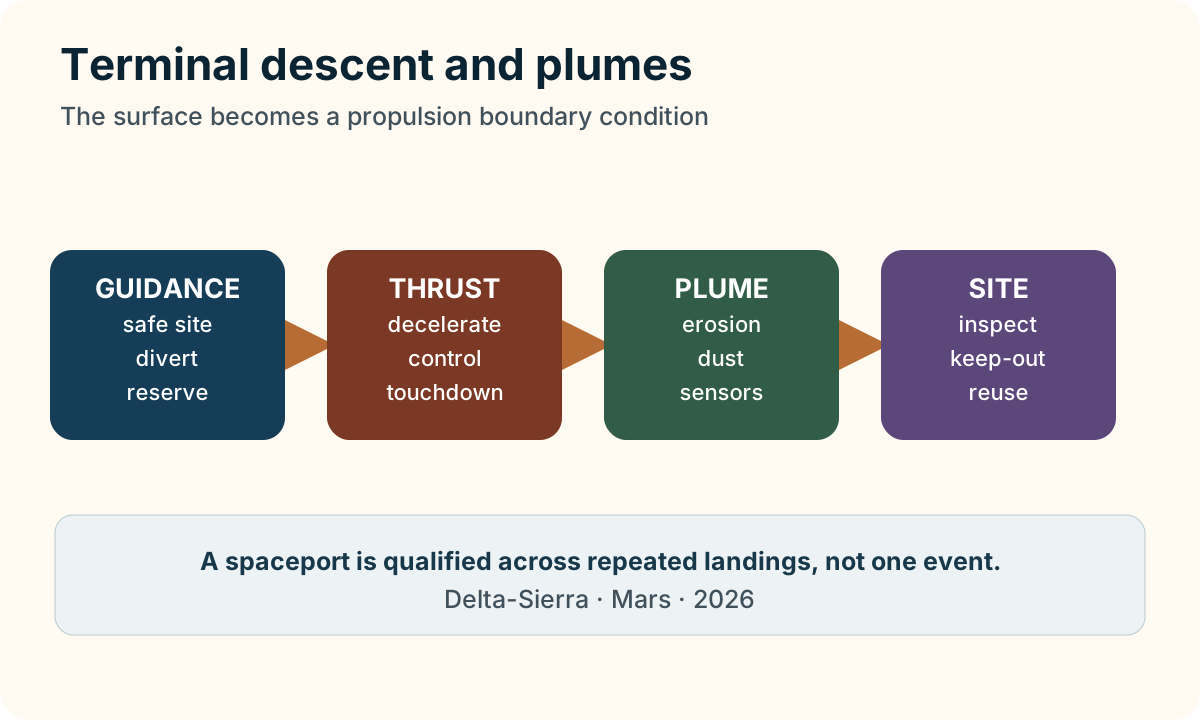
Heavy terminal descent turns the ground into part of the propulsion system
At altitude a descent engine is mainly exchanging momentum with the vehicle. During the final tens of metres, its exhaust meets the regolith, spreads as a wall jet, erodes material and accelerates particles. The surface is no longer scenery; it has become a boundary condition of propulsion. Human-scale Mars landers are expected to be far more demanding than the robotic vehicles that have already landed, so plume–surface interaction must be treated as a design problem rather than as a cosmetic dust issue.
From thrust balance to jet loading
A minimum vertical braking intuition is T > mg. T is total thrust in newtons, m is vehicle mass in kilograms and g is local Martian gravity, about 3.71 m/s². For m = 40,000 kg, Martian weight is about 148,400 N. If available thrust is 220 kN, thrust-to-weight is approximately 220,000 / 148,400 ≈ 1.48. That tells us the vehicle has vertical control authority; it tells us almost nothing about plume footprint, erosion or the stability of a landing leg.
A second elementary relation is dynamic pressure, q = ½ρv², where ρ is local gas density in kg/m³ and v is velocity in m/s. A rocket plume is hot, compressible, chemically complex and highly nonuniform, so this equation is not a plume solver. It does reveal the strong square-law sensitivity to velocity and helps explain why high-energy jets can produce particle hazards well outside the central crater.
The hazard envelope is larger than the hole beneath the engine
Plume–surface interaction can combine erosion, local excavation, loss of bearing under a footpad, optical obscuration, contamination, impact damage and abrasion. A particle that is harmless to primary structure can still damage a camera window, seal, connector or exposed thermal surface. Safety distance should therefore be tied to several consequence thresholds rather than to one guessed circle around touchdown.
Repeated operations add another dimension. The first landing changes the site presented to the second. A genuine spaceport needs post-landing surveys, records of erosion and compaction, inspection of protective infrastructure and rules for deciding whether a pad is reused, repaired or retired.
Terminal guidance must select a safe point that is also dynamically reachable
Terrain-relative navigation compares descent imagery with prior maps and enables the vehicle to update where it believes it is. This is a major capability, but a map is still a representation with finite resolution and age. Small rocks, slopes, mechanical soil properties or changed conditions may remain uncertain. The landing system needs to combine prior mapping, real-time sensing, divert capability and propellant reserve.
Divert authority is a consumable resource
A lateral divert requires time, thrust and propellant. The exact cost depends on trajectory and vehicle dynamics, but the operational lesson is simple: rejecting a hazard late leaves fewer reachable alternatives. Hazard detection should therefore output not merely a “best looking” pixel but a set of safe, reachable candidates with confidence and cost. The guidance law then chooses inside a feasible envelope rather than chasing an ideal point it cannot physically reach.
Failure case: intermittent radar altitude and a dust-degraded camera
Assume the radar altimeter becomes intermittent just as dust reduces optical contrast. A robust estimator does not merely vote between two sensors. It uses the inertial propagation, phase-of-flight knowledge, residuals and sensor health to decide whether altitude and velocity remain observable. If confidence drops below a defined limit, the system may restrict lateral divert, command a more conservative descent mode, or—if vehicle design and timing allow—abort before the trajectory becomes irreversible.
Design the spaceport before the first crewed arrival
A site intended for recurring heavy landings is infrastructure. It needs approach corridors, keep-out zones around habitats and tanks, independent navigation references, soil instrumentation, emergency access, inspection routes and rules for dust-sensitive assets. Distances should not be imported from a terrestrial airport. They must be derived from engine layout, lander mass, local soil, test evidence and the energy of the particle field.
Risk-reduction alternatives move cost rather than erase it
Designers can raise engines farther from the surface, distribute thrust, perform more braking at altitude, prepare or harden landing areas, add deflectors, select naturally favourable terrain, or simply place valuable infrastructure farther away. Each option changes another budget. Pad preparation consumes surface logistics; a deflector must withstand the plume; higher engines affect structure and stability; earlier braking can increase propellant. Trade studies are valuable because they make these transfers explicit.
Verification must climb from material physics to integrated vehicle behaviour
A credible evidence programme characterises soils and jets, runs plume tests with representative simulants and Martian pressure, validates numerical tools against measurements, and then addresses full vehicle geometry. Success criteria include lander stability, sensor visibility, erosion depth, particle energy and contamination—not a promise of “no dust.” The engineering objective is bounded, understood consequence and a recoverable site for the next arrival.
Plume–surface interaction closes a feedback loop with guidance
Plume–surface interaction is not only a contamination problem below the engines. Excavated soil and lofted dust can alter what the navigation system sees during the final seconds. A camera that loses contrast, a lidar return degraded by particles or a radar footprint modified by local geometry can increase state uncertainty while the vehicle is still translating and throttling. The landing controller must therefore be designed for a sensor environment partly created by its own propulsion system.
The practical response is to treat terminal sensing as a deliberately redundant chain. Optical terrain-relative navigation may provide precise horizontal information before the dust cloud develops; radar or lidar can carry altitude and vertical-rate estimation deeper into descent; inertial propagation bridges brief dropouts. The estimator should track not only position and velocity but the health of each measurement source. A sudden disagreement between optical and ranging channels is then evidence to be diagnosed, not averaged away blindly.
Engine cutoff logic also belongs to plume management. Keeping high thrust after firm contact can excavate material and load the landing gear; cutting too early increases impact velocity if the surface is lower than expected. Height uncertainty, leg-contact indication, vertical speed and engine transient time must therefore be combined in the cutoff rule. Testing should include dusty surfaces, off-nominal slopes, delayed contact switches and partial sensor obscuration. The goal is a terminal sequence whose margins remain observable even when the final meters are the least visually clean part of the flight.
Quantify the keep-out zone from particle physics to infrastructure consequence
A heavy-lander exclusion radius cannot be selected by a universal rule such as “one hundred metres is enough.” Plume flow depends on thrust, engine count and cant angle, nozzle height, terrain shape and regolith properties. The resulting particle field then has to be translated into consequences: impact on windows, seal abrasion, radiator contamination, optical obscuration or damage to exposed wiring. The same particle can be irrelevant to primary structure and unacceptable to a precision optic.
Particle kinetic energy gives useful scale: Ep = ½mpvp². mp is particle mass in kilograms and vp velocity in m/s. A one-gram particle, 0.001 kg, at 100 m/s carries 5 J. At 200 m/s it carries 20 J. Doubling speed quadruples kinetic energy. Real regolith contains a distribution of sizes, shapes and trajectories, but the calculation explains why a relatively small population of larger fragments may dominate protection of fragile hardware.
A keep-out analysis therefore combines occurrence, energy, direction and target vulnerability. A habitat wall may be structurally safe while a window, radiator or external connector at the same distance is not. Buried storage can be protected while surface instrumentation remains exposed. Safety zoning should be consequence-specific.
Measure the site after every severe arrival
A Mars spaceport should remember its own ground. Survey markers, cameras, lidar or other surface metrology can compare before and after conditions: erosion depth, moved rocks, slope change and dust deposition. This evidence updates models and the reuse decision. A pad is not “qualified forever”; it is an inspected asset whose state changes after each event.
Avoid false numerical precision
A prediction of 437 metres from a weakly validated model is less honest than a bounded envelope with explicit assumptions and a test programme designed to narrow it. Computational fluid and particle models are valuable when they are tied to measurements and uncertainty, not when decimal places substitute for evidence.
Site architecture separates touchdown, logistics and daily habitation
The first habitat has no inherent reason to sit beside the landing point. Logistics favours short travel, while plume, explosion, dust and operational hazards favour separation. A settlement can place its arrival zone at distance and connect it by cargo rovers, cables, pipelines or intermediate depots. Separation has a transport cost, but it decouples hazards and makes future expansion easier.
The arrival zone also needs to anticipate later vehicles. A spent lander can be a valuable resource while becoming an obstacle, contamination source or navigation feature. Approach corridors should avoid overflight of critical assets where practical. Surface traffic requires keep-out windows, and local operations authority must be able to freeze movement if landing time or target changes.
Independent navigation references
Terminal navigation should not rely on one infrastructure precisely when dust and plume can obscure it. Orbital maps, inertial propagation, ranging, terrain imaging and local references can provide diversity. The objective is not indiscriminate sensor duplication; it is preventing one physical phenomenon from invalidating every source at once.
Post-touchdown access is part of EDL operations
Successful contact is not the end. Teams must confirm stability, leaks, fire, tank condition, local contamination and safe approach. A tilted vehicle or deeply loaded footpad may be habitable while making egress difficult. Rescue rovers and surface crews need routes that avoid the most disturbed terrain.
Move from one landing to cadence: repeatability becomes a system requirement
A settlement depends on repeated arrivals. The relevant performance therefore includes turnaround: inspection time, terrain repair, dust deposition, logistics disruption and readiness for the next vehicle. A site optimised for one spectacular landing can be poor infrastructure for sustained operations.
A simple throughput indicator is C = N/T, with N handled arrivals and T elapsed time. It should never be optimised alone. If increasing C removes the inspection time needed to discover progressive erosion, nominal capacity rises while resilience falls. The objective is sustainable cadence with recovery margin.
Failure scenario: the second lander sees a changed pad
After the first arrival, one part of the pad contains a cavity and a region of loosened material. The second vehicle’s navigation dispersion can reach it. Before arrival, the settlement must know whether the onboard hazard map includes the new state, whether the primary pad is still qualified or whether a secondary zone is mandatory. That creates a controlled data chain from surface survey to mapping, validation, upload and onboard version identification.
The lesson extends beyond landing: Mars infrastructure is not static. Vehicles need the current state of the world they are entering, and a settlement must be capable of producing and validating that state locally rather than waiting for Earth to rebuild every operational map.
Engine cutoff logic links plume physics to touchdown stability
The last seconds couple navigation, thrust, plume interaction and landing-gear dynamics. Dust obscuration may degrade optical measurements just as the controller needs accurate height and horizontal velocity. A robust design therefore carries independent cues — inertial propagation, radar or lidar, engine state and leg-contact logic — and defines what happens when they disagree.
Cutoff criteria should be tested against uneven terrain and delayed contact indications. The safe action is not always to continue thrust until every sensor confirms touchdown: persistent thrust can destabilize a vehicle that already has one footpad loaded. Terminal descent is finished only when the control system has handed the vehicle to the mechanical support system without creating a new hazard.
Primary sources and specialist documentation
- NASA Advanced Supercomputing — Rocket Plume-Surface Interaction Simulations for Moon and Mars Landings
- NASA NTRS — Flow Visualization for Plume-Surface Interaction at Martian-Relevant Lander Environments
- NASA NTRS — PSI Flight Measurement Development Status
- NASA NTRS — Wall-Jet Evolution During Plume-Surface Interaction Using PLIF Imaging
- NASA NTRS — Moving Beyond Apollo: Vacuum Ground Testing to Reduce Plume-Surface Interaction Risks to Lunar Landers
- NASA NTRS — Flow Simulations for Martian and Lunar Lander Plume-Surface Interaction Prediction
- JPL — Pits Under InSight Lander
- JPL — Mars 2020 landing mission overview