


MARS BIBLE — REFERENCE GUIDE
Time, clocks and latency: the invisible infrastructure of a Mars society
Why time measures distance, synchronizes sensors, dates maps, coordinates machines and organizes a civilization living light-minutes from Earth.

Martian time begins with the speed of light
Time is the first invisible wall between Earth and Mars. No software can remove propagation delay: electromagnetic signals travel no faster than light. NASA gives roughly 3 to 22.4 minutes one way depending on geometry. Time therefore sits at the center not only of communications but of navigation, control and social organization.
Operational delay is longer than light time. A message is created, encoded, routed, transmitted, received, checked, decoded, shown to a human, interpreted and turned into a response. A troubleshooting exchange can take hours even when it contains only a few messages.
The cultural consequence is a move from synchronous to largely asynchronous operations. Earth teams send intentions, context and data rich enough to remain useful later. Mars teams document their decisions so Earth can reconstruct history when messages arrive.
The result resembles technical correspondence more than a phone call, enriched by models, video, logs and files. Accurate timestamps become essential for rebuilding the real sequence of events.
No software advance can reduce propagation below the limit imposed by the speed of light. With Earth and Mars separated by tens or hundreds of millions of kilometres, a question and reply naturally become an exchange lasting many minutes. A procedure built around 'ask Earth, wait, then act' is therefore unsafe for fast events.
It is also important to distinguish one-way light-time, round-trip light-time, processing delay and waiting time for a contact. A link may have only a few minutes of physical propagation but much longer operational latency because no relay or ground station is available. Perceived latency belongs to the entire architecture, not distance alone.
Clock error becomes distance, ordering and authority error
A clock offset is not merely an inconvenience in a distributed Mars system. In navigation, time error multiplied by velocity becomes a position error; in sensor fusion, mismatched timestamps can make measurements appear physically inconsistent; in operations, event ordering can be reconstructed incorrectly. Oscillators also drift with temperature and ageing, so synchronisation needs both an absolute or shared reference and an estimate of remaining uncertainty during outages. A network message should carry enough timing context that a delayed receiver knows when the observation was valid, not just when the packet arrived. This makes timekeeping an engineering service shared by navigation, communications, science and incident reconstruction.
Time uncertainty should travel with the timestamp
A timestamp should be accompanied, explicitly or implicitly, by confidence in the clock that produced it. After a long synchronisation outage, two systems may both report precise-looking times while disagreeing by an operationally important amount. Recording clock source, last synchronisation and estimated drift allows software and humans to decide whether measurements can still be fused or must be treated separately.
A clock does more than tell time: it makes measurement possible
In distributed systems time orders events, fuses sensors, compares logs, dates samples, synchronizes radios and measures flight time. A bad clock can therefore create a false anomaly or hide a real one.
Stability and accuracy are different. A clock can have a constant offset and remain very stable; another can be correct now and drift quickly. Navigation often cares deeply about stability during periods without external correction.
An oscillator drifting by one part per million — 1 ppm — accumulates about 0.0864 s in one day because 86,400 s × 10⁻⁶ = 0.0864 s. That seems small for human scheduling and enormous for some radio or navigation functions. A relative stability of 10⁻¹² corresponds, as an order of magnitude, to about 86 ns per day.
Real atomic clocks and synchronization chains have much richer error behavior. The simple calculation shows why a city losing its time reference cannot merely “look at another computer’s clock.”
A clock timestamps events but also measures radio time-of-flight, synchronizes sensors, orders logs, fuses measurements and supports networks. A drift of 1 ppm is 0.000001 second per second; across 86,400 seconds it becomes roughly 0.0864 s if uncorrected. That is trivial for a human appointment and enormous for some navigation functions.
The infrastructure therefore needs different timing grades. A calendar display does not require the stability of a ranging system. Local clocks can be disciplined while references are available and then operate in holdover during outages. This avoids paying for extreme precision everywhere while protecting the functions that truly need it.
Stability and accuracy are different properties. A clock can be highly stable — drifting predictably — while remaining offset from an absolute reference. Conversely, a frequently corrected clock can show good average time while carrying too much short-term noise for precise measurements. PNT services therefore need specifications for error, stability, drift and synchronization method rather than a single adjective such as 'accurate'.
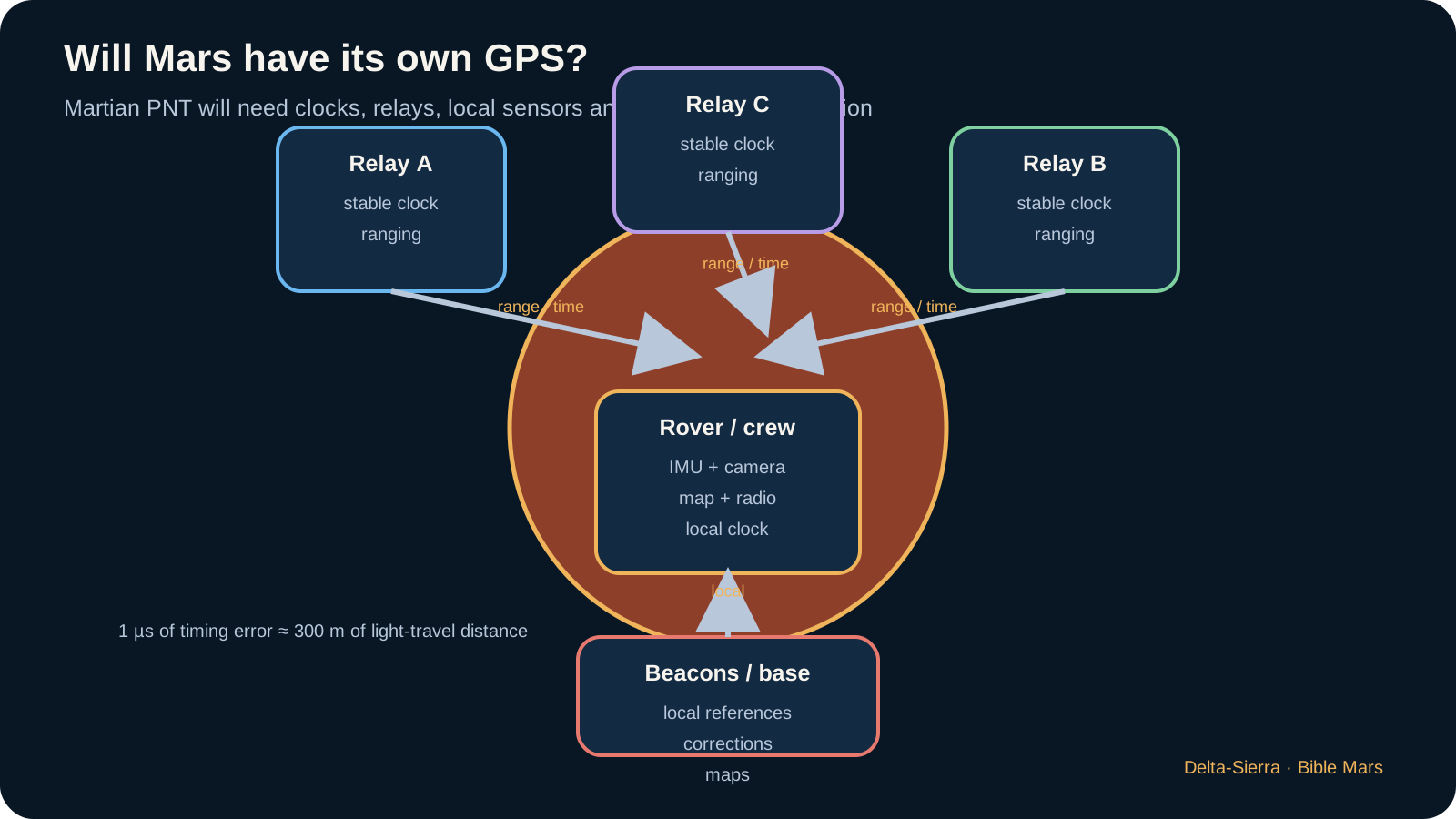
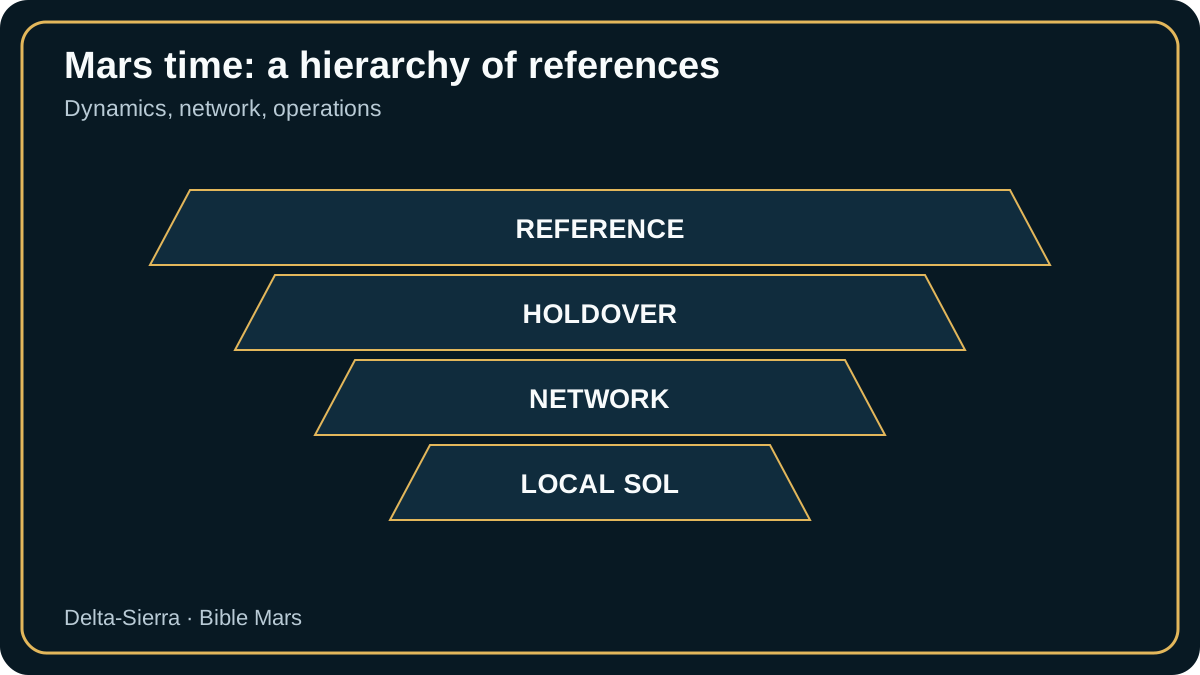
A Martian architecture can use layers: local oscillators in sensors, better clocks in vehicles, base references and potentially higher-grade clocks on relays. The network distributes corrections and publishes their quality. This hierarchy makes precision available without putting an atomic clock on every pump.
One microsecond can correspond to three hundred metres
Time-of-flight ranging directly connects clocks and geometry. Light travels about 299.8 m in one microsecond. A 100 ns error corresponds to roughly 30 m of light-travel distance; 10 ns to roughly 3 m. These are not automatically final position errors because systems fuse multiple measurements, but they reveal the scale.
Radio ranging, Doppler and orbit determination all depend on precise timing and frequency. JPL therefore emphasizes high-quality clocks for future Martian PNT. When terrestrial signals cannot act as a direct reference, time must be carried locally.
Time also connects instruments. A camera and IMU describing the same maneuver with a 10 ms offset can produce an inconsistent estimate during fast motion. Synchronization is a sensor property as much as a network property.
As a base grows, timing becomes common infrastructure: reference sources, distribution, delay measurement, drift monitoring and controlled resynchronization.
Light travels about 299,792,458 metres per second. In one microsecond it travels about 299.8 m; in ten nanoseconds, about 3 m. These conversions create intuition for time-derived ranging. They must not be confused with the final position error of a full PNT architecture, which combines multiple measurements and geometry.
The lesson is that the clock becomes part of the sensor. If two stations disagree about time, that offset can appear as range. One-way measurements can therefore demand particularly strong time knowledge, while some two-way techniques cancel part of the clock error at the cost of a different protocol.
From time to distance: the calculation that makes clocks tangible
Light travels at about 299,792 km/s. One microsecond is 10⁻⁶ s. The distance light travels in one microsecond is therefore:
299,792 km/s × 10⁻⁶ s ≈ 0.300 km, roughly 300 m.
One millisecond — one thousand times longer — corresponds to roughly 300 km of light travel. These numbers do not mean a clock error automatically becomes the same position error in every navigation architecture; geometry and multiple measurements matter. They show why time is a navigation observable and why a drifting clock gradually becomes a sensor that lies.
What time is it on Mars? Civil time and engineering time are different systems
A Martian sol lasts about 24 h 39 min 35 s. Robotic mission teams have sometimes worked on Mars-local schedules, but a permanent society needs much more: work shifts, dates, seasons, legal deadlines, Earth meetings and conventions shared across sites.
The challenge is mixing civil, mission and scientific time. A base might use local Mars time for daily life while keeping a continuous engineering timescale for network events and navigation. Software must name the timescale explicitly rather than silently converting.
Earth communications add another temporal layer. A message sent on a Tuesday on Mars can be read under a different terrestrial calendar label depending on convention. Critical logs cannot depend on an ambiguous date without a defined reference.
A Martian calendar is therefore not only cultural. It is an interoperability problem. Incompatible conventions across settlements would force translation into every schedule, contract and technical record.
The Martian sol is roughly 24 h 39 min, making a local civil time attractive. Engineering still has to manage several references simultaneously: atomic time, mission elapsed time, local solar time, event chronology, ephemerides and Earth exchange. Mixing these layers creates subtle software failures, especially when international systems or multiple settlements use different conventions.
A future Martian society will probably need standardized timestamp formats that explicitly identify the time scale. The problem resembles terrestrial time zones and leap seconds but adds another planet and interplanetary exchange. Format clarity becomes a safety requirement rather than clerical tidiness.
Mission teams already use the sol to follow local Martian days, but a permanent society would face ordinary questions too: work schedules, agricultural cycles, contractual deadlines, birthdays, archives and coordination with Earth. Those social conventions should not contaminate the time scales used for orbital dynamics or navigation. Human calendars and scientific time must remain explicitly separated in software.
Reference meridians and local zones would become practical issues once settlements are widely separated. A common civil time can simplify coordination while local solar time can help some energy or agricultural operations. As on Earth, several conventions can coexist if conversion is standardized and unambiguous.
Civil time, local solar time and engineering time
A settlement may choose civil time adapted to the Martian sol for sleep, school and daily life. Science teams may use local solar time or mission-sol counts. Interplanetary links remain tied to terrestrial references and ephemerides. Software must translate among these systems explicitly.
Calendar errors are dangerous precisely because they look administrative. A command scheduled for “tomorrow at 08:00” is meaningless unless every system knows which time scale, sol and convention are intended. Safety-critical interfaces should carry an explicit time reference rather than a human-readable string alone.
Network time: ordering events, consensus and security
Terrestrial distributed systems use time to order transactions, expire certificates and reconstruct incidents. On Mars, network partitions can last longer and affect physical systems. Engineers must decide what remains valid when no central source is reachable.
“Holdover” is the ability of a node to preserve sufficiently accurate time during loss of reference. When connectivity returns, resynchronization must not simply jump backwards through an audit log or invalidate signatures. Critical systems need controlled correction rules.
Cybersecurity also depends on time. Certificates, authentication tokens, replay protection and signatures may use validity windows. A fault or attack that falsifies time can therefore become an attack on authority.
A Martian city will likely tier time services: highest precision for PNT and instruments, strong stability for industrial control, coherent time for general computing and civil time for inhabitants. Mixing them wastes resources and creates unnecessary coupling.
In a distributed system, two events can be observed in different orders because messages take different paths and times. If one controller opens a valve while another orders it closed, investigators need to reconstruct what actually happened. Trusted timestamps, version numbers and event identifiers become essential for diagnosis.
Cybersecurity adds another reason. Authentication systems often use message freshness to prevent replay, yet DTN may legitimately store a bundle for hours. A delayed command can be valid; a replayed command can be dangerous. Timing policy has to distinguish the two, tying security semantics to the network's disruption-tolerant behavior.
Time, cybersecurity and reconstructing what actually happened
After an incident, engineers reconstruct a timeline. If habitat, rover and control-server clocks disagree, cause and effect become difficult to establish. Attackers can also exploit time because certificates, access tokens, signatures and updates often depend on trusted clocks.
Time distribution is therefore a security service. Critical systems should detect abnormal jumps, retain multiple references and enter degraded modes rather than blindly accepting an external clock. On Mars, “what time is it?” can become a safety question.
Latency and autonomy: a control loop cannot cross interplanetary space
A 10 Hz control loop decides every 0.1 s. Even a three-minute one-way delay is 180 seconds, or 1,800 such control periods. At twenty-two minutes the count exceeds 13,000 periods. No terrestrial pilot can directly close the loop of a fast rover, aircraft or life-support system on Mars.
Earth can send an objective — reach this zone, preserve this reserve, inspect this module — while the local machine turns that objective into thousands of control decisions. This is the distinction between teleoperation and supervision.
Autonomy remains bounded. A robot receives constraints, forbidden zones, margins and stop conditions, not abstract freedom. Delay forces intelligence close to the phenomenon while preserving logs for later Earth analysis.
Light time becomes an organizational principle: fast decisions local, slower decisions shared, strategic decisions assigned according to mission governance.
With only three minutes of one-way propagation, about 1,800 control periods pass before an Earth command arrives; with twenty-two minutes, more than 13,000. That simple comparison explains why attitude control, braking, engine protection or leak isolation must be local.
Earth can still remain in the loop at a slower level: setting goals, analyzing trends, preparing updates and proposing future trajectories. Martian autonomy is therefore not separation from Earth but separation of decision frequencies. Fast remains local; slow can be cooperative.
From onboard clock to Martian timing infrastructure
A first mission can operate with a few onboard clocks regularly correlated with Earth. A city cannot. It needs standards, time distribution, monitoring, maintenance procedures and references that survive communication outages.
PNT relays with stable clocks could contribute to this infrastructure. Surface stations compare references, detect drift and provide local service. Vehicles then use that time for ranging, sensor fusion and networking.
Local industry will need to diagnose parts of the chain: cables, oscillators, timing electronics, thermal sensors, software and calibration. The most sophisticated standards may remain imported for a long time, while local diagnostic depth reduces vulnerability.
A society controlling common time gains more than better navigation. It can reconstruct incidents, run distributed systems and preserve a trustworthy technical history of what actually happened.
At first, each vehicle may maintain its own clock and correct it during contacts. With dozens of systems, that becomes expensive. Time must be distributed, drift monitored, backup references maintained and source health published. A permanent base gradually creates a timing service just as it creates an electrical service.
At city scale the question becomes legal and economic as well as technical: which timestamp governs a contract, medical record, alarm or accident investigation? Trusted time links the physics of navigation to the institutions of a community.
Timing infrastructure also has an industrial maintenance cost. Oscillators age, connectors degrade, temperatures change and software is updated. Reference instruments must be compared, recalibrated and eventually replaced. PNT is not merely a satellite constellation; it is a local metrology and maintenance chain that must continue proving that distributed time remains trustworthy.
Long-duration archives make this even more important. A city operating for decades must relate an event recorded today to measurements made twenty years earlier. Changes of format, time scale and software need documentation. Preserving time becomes part of preserving technical memory.
Deep Space Atomic Clock: move part of navigation onboard
JPL’s Deep Space Atomic Clock was developed to bring highly stable navigation-grade timekeeping into a flight instrument. Conventional deep-space radio navigation keeps much of the timing truth on the ground. A much more stable onboard clock opens the door to more one-way measurements and less dependence on continuous round-trip exchanges.
A settlement would not necessarily put a DSAC-class instrument in every rover. More likely it would build a hierarchy: a few very stable references, network clocks, and lower-cost oscillators in ordinary equipment. Time metrology becomes distributed infrastructure with calibration, redundancy and drift monitoring.
Holdover: what happens when the primary reference disappears?
Holdover is the ability to preserve acceptable time when an external reference is lost. That matters on Mars because solar conjunction, relay failure, antenna faults or cyber incidents can interrupt synchronization. Nodes still need timestamps coherent enough that commands, logs and databases can later be reconciled.
The required quality depends on use. A wall clock can tolerate seconds; radio navigation may require far smaller errors; industrial controllers mainly need reliable causal ordering. There is therefore no single Martian timing requirement — there is a hierarchy of time services.
A microsecond becomes distance: why time is infrastructure
Radio navigation converts time into distance. Light travels about 299,792 kilometres per second. One microsecond is 10⁻⁶ second, during which light covers roughly 0.300 kilometre, or 300 metres. That does not mean every one-microsecond clock error creates exactly 300 metres of navigation error, because real architectures use differences, calibration and multiple observations. It does show why timing matters.
JPL's Deep Space Atomic Clock demonstrated a highly stable onboard clock intended to support more autonomous deep-space navigation. Traditional deep-space navigation relies heavily on Earth-based measurements and terrestrial time references. Better clocks on the vehicle can enable more one-way measurements and local decision-making.
Time also orders failures, science data, industrial events and transactions. Two controllers with inconsistent clocks may reconstruct different causal sequences. Accident investigation becomes difficult if events cannot be placed on a shared timeline.
A Martian city therefore needs a time hierarchy: reference clocks, local distribution, holdover during source loss, cross-checking and explicit drift limits. Time becomes an invisible utility comparable to voltage or water pressure.
Mars local time and interplanetary time: several clocks for one reality
A Martian solar day is about 24 hours 39 minutes. Mission teams have already lived on Mars time to operate rovers, but a permanent population adds civil requirements: work schedules, schools, maintenance, seasons, communications windows and coordination with Earth. One clock display cannot serve every technical and social purpose.
Critical systems need monotonic time, stable references and unambiguous timestamps. Humans need readable local schedules. Earth communications need shared standards. Science may require sol numbers and local solar time. Those conventions must be designed before they become an error source.
An instruction saying 'open at 14:00' is incomplete unless the time scale, site and date are defined. Safety systems should carry the reference with the value. Many terrestrial timing failures are convention failures rather than failures of physics.
Mars operations will therefore teach a simple rule: a timestamp without context is incomplete data. In an environment where orbital contacts, autonomous software and interplanetary delay interact, temporal coherence is part of safety.
Holdover: how long can Mars keep sufficiently good time by itself?
Holdover is the ability to maintain an acceptable time reference after the primary source disappears. The local oscillator keeps running, but its frequency is imperfect and error accumulates. Required quality depends on the application: a kitchen clock can tolerate seconds; navigation and scientific correlation may not.
A settlement can use several clock classes. High-stability references serve timing centres and relays; lower-cost oscillators serve local devices; synchronization protocols distribute time and estimate offsets. During isolation the network must know which clocks remain trustworthy and for how long.
Timing is also a cybersecurity issue. False time can invalidate credentials, reorder logs or corrupt navigation. Time sources should be authenticated and compared with independent references. Blindly accepting a network timestamp turns logical data into a physical failure point.
At one thousand inhabitants, timing becomes an operational institution with calibration, spares, monitoring and service guarantees. Once again, maturity is measured by how well the city functions without Earth.
The clock as scientific instrument, network service and public institution
A Martian city will need several notions of time at once. Dynamical time used for ephemerides, coordination time used by networks, operations-center time and civil time experienced by residents do not have the same requirements. A Martian sol is slightly longer than 24 Earth hours — familiar enough to be deceptive, different enough for a simple 24-hour clock to drift rapidly against local sunrise.
Early Mars missions can use sol numbers and mission-local time. A city turns that flexibility into an institutional problem: medical appointments, contracts, incident logs, digital evidence, orbital operations and schools need shared references. The choice is not only astronomical. The settlement must decide when a civil day begins, how distant sites express local time and how Martian dates map to legal and economic exchanges with Earth.
Deep Space Atomic Clock: moving part of temporal truth onboard
JPL’s Deep Space Atomic Clock explored the idea that a spacecraft could carry a reference stable enough to reduce dependence on two-way navigation from Earth. In traditional operations, ground systems measure and calculate much of the solution; a highly stable onboard clock enables more one-way navigation and autonomy. At Mars, the same logic can extend to relay orbiters and surface nodes that maintain a coherent time scale even while Earth is unavailable.
Holdover is the ability to continue during loss of an outside reference. A clock does not become suddenly wrong when Earth disappears; its error grows gradually according to stability, environment and elapsed time. A network can therefore define several thresholds. While uncertainty remains below a few microseconds, some functions are allowed; beyond that, precise navigation may require re-synchronization; farther still, only time-tolerant functions continue.
Time as a cybersecurity property
Distributed systems use timestamps to decide whether a command is fresh, a certificate remains valid, two events are causally related and which event occurred first. Clock drift or malicious time manipulation can therefore become a security problem. On Mars, where replicas may synchronize after minutes or hours of disruption, the network must distinguish the time an event occurred, the time it was received and sometimes the time it was validated.
A Martian time infrastructure should therefore be redundant and observable. Clocks can cross-check one another, drift can be estimated, relay orbiters can distribute references and vital equipment must remain safe during periods of elevated uncertainty. “What time is it?” becomes a question of metrology, networking and governance.
A clock can fail gradually while every display still looks normal
Timing failures are dangerous because they can be plausible. A stopped clock is obvious; a drifting clock may continue to produce tidy timestamps that are wrong by microseconds, milliseconds or seconds. Different applications tolerate very different errors. Human schedules can ignore microseconds, while ranging, distributed control and event reconstruction may not. A Martian time architecture therefore needs several quality classes rather than one universal “correct time.”
Holdover describes how well a local clock maintains useful time after its reference disappears. During a communications outage, local oscillators continue to run while their uncertainty grows. The system should therefore track not only the time estimate but its expected error. When connectivity returns, resynchronisation must avoid creating abrupt jumps that could confuse control software or forensic logs.
One city may need several clocks at once
Residents may organise daily life by local solar time and sols, engineers may use a continuous mission timescale, scientific datasets may require terrestrial standards, and interplanetary communications must map events across both planets. These are not competing truths; they are coordinate systems for different tasks. The failure occurs when software silently assumes they are interchangeable.
A robust architecture therefore stores explicit timescale metadata and converts at controlled interfaces. The same principle applies to “today” and “tomorrow” in human communication: a medical appointment, launch window and Earth video call may belong to different calendar conventions. Timekeeping is part of human factors as well as navigation.
Timing is the hidden spine of distributed autonomy
When autonomous vehicles cooperate, timestamps allow them to decide which observation is newer, reconstruct causality and merge data. If clocks disagree, two correct sensor reports can appear contradictory. This is particularly important for cybersecurity and incident analysis: signed commands, expiring credentials and audit logs all rely on trustworthy time.
Deep-space atomic-clock work is therefore relevant beyond precision navigation. It illustrates a larger trajectory toward spacecraft and settlements that can maintain their own high-quality temporal reference instead of asking Earth to solve every navigation problem in a two-way loop.
Time as an infrastructure of trust
A distributed society must be able to prove event order. That becomes critical when several systems make local decisions during a network disruption. Airlock, hospital and power-controller logs must be reconciled afterward. Poor timing can turn an incident investigation into guesswork.
Synchronization is also a cyber issue. Certificates, temporary keys and access policies may depend on time. A drifting device can reject a legitimate command or accept stale information. The time architecture therefore needs multiple sources, drift detection and recovery procedures.
Martian civil time will create cultural choices: local calendar, numbered sols, adjusted hours or periodic corrections. Engineers can keep SI seconds underneath while presenting a human-friendly civil layer. The key is to stop social conventions from contaminating physical calculations.
As the city grows, common time becomes like power or coordinates: invisible when it works, obvious when it fails. A clock is then an infrastructure of trust among machines, institutions and people.
Distributed time: from an onboard clock to a society that must agree without simultaneity
On Mars, time is more than a calendar or a delay to Earth. A technical society must order events, time-stamp measurements, synchronize networks, audit safety logs and allow machines to decide whether observations refer to the same event. As population grows, the time reference becomes an invisible infrastructure.
Holdover: keeping time when the reference disappears
A local clock does not stop when the link to Earth or an orbiter disappears. It drifts. Holdover is the ability to maintain an acceptable time reference during that absence. The engineering question is therefore how much drift can be tolerated over ten minutes, a day or a conjunction interval. The answer depends on the service: a human schedule may tolerate seconds, while some navigation and radio functions require much better stability.
This enables a hierarchy of clocks. Not every device needs an atomic standard. A settlement may maintain a small number of highly stable references distributed through the network, while ordinary equipment resynchronizes periodically. Resilience comes from continuing locally when the primary source is unavailable.
A microsecond becomes distance
Light travels about 299,792 kilometres per second. In one microsecond, 10⁻⁶ second, it travels about 0.300 kilometre, or 300 metres. That conversion immediately explains why timing error becomes ranging error in radio navigation systems.
The Deep Space Atomic Clock explored space-based clock stability that could support greater one-way navigation autonomy. On Mars, stable clocks could also synchronize relays, beacons and local networks without continuous dependence on a terrestrial reference.
Civil time, operational time and evidence time
A Martian city will likely need several time concepts. Civil time organizes sleep, school and social life; operational time organizes procedures; scientific and navigation time must remain tied to references that let data be compared across orbiters and Earth. Mixing these purposes can create subtle errors.
Safety logs provide a concrete example. If two controllers issue valve commands during a network disruption, their exact ordering matters. A distributed system must preserve not only time but provenance and sequence. Time becomes part of cybersecurity and accountability.
On Mars, “what time is it?” becomes an engineering question
A space system uses several notions of time simultaneously. Civil time serves teams; dynamics use defined time scales; software uses counters and epochs; instruments timestamp observations; a Mars base may also track local solar time and the Martian sol. Mixing those layers can create silent errors even when every individual clock appears to be working.
A Martian solar day is about 24 h 39 min 35 s. Human schedules can adopt local Mars time, but interplanetary navigation needs a continuous and precisely defined independent variable for dynamics and for comparing measurements from different systems.
Conversions therefore need explicit scale, epoch, longitude or zone where relevant, and restart behaviour. A timestamp written as “12:00:00” is not universal unless the system defines what that number means.
Earth–Mars latency changes the meaning of command and control
One-way light time is approximately distance divided by light speed. At favourable geometry it is a few minutes; at large separation it exceeds twenty minutes. A conversational round trip can therefore take from roughly six to more than forty minutes before human or computer processing is added.
Calculation — 225 million kilometres
For R = 225,000,000 km = 2.25 × 10¹¹ m, t = R/c ≈ 2.25 × 10¹¹ ÷ 2.9979 × 10⁸ ≈ 751 s, or about 12.5 minutes one way. The symbol c is light speed. Actual Earth–Mars distance changes dramatically, so this is a middle-range example, not a fixed mission value.
Latency changes mission control architecture. Earth can send objectives, updates, and analysis; it cannot steer an EDL sequence or stop a rover collision in the last second. Mars systems must close fast loops locally and reserve Earth involvement for decisions whose horizon is compatible with the delay.
Clock stability controls the quality of some measurements
A frequency error of a few parts per million sounds tiny. Over time it accumulates. A constant 1 ppm error corresponds to about one microsecond per second, or 0.0864 s per day if uncorrected. That can be irrelevant to one service and unacceptable to another; requirements should begin with the service, not with an arbitrary clock specification.
In radio navigation, time maps to distance at light speed. In networks, it orders events. In maintenance, it reconstructs causality. The same clock fault can therefore degrade navigation and make logs difficult to compare.
Stable onboard oscillators and atomic clocks reduce dependence on frequent synchronisation. NASA’s 2026 Small Spacecraft GNC survey lists classes of atomic clocks and notes the traditional use of two-way ground tracking referenced to accurate ground timing. Delta-Sierra uses that as component context, not as human-Mars qualification evidence.
A Mars society needs separate physical, network, and human time concepts
Local operations need an understandable calendar and sol schedule. Machines need monotonic epochs, synchronisation, and error bounds. Earth–Mars messaging needs timestamps that survive DTN queues. A single “Mars time” cannot serve all of these purposes any more than a wristwatch time can replace the independent variable in an orbit integrator.
A local network can define a clock hierarchy with primary references, backups, and holdover behaviour when links fail. Synchronisation itself needs monitoring: one bad reference should not contaminate the whole base. Distributed systems can compare sources and declare disagreement.
Four ways time becomes a fault
Two subsystems use different epochs
Numerical timestamps look similar but represent different instants. A command can be paired with the wrong observation. Interfaces should carry explicit time-scale identity or use a common format with no hidden convention.
The primary time server restarts
Clients should continue on local oscillators, carry an error estimate, and resynchronise smoothly. A sudden clock jump can break logs, timers, and controllers.
An urgent packet arrives after a newer packet
With DTN, arrival order is not transmission order. Applications need timestamps, versions, and expiry rules. “Last packet received” is not always “latest decision.”
Earth delay increases through the mission
A procedure designed around ten minutes one way may become inappropriate at twenty. Autonomy thresholds and batching policies should change with geometry rather than remain frozen at launch.
NASA’s 2026 Guidance, Navigation and Control chapter covers deep-space navigation and atomic clocks. NASA Science Mars Relay Network supplies current operational context for intermittent interplanetary relay service.
Synchronization should be designed as a safety function
A clock is not merely an electronic component. Whenever a system compares events, computes velocity from positions, fuses sensors or orders commands, time quality becomes an algorithm input. A timing error can look like a position, velocity or causality error. Important messages should therefore carry timestamp quality or uncertainty, not only a number.
Distributed synchronization should avoid a single point of failure. A primary reference can discipline secondary clocks, while those clocks need holdover capability during loss of contact. Monitoring compares drift, phase offset and agreement among sources. If references diverge, the system must choose the more credible source or enter a conservative mode.
Navigation and communications share time infrastructure
Radio-navigation often measures frequency, phase, range or propagation time. Networks have to sort packets produced at different times and sometimes received out of order. The same timing references therefore support navigation, telecommunications, logs, robotic coordination and maintenance. A Mars settlement benefits from treating time as a redundant common service instead of letting each subsystem invent a private calendar.
One microsecond is about 300 metres of light travel
Light travel distance is Δr = cΔt. With Δt = 1 µs = 10⁻⁶ s and c ≈ 2.998 × 10⁸ m/s, Δr ≈ 300 m. This does not mean every one-microsecond clock error produces 300 m of navigation error—many systems use differential measurements and estimation. It shows why time belongs among navigation quantities.
A settlement will need a time contract
The contract should define scales used for dynamics, software epochs, local civil time, Earth–Mars conversion, longitude convention and how to timestamp events when a clock is uncertain. The objective is not an elegant calendar; it is to prevent two teams from interpreting the same critical date differently.
As operations spread across longitudes, local solar time differs by site. A society may retain one common network time while displaying local solar time for daylight-sensitive activities. The distinction is analogous to UTC and terrestrial time zones: common machine reference, human-friendly presentation.
Archives should also preserve conversion provenance. Scientific and maintenance data revisited years later must remain placeable on the correct timeline even if software and conventions have changed.
Time quality needs to travel with data
A timestamp without an uncertainty can be misleading. Sensor fusion, maintenance logs and distributed control should know whether a time was disciplined, free-running in holdover, or reconstructed later. That metadata can prevent a stale or badly timed sample from being treated as current truth.
Clock faults can be common-cause faults
If every controller trusts one master time server, a single bad reference can make the whole system consistently wrong. Redundant references should therefore be compared rather than blindly mirrored. A safe architecture can reject an implausible jump and continue on local oscillators while the conflict is diagnosed.
For long-term Mars society, common network time and human local solar time can coexist. Machine coordination needs continuity; human schedules may prefer the daylight cycle. Separating those roles reduces the temptation to use one convention for every technical function.
Case study — translate timing error into physical consequence
A timing error Δt corresponds to path length cΔt when a system uses propagation time. One microsecond is about 300 m of light travel and 100 ns about 30 m. A 10⁻⁹ fractional frequency error over 86,400 s accumulates about 86.4 µs if uncorrected.
A command received after several minutes needs creation time, validity and expected state; otherwise the network can correctly apply an instruction that is no longer valid for the current configuration.
Tests inject drift, clock jumps, reference loss and late restoration, then verify event ordering, reported uncertainty and rejection of stale commands.
Synchronization is a safety function, not an IT convenience
An event log is useful only if timestamps preserve causal order. A valve command, current spike, pressure excursion and software restart that occur within milliseconds can be interpreted in opposite ways if subsystems disagree on time. The engineering requirement is therefore not merely that clocks “show the same time,” but that their uncertainty and holdover behaviour remain known when links disappear.
A Martian settlement will need at least three notions of time at once: physical time for navigation and science, network time for ordering data and human schedules for work and sleep. Keeping those layers distinct avoids forcing civil convenience into measurement systems. The safety case should state which clock each function trusts, how long it can coast without an update, and what happens when two references disagree.
Holdover is the bridge between synchronization updates
When a reference link disappears, a local clock does not instantly become useless; its error grows according to oscillator stability and environmental sensitivity. Specifying holdover means stating how long a subsystem can operate before time uncertainty exceeds the limit for navigation, data ordering or control. Different functions can therefore tolerate different update intervals even when they share the same master reference.
Sources and references
Specialized bibliography — communications, navigation and autonomy
- JPL — Deep Space Atomic Clock — Démonstration d’horloge atomique compacte pour navigation profonde.
- JPL IPN — PNT at the Moon and Mars — Besoin de synchronisation et architectures temporelles.
- CCSDS — Space Internetworking Services — Réseaux intermittents et gestion de données dans le système solaire.
Specialized sources — clocks, time and navigation
- JPL — Deep Space Atomic Clock — space atomic-clock demonstration for autonomous navigation
- JPL IPN — PNT at Moon and Mars — clocks and service architectures
- NASA — autoNGC — onboard autonomy and navigation