


Camping LA RESSOURCE: how an autonomy-themed campsite project begins
Documentary dossier for video 001: project origins, French campsite planning, access, land, autonomy, biodiversity and evidence hierarchy.
LA RESSOURCE combines an autonomy-themed campsite project with a long-running A-frame self-build. This page only links to dossiers materially available in both French and English.
LA RESSOURCE is both a project archive and a practical learning corpus. The earliest videos describe the campsite concept and the land; later episodes document surveying, infrastructure and the autonomous A-frame self-build. The English hub deliberately lists only dossiers that physically exist in both French and English. The French source hub contains a wider historical catalogue, but an untranslated title is not treated here as a finished English documentary page.
This distinction matters for search engines and for readers. A catalogue can acknowledge that a video exists without pretending that the corresponding long-form analysis has already been completed. The documentary transformation adds source provenance, technical context, calculations where useful, external references, visuals, structured video metadata and explicit statements about what the footage cannot establish.
The first project dossiers establish intent and geography. The launch video records how the project was presented publicly at that time. The land-presentation dossier then turns the site into a set of spatial questions: access, parking, accommodation zones, circulation, vegetation, utilities and constraints. The drone-topography dossier adds another evidence layer by explaining how aerial imagery can support planning while remaining distinct from legal cadastral boundaries or high-accuracy professional setting out.
The A-frame dossiers then move from planning to physical systems. Early water-storage work shows why capacity must be linked to catchment, seasonal demand, overflow, water quality and network separation. Concrete episodes show the importance of geometry, pump reach, workability, finishing and curing. Tank construction introduces hydrostatic pressure, loads and maintenance access. Straw delivery shifts attention to moisture control, storage and continuity of the building envelope.
The project is valuable precisely because it contains real decisions, constraints and mistakes. Delta-Sierra therefore does not rewrite each episode as a success story. The footage is primary evidence of a sequence; it is not a universal construction specification. A viewer planning another building must still account for location, soil, climate, structure, current regulations, manufacturers’ requirements and the competent professionals required by the project.
This is also why dates and chapter timestamps are handled conservatively. When the creator published exact chapters, the dossier can expose those points and structured-data clips. When no reliable chaptering is available, the page does not manufacture a neat timeline by dividing the duration into equal intervals. The absence remains visible as documentary work still to be completed.
The available dossiers can be read in three complementary ways. A project-history reading starts with the concept and land, then follows later construction. A water-and-autonomy reading connects early storage, tank structure, roof details and maintenance. A construction-quality reading follows access, concrete logistics, load paths, material storage and repairability.
The dedicated A-frame hub provides a narrower route through the house itself. The general video library remains the widest entry point and also contains nature, travel and outdoor documentary dossiers unrelated to LA RESSOURCE. These layers avoid forcing every visitor through one enormous list while preserving reciprocal navigation between the project and the broader Delta-Sierra corpus.
This English hub grows only when a pair of FR/EN dossiers is materially present. It is therefore a status page as well as a navigation page. The broader target remains 69 documentary pairs across the video corpus. New LA RESSOURCE episodes will appear here after their primary source has been identified, their documentary content has reached the required depth, their metadata has been checked and their reciprocal language pages exist.
The library prioritises verifiable context over completeness for its own sake. When a timestamp or technical detail cannot be established reliably, it is left unstated rather than invented; additional visuals are used only when they genuinely explain the subject.
The project spans many years, so the public archive can otherwise blur three different things: what was planned at a given date, what was actually built later, and what the project intends to do next. The documentary pages keep those time layers separate. An early statement is treated as an archive of that moment, not silently rewritten to match a later outcome.
This makes the collection useful beyond the project itself. It shows how to document a long self-build without erasing changes of plan, incomplete assumptions or lessons learned. The remaining episodes will extend that history while preserving the original chronology.
Documentary dossier for video 001: project origins, French campsite planning, access, land, autonomy, biodiversity and evidence hierarchy.

Documentary dossier for video 003: 30,000 m², access, parking, slopes, light leisure dwellings, sanitary facilities, hedges, biodiversity, rights of way and eight verified chapters.

Documentary dossier for video 006: drone mapping, photogrammetry, orthophotos, DTM/DSM, accuracy, flight regulation and the use of relief in site planning.

Documentary dossier for video 017: C30/37, XF1(F), S3, D11, pumping, night work, set accelerator, finishing, curing and lessons from a high-pressure pour.

Documentary dossier for video 005: site base, 1,000-litre tanks, rainwater harvesting, gate, workshop, planting and eight verified key moments.
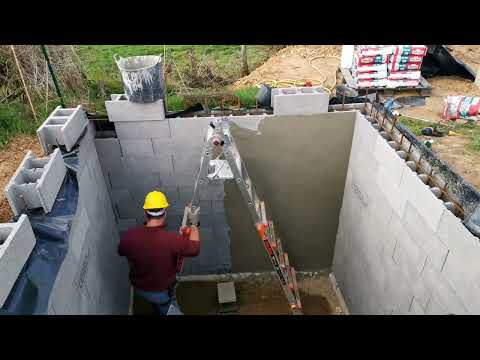
Documentary dossier for video 025: water tank, p=ρgh hydrostatic pressure, stored mass, reinforced-concrete pillars, waterproofing, overflow, access and maintenance.

Documentary dossier for video 029: tank roof, loads, inspection hatch, penetrations, ventilation, condensation, rainwater network and future maintenance.

Documentary dossier for video 031: straw-bale delivery, bio-based materials, storage, moisture, logistics, fire, pests, envelope continuity and site traceability.