Measure 23 / 155

02 — Administration · Measure 2.03 · 23 / 155

Manage the transition of 128,000 public employees without forced redundancies

Treat the 128,000 figure as a planning target to be audited, then manage mobility, reskilling, natural departures and transfers role by role.

Bible France · documentary chapterUpdated : 12 August 2026Primary sources prioritised
Measure 2.03 — Manage the transition of 128,000 public employees without forced redundancies
Measure-specific visual explanation 2.03

In 30 seconds

Current positionTreat the 128,000 figure as a planning target to be audited, then manage mobility, reskilling, natural departures and transfers role by role.
ProposalManage the transition of 128,000 public employees without forced redundancies
Legal routeProgramme legislation, collective agreements, statutory mobility tools and dedicated training/transition budgets.
Financial effectTransition is an upfront investment; savings arise only after roles that are genuinely no longer required disappear.
ConfidenceHigh on legal framing and method; financial estimates require consolidation before booking.
Main riskDo not confuse abolishing an organisation with eliminating the underlying work or skill.

The 128,000 figure must become an auditable workforce perimeter

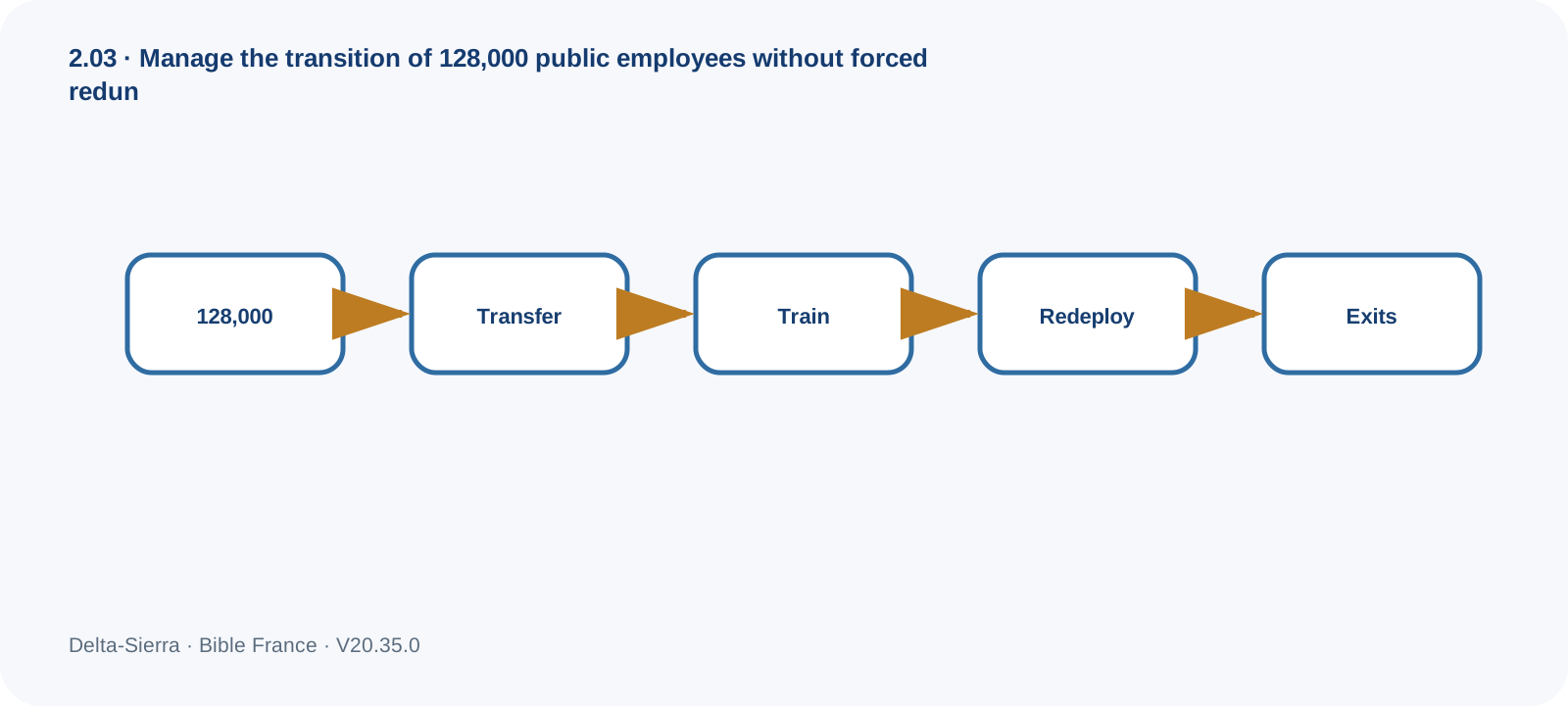
The Plan’s 128,000 figure should be treated as a planning estimate until the affected employers, positions, statutes and skills are listed. Public-service retirement flows are large, but retirement is not the same as an automatically removable vacancy. Each role must be classified as transferred, redeployed, naturally extinguished or eligible for a negotiated exit.

Mobility data show that movement already exists inside public service. The reform should build a skills-based matching system with bridging training, geographic support and explicit protection for rare capabilities.

Publish social and service outcomes together

Headcount statistics alone are insufficient. The transition report should track people transferred, trained, redeployed or leaving, alongside case backlogs, processing times and error rates. A staffing reduction that creates service failure is not a net saving.

Training, relocation, double-running and severance are transition costs and must be separated from recurring savings. This also prevents the same headcount benefit from being counted again under natural attrition or digitisation measures.

Costing and legal delivery

Programme legislation, collective agreements, statutory mobility tools and dedicated training/transition budgets.

Transition is an upfront investment; savings arise only after roles that are genuinely no longer required disappear.

Transition expenditure is reported separately from recurring savings, and transferred activity remains public expenditure unless the policy itself is discontinued.

What must be proved before implementation

Do not confuse abolishing an organisation with eliminating the underlying work or skill.

The implementation file should be a workforce register rather than an organisational chart. It needs verified affected posts, skills, location, receiving vacancies, training and the chosen transition route for each group, with one-year outcomes for mobility and retention.

Notes and sources

  1. DGAFP — Rapport annuel sur l’état de la fonction publique 2025 — primary/institutional source used for the measure framework.
  2. DGAFP — Mobilité des agents, édition 2025 — primary/institutional source used for the measure framework.
  3. DGAFP — Stratégie territoriale RH de l’État 2026-2028 — primary/institutional source used for the measure framework.
  4. Code général de la fonction publique — primary/institutional source used for the measure framework.


Further reading

The author’s books extend the programme but do not replace the primary sources cited in this chapter.

Réforme de l’État book cover

Réforme de l’État — Plan de Rupture

The architecture of the 155-measure programme.

IA : comment transformer la France book cover

IA : comment transformer la France

AI use cases, automation and human oversight in public services.

Turn the 128,000 target into an auditable workforce plan

The Plan's 128,000 figure must be treated as a perimeter to verify, not as an official workforce count. A transition register should record employer, status, profession, location, scarce skills, vacancies and possible receiving services. The DGAFP annual report provides the baseline for retirement, recruitment and workforce flows. [1]

Mobility should operate as an internal skills market rather than a generic instruction to move. DGAFP mobility data and the 2026-2028 territorial HR strategy provide evidence on real flows and local needs. [2] [3] The statutory safeguards of the General Civil Service Code remain applicable. [4]

The public dashboard should separate transfer with the function, voluntary mobility, end-of-career transition and voluntary departure, then publish vacancy rates, transition costs and retention of critical skills one year later.

Implementation evidence to publish

The workforce transition should be managed as a public labour-market operation rather than a headcount target. A skills register and vacancy map should precede every reorganisation so that the administration can show which people moved with their function, which retrained and which left voluntarily.

The post-reform comparison should focus on successful placements, critical-skill losses, vacancy rates and the total transition cost per pathway.

Failure modes to test before national rollout

The transition must be stress-tested against staffing gaps, forced mobility and hidden replacement costs before national deployment.