Measure 24 / 155

02 — Administration · Measure 2.04 · 24 / 155

Run a five-year legislative clean-up without creating another wave of rules

Turn simplification into a measurable programme: inventory, repeal of obsolete provisions, consolidation, burden assessment and an annual dashboard.

Bible France · documentary chapterUpdated : 12 August 2026Primary sources prioritised
Measure 2.04 — Run a five-year legislative clean-up without creating another wave of rules
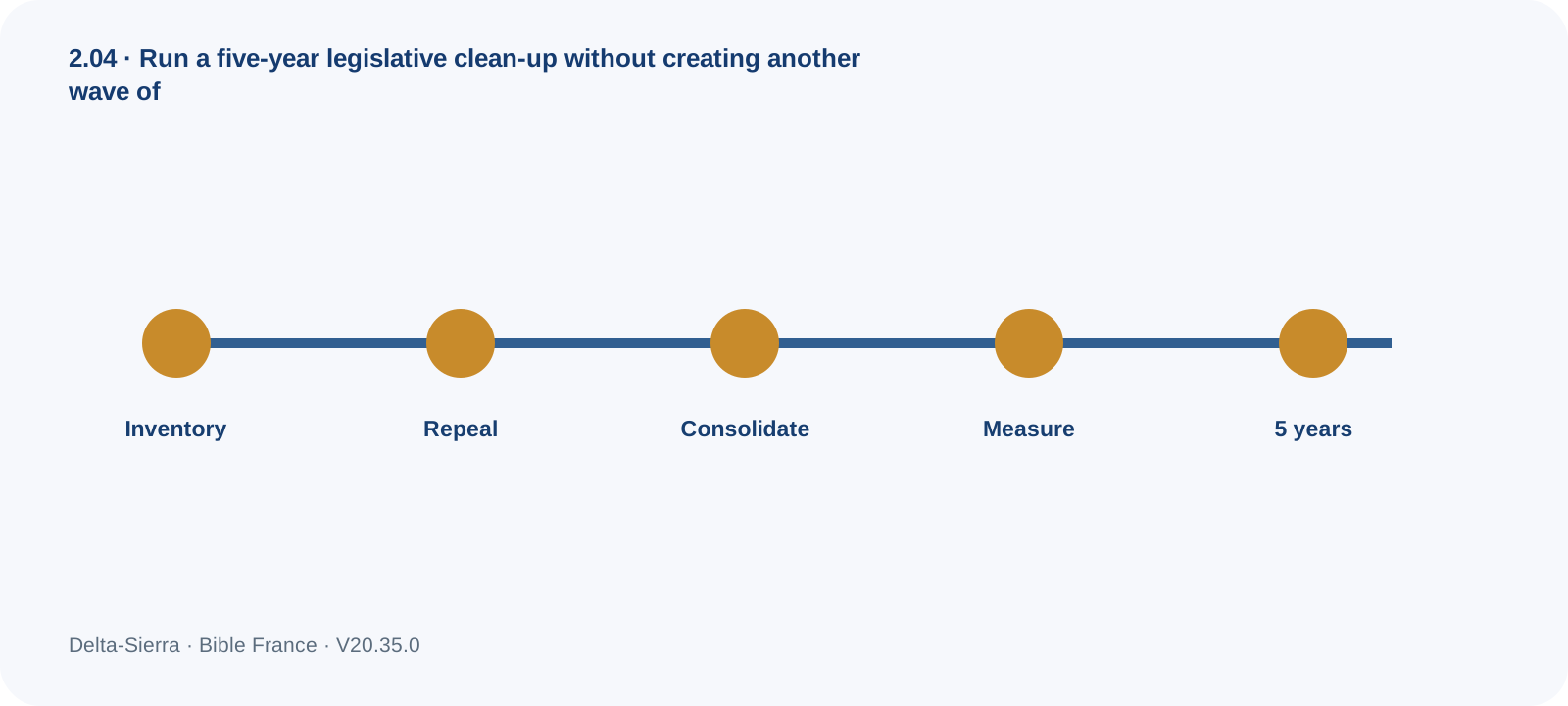
Measure-specific visual explanation 2.04

In 30 seconds

Current positionTurn simplification into a measurable programme: inventory, repeal of obsolete provisions, consolidation, burden assessment and an annual dashboard.
ProposalRun a five-year legislative clean-up without creating another wave of rules
Legal routeInterministerial mission under the Prime Minister/SGG, with annual packages of statutes, ordinances and regulatory clean-up.
Financial effectThe Plan’s historic €8–12bn annual target remains an objective until avoided compliance and administrative costs are measured rigorously.
ConfidenceHigh on legal framing and method; financial estimates require consolidation before booking.
Main riskA repealed rule can be replaced by guidance, forms or reporting duties; the metric must capture burden, not just document counts.

Simplification is about burden, not document counts

The Council of State has repeatedly warned that unstable and layered rules create real costs for citizens, businesses and administrations. A five-year clean-up programme should therefore inventory forms, reporting duties, controls and evidence requirements as well as statutes and decrees.

The current Légifrance filter lists 76 codes in force, showing that the Plan’s historic baseline of 69 is outdated. A public methodology must define what is counted and measure the time and cost removed by each reform.

A financial target needs reconstruction

The Plan’s €8–12 billion annual target should remain labelled as a target until sector-by-sector burden reductions are measured. Repealing a provision that leaves the same form, IT workflow or control in place creates no practical saving.

An annual dashboard should report rules created, simplified and repealed, stability, processing time, compliance hours and IT retirements. Codification and substantive policy change should be tracked separately so that political choices are not hidden inside renumbering exercises.

Costing and legal delivery

Interministerial mission under the Prime Minister/SGG, with annual packages of statutes, ordinances and regulatory clean-up.

The Plan’s historic €8–12bn annual target remains an objective until avoided compliance and administrative costs are measured rigorously.

Transition expenditure is reported separately from recurring savings, and transferred activity remains public expenditure unless the policy itself is discontinued.

What must be proved before implementation

A repealed rule can be replaced by guidance, forms or reporting duties; the metric must capture burden, not just document counts.

The implementation file should operate as a public rule inventory. Every proposed repeal or consolidation needs a legal owner, reason, affected rights, consultation path, concordance table and post-reform measure of administrative burden so Parliament can audit the five-year sequence.

Notes and sources

  1. Conseil d’État — Simplification et qualité du droit — primary/institutional source used for the measure framework.
  2. DGAFP — Code général de la fonction publique et codification — primary/institutional source used for the measure framework.
  3. Légifrance — liste des codes en vigueur — primary/institutional source used for the measure framework.
  4. Conseil d’État — Mesurer l’inflation normative — primary/institutional source used for the measure framework.


Further reading

The author’s books extend the programme but do not replace the primary sources cited in this chapter.

Réforme de l’État book cover

Réforme de l’État — Plan de Rupture

The architecture of the 155-measure programme.

IA : comment transformer la France book cover

IA : comment transformer la France

AI use cases, automation and human oversight in public services.

Build a simplification pipeline that does not recreate regulation

A five-year legal clean-up should classify every candidate rule by purpose, use, legal hierarchy and dependency before repeal or consolidation. The Conseil d'État's work on legal quality is more useful than a raw target of pages deleted because it focuses attention on accessibility, stability and coherence. [1]

Codification is a useful precedent but it is not the same as deregulation. The General Civil Service Code illustrates the need for concordance tables and careful migration of references. [2] The live Legifrance list of codes also shows that the legal corpus evolves continuously. [3]

Annual reporting should measure obligations created and removed, administrative time before and after reform, litigation and corrective amendments. The Conseil d'État's work on regulatory inflation can support this measurement framework. [4]

Implementation evidence to publish

The five-year clean-up needs a public regulatory inventory with a reason for every proposed repeal, merger or rewrite. A simple count of deleted provisions is insufficient because complexity can be concentrated into fewer but more demanding rules.

The post-reform comparison should focus on compliance time, legal clarity, litigation and whether new rules have recreated the burden that was removed.

Failure modes to test before national rollout

A legislative cleanup must be tested for legal gaps, contradictory repeal effects and the risk of recreating obsolete rules under new wording.