Measure 25 / 155

02 — Administration · Measure 2.05 · 25 / 155

Constitutionalise a one-in, two-out rule for regulation

Make control of regulatory stock a durable political constraint while avoiding a mechanical count in which one heavy rule is offset by two trivial repeals.

Bible France · documentary chapterUpdated : 12 August 2026Primary sources prioritised
Measure 2.05 — Constitutionalise a one-in, two-out rule for regulation
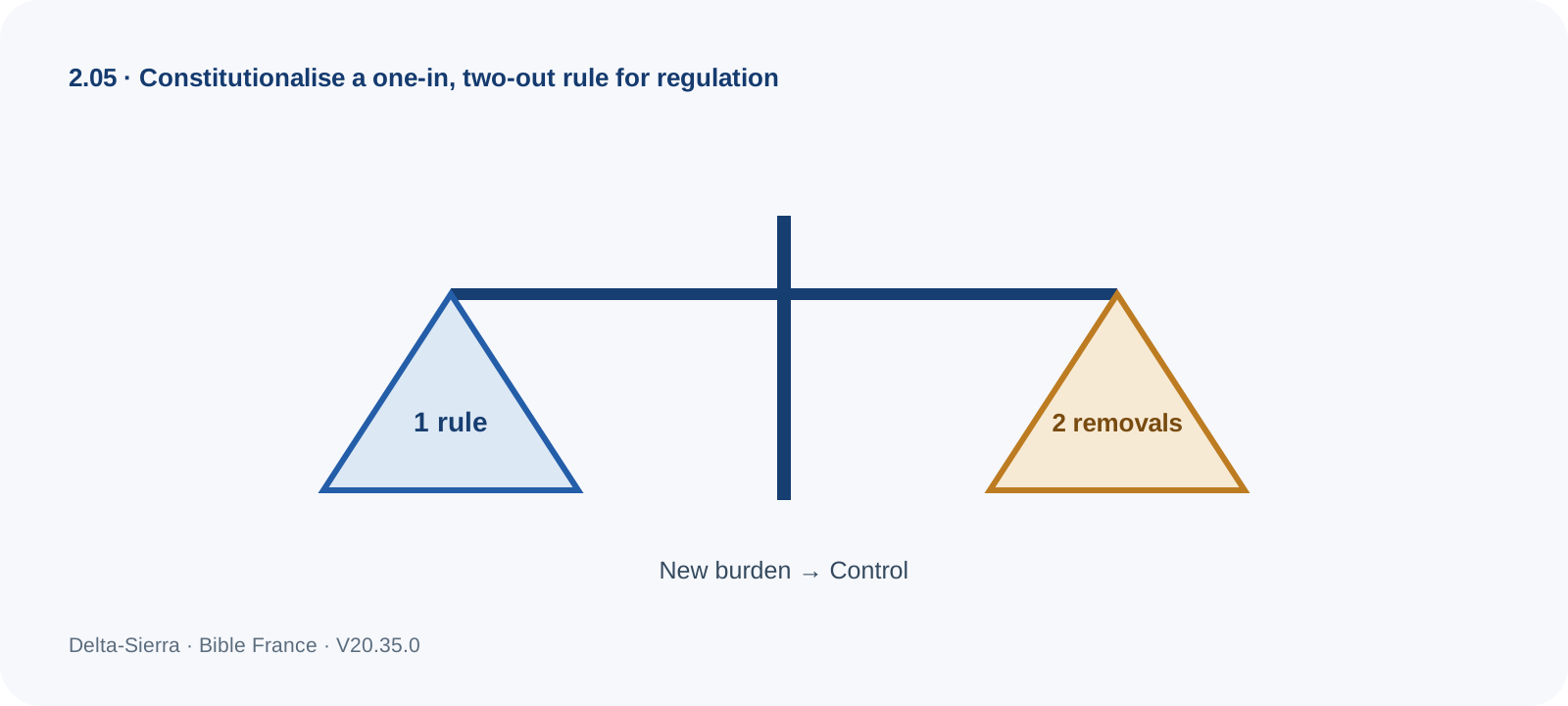
Measure-specific visual explanation 2.05

In 30 seconds

Current positionMake control of regulatory stock a durable political constraint while avoiding a mechanical count in which one heavy rule is offset by two trivial repeals.
ProposalConstitutionalise a one-in, two-out rule for regulation
Legal routeConstitutional amendment under Article 89, followed by implementing rules defining measurement, scope and exceptions.
Financial effectStructural effect only: no automatic budget saving should be claimed without measuring the burden actually removed.
ConfidenceHigh on legal framing and method; financial estimates require consolidation before booking.
Main riskCounting documents is easy to game; impact, stability and administrative burden need to be measured instead.

A constitutional principle should not become a mechanical counting game

Putting a one-in, two-out discipline in the Constitution would make it harder to abandon. Article 89 sets a demanding amendment procedure, so the constitutional text should express a principle of compensating and reducing regulatory burden rather than hard-code a simplistic arithmetic formula.

The implementing system should estimate obligations, time, frequency, IT costs and affected populations. Two trivial repeals cannot credibly offset one major new reporting burden.

Exceptions must be visible and temporary

Emergency, security, EU implementation or court rulings may require new rules without immediate offsets. The system can allow a temporary deficit recorded in a public account and repaid later through simplification, rather than pretending that every case fits the ratio.

A three-year review should test whether regulatory burden, stability and user comprehension improved. If document counts fall while complexity rises, the mechanism has failed and its implementing metrics need adjustment.

Costing and legal delivery

Constitutional amendment under Article 89, followed by implementing rules defining measurement, scope and exceptions.

Structural effect only: no automatic budget saving should be claimed without measuring the burden actually removed.

Transition expenditure is reported separately from recurring savings, and transferred activity remains public expenditure unless the policy itself is discontinued.

What must be proved before implementation

Counting documents is easy to game; impact, stability and administrative burden need to be measured instead.

The implementation file should define the accounting unit of the constitutional rule. Each new burden must disclose who complies, what information or action is required and the estimated time, while the two compensating removals must demonstrate comparable real-world relief rather than formal deletion.

Notes and sources

  1. Constitution — article 89, procédure de révision — primary/institutional source used for the measure framework.
  2. Conseil d’État — Simplification et qualité du droit — primary/institutional source used for the measure framework.
  3. Conseil d’État — Mesurer l’inflation normative — primary/institutional source used for the measure framework.
  4. Légifrance — liste des codes en vigueur — primary/institutional source used for the measure framework.


Further reading

The author’s books extend the programme but do not replace the primary sources cited in this chapter.

Réforme de l’État book cover

Réforme de l’État — Plan de Rupture

The architecture of the 155-measure programme.

IA : comment transformer la France book cover

IA : comment transformer la France

AI use cases, automation and human oversight in public services.

Make 'one in, two out' a measurable rule

Constitutionalising a one-in-two-out rule requires a definition of what is actually counted. Article 89 governs constitutional revision. [1] Counting statutes, articles or decrees would be easy to game because a major burden can fit into one provision while technical coordination may require many provisions.

A better unit is regulatory burden: populations affected, forms, data requested, inspections, deadlines and estimated compliance time. Conseil d'État work on simplification and regulatory inflation provides a methodological basis. [2] [3]

Emergency, security, EU and constitutional requirements need transparent exceptions with later compensation where appropriate. The live code inventory can then show whether the rule changes applicable law rather than only publication statistics. [4]

Implementation evidence to publish

A constitutional one-in-two-out rule must be auditable in terms of burden rather than publication volume. The public should be able to see what a new obligation asks citizens, firms or administrations to do and what equivalent burden was genuinely removed.

The post-reform comparison should focus on net regulatory burden and the quality of exceptions, not the ceremonial number of provisions deleted.

Failure modes to test before national rollout

The one-in-two-out rule must be tested against cosmetic repeals, regulatory displacement and incentives to redefine rather than remove obligations.