Measure 26 / 155

02 — Administration · Measure 2.06 · 26 / 155

Reduce the number of legal codes without making the law harder to use

Update the baseline: Légifrance currently lists 76 codes in force, not 69. A target of 20 must therefore be a coherent consolidation project, not a numerical purge.

Bible France · documentary chapterUpdated : 12 August 2026Primary sources prioritised
Measure 2.06 — Reduce the number of legal codes without making the law harder to use
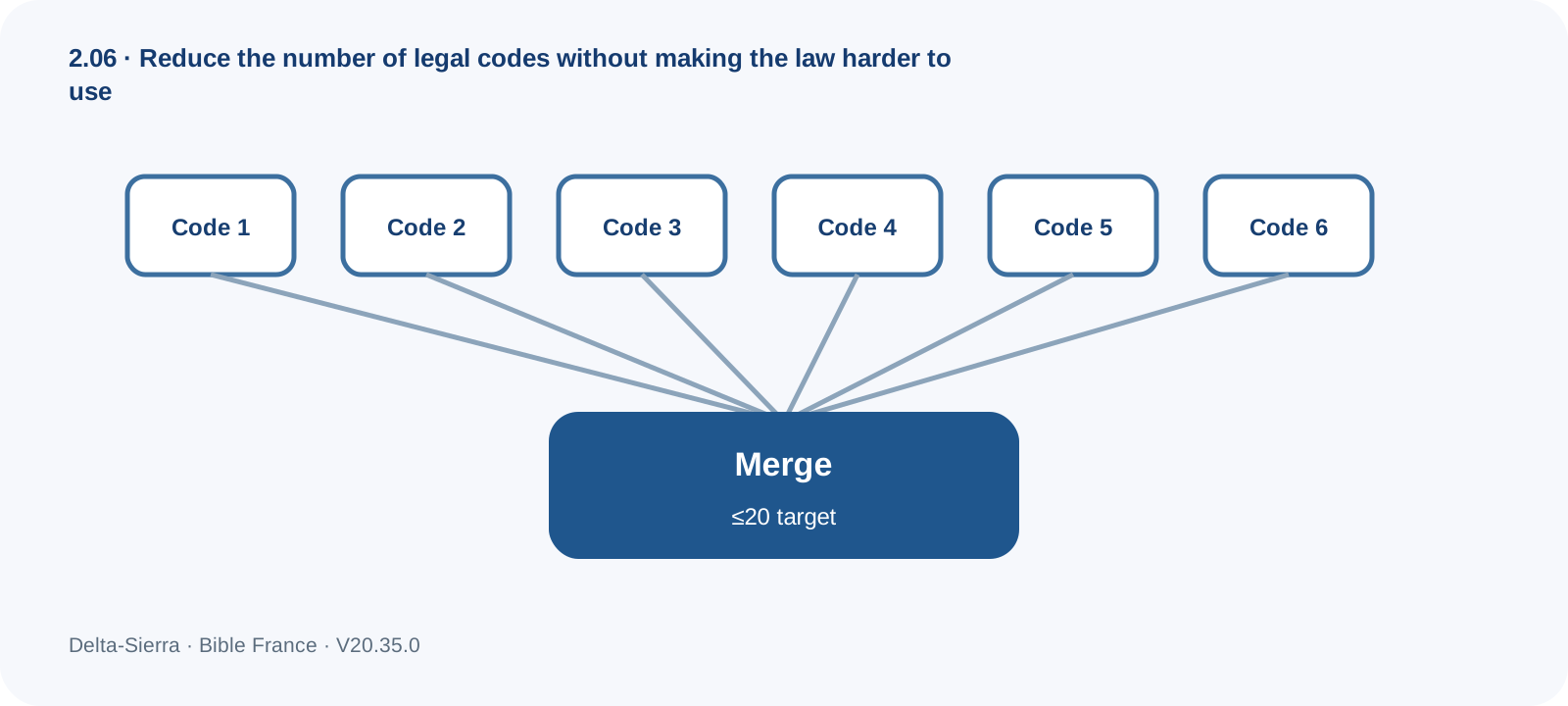
Measure-specific visual explanation 2.06

In 30 seconds

Current positionUpdate the baseline: Légifrance currently lists 76 codes in force, not 69. A target of 20 must therefore be a coherent consolidation project, not a numerical purge.
ProposalReduce the number of legal codes without making the law harder to use
Legal routeEnabling legislation, codification ordinances and ratification statutes, with concordance tables and constant-law controls.
Financial effectStructural and legal-productivity effect; annual savings cannot be inferred from the number of codes alone.
ConfidenceHigh on legal framing and method; financial estimates require consolidation before booking.
Main riskOne oversized, badly structured code can be less usable than several coherent codes.

The baseline is 76 codes in force, not 69

Légifrance currently lists 76 codes in force. The Plan’s target of no more than twenty should therefore be presented as a consolidation objective built on an updated, reproducible baseline.

Grouping must follow coherent legal domains and user needs. A single oversized code can be harder to use than several well-structured codes, so accessibility and search time are better success measures than the headline number alone.

Constant-law codification needs safeguards

Reorganisation of legal material should be separated from substantive changes to rights and obligations. Every consolidation should provide concordance tables, redirects, history and a transition period so that contracts, court decisions and professional practice can still trace older references.

User testing with judges, lawyers, administrations, companies and citizens should precede final validation. The political target remains useful as a pressure for consolidation, but it should not override intelligibility.

Costing and legal delivery

Enabling legislation, codification ordinances and ratification statutes, with concordance tables and constant-law controls.

Structural and legal-productivity effect; annual savings cannot be inferred from the number of codes alone.

Transition expenditure is reported separately from recurring savings, and transferred activity remains public expenditure unless the policy itself is discontinued.

What must be proved before implementation

One oversized, badly structured code can be less usable than several coherent codes.

The implementation file should map every existing code into a target legal architecture. It must distinguish right-constant codification from substantive reform, preserve citation continuity and report user testing before any merger is made irreversible.

Notes and sources

  1. Légifrance — codes en vigueur — primary/institutional source used for the measure framework.
  2. DGAFP — codification du Code général de la fonction publique — primary/institutional source used for the measure framework.

  3. Conseil d’État — Simplification et qualité du droit — primary/institutional source used for the measure framework.
  4. Légifrance — Code général de la fonction publique — primary/institutional source used for the measure framework.


Further reading

The author’s books extend the programme but do not replace the primary sources cited in this chapter.

Réforme de l’État book cover

Réforme de l’État — Plan de Rupture

The architecture of the 155-measure programme.

IA : comment transformer la France book cover

IA : comment transformer la France

AI use cases, automation and human oversight in public services.

Reduce the legal corpus without destroying usable landmarks

The starting figure needs correction: Legifrance's current list contains 76 codes in force. [1] The historical '69 to 20' wording should therefore remain identifiable as the Plan's original target rather than be presented as the 2026 inventory.

Consolidation should follow user journeys and legal domains, not a numerical quota. The General Civil Service Code shows how demanding a large codification project is, including concordance and reference migration. [2] [4]

Prototype structures should be tested with judges, lawyers, public officials, businesses and citizens. Search time, broken references and interpretation errors matter more than the headline number of codes. Conseil d'État guidance on simplification supports that user-centred test. [3]

Implementation evidence to publish

The target architecture should be tested as an information system for law, not as a graphic exercise in reducing the number of book spines. Users need stable citations, predictable subject boundaries and reliable search throughout the transition.

The post-reform comparison should focus on search time, broken references and interpretation errors for real users of the legal corpus.

Failure modes to test before national rollout

Reducing the number of codes must be tested for loss of legal clarity, unstable cross-references and consolidation costs borne by users and courts.