


MARS BIBLE — TRANSPORT · FLEET · PROPULSION · LOGISTICS
Launch windows and Earth–Mars transfer: why geometry controls the calendar
Launch windows, cargo, crews, propulsion and fleet architecture
Deepening — turn the “26-month window” into an operational fleet calendar
The synodic period explains recurrence, not the exact shape of a launch window
Earth orbits the Sun in about 365.256 days and Mars in about 686.98 days. The synodic period can be written as 1 / |1/TEarth − 1/TMars|, where the vertical bars denote an absolute value. The result is about 779.9 days, or 25.6 months. That is why broadly favourable Earth-Mars geometry returns approximately every twenty-six months.
Launch-window geometry is one part of the wider human journey to Mars, from transit through entry, descent and landing, where departure energy, travel time, cargo sequencing and arrival risk must be solved as one chain.
The period does not mean every day around opposition is equivalent. A real mission has departure-energy limits, a departure direction, a flight-time range, an arrival speed and often parking-orbit geometry constraints. An interplanetary “window” is therefore a region of acceptable trades rather than one magic calendar date.
This matters even more for crewed campaigns. Launch-site weather, cryogenic storage, orbital assembly and rendezvous order can narrow the usable opportunity. Planetary geometry opens the door; system architecture determines how long that door is practically open.
Reading a porkchop plot means reading the energy price of the calendar
A porkchop plot usually places departure date on one axis and arrival date on the other. Contours show quantities such as departure C3 or arrival v∞. C3 is the square of hyperbolic excess speed at Earth departure. Higher C3 generally demands more performance from launch and departure stages. The map therefore reveals energetic valleys and expensive regions.
Minimum C3 is not automatically the best human mission. A somewhat higher-energy transfer may reduce time in radiation and microgravity, while a very fast mission can demand much more propulsion and arrive at Mars faster. NASA fast-trajectory studies illustrate this triangle: flight time, Δv and architecture cannot be optimized independently.
For a settlement, porkchop plots become logistics tools. Slow economical cargo, faster crew, precursor probes and return vehicles can use different parts of the opportunity space. The window becomes a transportation season.
The daily launch opportunity has geometry relative to the parking orbit
Even inside a favourable interplanetary season, an Earth parking orbit cannot inject toward Mars at any arbitrary instant. The departure asymptote must be compatible with the parking-orbit plane. Otherwise a plane-change penalty appears. Classical NASA launch-window work therefore distinguishes daily injection opportunities and several departure strategies.
This is the difference between a launch day and a launch instant. A campaign may have several acceptable days, while each day offers a narrower geometric opportunity for final injection. A delayed rendezvous, tanker or checkout can therefore miss the daily geometry even when the broader Mars season remains open.
Robust architecture provides waiting and recovery strategies — longer parking, another injection time, altered Δv allocation or delay — but every option consumes resources. Parking orbit is part of the interplanetary schedule, not a neutral waiting room.
Prepositioned cargo turns the window into a chain of dependencies
A rational crewed mission should not arrive before the infrastructure on which it depends. Power, habitat, communications, vehicles, consumables and perhaps local production can depart in an earlier opportunity. A logistics failure can therefore propagate across years: missing a cargo departure now may cancel a crew opportunity twenty-six months later.
Planning needs a dependency graph. Each element has a departure deadline, arrival date, commissioning phase and proof of operation before the next crew-dependent element is released. Cargo becomes a human-go criterion. Mars makes ordinary project dependency physically unforgiving because replacement cannot simply be expedited after the planets move apart.
Settlement safety stock should therefore include orbital timing. A part described as “nine months from Earth” is not equivalent to a part that misses the next departure and waits more than two years. True logistics lead time includes production, planetary window, launch, transit, arrival and unloading.
A Martian civilization will think in waves, not isolated flights
As traffic grows, one opportunity becomes a campaign of vehicles with different departure dates and transit times. Mars-side navigation, relays and landing operations must absorb the arrival concentration. The Martian spaceport experiences a high season every twenty-six months, with preparation beginning months before and recovery continuing afterward.
The rhythm affects the economy. Companies synchronize imports and exports, hospitals anticipate incoming residents, industry builds stock in waves and critical equipment may be ordered an entire window ahead. Orbital mechanics becomes a social season.
Future propulsion and higher-energy routes may widen options, but they will not erase planetary dynamics. A serious reference should therefore move beyond the slogan “every 26 months” and explain the temporal structure around which interplanetary logistics is built.
Treating the launch window as a twenty-six-month industrial constraint
Connect orbital geometry to the settlement calendar
Earth-Mars geometry repeats on the synodic period. In a simple approximation, 1/S = |1/P_E − 1/P_M|, where S is the synodic period and P_E and P_M are the orbital periods of Earth and Mars. Using about 365.25 and 686.98 days gives S ≈ 779.9 days, about 25.6 months. The symbol “≈” means approximately equal. This is not merely celestial mechanics: it shapes procurement, cargo production, inventories, crew rotation and the way a settlement survives a failed launch campaign.
If a critical component misses the intended campaign, “send it next month” is usually not equivalent. The mission must accept a more demanding trajectory or wait for a later favorable geometry. Autonomy can therefore be measured partly by how many launch opportunities the settlement can survive without one indispensable delivery.
Understand why days inside a window are not equivalent
A multi-week window is not a flat plateau. Each departure and arrival date produces different energy, often shown on porkchop plots. They may display C3, flight time or arrival velocity. C3 is the square of hyperbolic excess velocity and is expressed in km²/s². Higher departure energy requires more launch or propulsion performance, reducing payload or increasing propellant demand.
The choice is multidimensional: mass, duration, radiation exposure, consumables, arrival velocity, EDL margin and surface schedule. A faster trajectory may reduce crew exposure while increasing departure and arrival energy. There is no single “best window” independent of the vehicle and mission architecture.
Build the cargo campaign before the crew campaign
A credible settlement sequences dependencies. Some cargo has to arrive early enough to demonstrate power, communications, water production or site preparation before a crew leaves Earth. Critical spares can be distributed among arrivals so that one failure does not erase an entire capability. The window becomes a logistics network: which elements must precede which others, with what margin and substitution paths?
As population grows, the roughly 26-month rhythm creates large seasonal inventories. Food, medicine, rare components and storage capacity must be sized not for an annual average but for survival after a partially failed campaign. Orbital mechanics becomes an economic constraint resembling a port that receives ships only in widely separated seasons.
verification cases and operational margin
Stress the campaign by deleting one entire launch
A revealing robustness test removes one launch from the campaign and asks whether the mission remains viable. If one cargo failure simultaneously removes water-system spares, the second rover and part of the medical inventory, logistical concentration is excessive. Distributing critical functions across vehicles may cost interfaces and mass but reduces the chance that one event removes several safety barriers.
The analysis must include recovery time. Some goods can be replaced from Earth at the next opportunity; others require local manufacture or stocks covering more than two years. The cargo manifest therefore becomes a safety instrument showing which dependencies share the same launcher, transfer stage and arrival date.
The reasoning starts from accessible geometry, then connects mechanics, calculations, navigation and architecture consequences. Simplified models expose the governing relationships; operational ephemerides and mission software are required for flight design.
From planetary geometry to mission calendar
1 — The trip starts with a future rendezvous
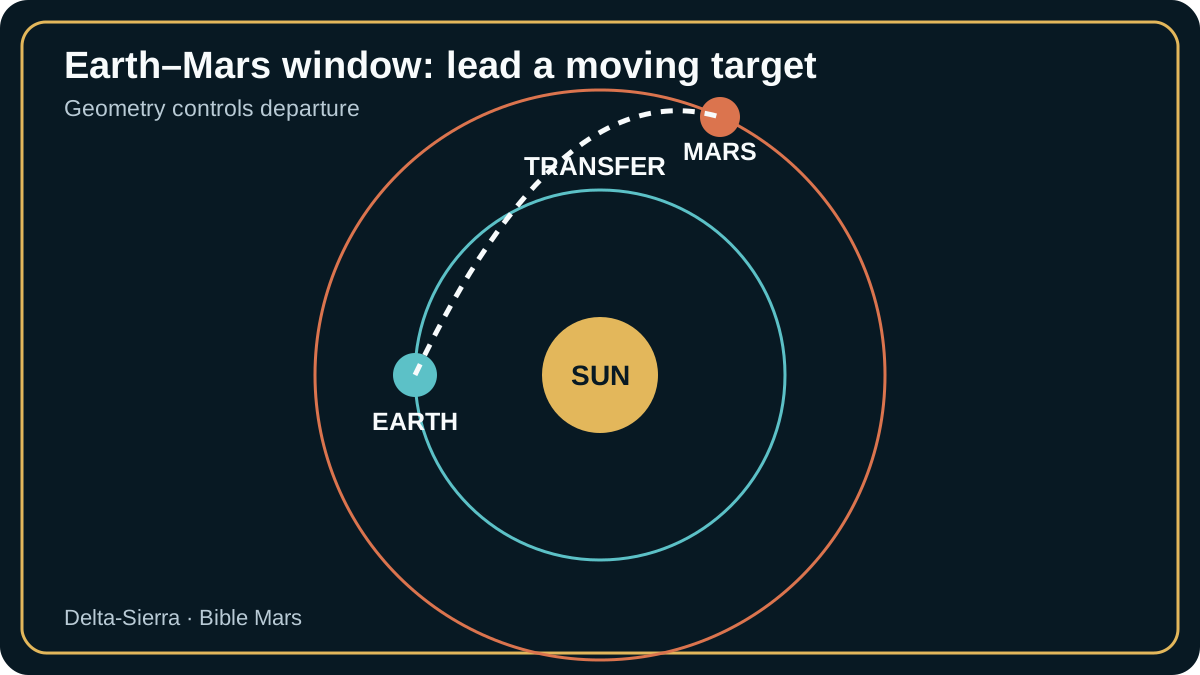
Mars keeps moving while the spacecraft cruises. Departure must be timed so both reach the same region at the same time.
2 — Why roughly twenty-six months
Earth laps Mars in relative orbital phase. The synodic period is about 780 days, or roughly 25.6 months. This is the recurrence of similar geometry, not the spacecraft's flight time.
3 — The simplified Hohmann estimate
Using 1 AU for Earth and about 1.524 AU for Mars gives a transfer semi-major axis near 1.262 AU. Kepler's third law yields about 1.418 years for the full transfer ellipse; half is about 259 days.
4 — Why Mars must lead
During 259 days Mars travels roughly 136 degrees, while the ideal half-transfer spans 180 degrees, producing a simplified departure lead angle near 44 degrees.
5 — A real window is not one instant
Launcher performance, site constraints, daily targeting, arrival lighting, communications and entry geometry create a span of usable dates with different solutions.
6 — Cargo and crew need not fly the same way
Cargo can accept longer transit for propellant efficiency; crew missions trade duration against radiation, consumables, health and habitat requirements.
7 — The cost of missing a window
A critical missed launch can delay replacement hardware for many months. Strategic inventory, redundant cargo and local manufacturing become mission-architecture requirements.
8 — Pre-deploy before committing crews
Life-critical surface systems should be delivered, checked and operated before a crew depends on them whenever architecture permits.
9 — Return has its own geometry
Mars–Earth return opportunities impose their own timing. Human missions must plan departure, surface stay, return opportunity and contingency endurance together.
10 — Toward an interplanetary logistics line
Long-term settlement requires coordinated fleets of cargo, crew vehicles, depots, tugs, surface systems and rescue capacity synchronized to orbital opportunities.
Intermediate synthesis
The essential lesson is integration: a trajectory is not merely a line, a launch window is not merely a date, and arrival is not merely a location. They are dynamic states, margins, maneuvers, measurements and decisions forming one system.
Technical deepening — from teaching model to real architecture
1. Synodic period is only the first layer
The ~26-month rhythm says when similar geometry returns, not which exact day to launch. Actual targeting adds planetary ephemerides, launcher limits, site constraints, arrival lighting and entry geometry.
2. Departure C3 couples calendar and payload
Each departure/arrival pair requires a specific launch energy often expressed through C3 or hyperbolic excess speed. A higher-energy day may reduce the mass that the launch vehicle can deliver.
3. Porkchop plots map trade space
Interplanetary designers often plot departure date against arrival date with contours of energy, delta-v or flight time. The result shows families of solutions rather than one magic trajectory.
4. Faster is not automatically better
Shorter flight can reduce crew radiation time and confinement but usually demands more energy. Slower cargo transit may save propellant while increasing equipment operating time and delaying availability.
5. Conjunction- and opposition-class logic
Historical human Mars studies distinguish long-stay and shorter-stay mission families because return geometry strongly affects total mission duration. Modern architectures may differ, but surface stay cannot be chosen independently of planetary motion.
6. Cargo should precede crew dependence
Power, habitat, communications, mobility and reserves can be pre-deployed and verified before a crew relies on them, turning orbital timing into a risk-reduction strategy.
7. What if a launch is cancelled?
A delay of hours may remain inside the launch period with new targeting. Missing the entire opportunity can delay replacement capability by many months. Programs must distinguish daily delay from loss of a whole campaign.
8. Return and rescue are also window-limited
Mars cannot be managed like a near-Earth outpost with immediate evacuation. Medical, food, power and industrial reserves must cover scenarios in which the next cargo or return opportunity is unavailable.
9. Build a ten-year fleet calendar
A durable settlement requires multiple synodic cycles of robotic precursors, cargo, crews, power expansion, ISRU, replacements and rescue capacity. Each wave changes the payload needs of the next.
Why opportunities recur roughly every twenty-six months
Earth completes an orbit in about 365.256 days and Mars in about 686.98 days. Because both move in the same direction at different angular rates, favorable geometry repeats according to the synodic period. It is calculated from 1/S = |1/Earth period − 1/Mars period|. Substitution gives S ≈ 779.9 days, about 25.6 months. This number explains the broad rhythm of Mars campaigns. It does not mean a rocket can depart on only one day: a band of dates around the optimum still provides energy and arrival conditions compatible with mission constraints.
For an ideal Hohmann transfer between circular coplanar orbits, the transfer ellipse semi-major axis is the average of Earth’s and Mars’s orbital radii. Using 1 AU for Earth and about 1.523679 AU for Mars, half the transfer period gives about 258.9 days. Mars moves during that time, so in this simplified model it must lead Earth by roughly 44.3° at departure. ISRO describes this intuition for Mars Orbiter Mission, citing a phase angle near 44° and recurrence around 780 days. Real missions use precise ephemerides and do not assume circular coplanar orbits, but the calculation exposes the origin of the launch opportunity.
A launch window therefore has physical depth: it links planetary position, departure energy, flight time and arrival speed. Leaving earlier or later may raise the C3 demanded from the launcher or the v∞ encountered at Mars. A faster arrival must then be removed by propulsion or atmosphere. ‘Launch when the rocket is ready’ is not independent from EDL; a shift of days or weeks can move tonnes of propellant or thermal margin to the far end of the mission.
Reading a porkchop plot
Porkchop plots usually place departure date on one axis and arrival date on the other. Contours show time of flight, departure C3 and often arrival v∞ or Δv. They resemble a weather map: every point represents a different mission. The low-energy center is attractive but not automatically the best choice. A crew may accept greater C3 to shorten exposure; cargo may accept more time to reduce launcher demand. The plot turns a launch window into a trade space rather than a sacred date.
C3 deserves a precise definition. It is the square of hyperbolic excess speed v∞ relative to Earth: C3 = v∞². If v∞ is 3.2 km/s, C3 is 10.24 km²/s². It is neither the rocket’s total Δv nor the vehicle’s total kinetic energy; it is an orbital parameter describing residual energy as the trajectory escapes Earth’s gravity well. Two launch vehicles can therefore deliver different masses to the same C3 depending on staging, launch site and ascent profile.
For a fleet, those contours must be overlaid with real constraints: allowed launch days, pad availability, fueling time, weather risk, tanker cadence, on-orbit propellant lifetime, rescue posture, daylight or nighttime arrival, Martian season and landing-zone capacity. A broad astrodynamics window can become narrow operationally. Settlement therefore requires an integrated campaign calendar months before departure.
Window, launch instant and orbital plane
A Mars window may span weeks, but an individual launch has a much more precise daily opportunity. The interplanetary departure plane and Earth’s rotation determine when the launch site is correctly oriented. Missing that instant may produce another opportunity the next day at slightly different cost, or none under certain constraints. This is why a weather delay of hours can become a delay of a day, while a delay of weeks can change the entire trajectory.
Plane changes are expensive when velocity is high. An architecture therefore tries to use launch geometry and maneuvers at favorable locations instead of correcting a large inclination later. The same principle applies at Mars: landing-site latitude, incoming trajectory and any parking orbit are coupled. A base chosen for water ice at higher latitude can create a different transportation trade from an equatorial site.
For a general reader, the conclusion is simple: a Mars window is not a door that suddenly opens and shuts. It is a valley in an energy landscape. The farther one moves from the valley floor, the more is paid in performance, duration or arrival conditions. Engineers choose the point at which the entire system—launcher, spacecraft, crew, arrival and surface—retains adequate margin.
Planning a settlement in waves
A settlement dependent on roughly 26-month opportunities lives with very long logistics cycles. A forgotten part cannot arrive the following week. Safety stock must cover nominal consumption plus launch failure, loss of a lander and the wait until the next opportunity. Terrestrial just-in-time inventory logic is insufficient; the settlement must be designed to survive between waves.
A campaign can be structured in waves: robotic reconnaissance, installation of power and communications, resource production, first crew, second crew with redundancy, then industrial scaling. Every wave should have measurable go/no-go criteria. The first crew should not depart merely because the astronomical date is approaching; it should depart if pre-positioned power has demonstrated availability, water access is verified, communications are healthy and emergency habitat is confirmed.
This discipline leads to an important idea: deliberately missing a window can be the safest decision. In conquest narratives every opportunity seems destined to be seized. In real infrastructure, an unqualified system, insufficient inventory or incomplete refueling campaign can justify waiting another cycle. Program maturity is also measured by the ability not to launch when declared margins are absent.
A launch opportunity is a campaign, not a date on a calendar
Once multiple vehicles are involved, the Mars opportunity must be treated as a campaign. Tankers, cargo vehicles and crew vehicles may each have different daily launch times, checkout durations and acceptable departure energies. The first tanker can launch long before the crew, while the last tanker may sit on the critical path because its failure leaves the interplanetary vehicle under-fueled. Launch pads, range availability, propellant production, weather and ground crews become coupled resources. A settlement architecture should therefore model the probability that the entire departure sequence can be completed inside the usable opportunity, not merely show that one vehicle can reach the required C3.
Arrival geometry also feeds back into departure choice. The date selected on Earth determines Martian season, local solar time, dust statistics, communication geometry and sometimes the lighting available for terrain-relative navigation. If surface solar power is important, arriving during an unfavorable season can reduce energy margins exactly when unloading and commissioning demand their highest power. The 'best' astrodynamics point is therefore not necessarily the best settlement point. Mission design trades departure energy against arrival safety and the readiness of the surface system.
For long-range planning, a sequence of synodic opportunities becomes a strategic calendar. Equipment that must be demonstrated before crew arrival has to be launched one or more opportunities earlier; replacements for a failed pre-positioned asset may push the human mission back an entire cycle. This is why Mars settlement schedules measured only in years are misleading. The more useful unit is often the number of Earth–Mars opportunities required to prove, deploy, duplicate and finally depend on each critical system.
The return window is part of the outbound decision
Earth–Mars planning is incomplete without Mars–Earth geometry. A crew that lands safely still needs a departure opportunity compatible with the return vehicle, surface stay and Earth-entry system. Long-stay architectures exploit the next favorable geometry after many months on Mars; shorter stays require higher-energy combinations and can narrow the overall trade space. The outbound launch date therefore fixes much of the later return calendar.
For a permanent settlement, return windows remain important even if most residents intend to stay. Medical evacuation cannot be immediate, crew rotation cannot be scheduled arbitrarily, and reusable interplanetary vehicles may need their own cycle. A mature timetable would therefore publish both directions as one network, including reserve vehicles and the possibility that a vehicle skips one opportunity for maintenance.
A launch window is the intersection of planetary geometry and mission architecture
The familiar statement that favorable Earth–Mars opportunities recur about every twenty-six months is only the beginning. A window is not a magic date. It is a family of trajectories linking two moving planets while satisfying launch energy, trip duration, arrival conditions, thermal constraints, launcher availability and sometimes return strategy. A crewed mission does not merely seek minimum energy; it trades mass, time, exposure, propulsion and rescue options.
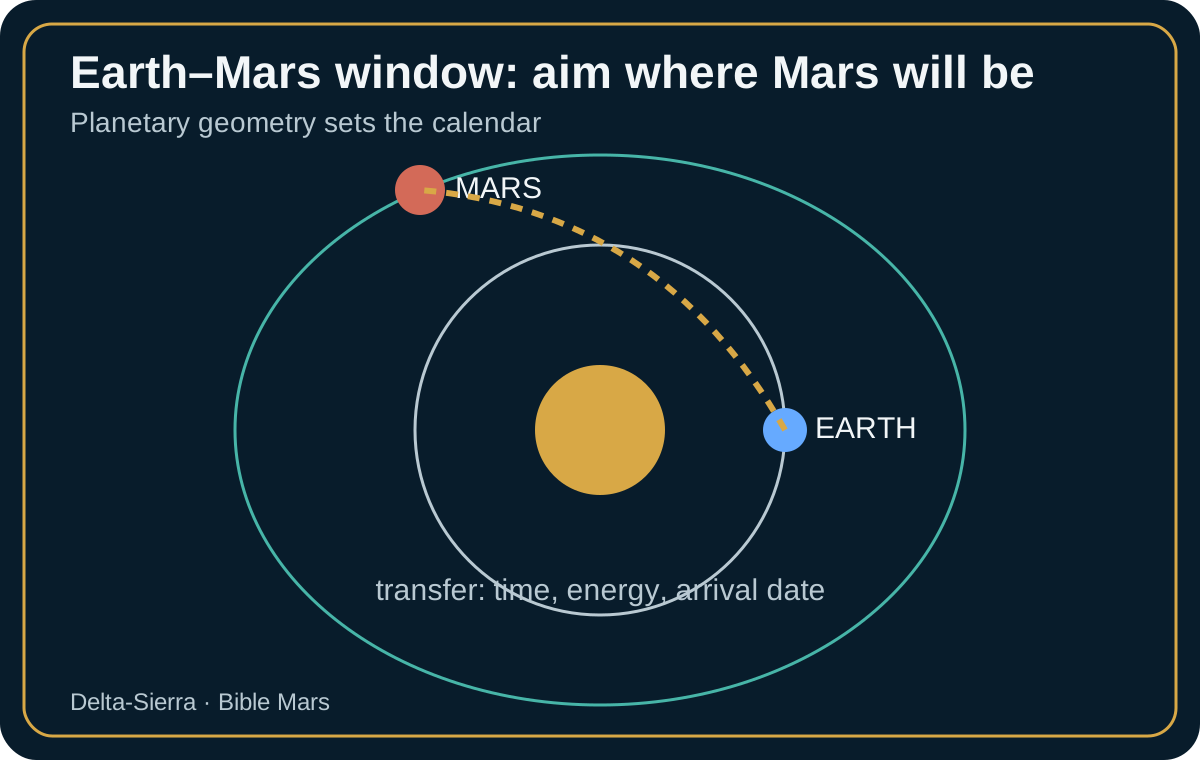
The Hohmann transfer offers a useful benchmark. In the simplified circular-orbit model, the half-ellipse from 1 AU to 1.52 AU has a semi-major axis near (1 + 1.52) ÷ 2 = 1.26 AU. Kepler's third law gives a full period near √(1.26³) ≈ 1.41 years; half the ellipse is roughly 259 days. JPL's launch-window lesson obtains the same order of magnitude and a simplified ideal launch phase angle near 44° with Mars ahead of Earth. These are teaching anchors, not prescriptions for human transport.
Changing duration changes the whole mission
A faster trajectory generally demands greater characteristic energy and can increase launcher or departure-stage performance. It reduces time exposed to microgravity, radiation and consumable losses. A slower trajectory may save propulsion but adds life-support days and can change arrival energy. The correct comparison is therefore total mission mass after propulsion, consumables, shielding, power and margins—not days alone.
As an illustration, if four people together require 12 kg/day of net unrecycled resources and losses, extending a flight from 180 to 260 days adds 80 × 12 = 960 kg. If a faster architecture needs 700 kg more propulsion but avoids 960 kg of consumables and reduces some risks, it may compete. Real numbers depend on recycling and propulsion, but the method shows why time and mass cannot be optimized independently.
“The window” exists at several time scales
The interplanetary opportunity may last weeks, while the actual launch also has a daily window. The launch site rotates with Earth; injection plane, downrange safety and parking-orbit geometry constrain the clock time. A mission can therefore be in the right Mars season yet miss its daily opportunity. Operations distinguish planetary opportunity, launch-day window and the final trans-Mars injection time.
Human missions also need decision windows. What happens if a fault appears two days before launch? When does a repair turn an hour delay into a multi-day slip? At what point must stages or consumables be reconfigured? Astronomy supplies the corridor; engineering turns it into countdown rules.
The next return opportunity already influences departure
A permanent settlement may accept that a crew will not return soon, yet transport architecture still needs future return, rescue and logistics opportunities. Synodic cadence structures settlement inventory: missing one cargo campaign can mean waiting for the next. The Earth–Mars window is therefore also an economic clock.
As traffic grows, arrivals must be distributed across surface capacity. Concentrating every cargo landing into a short period is pointless if unloading crews, power systems and landing zones cannot absorb it. Celestial mechanics ultimately shapes Martian industrial organization.
The window also creates an industrial calendar on Earth and Mars
A departure campaign is not one rocket. Months before the opportunity, multiple vehicles must be built, tested, transported, integrated and loaded. A component arriving two weeks late may lose not two weeks but an interplanetary opportunity. Planning therefore identifies items whose delay threatens injection and prepares substitution or deferral options.
Cargo can use different trajectories from crew. Robust freight may accept a slower, lower-energy trip, while crew may value shorter exposure. The campaign becomes a portfolio: prepositioned supplies, rescue assets, arrival stocks and equipment that can wait for the following opportunity.
Return geometry influences surface strategy. Short opposition-type missions and long conjunction-class stays have different time structures. For a permanent settlement this becomes crew-rotation and transport policy; people and cargo need not arrive on identical trajectories.
A few days of launch margin have operational value. If launcher performance changes across the window, injected mass or flight time may change. Missions need an envelope, not only a nominal date: what remains possible at D+1, D+5 or D+10, and what changes at arrival?
Windows create peaks in data and decision demand. Earth concentrates weather, tracking and coordination before launch; Mars concentrates relay, traffic control, surface teams and power during arrivals. Mature colonization will spread operational peaks where possible rather than stack every activity around one astronomical instant.
Over decades, the roughly twenty-six-month rhythm may become part of Martian economics. Major expansions, crew rotations and high-value imports can be planned in cycles, much as seasons or tides structured some Earth economies.
Launch energy, parking orbit and slip strategy turn planetary geometry into an executable departure
The planetary window defines useful departure geometry, but the launch vehicle must still place the spacecraft into a suitable Earth departure state. Many architectures first reach a parking orbit, perform checkout and then execute trans-Mars injection. The parking-orbit altitude, inclination and launch-site latitude influence the injection opportunity and propellant needs.
Characteristic energy C3 is a useful bridge between trajectory and launch vehicle. It represents the square of hyperbolic excess speed after Earth escape. A mission with higher C3 generally asks more performance from the launcher or departure stage, reducing delivered mass. Comparing launch vehicles only by low-Earth-orbit payload can therefore be misleading for Mars.
Daily slip strategy should be designed before countdown. A one-day delay changes Earth rotation geometry and slightly changes the interplanetary solution. The mission should know whether it can retarget software and guidance, how propellant changes and when the next attempt moves outside the certified envelope.
Cryogenic stages add time dependence. Boil-off, thermal conditioning and propellant transfer can make long parking-orbit waits expensive. Storable propulsion changes those constraints but may carry performance or toxicity trade-offs. Departure architecture and window strategy are coupled.
For a crewed campaign, launch sequence also affects rescue. If cargo and crew launch separately, the order determines what assets already exist if one launch fails. Prepositioning critical supplies before crew departure can convert a launch failure from a crew emergency into a schedule delay.
An executable window is therefore a decision tree: launch, hold, recycle, retarget, abort to Earth orbit or defer to another opportunity. Planetary mechanics opens the door; operations decide whether the mission can walk through it safely.
Case study: a six-day slip during a Mars departure campaign
A launcher issue forces a six-day delay. The interplanetary opportunity may remain open, but the nominal trajectory must be revalidated. Injection, trip time, launch margin and arrival conditions are recomputed. A modest date change can alter entry time, illumination or communications geometry.
The crew vehicle already has loaded consumables and maintained batteries. Ground delay consumes resources and can conflict with another launch. A campaign sharing pads and tracking assets makes one slip propagate operationally.
Mars is affected too. Prepositioned cargo may now arrive earlier relative to crew, and surface infrastructure may need to operate autonomously longer. An Earth launch delay becomes a Mars operations scenario.
Robust campaigns therefore precompute fallback profiles. On the failure day, teams do not discover J+6 for the first time; they select from analyzed options with known mass, duration and arrival limits.
Window planning should connect departure probability to settlement inventory risk
Not every scheduled cargo vehicle will launch successfully. Weather, launcher faults, integration delays or range conflicts can cause slips and missed opportunities. A settlement should therefore plan inventory against probability of delivery, not a perfect cadence.
If a critical consumable stock covers thirty months and the nominal cargo opportunity occurs every roughly twenty-six months, only four months of schedule margin remain before the next cycle becomes dangerous. Delayed departure, slow trajectory or landing failure can consume that reserve. Stock policy should include arrival uncertainty as well as consumption uncertainty.
Prepositioning can reduce crew risk. Habitat spares, surface power or return assets launched on an earlier cargo trajectory can be confirmed before people depart. The price is earlier capital commitment and the possibility that equipment ages before use.
Campaign design can also distribute cargo among independent launches. One large vehicle minimizes interfaces but concentrates failure consequence; several vehicles increase operations while avoiding a single loss of all supplies. Window geometry and launch infrastructure determine how much diversification is realistic.
The settlement should know which shipments can be deferred. Scientific equipment may wait for the next cycle; medical, power or food-system components may not. Mission planning therefore links Earth manifests to a Martian criticality database.
Launch windows ultimately connect celestial mechanics with resilience economics. The calendar of the planets becomes a boundary condition on inventory, construction schedules and population growth.
Trajectory campaigns also interact with launch-site weather and range availability. The planetary opportunity may remain favorable while terrestrial constraints remove several daily attempts. Program schedules should therefore carry enough launch-day flexibility to absorb ordinary ground delays without immediately entering a new vehicle configuration.
For assembled spacecraft departing from Earth orbit, the 'launch window' can include rendezvous and propellant-transfer sequencing before trans-Mars injection. This separates surface launch from interplanetary departure but creates orbital storage and schedule dependencies of its own.
A settlement planning decades ahead may intentionally alternate high-mass cargo campaigns and crew-focused campaigns according to infrastructure demand. The synodic cycle becomes a planning framework rather than a repeated copy of one mission profile.
Primary sources and research landmarks
Sources used for this expansion, checked 2026-08-14.
- NASA — Moon to Mars Architecture
- NASA — Moon to Mars Architecture White Papers
- NASA — Moon to Mars Architecture Components
- NASA NTRS — Human Exploration of Mars Design Reference Architecture 5.0
- NASA NTRS — Interplanetary Mission Design Handbook: Earth-to-Mars Mission Opportunities and Mars-to-Earth Return Opportunities 2009-2024
- NASA Science — How We Land on Mars
- NASA Science — Zero-Boil-Off Tank Experiments
- ISRO — Mars Orbiter Mission Profile
- SpaceX — Mars
- NASA NTRS — Interplanetary Mission Design Handbook: Earth-to-Mars Mission Opportunities 2026 to 2045
- NASA NTRS — Interplanetary Mission Design Handbook: Earth-to-Mars Mission Opportunities 2026 to 2045 — porkchop plots, departure energy and transfer opportunities
- NASA NTRS — A One-year, Short-Stay Crewed Mars Mission Using Bimodal Nuclear Thermal Electric Propulsion (BNTEP) - A Preliminary Assessment — flight-time, Δv and crew-risk trades
A launch window is the meeting of two orbital clocks
Earth and Mars do not remain aligned. They orbit the Sun with different periods, so a broadly favourable transfer geometry repeats according to the synodic period. As a first model, treat both orbits as circular and coplanar. The synodic period S obeys 1/S = |1/PE − 1/PM|, where PE is Earth’s orbital period and PM is Mars’ orbital period.
Guided calculation — why the opportunity cycle is about 26 months
Using PE = 365.256 days and PM = 686.98 days gives 1/S = |1/365.256 − 1/686.98| and S ≈ 779.9 days, or about 25.6 months. This explains the broad rhythm of Earth–Mars opportunities; it does not give an exact launch date or the operational width of a window.
Real mission design adds eccentricity, inclination, launch-vehicle capability, injection energy, desired arrival date, lighting, and EDL geometry. A “2028 window” is therefore not a single day. It is a family of dates, each associated with different departure energy, arrival velocity, and time of flight.
The Hohmann transfer is a teaching model, not a mission calendar
A Hohmann transfer between circular orbits is an excellent first model. The transfer ellipse touches the departure orbit at perihelion and the arrival orbit at aphelion, and the travel time is half the ellipse period. With mean Earth and Mars orbital radii, the result is roughly 259 days, which is why introductory explanations often say “about eight or nine months.”
A mission may choose a faster trajectory with higher energy or a longer one for other trade-offs. C3, expressed in km²/s², is characteristic launch energy and in a simple hyperbolic convention equals v∞² relative to Earth. Higher C3 increases launch demands and changes Mars arrival conditions. Flight time is therefore inseparable from mass and energy.
Arrival date can constrain the problem as strongly as departure. A lander may need a particular season, local solar time, thermal environment, or relay geometry. Mission design searches for a trajectory that satisfies both departure performance and terminal conditions.
Operational window width belongs to the launch system as well as the planets
Adjacent dates do not require identical C3 or launch azimuth. A launch vehicle has a performance envelope; the interplanetary spacecraft has correction capability. As long as the combined demand remains inside those envelopes, departure remains feasible. The operational window is therefore a region of constraints, not a celestial on/off switch.
A pad delay can rapidly become an architecture problem. Ten days may force lower injected mass, a faster trajectory, or a less favourable arrival season. Missing the opportunity entirely can postpone departure by more than two years. Surface inventories should therefore be sized against synodic-cycle contingencies, not only nominal transit duration.
A human campaign also need not launch every element together. Cargo may precede crew, relay spacecraft may be deployed first, and a return element may be pre-positioned. The window becomes fleet phasing: multiple trajectories must create a coherent configuration at Mars.
Midcourse corrections are part of the window budget
Real launches inject small errors. Trajectory Correction Maneuvers — TCMs — reduce those errors during cruise. Their timing matters: a small early correction can create a large displacement at arrival, while a late correction may need more Δv and can interfere with approach configuration.
Mission planners therefore reserve both Δv and attitude time. Instruments, arrays, and antennas may impose pointing constraints. A TCM also uses operator attention, power, and communication time. On a crewed vehicle, correction maneuvers must fit into the life of the spacecraft, not merely into a propulsion spreadsheet.
Four campaign scenarios the calendar should survive
The main cargo flight misses the end of the window
The problem may not be a ten-day slip but loss of the synodic opportunity. Should crew still depart? Is another cargo vehicle already on the way? Can surface stocks bridge to the next cycle? Those decisions need to exist before launch-site weather forces them.
The launcher can depart only with lower injected mass
The architecture may remove cargo, accept a different transfer, or move part of the correction burden to the spacecraft. A launch margin is useful only if the manifest identifies what can be removed without making the surface mission incoherent.
Navigation requires a larger-than-expected correction
Some of the cruise Δv reserve is spent early. Decision rules should protect arrival: improving targeting cannot consume propellant that is required for capture or for the final entry-corridor bias.
Arrival shifts into poor communications geometry
The trajectory may remain physically feasible while relay or Earth visibility worsens. The system then has to decide whether autonomy and onboard data storage are sufficient. A launch window is also an operations window.
NASA NTRS — Astrodynamics Convention and Modeling Reference for Lunar, Cislunar, and Libration Point Orbits is useful for the discipline of declaring frames, time systems, integration methods, and modelling conventions. It is centred on cislunar applications, so Delta-Sierra uses its modelling discipline rather than presenting it as an Earth–Mars ephemeris.
Case study — derive launch-window cadence from celestial mechanics
Synodic period S satisfies 1/S = |1/T_E − 1/T_M|. With T_E = 365.25 days and T_M = 686.98 days, S ≈ 779.9 days, about 26 months. T_E and T_M are Earth and Mars orbital periods. A missed campaign therefore cannot simply slide by a few weeks.
A delayed launch can push critical cargo to the next opportunity. Surface stocks and local production have to absorb that orbital calendar.
Review sweeps dates, launcher performance, flight time and arrival state to preserve a launch–cruise–Mars chain compatible with mass, thermal and operations constraints.
Launch slip is an architecture event, not only a calendar event
A Mars departure window is narrow enough that a delay cannot always be treated like an airline reschedule. A slip of hours can be absorbed by retargeting the injection time and accepting a small change in departure energy; a slip of days can alter launch azimuth constraints, phasing with the departure stage, propellant boil-off, crew consumables and the arrival geometry at Mars. Eventually the mission crosses a line at which the required departure state is no longer compatible with the launcher or the arrival season. The useful question is therefore not merely “is the window still open?” but “which coupled constraints have consumed their margin?”
A campaign should carry a decision chart that links launch date to characteristic energy, parking-orbit coast time, departure-stage propellant reserve, arrival velocity, solar geometry and surface-season constraints. If one quantity changes, the chart shows what else is being spent. This makes a weather delay operationally legible. For example, a slightly later launch might remain energetically feasible while producing an arrival geometry that increases relay dependence or reduces time available for aerocapture and checkout. The same launch vehicle performance can therefore lead to a less robust mission.
The longer strategic consequence is set by the Earth–Mars synodic rhythm. Missing an entire opportunity does not mean waiting a few weeks; it means replanning around the next favorable relative geometry, roughly twenty-six months later. Hardware storage, workforce retention, consumable shelf life, software configuration and political or budgetary continuity then become part of trajectory design. This is why window management belongs to mission architecture rather than to launch operations alone.
Sources and references
Primary institutional sources
- JPL Education — Let’s Go to Mars! Calculating Launch Windows
- NASA Science — Basics of Space Flight, Encounter / Mars mission timing
- NASA Science — Basics of Space Flight, Trajectories
Primary references
NASA Basics of Space Flight — Trajectories; NASA/JPL — Calculating Launch Windows; and NASA — Launch.