


MARS BIBLE — TRANSPORT · FLEET · PROPULSION · LOGISTICS
Arrival at Mars: targeting, orbital capture, atmospheric entry and irreversible decisions
Launch windows, cargo, crews, propulsion and fleet architecture

Deepening — treat arrival as a chain of energetic and geographic decisions
The B-plane: targeting Mars means targeting an arrival state, not the planet’s centre
Interplanetary navigators often describe encounter geometry with the B-plane, a mathematical plane perpendicular to the incoming hyperbolic asymptote. The practical idea is simple: a spacecraft does not aim for “Mars” as a circular target. It aims for a position and direction that lead to the desired periapsis, orbit or atmospheric-entry corridor.
Trajectory corrections progressively reduce uncertainty. A very late correction can be expensive or disrupt entry preparation; a very early correction is made before some errors are well observed. Navigation planning therefore chooses times that balance knowledge and control authority.
Crewed missions add forbidden states. A correction that improves entry targeting while eroding an abort option may be unacceptable. Navigation is not only about precision; it preserves a set of safe options until the mission deliberately crosses irreversible gates.
Hyperbolic arrival speed sets part of the price
Arrival is often characterized by v∞, the hyperbolic excess speed relative to Mars. Higher v∞ means more energy must be removed during capture or entry. A very fast Earth-Mars trajectory may therefore shorten exposure time while making Mars arrival more demanding.
A propulsive orbit insertion removes energy near periapsis to turn the hyperbola into a bound ellipse. The Oberth effect makes a burn near the planet energetically powerful, but the propulsion system must operate at a uniquely important moment. Failure can leave the spacecraft on a flyby trajectory.
Aerocapture, aerobraking and direct entry use the atmosphere differently. Aerocapture seeks to become bound in one atmospheric pass; aerobraking gradually changes an already bound orbit; direct entry continues toward landing. The terms are not interchangeable and their thermal, guidance and schedule risks differ.
Direct entry versus Mars orbit is an architecture decision
Direct entry avoids a major orbital braking event and can simplify sequence length, but it makes successful EDL immediately critical. An orbital architecture separates transit from landing and can permit rendezvous, checkout or vehicle change. The price is additional operations, propellant or aerocapture, infrastructure and rendezvous risk.
For an early human mission, Mars orbit may offer time to verify the system before descent. Yet orbit is not automatically a safe haven. Without durable orbital habitation or a return path, remaining in orbit may only delay a problem. Abort capability should therefore be described in terms of duration, resources and destination.
A mature settlement could use Mars orbit as a logistics node for cargo, tugs, relays and surface vehicles. Arrival architecture then changes because every vehicle no longer needs to perform the complete Earth-to-surface chain.
The entry interface is a contract between navigation and atmosphere
Before EDL, the spacecraft crosses a defined entry interface with a state: position, velocity, flight-path angle, attitude and uncertainty. Navigation must deliver that state inside a box small enough for atmospheric guidance to retain margin. A heat shield cannot compensate for an arbitrarily poor arrival state.
Navigation can combine radiometric tracking, inertial data and optical observations. Each measurement has different errors. The estimator maintains covariance, a representation of uncertainty and correlation. A position without uncertainty is incomplete information for a critical decision.
The final hours also configure the physical vehicle: batteries, thermal state, memory, antennas, propulsion, staging and crew. Perfect navigation cannot rescue a badly configured spacecraft. Arrival is a system event, not only an astrodynamics problem.
Landing precision matters because it enables prepared infrastructure
A smaller landing ellipse brings vehicles closer to habitats, resources, roads and predeployed equipment. Precision costs sensors, maps, navigation and guidance, and it never eliminates residual dispersion. A safety zone still has to absorb error.
Habitats should not sit at the edge of a heavy-lander target area. Guidance error, plumes and debris demand separation. Precision makes that separation practical; it does not remove hazard. Arrival corridors and abort zones belong in settlement planning.
As traffic grows, arrival navigation becomes a service. Beacons, updated maps, weather, orbital relays and traffic management support multiple vehicles. What began as spacecraft-specific navigation evolves toward Martian aviation-like infrastructure.
Arrival begins long before atmospheric interface
Control the arrival state, not merely the destination
An interplanetary trajectory ends in a state: position, velocity and uncertainty at a specific time. Hyperbolic excess velocity, often written v∞, describes residual relative velocity with respect to Mars before close encounter effects dominate. It influences the energy that must be removed by orbital capture or entry. Two missions that both “arrive at Mars” can therefore face very different constraints because v∞, geometry and arrival time differ.
Navigation needs to reduce uncertainty early enough that corrections remain efficient. A small maneuver days before arrival can move the future intercept substantially; the same correction very late requires more authority and leaves less time to verify the result. Arrival precision is therefore a product of navigation, propulsion and decision timing.
Compare orbital capture and direct entry through complete risk chains
Orbital capture buys time to check the vehicle, observe conditions, select a descent opportunity or wait for another asset. It also requires propulsive or other capture capability and adds orbital operations. Direct entry avoids that stage but converts more cruise uncertainty directly into EDL corridor constraints. Neither option is universally superior.
The trade depends on propulsion, mass, communications reliability, abort strategy, relay availability, site condition, navigation accuracy and rendezvous needs. In a multi-cargo architecture, orbit may become a logistics node; in a minimum-mass mission, it may be an expensive penalty.
Define decisions that must be made without Earth
Near Mars, radio delay prevents Earth controllers from flying the vehicle second by second. Thresholds for correction, abort, corridor selection and degraded modes must be onboard and understood by the crew. Unexpected data should lead to a known logic: continue, delay, enter a safe orbit or use a backup configuration.
Autonomy is also documentary. Each decision needs to be tied to the assumptions that justify it. If expected atmosphere, engine state or navigation covariance moves outside the envelope, the system should show which rule is no longer valid. Human arrival should rely on explainable tested decision chains, not an opaque algorithm.
Verification cases and operational margin
Build arrival review around measurable criteria
Before the final commitment, the mission needs a small set of criteria that can genuinely drive a decision: navigation covariance, propulsion health, estimated mass, available atmosphere or weather information, communications, site state and corridor margin. Each criterion needs a green range, a review region and a threshold that prohibits the planned sequence. A review that can never conclude “no” is not a safety barrier.
This is especially important with crew onboard. Decision authority, abort criteria and alternatives must be known before the high-workload period. Mars arrival cannot become an improvised debate among experts separated by minutes of light time. Data may evolve until late, but the logic that turns those data into a decision should have been tested long before.
Another essential margin is the ability to delay commitment. If the architecture includes a waiting orbit or an additional revolution, that option must be evaluated with its consumables, power, thermal constraints and communications opportunities. A “wait” option that exhausts a battery or makes the next descent impossible is not a real option. Abort branches should be sized as short missions in their own right, with their own limits and exit criteria.
From interplanetary targeting to Mars arrival
1 — Reaching Mars is not mission success
A spacecraft arrives with substantial relative velocity. Without braking or atmospheric entry it may simply fly past.
Arrival targeting must preserve options until the branch point
The approach trajectory should keep capture, entry and contingency decisions open for as long as practical. Navigation updates close uncertainty while propulsion and attitude systems preserve authority. Once the vehicle commits to a narrow atmospheric corridor or a specific capture burn geometry, many alternatives disappear. Mission rules therefore need a clear last safe point for each branch and the evidence required to cross it.
2 — Target a state, not merely a point
Navigation targets position, velocity and time. Orbiters need a state compatible with insertion; landers need an entry corridor compatible with thermal protection and deceleration systems.
3 — Orbit insertion removes energy
A retrograde burn near Mars can convert an open arrival trajectory into a bound orbit. Mars Reconnaissance Orbiter used an approximately 25-minute insertion burn before its aerobraking campaign.
4 — Periapsis is critical
Arrival periapsis, plane orientation and timing determine both propellant demand and atmospheric/terrain risk.
5 — Aerobraking uses atmosphere without landing
Repeated controlled passes through the upper atmosphere dissipate orbital energy and lower apoapsis while saving propellant, at the cost of time and sensitivity to atmospheric density and heating.
6 — EDL turns kilometres per second into zero
Mars has enough atmosphere to generate severe entry heating yet too little density to make heavy landing easy. Heat shield, aerodynamics, parachutes and propulsion form a coupled deceleration chain.
7 — Seven minutes without an Earth joystick
Perseverance's critical EDL sequence lasted about seven minutes while one-way light time exceeded eleven minutes, requiring onboard autonomous execution.
8 — Landing accuracy becomes infrastructure
A settlement needs cargo not merely on Mars but within recoverable range of power, habitats and logistics while protecting people and equipment from landing hazards.
9 — Some failure points become irreversible
Cruise errors can often be corrected; after atmospheric entry, decision time collapses. Point-of-no-return logic, degraded modes and abort criteria must be designed in advance.
10 — Complete chain: navigation → targeting → braking → delivery
The meaningful metric is not mass reaching Mars vicinity but useful mass delivered intact and recoverably to the required location.
The final week before Mars: turn an interplanetary trajectory into controlled arrival conditions
During cruise, some errors can be corrected later. As Mars approaches, the mission crosses a sequence of deadlines after which options disappear. Navigation must reduce uncertainty, the vehicle must confirm its target, propulsion and attitude systems must be declared ready, power and thermal configurations must be prepared, communications plans must be loaded, and flight software must enter increasingly controlled states. The objective is no longer simply to reach the planet. It is to arrive with the right geometry while the spacecraft is still capable of surviving the next phase.
Arrival should be targeted as an envelope, not a point
An estimated trajectory always has uncertainty. The operational question is therefore not “are we exactly on the target?” but “does the plausible arrival region remain inside the corridor that capture or entry can tolerate with available margin?” This creates decision thresholds for late trajectory corrections. While uncertainty is large, a correction can be valuable. Once uncertainty is small, another burn may add execution error and consume reserve. Each late maneuver must also leave enough time to reconstruct the orbit determination, verify burn performance and decide whether any further action is permitted.
Propulsive capture pays for arrival energy with propellant
A spacecraft approaching Mars on a hyperbolic trajectory will depart again unless enough energy is removed. A Mars orbit insertion burn reduces velocity near periapsis so the resulting orbit becomes bound. Required delta-v depends on arrival speed, periapsis altitude and the desired orbit. A deeper periapsis can make the burn energetically efficient because velocity is high, but it also places the vehicle closer to the atmosphere and terrain and leaves less geometric margin. Navigation precision, propulsion performance and orbit design therefore cannot be traded independently.
Aerocapture pays part of the energy with atmosphere
Aerocapture uses a deliberately designed atmospheric pass to leave the vehicle in orbit rather than merely using atmosphere after an orbit already exists. The attraction is reduced capture propellant. The cost is transferred into thermal protection, atmospheric uncertainty, lift control, guidance and exit-condition accuracy. Large human-class Mars aerocapture remains a studied architecture rather than a routine operational capability. Its potential mass benefit should therefore be compared with the development burden, dispersion and failure modes it introduces instead of being presented as “free braking.”
Direct entry removes an intermediate step but concentrates consequence
A direct-entry architecture can avoid a separate orbital-capture phase and may shorten the chain between interplanetary arrival and surface access. It also couples navigation, atmospheric entry, descent and landing into one critical sequence with fewer opportunities to pause. A late anomaly can leave less refuge or diversion capability. The correct trade depends on EDL reliability, available orbital infrastructure, rescue concepts, surface weather and the overall campaign. Direct entry is not inherently simpler if the eliminated orbital step was also the mission’s most useful decision point.
Arrival has to accommodate a crew weakened by transit
Human passengers may reach Mars after months of confinement and altered gravity, with fatigue and deconditioning at the same time that operational workload peaks. The design should not assume flawless manual performance during a high-acceleration, high-stress phase. Displays, automation, procedures and abort logic should reduce dependence on exceptional human reaction. After landing, the sequence should also provide a safe environment before demanding heavy physical work: breathable atmosphere, power, communications, medical support and a practical route from the vehicle to shelter.
The surface site and arrival trajectory are one engineering problem
A location can be excellent for science, water access or settlement growth yet difficult for EDL because of altitude, terrain, hazards, winds or latitude. Conversely, a broad safe landing region can place a vehicle far from critical infrastructure. Targeting should therefore connect terrain mapping, hazard-relative navigation, divert capability, surface mobility and the locations of earlier assets. Repeated settlement flights add another constraint: new landers should not unnecessarily overfly or endanger occupied habitats, power farms or storage areas if dispersion or vehicle loss occurs.
Earth watches the critical minutes; the spacecraft decides locally
Light-time delay makes real-time terrestrial piloting impossible. Earth can monitor, upload rules before the event and analyze telemetry, but the vehicle must execute time-critical decisions onboard. Abort criteria, navigation thresholds, alternate targets and responses to faults therefore have to be encoded or crew-authorized before the event. Telemetry remains essential because it explains performance and supports later vehicles, but telemetry is evidence after or during the event, not a substitute for local control.
Campaign architecture should survive one lost arrival
A settlement using many cargo flights cannot treat each landing as an isolated success-or-failure event. Critical resources should be distributed so one lost vehicle does not remove the only power source, all medical reserves or every compatible spare. Later vehicles should retain retargeting or sequencing options after an accident or a change in surface conditions. Arrival resilience is therefore a campaign property: how much function remains if a cargo ship is lost, a landing zone is closed, an orbiter relay fails or one surface route becomes unusable?
Arrival data should improve the next mission
Every approach and landing should create a structured evidence package: atmosphere encountered, navigation residuals, thermal response, control activity, propulsion performance, hazard detections, touchdown conditions and deviations from prediction. The value is not merely historical. A repeated campaign can update atmospheric models, refine landing maps, retune dispersions and identify components that consume margin. A settlement programme becomes safer when each arrival changes the assumptions of the next one instead of treating qualification as a one-time event.
Rescue must be defined before the word is used
“Rescue” at Mars can mean very different things: remaining in orbit, diverting to another landing site, using a surface vehicle to reach a stranded crew, transferring consumables between spacecraft or simply preserving life until a later launch opportunity. Many terrestrial intuitions are impossible because Earth cannot dispatch rapid help. Arrival architecture should therefore name the available safe states, their duration, the resources required to reach them and the failures that make them unavailable. Only then can one compare orbit-first and direct-entry concepts fairly.
Documentary anchors: NASA’s encounter and navigation material, robotic Mars mission records, Terrain Relative Navigation work, and NTRS studies of high-mass EDL and aerocapture provide the technical evidence base. They demonstrate methods and partial capabilities; they do not by themselves validate a future human settlement arrival architecture.
Write decision windows in time remaining
Arrival procedures become clearer when each decision is tied to time before a boundary: the last useful correction opportunity, the last point at which a previous configuration can be restored, the beginning of a region where propulsion can no longer recover the targeting error, relay acquisition, an expected communications blackout or a separation event. This clock distinguishes an anomaly that permits diagnosis from one that demands immediate action. It also helps automation and crew share authority because both know which decisions are becoming irreversible.
Qualification should couple atmosphere, navigation and control
Atmospheric uncertainty changes density, heating and deceleration; those changes alter guidance authority and therefore the reachable region. Testing each discipline independently is not enough. Integrated dispersions should combine density variation, sensor bias, mass-property error, propulsion under-performance and winds so engineers can see interactions. The dominant risk may come from several moderate deviations occurring together rather than one spectacular single failure.
Orbit-first architecture needs its own safe-state ladder
If a vehicle captures into Mars orbit, “in orbit” is not one safe condition. A highly elliptical capture orbit, a lower staging orbit and a rendezvous orbit can have different communications, thermal, radiation, lifetime and maneuver requirements. The mission should define which of those states can preserve crew and vehicle after propulsion or navigation degradation, how long consumables last there and which assets can reach them. Orbit can create options only when those options are operationally supported.
Direct entry needs a diversion philosophy
A direct-entry vehicle should define what “divert” means after the entry state is committed. Some architectures can change downrange or crossrange target within limits; none can suddenly return to interplanetary cruise. Alternate landing zones must therefore lie inside a physically reachable set and must have enough surface support or mobility to keep the crew alive. A list of alternate sites is not a rescue plan unless guidance authority and post-landing logistics make those sites usable.
Touchdown is not the end of EDL risk
After contact, the vehicle still has to prove that it is stable, sealed and able to support life. A tilted lander, damaged leg, plume-eroded surface, leaking line or blocked hatch can turn a nominal touchdown into an emergency. The sequence needs post-landing checks, safeing of propulsion, fire detection, atmosphere verification and a route for crew transfer. Settlement infrastructure should be designed to assist those first minutes without exposing residents to a failed vehicle.
Arrival should be verified as an integrated chain
Approach navigation, propulsion, thermal protection, guidance, communications and crew procedures should not be accepted only as separate subsystems. Integrated simulations and hardware tests need to show how uncertainties move across interfaces. A navigation bias changes periapsis; periapsis changes atmosphere encountered; atmosphere changes heating and guidance authority; guidance changes propellant or divert margin. The verification question is whether the complete chain still reaches a safe state when several realistic dispersions interact.
Late corrections need a decision rule, not intuition
A final trajectory correction can reduce targeting error but also introduces burn-execution uncertainty. Mission rules should define when the expected benefit exceeds the risk and when the vehicle should accept the current solution. That decision can use predicted arrival covariance, propulsion accuracy, time to reconstruct navigation and corridor margin. The same logic should be rehearsed before flight so a late disagreement does not become an improvised debate during the most time-constrained part of the mission.
Human arrival needs workload budgeting
Arrival can concentrate alarms, checklists, communications, medical monitoring and configuration changes into a short period. Crew workload should be budgeted like power or propellant. Automation can remove repetitive monitoring, but it must present high-consequence decisions clearly. Procedures should identify which crew member owns navigation review, systems readiness, communications and medical status, and what happens if one person is unavailable.
Surface support should be ready before crew arrival
Where campaign architecture allows, power, communications, navigation aids, shelter and mobility should be demonstrated before a crew relies on them. “Pre-deployed” must mean more than “landed.” The asset should report health, have survived the local environment and, where possible, have been exercised under load. This converts the crew landing from the first integrated test of the settlement into an arrival at an already characterized support system.
Landing-zone growth needs spatial governance
Repeated arrivals create blast, debris, traffic and hazard zones. The settlement should reserve corridors and landing sectors, track failed or abandoned vehicles, and prevent later construction from occupying areas needed for safe approach or diversion. Site planning therefore becomes part of EDL architecture. The safest site for the first mission may not be the best layout for the hundredth arrival unless growth is anticipated from the beginning.
Propellant margin and landing margin are connected
Extra divert or terminal-propulsion reserve can expand the reachable safe region, but it costs mass. Better navigation and hazard detection may reduce the reserve needed for the same risk. This creates an engineering trade among sensors, computation, mapping, propulsion and fuel. The best solution is not necessarily the vehicle with the most propellant; it is the system that converts its knowledge and control authority into a sufficiently large safe-arrival envelope.
Arrival autonomy should be explainable after the event
When onboard software changes target, rejects a sensor or selects a contingency path, the decision should leave a trace: evidence used, thresholds crossed, alternatives considered and resources consumed. That record is essential for certifying later flights and for determining whether a surprising outcome came from the environment, hardware or decision logic. Explainability here is not cosmetic artificial-intelligence language; it is engineering configuration and event history.
Margins should be tracked continuously during approach
Remaining delta-v, navigation uncertainty, electrical energy, thermal capacity, actuator health and time to decision form a multidimensional reserve. A vehicle can have ample propellant but insufficient time to correct, or an excellent trajectory with degraded thermal margin. Operations should display those reserves together so that no discipline can declare the mission healthy while another hidden boundary has already removed resilience.
Authority should be explicit before the final day
Who can cancel a correction? Who confirms entry configuration? Who chooses between alternate sites? Which decisions remain automatic if Earth communications are lost? Those questions belong in mission rules and simulation. Arrival should not depend on specialists negotiating authority for the first time while decision windows are closing.
Approach can provide final calibration opportunities
Optical observations of Mars or its moons, radiometric tracking and stellar references can improve navigation or alignment before the critical phase. These activities should be scheduled for decision value: an observation matters when it reduces uncertainty that still affects a future choice. The crew and vehicle should not be overloaded with measurements that cannot change the outcome.
Landing-site margin includes post-landing mobility
A touchdown several kilometres from the aim point may be acceptable if a reliable vehicle, traversable route and reserves allow the crew to reach shelter. The same error is severe if terrain is impassable or if deconditioned crew cannot travel far after transit. Landing ellipses should therefore be connected to surface-mobility maps and realistic human capability.
Loss of a cargo lander should trigger campaign replanning
A missing cargo vehicle changes inventories, maintenance capacity, redundancy and sometimes which sites remain usable. Later flights need a process for reprioritizing payload or retargeting. This prevents a campaign designed years earlier from continuing mechanically after its central assumption — presence of a critical asset — is no longer true.
Arrival performance should be expressed statistically
One successful simulation does not define reliability. Dispersions in atmosphere, navigation, propulsion, mass and control should produce a distribution of outcomes: corridor entry, heat load, fuel use, landing error and touchdown state. Analysts should identify which combinations drive the unsafe tail and then change the architecture or margins accordingly.
Critical sensors need independent cross-checks
Near arrival, a single biased sensor can affect high-consequence decisions. Independent measurements need not have identical precision; their value is the ability to reveal inconsistency. Examples can include inertial data checked against optical navigation, altitude sources with different physics or propulsion performance inferred from multiple state variables. Cross-checks support both navigation and FDIR.
Communications outages should be rehearsed as normal cases
The crew and autonomy should practice arrival with incomplete Earth contact, delayed advice and relay loss. If the mission works only when every planned communications path remains available, the architecture is fragile by design. Rehearsal should verify onboard data, local authority, stored procedures and the ability to produce a clear post-event record for Earth when contact returns.
Four campaign scenarios belong in the arrival plan
Nominal arrival: navigation and vehicle capability are fully available, so the objective is to preserve margin rather than spend it unnecessarily. Degraded navigation: uncertainty grows and the vehicle may need a more tolerant target or a safe orbital state. Degraded propulsion: capture, divert or terminal landing must be recomputed using remaining authority. Unavailable site: weather, hazard or infrastructure status requires an alternate target and a new surface-mobility plan.
For each case, the architecture should state the last useful decision time, the reachable safe state, resources consumed and evidence required before resuming the nominal sequence. This makes words such as abort, divert and rescue technically testable rather than rhetorical promises.
Arrival readiness should be a signed configuration state
Before the final sequence, the vehicle needs a known set of software, parameters, target data, maps, mass properties and subsystem modes. Late uncontrolled changes are dangerous because they can invalidate assumptions across disciplines. A formal readiness state records what is loaded and which deviations are accepted so navigation, GNC, propulsion and crew are all operating from the same configuration.
The first surface communications check should be immediate
After landing, the vehicle should establish local and relay communications as part of safeing. If the high-rate path fails, a low-rate contingency message should still report crew status, vehicle attitude, atmosphere, power and location. This helps the settlement decide whether to dispatch assistance without waiting for a complete post-landing diagnostic.
Landing dispersions should feed infrastructure placement
Observed landing accuracy and plume effects should influence where future pads, roads, power farms and habitats are constructed. If real dispersions are larger than expected, critical infrastructure may need greater stand-off distance. EDL evidence therefore changes urban planning, not only vehicle design.
Surface weather belongs in the final targeting picture
Local winds, dust and atmospheric state can affect an entry or landing vehicle differently from the long-range trajectory. A mature settlement can provide local observations to arriving spacecraft, but those data arrive with age and uncertainty. Guidance should use them as one input rather than assuming a single weather measurement describes the entire descent path.
Closure: arrival is a sequence of evidence gates
Before each irreversible boundary, the vehicle should demonstrate that navigation, energy, control authority, thermal capacity and configuration remain adequate for the next step. If one proof is missing, the architecture should prefer a more conservative reachable state while that option still exists. This turns arrival into a chain of verifiable decisions rather than one dramatic sequence that assumes every earlier condition remained true.
Each settlement arrival then contributes evidence to the next one: actual atmosphere, map quality, landing dispersion, relay performance, plume effects and surface response. A repeated campaign becomes safer only if those observations update models and procedures rather than remaining archived telemetry.
The deepest resilience comes from the ability to say “not yet,” “use the alternate,” or “hold in the safe state” before physics removes the choice. A vehicle with several defined safe states and explicit transition criteria is more robust than one whose success depends on a perfectly executed nominal chain.
Practical consequence: every arrival scenario should carry a compact state sheet: target, accepted uncertainty, remaining control or delta-v, last decision point, reachable safe state, communications path and post-touchdown support. This makes cross-disciplinary assumptions visible.
Final rehearsal should use the actual mission configuration, target data, maps, crew roles and contingency paths. Generic simulations teach principles; mission rehearsal proves that software, documentation, crew and systems share the same arrival state.
Safety depends on that coherence.
2026 Source update — from a one-tonne rover to human-scale payloads of tens of tonnes
Mars EDL changes character as payload mass grows. Perseverance is a strong robotic reference case: entry began near 20,000 km/h, and its autonomous chain — heat shield, supersonic parachute, terrain-relative navigation, powered descent, and sky crane — brought the rover to rest in roughly seven minutes. Earth could not pilot that sequence because the radio light-time was longer than the complete EDL itself.
Human-scale payloads cannot simply scale that architecture upward. NASA work on human-scale Mars entry discusses future payload classes of roughly 20–30 metric tons, far above historical robotic payloads. At that scale, conventional parachute-based deceleration cannot be the only answer. NASA is therefore studying supersonic retropropulsion, in which rocket engines decelerate the vehicle while it is still moving supersonically through the Martian atmosphere.
That approach creates new problems of its own: interaction between engine plumes and aerodynamic flow, vehicle stability, changing loads, attitude control, plume–surface interaction, and the need for a compatible landing site. A common mistake must therefore be avoided: a compelling illustration of a heavy lander must not be presented as “the NASA system.” Human-scale Mars EDL remains an active research and architecture-development problem, not a certified operational chain.
Primary sources: NASA/JPL — Perseverance EDL · NASA — Human-scale Mars entry · NASA — Propulsive Descent Technologies · NASA NTRS — New Developments in Retropropulsion Testing for Mars Entry, Descent, and Landing.
Primary institutional sources
Technical deepening — from teaching model to real architecture
1. Arrival is prepared months before Mars
Cruise targeting progressively shapes the future arrival state. Corrections aim at geometry compatible with orbit insertion or a specific atmospheric-entry corridor, not at a generic point called Mars.
2. The B-plane as an arrival targeting tool
A B-plane is a convenient geometric representation of where an incoming hyperbolic trajectory passes relative to a planet. Small cruise maneuvers move the targeted location on this plane and therefore adjust periapsis or entry conditions.
3. Arrival v-infinity sets the energy problem
Hyperbolic excess speed v∞ at Mars strongly affects capture burn or entry severity. Faster transfer can shorten cruise while increasing braking or thermal demands.
4. Orbit insertion near the planet
A retrograde burn near closest approach can strongly reduce orbital energy. Engine failure, insufficient burn duration or pointing error can produce a flyby or the wrong capture orbit.
5. Aerobraking versus aerocapture
Aerobraking occurs after orbital capture through repeated upper-atmosphere passes. Aerocapture would use one major atmospheric pass to become bound directly from arrival. The latter can save propellant but demands much more exact thermal and guidance performance and is not an operational human-Mars capability today.
6. Ballistic coefficient and heavy EDL
Mass, reference area and drag coefficient influence how strongly a vehicle decelerates. Heavy compact vehicles retain momentum more readily, making Mars heavy-payload landing a fundamentally difficult scaling problem.
7. Parachutes help but do not scale without limit
Supersonic parachutes have strong Mars heritage, yet deployment loads, material limits, packaging, stability and thin atmosphere constrain how far the approach can scale.
8. Retropropulsion
Using engines during descent can remove velocity that atmosphere and parachutes cannot. It introduces plume-flow interaction, regolith effects, propellant margin, engine-out logic and terrain sensing requirements.
9. Landing ellipse and terrain-relative navigation
Settlement logistics require increasingly precise delivery. Terrain-relative navigation, high-resolution maps, future beacons and prepared landing zones can turn landing from exploration into repeatable logistics.
10. After touchdown, delivery is still incomplete
A cargo vehicle kilometres from the base or unable to unload may provide little practical value. Power-up, communications, health checks, unloading, towing and recovery must be part of arrival architecture.
The final weeks: turning a solar trajectory into a Mars target
Millions of kilometers from Mars, the vehicle has not truly ‘arrived’; it is still on a solar trajectory that will intersect the Martian environment. The final weeks refine the state—position and velocity—through radiometric tracking, optical navigation, star references and range or Doppler measurements. A tiny angular error can become tens or hundreds of kilometers at entry. Navigation must converge before late corrections become expensive or risky.
The B-plane target is progressively tightened. For an orbiter it leads to the periapsis where capture occurs. For direct entry it leads to entry interface with a flight-path angle compatible with the aerodynamic corridor. ‘Aiming for the landing site’ therefore begins long before terrain-relative navigation cameras see the ground. Precision EDL is a targeting chain that starts in interplanetary space.
Communications complicate the decision. Light-time delay prevents Earth from steering arrival second by second. Critical sequences must be automated, with protection rules and fallback modes prepared in advance. Autonomy is therefore not merely sophisticated artificial intelligence; it begins with the vehicle knowing its state, detecting a deviation and executing a safe procedure without waiting for distant human instruction.
Choosing orbit, aerocapture or direct entry
Propulsive Mars orbit insertion provides an operational staging point: the vehicle can be checked, landing-site geometry awaited, a lander separated or multiple descents prepared. But every meter per second of capture requires propellant transported from Earth or produced elsewhere. For a large vehicle the mass can be substantial. Direct entry saves that maneuver but removes the pause: after months of cruise the chain transitions within minutes from interplanetary flight to hypersonic entry and touchdown.
Aerocapture seeks orbit using the atmosphere as the main brake in a single pass. It can reduce propellant mass substantially, but atmospheric density becomes critical: too much deceleration can exceed load or heating limits; too little can leave the post-pass orbit too energetic or even unbound. Martian atmospheric variability, dust and season must therefore be integrated into navigation and guidance.
The choice is also industrial. A system with a large vehicle capable of SRP may favor direct entry; a modular architecture may keep the interplanetary transport in orbit and descend with dedicated landers. A mature settlement could even use both: direct cargo to a logistics zone and crew vehicles through orbit if that offers better abort options. There is no single Mars arrival architecture.
Entry interface: meeting a variable atmosphere
Mars’s atmosphere is thin but far from negligible. At interplanetary speed, even low density produces drag, dynamic pressure and heating. The vehicle must enter a corridor balancing multiple constraints. Too steep an angle concentrates deceleration and heat; too shallow can prolong flight or result in atmospheric skip-out. Guidance uses lift, when the vehicle shape provides it, to modulate trajectory and correct downrange.
Actual atmospheric density is not constant. It depends on altitude, season, weather, dust, location and time of day. Mars climate models support distributions rather than a single nominal atmosphere. Robust design therefore does not test only an average case: it simulates hundreds or thousands of profiles and verifies thermal, dynamic and propulsion limits across uncertainty.
For a crew, arrival is a medical scenario as well as a mechanical one. Acceleration, vibration, posture, possible crew incapacitation and access to controls after months of microgravity influence design. A trajectory that saves propellant but imposes excessive physiological load may be unacceptable. The human corridor can therefore be narrower than the purely structural corridor.
When Earth can no longer help
During the final minutes, the sequence must run onboard. Sensors estimate velocity, attitude and altitude; software compares expected and actual trajectory; actuators modify lift, thrust or orientation. Earth can receive telemetry afterward but cannot rescue a decision that must be taken within a second. Mars arrival is therefore one of the domains where software verification, hardware-in-the-loop simulation and sensor diversity are essential.
Autonomy must also know when to give up. If navigation shows the primary point is unsafe, hazard detection can select a safer location within its authority. If a subsystem is degraded, the vehicle can use a less precise but more robust guidance mode. Sophistication is not always hitting the planned point; it is knowing which performance to sacrifice to preserve survival.
This principle prepares for settlement: multiple landing zones, distributed depots, beacons and surface routes can turn an error of a few kilometers into a logistics incident rather than a catastrophe. As the surface gains infrastructure, arrival architecture can exploit it. A Martian city begins influencing navigation before the spacecraft touches its atmosphere.
Arrival decisions begin before Mars fills the camera
Arrival architecture also includes decision points long before entry interface. Mission rules may define the latest time at which a targeting correction is allowed, the navigation accuracy required before committing to direct entry, and the conditions under which a vehicle must choose orbital capture or a contingency trajectory. Each late maneuver consumes propellant and can introduce execution error, so teams balance the benefit of waiting for better navigation data against the shrinking time available to recover. A crewed system would need these rules encoded in advance and understandable to the crew.
Planetary protection and traffic management can add constraints as Mars activity grows. Orbiters, communications relays, cargo vehicles and crew landers may share arrival periods. Their trajectories must avoid hazardous conjunctions and protect critical infrastructure. A settlement with repeated arrivals will need standardized approach corridors, communication handovers and perhaps designated orbital staging regions. These are not immediate requirements for the first landing, but they illustrate how an arrival sequence evolves into transport infrastructure.
The strongest architecture is one that converts a navigation miss into a manageable operational problem. If several safe entry targets, landing zones and surface routes exist, the system does not require every flight to hit one exact point. Precision remains valuable because it reduces surface logistics, but resilience comes from having acceptable alternatives. This distinction—precision versus survivable dispersion—is central to designing human arrival rather than a demonstration landing.
Arrival at Mars begins weeks before the planet fills the camera
The dramatic orbit-insertion burn or atmospheric entry is prepared long beforehand. Final corrections set encounter plane, timing, periapsis and, for direct entry, the atmospheric flight-path angle. Navigation must reduce uncertainty enough to reach a narrow corridor without exhausting maneuver reserve. As Mars grows in optical sensors, radiometric and optical observations improve the solution, but decisions become increasingly irreversible.
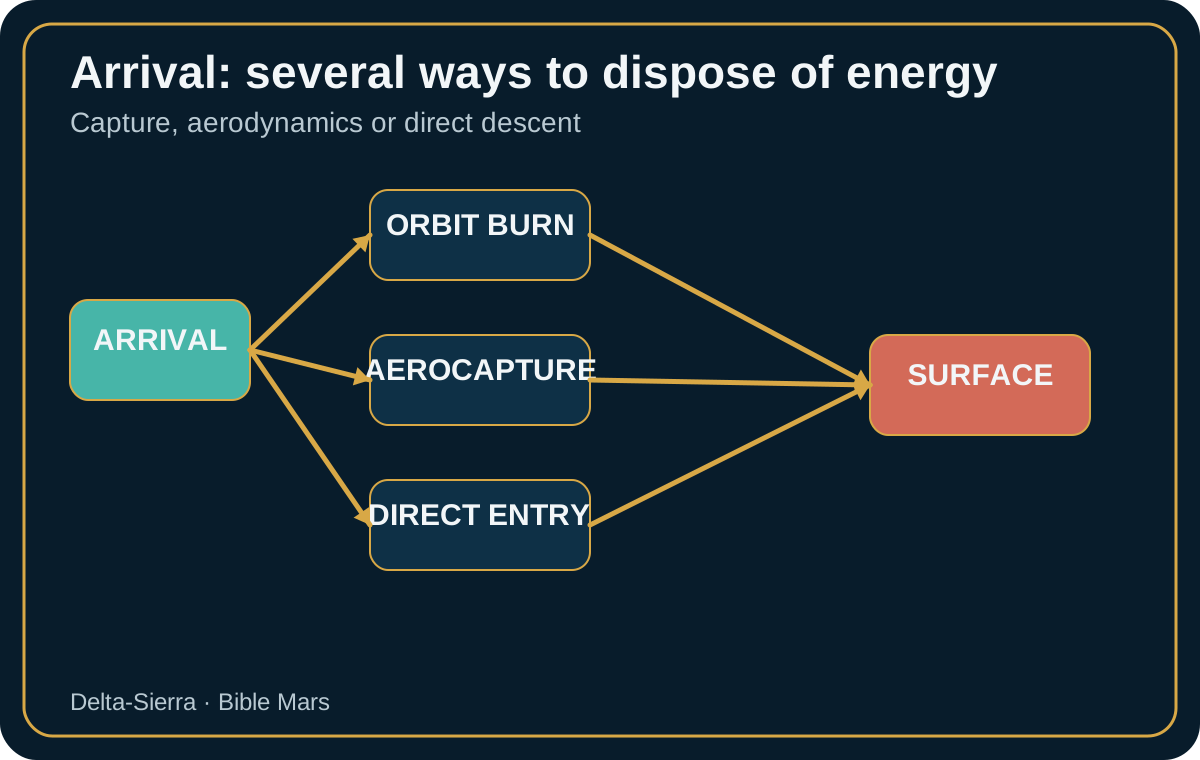
Propulsive capture illustrates that irreversibility. NASA notes that orbit insertion requires controlled deceleration at the correct attitude, time and duration. If the retro-burn fails, the spacecraft can continue past the planet as a flyby. A human architecture must therefore treat electrical power, propulsion, attitude, software, navigation and communications as one critical chain.
Capture cost rises with hyperbolic arrival speed
In a two-body approximation, hyperbolic periapsis speed is vₚ = √(v∞² + 2μ/rₚ), where μ is Mars' gravitational parameter and rₚ the radius from the planet center. Higher v∞ therefore raises the maneuver required to enter a chosen orbit. A very fast transit can pay part of its time saving at arrival. The “go faster” trade must include propulsive or aerodynamic energy disposal, not only cruise days.
For direct atmospheric entry, the problem changes form: drag, possible parachutes and propulsion dissipate energy while heating and deceleration remain within limits. Entry angle is fundamental. Too steep increases thermal and structural loads; too shallow risks skip-out or an unacceptable downrange footprint.
Waiting orbit, direct entry or functional separation
A crew architecture can separate the interplanetary ship and the lander. The large vehicle remains in orbit while a landing element descends. This reduces landed mass but introduces rendezvous, crew transfer and ascent requirements. Direct entry removes some orbital complexity while forcing a much larger interplanetary vehicle through Mars entry, descent and landing.
A waiting orbit can also buy time for weather, dust, site reconnaissance and synchronization with surface assets. The time is not free: the orbital vehicle needs consumables and Δv compatible with the stay. A permanent settlement may eventually use orbital infrastructure as a logistics buffer between interplanetary transport and the surface.
Safe arrival plans for the nominal landing site to be unavailable
Dust, fire, local power loss or an immobilized recovery vehicle can make the intended site unsuitable. The arrival system needs realistic alternatives: a secondary zone, another orbit, delayed descent, diversion or a safe-haven interface. Margin is not only propellant; it includes information, maps, communications and alternate-site compatibility.
Regular traffic requires Mars arrival management
A city receiving multiple cargo and crew vehicles in one campaign must deconflict trajectories, plume zones, communications and recovery teams. Closely spaced arrivals may be unsafe if an incident at the first site immobilizes infrastructure for hours.
Colonization therefore turns EDL—entry, descent and landing—into a shared service. Slots, alternates, weather data, relays, abort procedures and operational learning become part of Martian infrastructure. A one-off mission achievement must become a repeatable transportation process.
The final hour should be prepared as a chain of irreversible decisions
Some approach decisions can still be corrected; others commit the vehicle. A trajectory correction can be followed by another maneuver, while atmospheric entry crosses a point after which cruise cannot simply resume. The system needs gates: required navigation quality, propulsion health, weather, surface state and explicit continuation criteria.
Earth communications delay reinforces this structure. During critical events, Earth may receive information after the next decision is already due. Abort and continuation rules therefore live on board. Earth remains useful for preparation and learning, not last-second remote control.
Landing dispersion becomes a surface-operations problem. Touching down 20 km from target can be an aerodynamic success and a logistics emergency if no rover, power or route can recover crew. EDL performance should connect to mobility networks and alternate sites. A settlement can progressively build beacons, roads, depots and landing infrastructure that improve tolerance.
Cargo can use different criteria from crew. Freight may accept stronger acceleration or a distant zone; a pressurized crew vehicle needs tighter margins. Traffic management therefore classifies arrivals by mass, hazard, accuracy and consequence of failure.
Landing does not immediately end the arrival sequence. Residual propulsion must be safed, power sources configured, damage assessed, local communications established and the external environment checked before egress. The first minutes on the ground belong to operational EDL.
In the long term, repeatability is the true proof. A city needs procedures that different vehicle generations can use with common maps, interfaces and recovery teams. Industrializing arrival is one threshold between exploration and transportation.
Aerobraking, aerocapture and direct entry are different ways of spending arrival energy
Propulsive orbit insertion spends propellant quickly. Aerobraking enters orbit first and then uses repeated shallow atmospheric passes to lower apoapsis over time, as several Mars missions have done. Aerocapture would use a deeper atmospheric pass to achieve capture directly, demanding precise guidance and thermal protection. Direct entry continues toward the surface. These approaches trade propellant, time, thermal load, risk and vehicle geometry.
Aerobraking is attractive for propellant reduction but is not instantaneous. Atmospheric density varies, so each pass can require prediction and adjustment. A crewed mission may value the saved mass but dislike the long operational campaign; the trade is different from a robotic orbiter.
Aerocapture can save large propulsive capture mass in principle, but a heavy human vehicle raises challenges in heat shield size, guidance authority and uncertainty. The atmosphere becomes part of the propulsion system, and its variability becomes a navigation variable.
Direct entry couples interplanetary navigation to landing. A small error in arrival state can shift heating, downrange distance or landing footprint. That is why targeting and EDL cannot be independent teams linked only at the last review.
Heavy cargo also changes the descent problem. Mars' thin atmosphere provides useful drag but limited parachute capability for very large masses. Propulsion, deployable decelerators or other techniques may carry more of the final velocity reduction. The system must transition between regimes without losing controllability.
No single method is automatically “best.” Colonization may use different arrival architectures for crew, bulk cargo, orbital infrastructure and high-value equipment. Common navigation and traffic standards can coexist with different energy-disposal methods.
Case study: the nominal landing zone becomes unavailable two hours before entry
Local dust and a failed recovery vehicle make the planned site temporarily unacceptable. Two hours before entry, the spacecraft must continue, divert to a secondary zone or use an orbital option if the architecture supports it. Fuel, crossrange, navigation and alternate-site preparation all matter.
The secondary site is 35 km farther from the habitat. Landing there is safe only if a recovery rover has enough energy and supplies. EDL therefore depends on surface systems that are not physically aboard the arriving vehicle.
If retargeting increases dispersion or changes entry geometry, navigation must recheck thermal and control margins. An empty place on a map is not automatically a qualified destination.
Surface teams reconfigure communications, recovery route and reserves. A mature settlement maintains multiple arrival zones and current data. Landing infrastructure is a network of fallback solutions, not one dot.
Heavy Mars arrival requires managing energy, uncertainty and surface consequence together
Increasing landed mass changes more than parachute size. Ballistic coefficient, heat-shield diameter, center of mass, control authority and propulsion all interact. A technique demonstrated on a small robotic mission cannot be scaled by multiplying dimensions alone.
Navigation accuracy has physical value. A tighter entry state can reduce required landing footprint or reserve, but only if atmospheric uncertainty and vehicle guidance can use that accuracy. Past a point, better navigation does not overcome uncertain density or limited control authority.
Surface infrastructure can relax some constraints. Prepared landing zones, beacons, weather observations and emergency mobility increase the range of acceptable touchdown states. Investment on Mars can therefore reduce requirements on every later vehicle.
Plume interaction becomes more important for propulsive descent. Dust and ejecta can threaten sensors, nearby hardware and previously built infrastructure. Landing-zone separation and surface preparation are not merely civil engineering topics; they are part of the vehicle arrival architecture.
Post-landing stability must also be considered. A heavy vehicle on uncertain soil may settle or tilt after engine shutdown. Landing gear, site characterization and load distribution protect egress and future unloading. Success means a usable landed system, not only zero vertical velocity.
Colonization will therefore push EDL toward a standardized service with known zones, navigation aids, environmental monitoring and recovery capacity. Repetition allows each arrival to benefit from infrastructure built by earlier missions.
Atmospheric knowledge should be refreshed close to arrival when possible. Dust activity, density profiles and seasonal conditions influence entry predictions. A permanent Mars observing network could therefore improve future EDL performance by supplying local measurements to incoming vehicles.
Landing-site certification is a continuing activity. New imagery, surface changes, previous plume effects and construction may alter hazard maps. A site qualified five years earlier should not be assumed unchanged without review.
Recovery planning should include communication failure after touchdown. Vehicles and surface teams need local search procedures, beacon options and expected timelines so silence does not immediately trigger unsafe movement into a plume or hazard zone.
Arrival architecture should include navigation-sensor failure cases. Loss of one radar, camera or inertial channel close to entry may force a switch to a less precise mode. The landing footprint and divert options should be known for each degraded sensor set rather than treated as one generic backup.
Communications blackout or weak geometry during entry should be expected, not interpreted immediately as vehicle loss. Surface and orbital teams need timelines for when telemetry should return and what autonomous actions occur during silence.
Cargo unloading is also part of arrival-system availability. A vehicle that lands safely but blocks the only prepared pad for days can constrain the next arrival. Turnaround and site-clearance time become traffic-management parameters in a mature settlement.
Primary sources and research landmarks
Sources used for this expansion, checked 2026-08-14.
- NASA — Moon to Mars Architecture
- NASA — Moon to Mars Architecture White Papers
- NASA — Moon to Mars Architecture Components
- NASA NTRS — Human Exploration of Mars Design Reference Architecture 5.0
- NASA NTRS — Interplanetary Mission Design Handbook: Earth-to-Mars Mission Opportunities and Mars-to-Earth Return Opportunities 2009-2024
- NASA Science — How We Land on Mars
- NASA Science — Zero-Boil-Off Tank Experiments
- ISRO — Mars Orbiter Mission Profile
- SpaceX — Mars
- NASA — Mars Architecture Trade Space — orbit, lander and arrival sequence trades
Arrival at Mars is an early decision about how much energy must still be removed
Mars arrival does not begin when a heat shield touches the atmosphere. It begins weeks earlier, when navigation teams choose the approach geometry and decide how much dispersion can still be tolerated at the planet. Far from Mars, a correction of only a few metres per second can move the eventual encounter point by thousands of kilometres. Hours before arrival, the same correction is more expensive and may interfere with attitude, thermal constraints, separation events, or the configuration needed for entry.
The first architectural choice is what to do with hyperbolic arrival energy. A direct-entry vehicle accepts that a large fraction of that energy will be removed by the atmosphere and the descent system. An orbiter or staged architecture instead reserves propulsion to reduce velocity near periapsis and enter a bound orbit. Aerocapture and multi-pass aerobraking sit between those extremes. None is automatically superior: each shifts risk among propulsion, thermal protection, navigation, mission duration, and abort options.
A useful parameter is the hyperbolic excess velocity, written v∞ and read “v infinity.” It is the spacecraft’s relative speed with respect to Mars far enough away that the local gravitational acceleration is no longer the dominant part of the description. A higher v∞ means that Mars gravity will accelerate the spacecraft to an even higher speed by periapsis. Fast transfers can therefore buy time while making capture or atmospheric entry more demanding.
Reproducible calculation — periapsis speed before capture
For a simplified hyperbolic approach, vₚ = √(v∞² + 2 μ / rₚ). Here vₚ is periapsis speed in m/s, v∞ is hyperbolic excess speed in m/s, μ is Mars’ gravitational parameter in m³/s², and rₚ is distance from Mars’ centre in metres. Taking μ ≈ 4.2828 × 10¹³ m³/s², v∞ = 2.6 km/s, and rₚ ≈ 3,690 km gives about 5.48 km/s. This is not a mission prescription; it simply shows why a few km/s at infinity turns into a much larger local speed near Mars.
From the B-plane to the entry corridor: turn uncertainty into controllable geometry
Interplanetary navigators do not aim at a generic point called “Mars.” They target an arrival geometry. The B-plane is a mathematical plane normal to the incoming hyperbolic asymptote. Two coordinates on that plane provide a compact way to express how the trajectory would pass the planet and how a correction changes periapsis altitude, entry location, or a potential miss distance.
Uncertainty is not a fixed circle around the nominal path. It is a covariance that evolves with dynamics and measurements. Doppler tracking constrains some velocity components; range measurements constrain distance; optical observations of Mars and its moons contribute angular information. Correlations matter. A trajectory correction therefore does more than move the nominal aim point: it can rotate or shrink the uncertainty ellipse so that its dangerous edge no longer crosses the corridor boundary.
For atmospheric entry, the target must also deliver an acceptable flight-path angle at the entry interface. Too steep and heating and deceleration rise; too shallow and the spacecraft may skip out or fail to dissipate enough energy. The corridor is not a universal angle. It depends on mass, lift, ballistic coefficient, atmospheric uncertainty, thermal protection, and guidance authority. That is why interplanetary targeting and EDL cannot be designed as separate stories.
Orbit capture or direct entry: the choice changes what “rescue” can mean
Orbit capture buys time. A successfully captured vehicle may assess its condition, wait for phasing, rendezvous with an orbital habitat, or prepare a later descent. But that time is purchased with propellant, engines that must start after months in deep space, accurate navigation, and often another rendezvous chain. A propulsion failure at the wrong instant can turn a planned orbit into an irreversible flyby.
Direct entry removes the capture burn and can reduce propellant mass, but it compresses the decision timeline. Once the spacecraft is committed to atmospheric entry, heating, deceleration, heat-shield separation, terrain-relative navigation, powered descent, diversion, and touchdown unfold in minutes. Earth cannot close that control loop because the radio delay is far longer than the event sequence.
Human architecture studies therefore need explicit abort logic. Can a crewed element remain in orbit if a surface asset is not ready? Can a cargo lander survive an arrival window in a parking orbit? If the primary landing zone becomes unavailable, is a second site physically reachable given the remaining energy and map coverage? A backup site drawn on a map is not a backup unless it is reachable at the time the decision can still be made.
Four arrival scenarios that force different reasoning
A late trajectory correction is deliberately rejected
A navigation update shows a bias, yet executing the correction would violate a thermal attitude or interfere with a separation sequence. The team must compare the residual dispersions with the corridor and with the maneuver-execution error itself. Sometimes the safer action is not to fire: a late maneuver creates a new uncertainty source.
Orbit insertion delivers less Δv than commanded
If the resulting orbit remains bound, the emergency becomes a safe-orbit problem: periapsis, apoapsis, time to the next opportunity, propulsion restart capability, and power or thermal survival. If specific orbital energy remains positive, the vehicle is still on an escape trajectory. The boundary between those cases must be calculated before arrival.
The atmosphere is thinner than the central model
The vehicle decelerates more slowly. Lift and bank modulation can lengthen the atmospheric path, but only within finite control authority. A low-density atmosphere can also shift events downstream and increase the velocity handed to powered descent. Robust EDL therefore uses families of plausible atmospheres rather than a single “average Mars” curve.
The primary landing site becomes unavailable
Dust, a failed beacon, or a surface hazard report can invalidate the nominal zone. Diversion is only real if the trajectory, hazard map, propellant, and navigation state permit another landing location. The design question is not whether a second site exists but whether it is reachable when the fault becomes observable.
What robotic demonstrations prove — and what remains open at human scale
Perseverance successfully demonstrated terrain-relative navigation during the 2021 Mars landing. A descent camera compared observed terrain with an onboard map to estimate position and avoid pre-identified hazards. That is a major proof of principle for precision landing. It is not, by itself, qualification for a much heavier human lander: mass, powered-descent margins, plume effects, sensor geometry, and consequences of an error all change with scale.
NASA’s human-scale EDL architecture studies examined systems intended to deliver payloads around 20 tonnes and above. Their importance is that they expose a coupled architecture problem: ballistic coefficient, lift, packaging, control, supersonic retropropulsion, and powered-flight aerodynamics. The analysis should therefore label flight-proven robotic capabilities separately from human-scale concepts still requiring maturation.
Primary references for this chapter include NASA TechPort’s Terrain Relative Navigation project, which records the Mars 2020 demonstration, and NASA NTRS — Human Mars Entry, Descent, and Landing Architecture Study: Phase 3 Summary, which documents a studied human-scale design space rather than an operational lander.
Arrival should be prepared as a tree of irreversible decisions
Weeks from Mars, many options remain: shift the B-plane, choose a different capture orbit, prepare a flyby or retarget entry. Minutes before atmospheric interface, options close. Architecture should identify when each option disappears and what evidence is required before crossing that point.
Arrival can therefore use explicit gates. Before the final trajectory correction: coherent navigation and available propulsion. Before stage separation: known target-vehicle state and communications. Before capture: engines, tanks and attitude ready. Before direct entry: corridor, thermal protection, navigation and landing region compatible. Gates prevent an automated timeline from pushing the spacecraft into a phase whose prerequisites are no longer satisfied.
Capture should be analysed in orbital energy
Specific orbital energy is ε = v²/2 − μ/r. If ε remains positive after the burn, the path is hyperbolic and the spacecraft leaves Mars. If ε becomes negative, the orbit is bound. This is more fundamental than asking whether the engine burned for the planned duration; near the boundary a small velocity difference changes the mission’s fate.
Reading a partial capture
Suppose post-burn speed is v = 4.5 km/s at r = 3.69 × 10⁶ m. With μ = 4.2828 × 10¹³ m³/s², ε ≈ (4,500²)/2 − μ/r ≈ 10.125 MJ/kg − 11.607 MJ/kg ≈ −1.48 MJ/kg, so the orbit is bound. This does not yet give periapsis or apoapsis; it first establishes that the vehicle will not depart on a hyperbola.
A “successful” capture can still be poor: bound orbit with unsafe periapsis, excessive apoapsis or unusable period. FDIR must evaluate the resulting orbit, not only engine status.
Communications must accept that Earth is a spectator at the critical moment
Mars occultation can block the link near periapsis; antenna geometry can be unfavourable; events happen faster than one-way light time. The vehicle must record measurements and decisions, continue using local criteria, then transmit a coherent timeline later. Any architecture requiring Earth approval during the burn or entry conflicts with the physics of delay.
For crew this also changes displays: show envelope, margins, remaining options and the reason for an abort rather than raw telemetry. Autonomy is not the absence of humans; it is allocation of decisions to where time permits them.
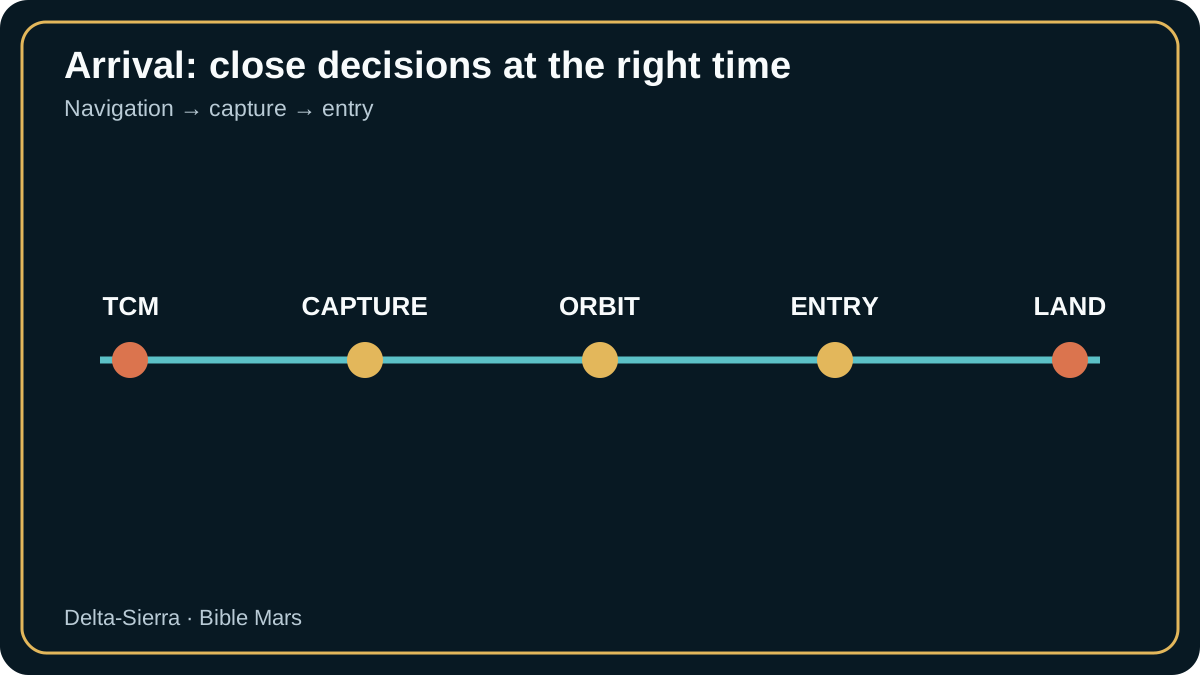
Case study — make arrival energy explicit before periapsis
Specific orbital energy is ε = v²/2 − μ/r, where ε is energy per unit mass, v velocity, μ Mars' gravitational parameter and r distance from the centre. At r = 3.8×10⁶ m, escape speed √(2μ/r) is about 4.75 km/s. An arrival at 5.5 km/s is therefore still strongly hyperbolic.
An error found hours before arrival may still be cheap to correct; the same error detected minutes before periapsis can force flyby, imperfect capture or reduced-margin entry.
Dispersed campaigns propagate position, velocity, thrust and atmosphere to identify early enough the cases that must leave the nominal branch.
Capture decisions should be framed as energy gates
Near periapsis, a small velocity error changes orbital energy strongly. The decision to commit to a capture burn should therefore use more than a clock time: navigation covariance, engine health, propellant margin and the predicted post-burn orbit all matter. If the burn underperforms, the priority may shift from the planned orbit to any bound orbit that preserves communication and another correction opportunity.
This energy-gate view connects navigation and propulsion. The question is not only whether the engine produced the commanded impulse, but whether the resulting specific orbital energy and periapsis keep the vehicle inside a recoverable set of trajectories.
Sources and references
Primary references
NASA — Encounter covers targeting, deceleration and orbit insertion; NASA — Trajectories provides the interplanetary context.