Course compass
Guiding question : How do expelled mass and nozzle-exit pressure become a measurable force?
Markers : 📏 MEASURED 📐 CONVENTION 🧮 CALCULATED 🎓 LEARNING ASSUMPTION 🚀 MISSION DATA 🏭 MANUFACTURER DATA ⚠️ APPROXIMATION
Objectives :
- rebuild the thrust equation
- read ṁ and explain the dot
- convert Pa/kPa and N/kN
- solve three examples and an inverse problem
- explain why mass flow is not chosen arbitrarily
1 — Before the equation: what is the engine physically doing?
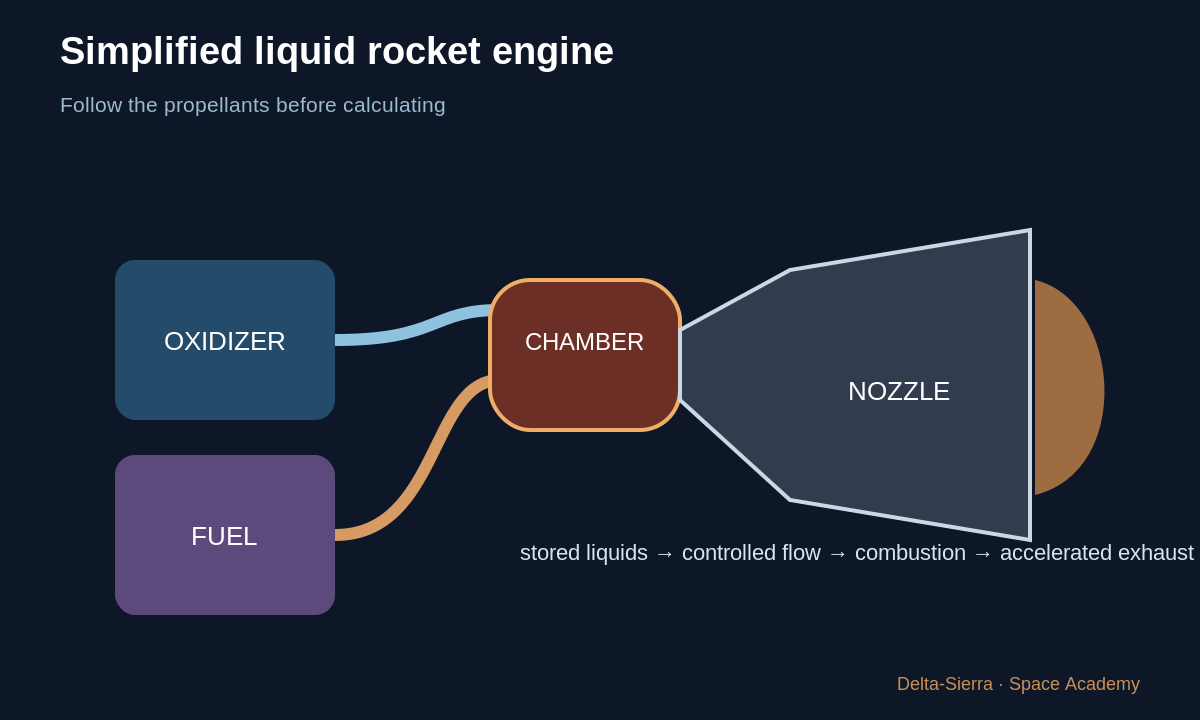
A liquid engine stores fuel and oxidizer, feeds them into a chamber, releases chemical energy, and accelerates hot gas through a nozzle. The objective is not to “make fire”; it is to create a high-speed mass flow rearward.
2 — Build the first term: flow × velocity
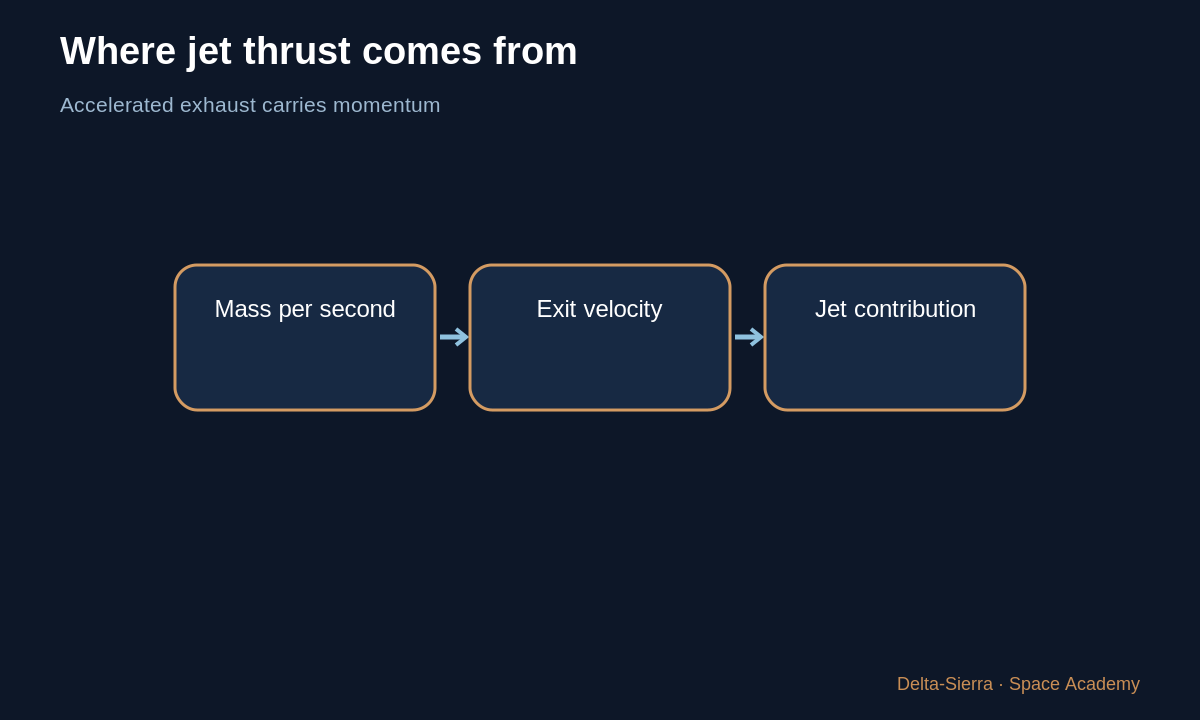
Imagine 🎓 LEARNING ASSUMPTION 5 kilograms of gas each second exiting at 🎓 LEARNING ASSUMPTION 2,500 metres per second. Before symbols: 5 kg/s × 2,500 m/s = 12,500 N.
The “kilograms each second” quantity is mass flow rate, written ṁ and read “m dot.” The dot means rate with respect to time.
3 — Why add a pressure term?
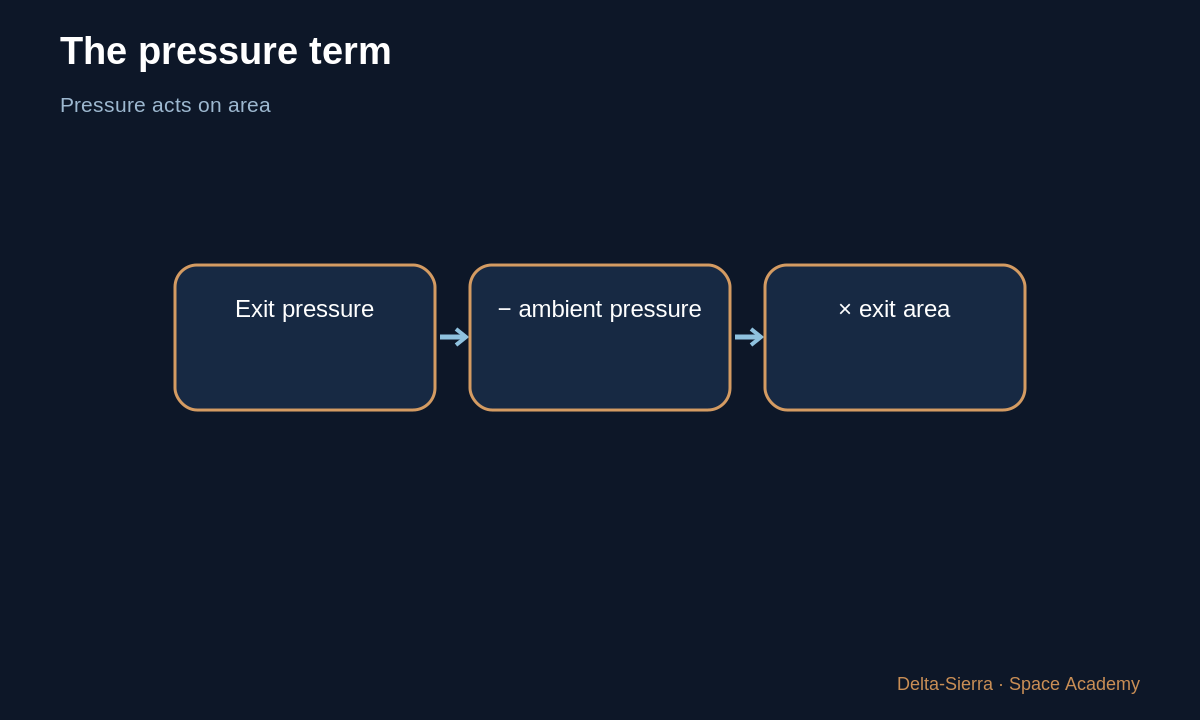
Exhaust at the nozzle exit has pressure pe; the surrounding environment has pressure p0. Pressure is force per area, so a pressure difference becomes force when multiplied by exit area Ae.
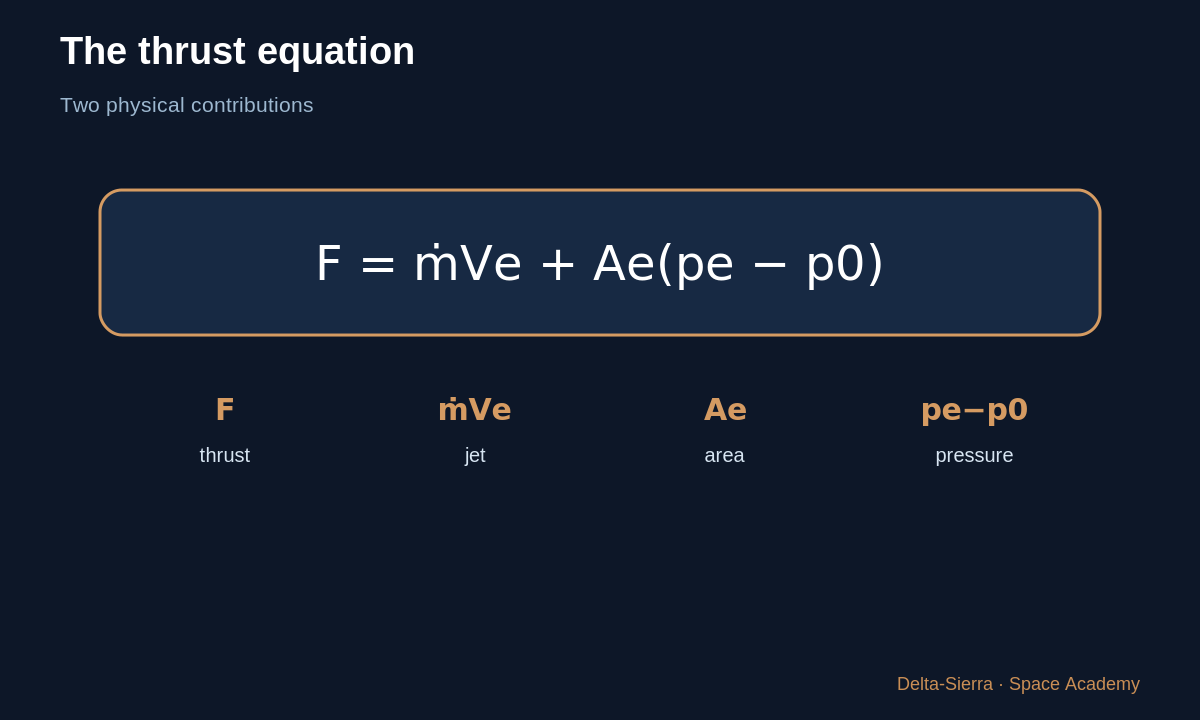
NASA Glenn presents this rocket-thrust relation. The first term is jet momentum flow; the second accounts for exit-pressure difference acting over the nozzle exit.
4 — Example A: easy numbers in vacuum
🎓 LEARNING ASSUMPTION ṁ = 5 kg/s; Ve = 2,500 m/s; Ae = 0.40 m²; pe = 20 kPa; p0 = 0 Pa.
20 kPa = 20,000 Pa5 × 2500 = 12,500 N0.40 × (20,000 − 0) = 8,000 NF = 20,500 NThe answer preserves its origin: 12,500 N from the jet and 8,000 N from pressure.
5 — Example B: same idea at sea level
🎓 LEARNING ASSUMPTION Let pe = 100,000 Pa and p0 = 101,300 Pa. Pressure contribution is 0.40 × (100,000 − 101,300) = −520 N. The negative sign means ambient pressure subtracts slightly from thrust in this example. Total with the 12,500 N jet term is 11,980 N.
6 — Example C: a pedagogical Mars environment
🎓 LEARNING ASSUMPTION ṁ = 6 kg/s; Ve = 3,000 m/s; Ae = 0.50 m²; pe = 10,000 Pa; p0 = 600 Pa.
6 × 3000 = 18,00010,000 − 600 = 9,4000.50 × 9,400 = 4,700F = 22,700 NThis is not a real engine data sheet. It is constructed to make the role of ambient pressure visible.
7 — Inverse calculation: what flow for a requested thrust?
For a first estimate, use F ≈ ṁ Isp g0. 🎓 LEARNING ASSUMPTION Let F = 2,000,000 N, Isp = 330 s, and g0 = 9.81 m/s².
ṁ = F ÷ (Isp × g0)330 × 9.81 = 3,237.32,000,000 ÷ 3,237.3 ≈ 618 kg/s8 — So who “orders” 5 kg/s rather than 3 or 10?
The engine controller receives an operating command. It moves valves and controls turbopump operating state; these actions change pressures and therefore propellant flow to the injectors. Sensors observe pressure, temperature, shaft speed, and other variables, and the controller corrects the command.
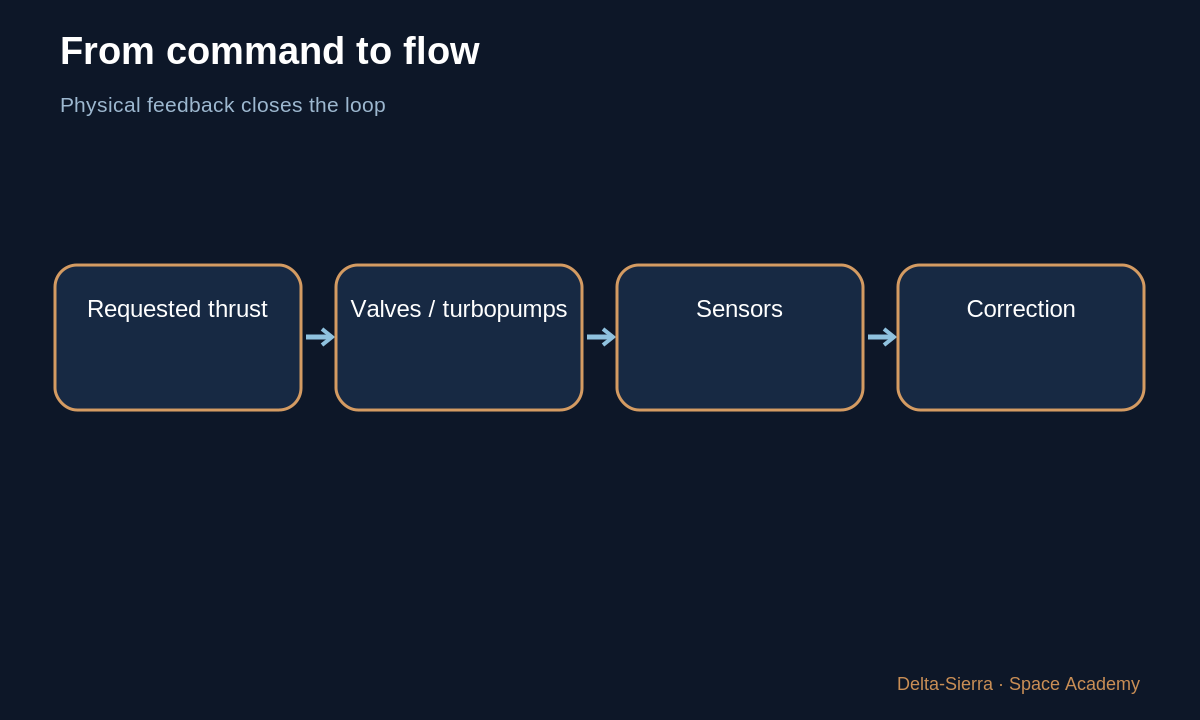
Mass flow is therefore the result of physical architecture plus control. In a nozzle, flow is also linked to throat geometry and choking; NASA Glenn shows how Mach 1 at the throat strongly constrains mass flow for given thermodynamic conditions.
9 — What the thrust equation cannot predict by itself
Real engine design also needs combustion, thermodynamics, mixture, stability, cooling, losses, transients, gas properties, and geometry. The thrust equation alone cannot tell whether an injector is stable or a chamber survives.
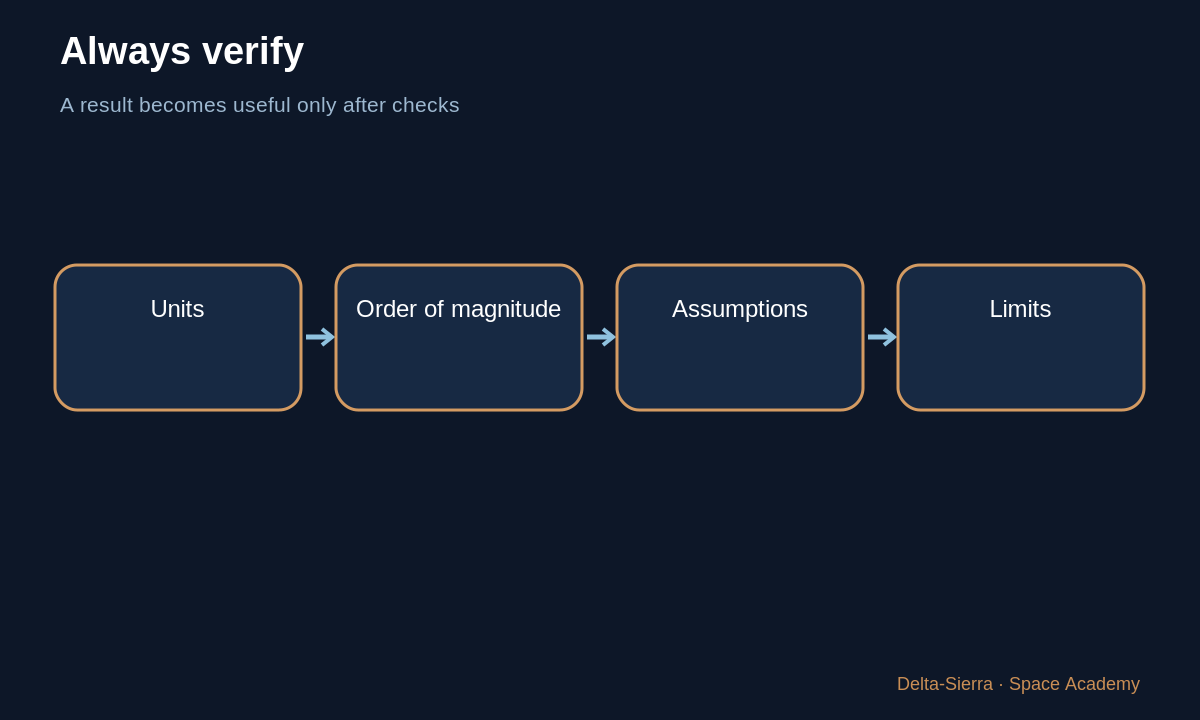
Engineering skill includes knowing when a simple model is enough and when a richer model or test is required.
Exercises and solutions
Exercise A — jet term
ṁ = 8 kg/s and Ve = 2,000 m/s. Ignore pressure.
Exercise B — pressure term
Ae = 0.25 m²; pe − p0 = 12,000 Pa.
Challenge — recover mass flow
F = 100,000 N, Isp = 250 s, g0 = 9.81 m/s².