Course compass
Guiding question : How can a methane/oxygen full-flow staged-combustion engine still be fundamentally a liquid rocket engine?
Markers : 📏 MEASURED 📐 CONVENTION 🧮 CALCULATED 🎓 LEARNING ASSUMPTION 🚀 MISSION DATA 🏭 MANUFACTURER DATA ⚠️ APPROXIMATION
Objectives :
- explain methane + oxygen
- distinguish gas generator, staged combustion, and full-flow
- follow the two preburner branches conceptually
- compare Raptor with Vulcain/Vinci without caricature
- separate published data, announcements, and unknowns
1 — Do not begin with “full-flow staged combustion”
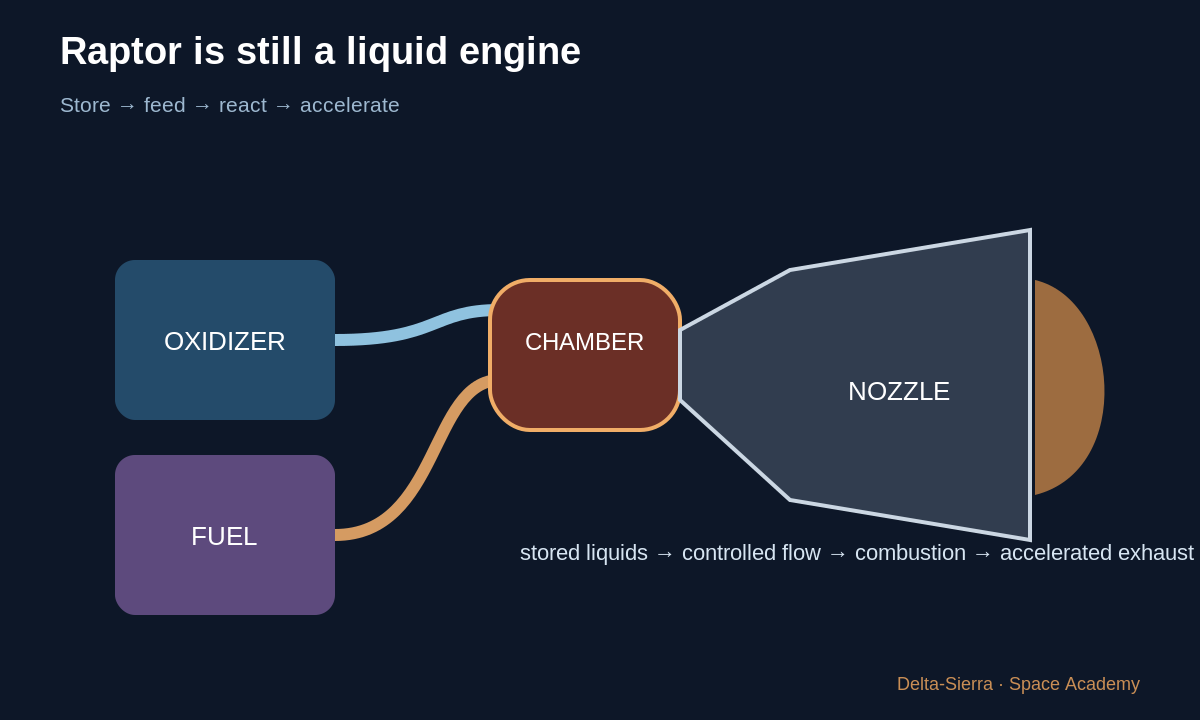
Raptor is first a liquid engine: two propellants reach a chamber, react, create hot gas, and a nozzle accelerates that gas. Once that chain is understood, the complex cycle becomes a sophisticated way to power pumps and recover energy rather than a new propulsion principle.
2 — Methalox: what does the word mean?
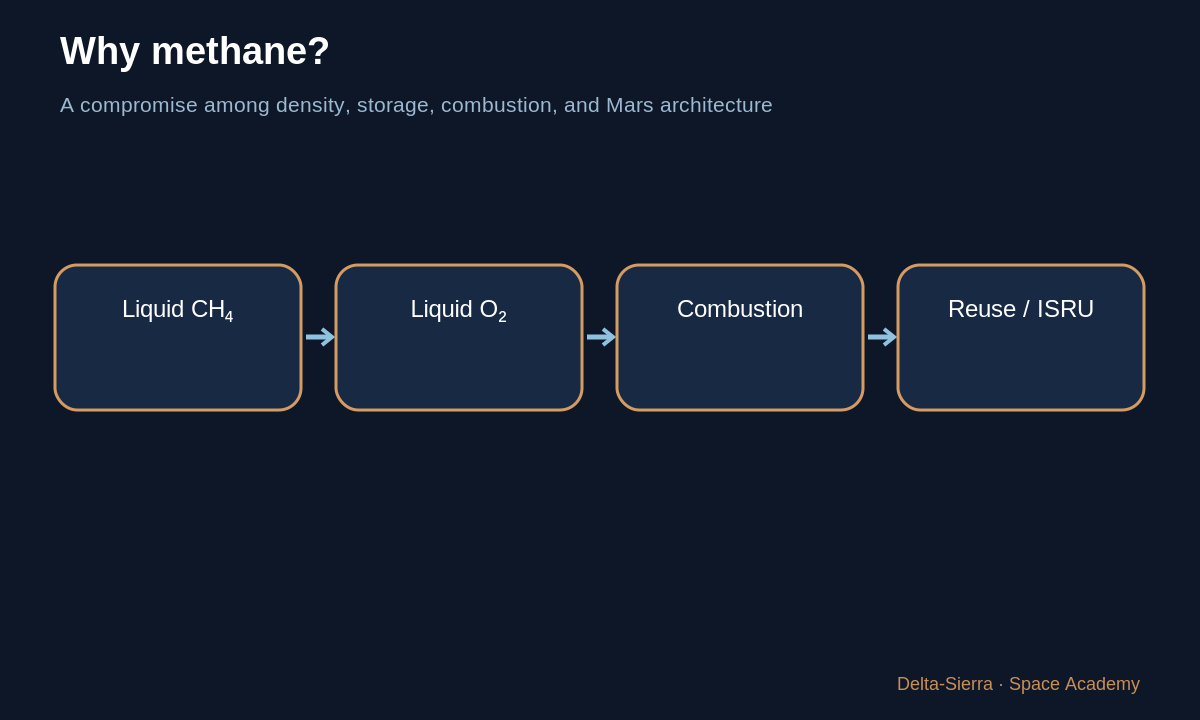
Methalox combines methane and oxygen. CH₄ means one carbon atom and four hydrogen atoms; O₂ means an oxygen molecule made of two oxygen atoms.
3 — Why such powerful turbopumps?
A high-pressure chamber requires propellants delivered with enough pressure to pass through lines and injectors. Turbopumps turn energy available in the engine cycle into liquid pressure.
The problem is circular: energy is needed to pump the propellants that will release energy. The engine cycle describes how this loop is organized.
4 — Three cycle ideas that explain the progression
In a gas generator, a fraction of propellants creates turbine drive gas that is then exhausted separately. In staged combustion, preburner gas continues into the main chamber. In full-flow staged combustion, the main propellant streams pass through preburner/turbine branches before the chamber.
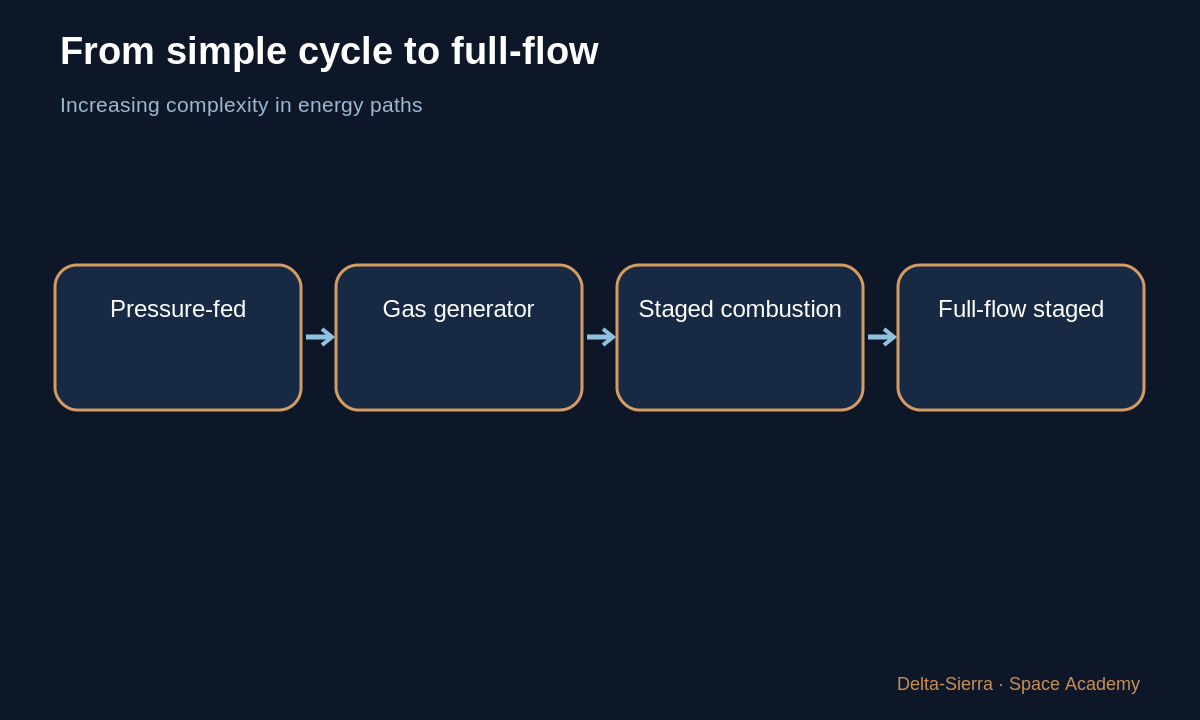
NASA demonstrated a U.S. full-flow concept using a fuel-rich preburner for the fuel turbopump and an oxidizer-rich preburner for the oxygen turbopump. The architecture can distribute turbine work and remove some problematic seal-mixing modes.
5 — Fuel-rich? Oxidizer-rich?
A preburner does not necessarily seek the hottest complete-combustion mixture. It can intentionally operate with excess fuel or oxidizer to create turbine drive gas compatible with the rest of the cycle.
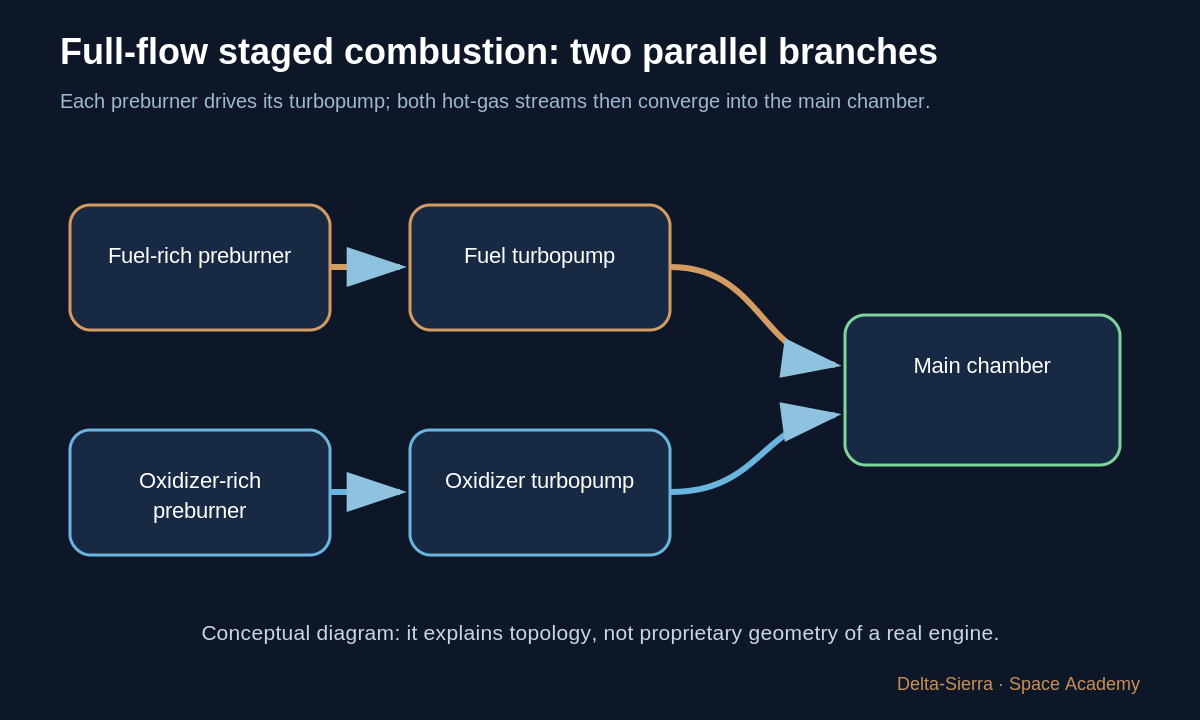
Caution: this diagram is conceptual. Exact sequencing, pressures, mixture ratios, and geometry for a specific engine must come from published data or remain identified as non-public.
6 — Raptor 1, 2, 3: evidence-level discipline
The Raptor family has evolved, but Space Academy will not turn photographs, posts, or community estimates into certified specifications. Every claim receives a status.
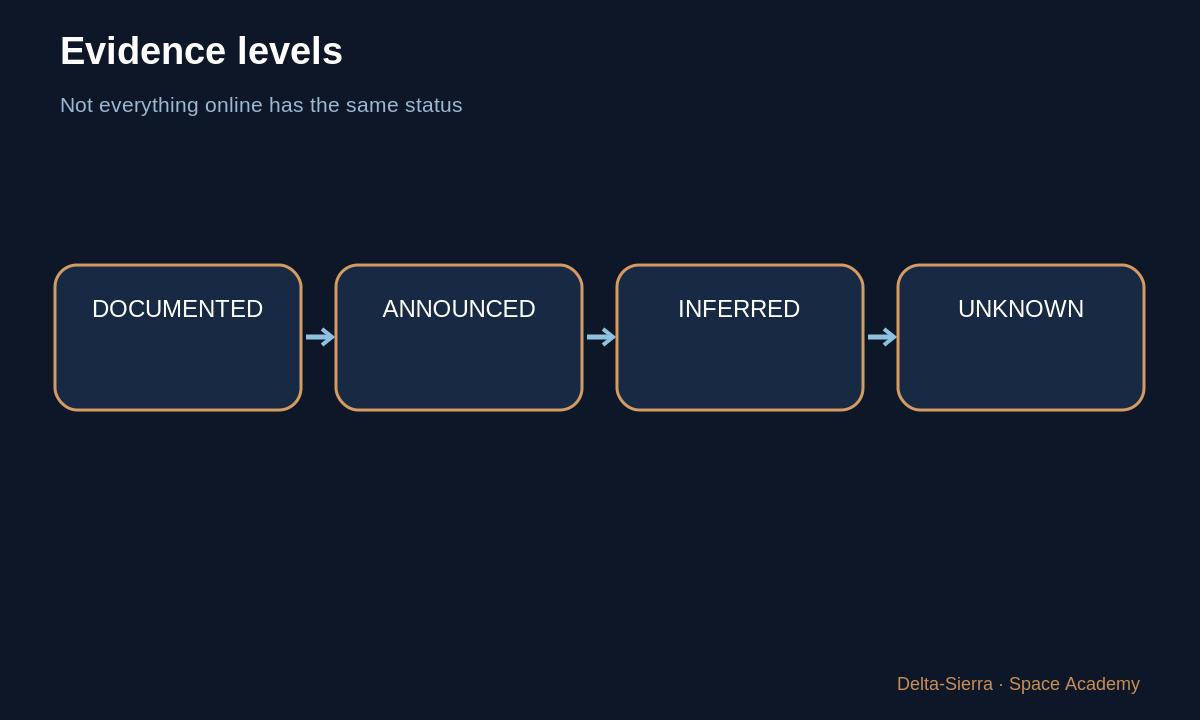
🏭 MANUFACTURER DATA = explicitly published by the manufacturer. 📏 MEASURED = published measurement/test data. ANNOUNCED = public goal or description that may evolve. UNKNOWN = not sufficiently documented; write “not public” instead of inventing.
7 — Compare Raptor, Vulcain, and Vinci without creating a contest
ESA documents Vulcain 2.1 as Ariane 6’s main-stage liquid-oxygen/liquid-hydrogen engine, with two turbopumps and more than 1,370 kN thrust. Vinci is a restartable oxygen/hydrogen upper-stage engine.
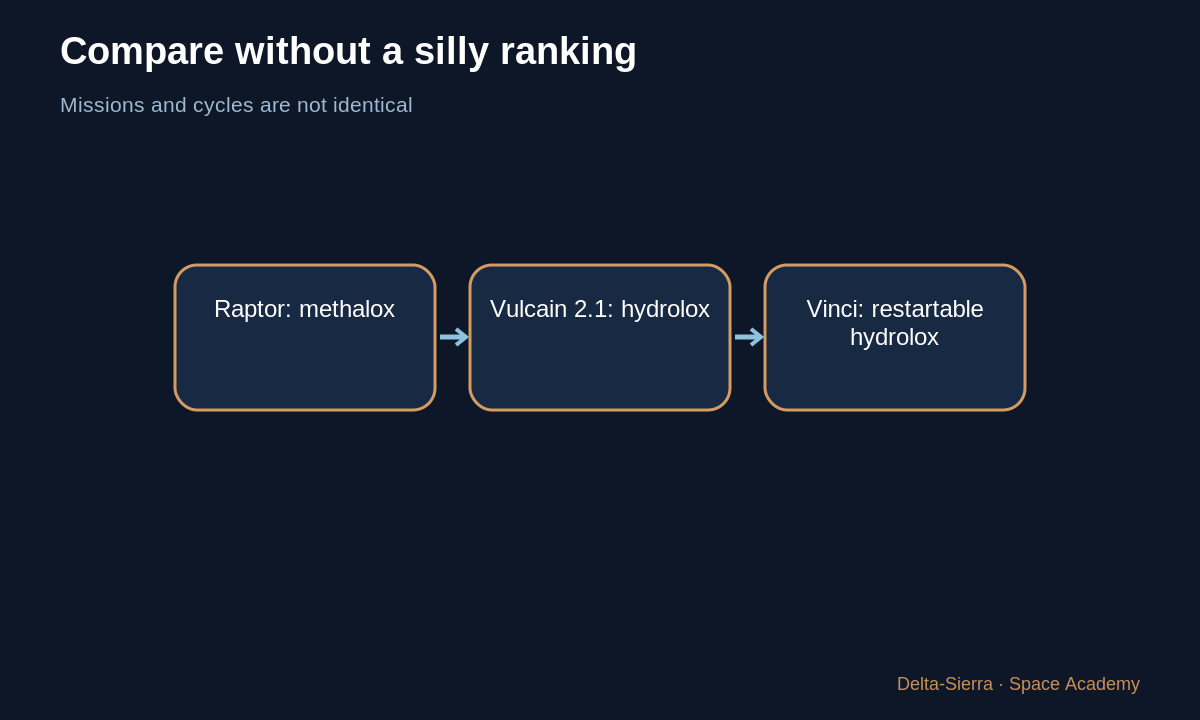
Comparison must therefore start with mission. A first-stage engine, restartable upper-stage engine, and engine intended for a reusable architecture do not optimize exactly the same problem. “Best” only makes sense relative to system requirements.
8 — What full-flow does not make disappear
A sophisticated cycle does not eliminate combustion instability, fatigue, heating, cavitation, material limits, or difficult start transients. It redistributes constraints and adds advantages at the cost of more complex control and development.
Real reliability comes from testing, manufacturing control, margins, instrumentation, and experience—not from the cycle name.
9 — Why this matters to a Mars architecture
If a Mars transportation system uses methane and oxygen, future local propellant production can change logistics. But “the molecules exist on Mars” does not mean “fuel is free.” Water or hydrogen must be obtained, CO₂ processed, products purified, liquefied, stored, and transferred.
Raptor therefore connects directly to electrolysis, Sabatier chemistry, cryogenics, power, storage, maintenance, and ISRU.
10 — What Raptor really teaches
The educational value is not memorizing a specification that may change. It is seeing how the simple idea of accelerating mass becomes a system where chemistry, turbomachinery, heat transfer, control, materials, and operations all have to work at once.
Exercises and solutions
Exercise A — vocabulary
What does methalox mean?
Exercise B — cycles
Conceptual difference between gas generator and staged combustion?
Challenge — evidence level
You find a Raptor 3 chamber-pressure number online with no identifiable SpaceX or technical primary source. How should it appear?