Course compass
Guiding question : If the Moon moves during the trip, how can we predict where it will be when the spacecraft arrives?
Markers : 📏 MEASURED 📐 CONVENTION 🧮 CALCULATED 🎓 LEARNING ASSUMPTION 🚀 MISSION DATA 🏭 MANUFACTURER DATA ⚠️ APPROXIMATION
Objectives :
- explain the origin of 27.32166 days
- distinguish sidereal month from phase cycle
- explain 360°, π, and radians
- justify the time factor in a lead angle
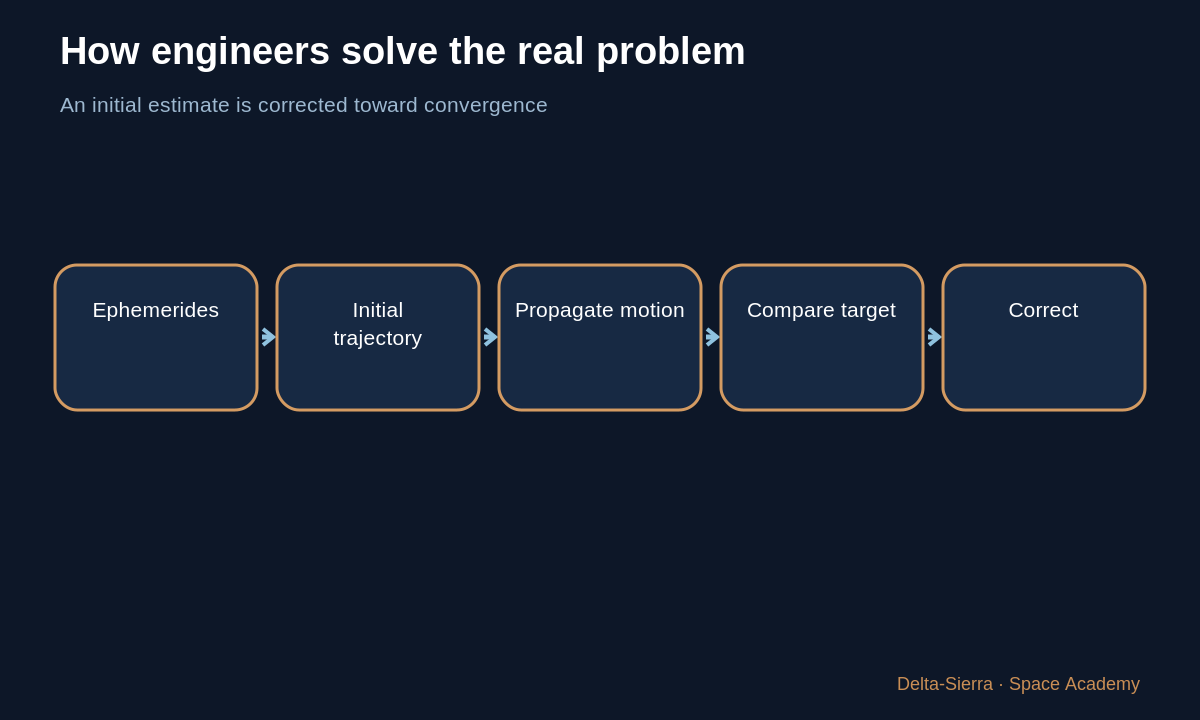
- understand why real targeting is iterative
1 — A simple question opens orbital mechanics
If we aim at where the Moon is at departure, it will have moved before arrival. We need its future position. But future position requires flight time, and flight time depends on trajectory. That apparent loop is exactly what orbital calculations solve.
2 — Where does 27.32166 days come from?
📏 MEASURED NASA GSFC gives about 27.32166 days for the Moon’s orbital period with respect to the stars. This is an astronomical measurement of lunar motion in a celestial reference frame.
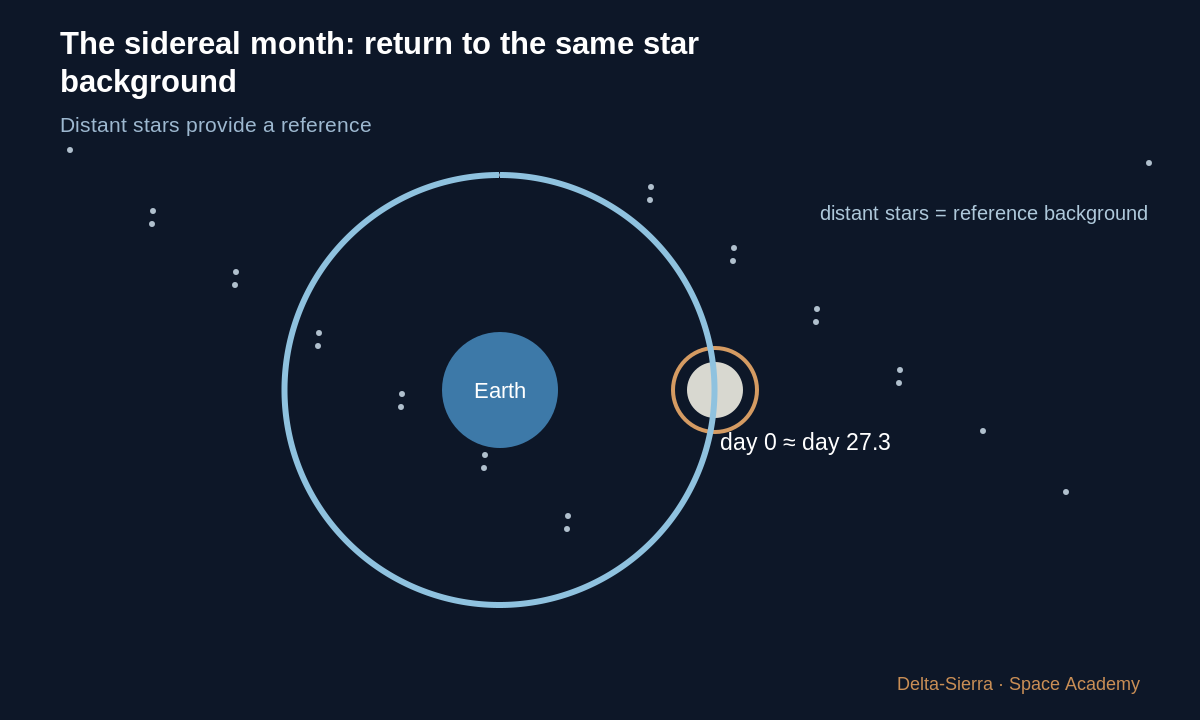
Sidereal means “related to the stars.” The value is measured, not selected to make the arithmetic convenient.
3 — Why do lunar phases take about 29.5 days?
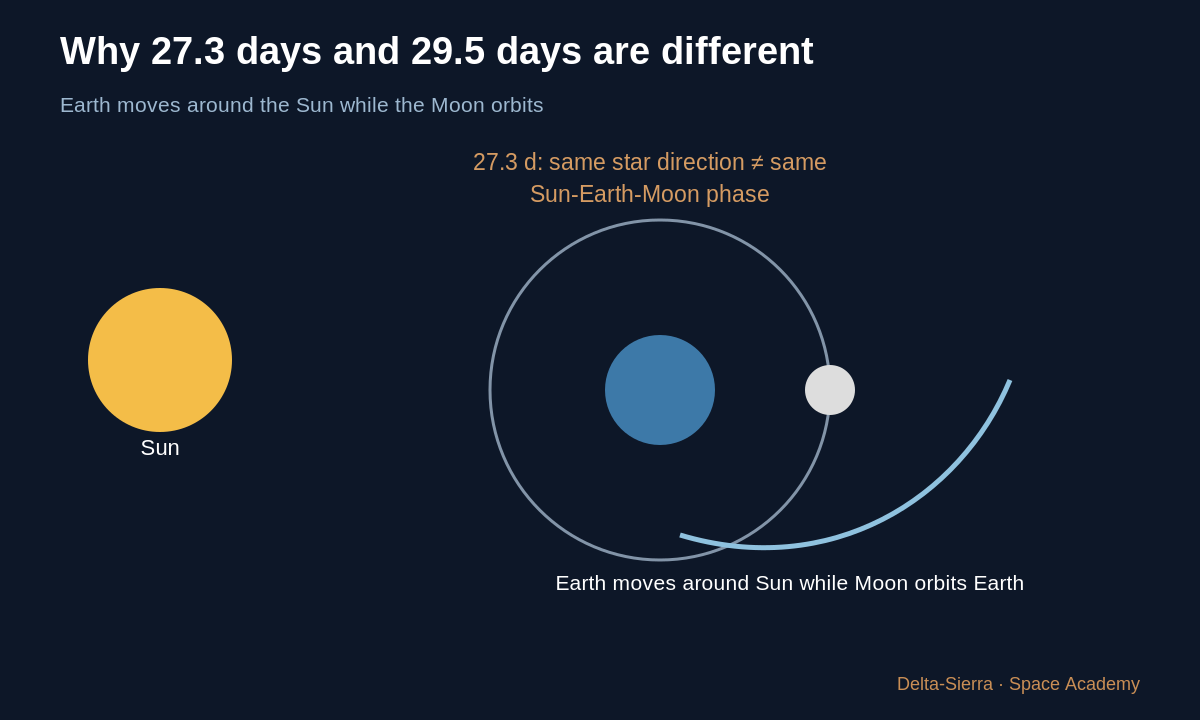
During those 27.3 days, Earth itself moves along its orbit around the Sun. The Moon needs additional time to recover the same Sun–Earth–Moon geometry and therefore the same phase.
4 — Why is a circle 360°, not 359 or 450?
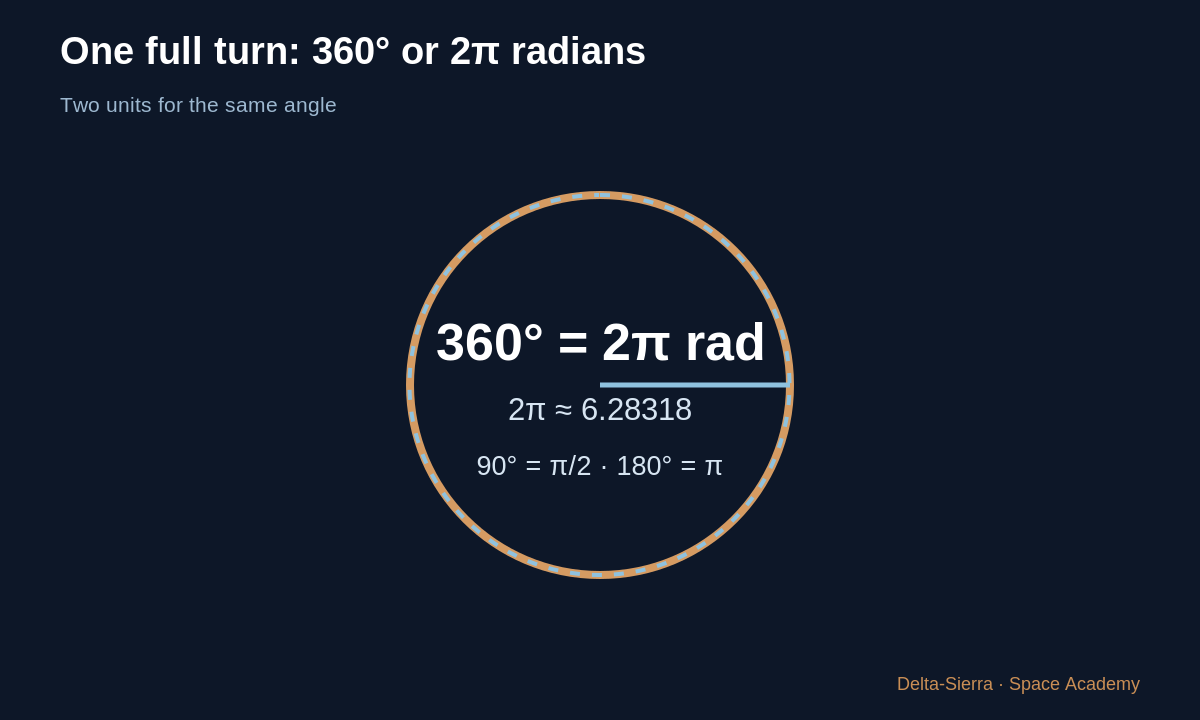
📐 CONVENTION 360° is a human convention, not a mandatory property of a circle. A full turn could have been defined as 100, 400, or 450 units if all geometry were converted consistently.
The 360-degree convention is connected with the long Mesopotamian/Babylonian sexagesimal tradition and is convenient because 360 has many divisors.
5 — Average angular speed: why divide?
We ask: if 360° takes 27.32166 days, how many degrees correspond on average to one day? That is why we divide:
🧮 CALCULATED The unit °/day means “degrees per day.” “Average” matters because the real lunar orbit is elliptical and perturbed, so instantaneous angular speed is not constant.
6 — Why multiply by three? Why not two or four?
Now choose 🎓 LEARNING ASSUMPTION 3 days as a first Apollo-scale travel-time estimate. Apollo 11 performed lunar orbit insertion about 75 h 50 min after launch, slightly more than three days. The number is therefore a learning assumption connected to mission data, not a natural constant.
We multiply because we want the angle accumulated over three days. Day units cancel: (°/day) × day = °.
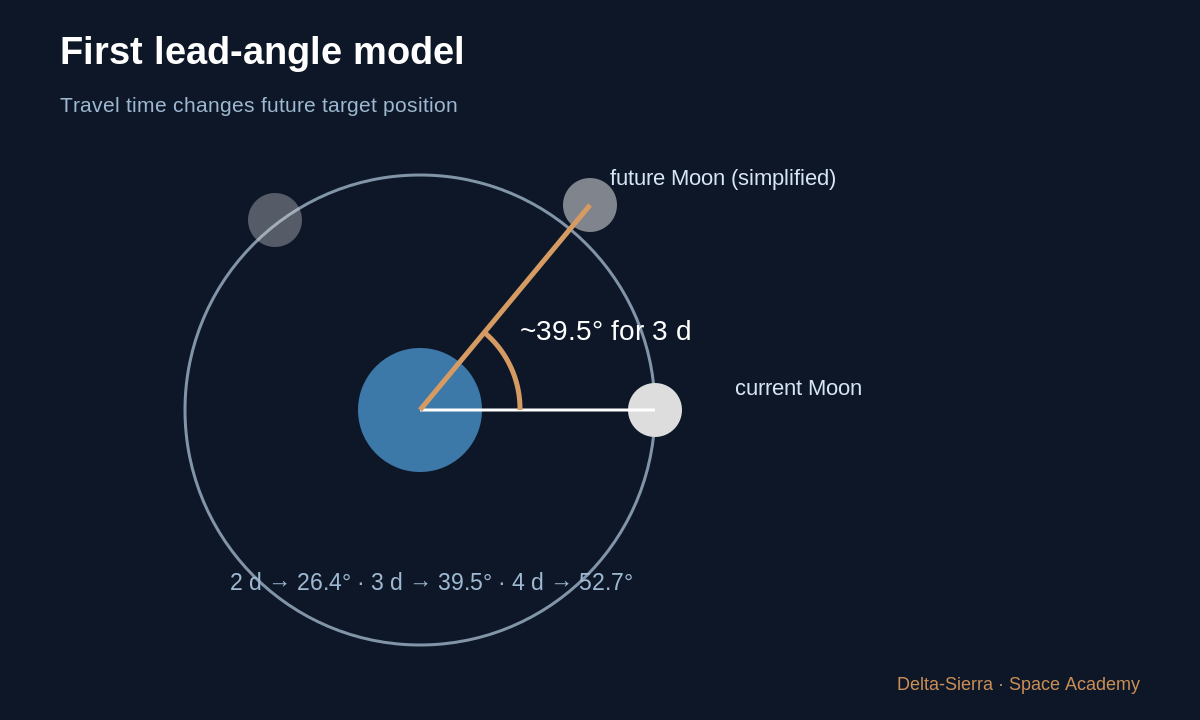
Two days gives about 26.4°; four days gives about 52.7°. Future target location depends on travel time.
7 — How could engineers know travel time before humans went there?
They did not guess. Newtonian mechanics, gravitation, lunar position, and launch-vehicle performance were already known. Given an initial position and velocity, engineers can propagate a spacecraft state under gravitational forces.
Robotic missions and observations also provided measurements and validation before a crewed landing. Human flight was not the first time the physics was tested.
8 — Why 39.5° is definitely not “the Apollo aiming angle”
Our exercise assumes constant angular speed on a perfect circle, known travel time, and geometric interception. Those assumptions build intuition but are insufficient for flight guidance.
The real lunar orbit is elliptical; solar gravity perturbs it; the spacecraft accelerates; Earth rotates; and course corrections occur. Engineers use ephemerides—models or tables giving body positions as a function of time.
9 — What changes when the target is Mars?
The general logic remains: know the departure state, predict the target, and find a trajectory connecting them at the correct time. But Earth and Mars both orbit the Sun and flight lasts months. “Current distance ÷ constant speed” is not a mission trajectory calculation.
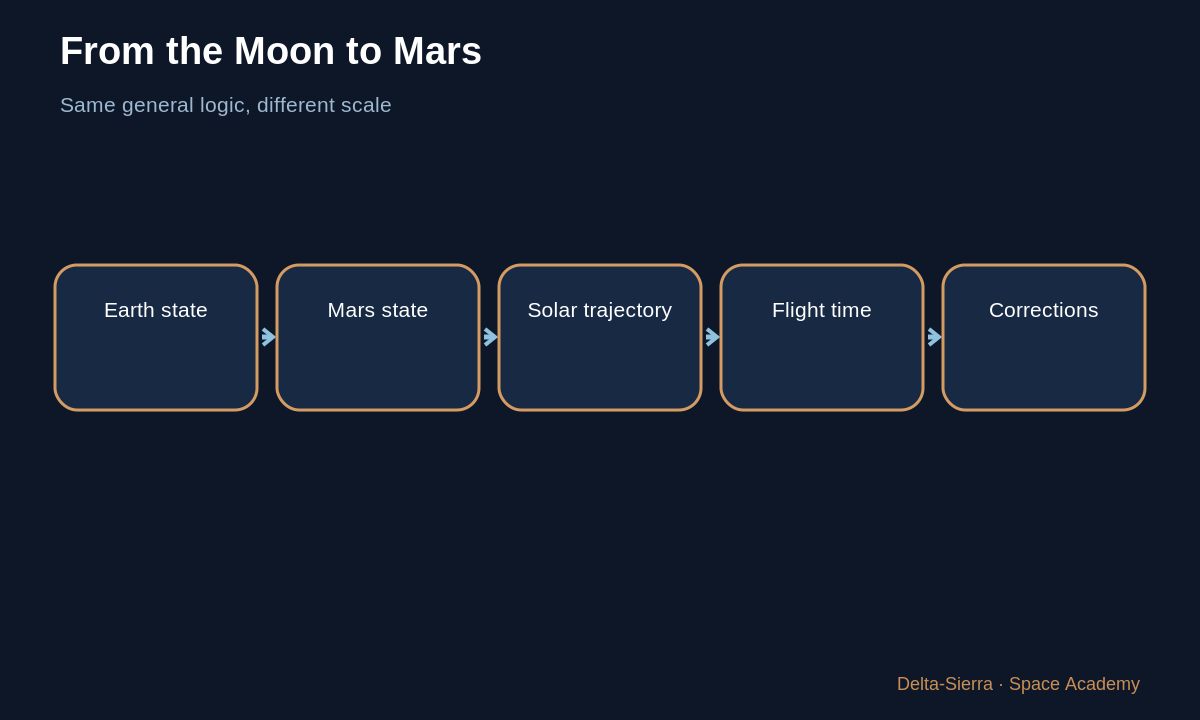
A school-level distance/speed model can teach units first, then the course must explicitly remove that simplification and introduce heliocentric transfer, launch window, planetary phase, relative velocity, and corrections.
10 — The skill to keep: know which model you are using
A simple model is not wrong when its assumptions are visible and we know where it stops being sufficient. The pedagogical error would be hiding those assumptions and presenting 39.5° as a mission solution.
Later modules add position/velocity vectors, ellipses, orbital elements, Hohmann transfer, phasing, rendezvous, and numerical propagation.
Exercises and solutions
Exercise A — two days
Use 13.176°/day for 2 days.
Exercise B — radians
How many degrees equal π radians?
Challenge — provenance
Classify 27.32166 d, 360°, 3 d, and 39.5°.