


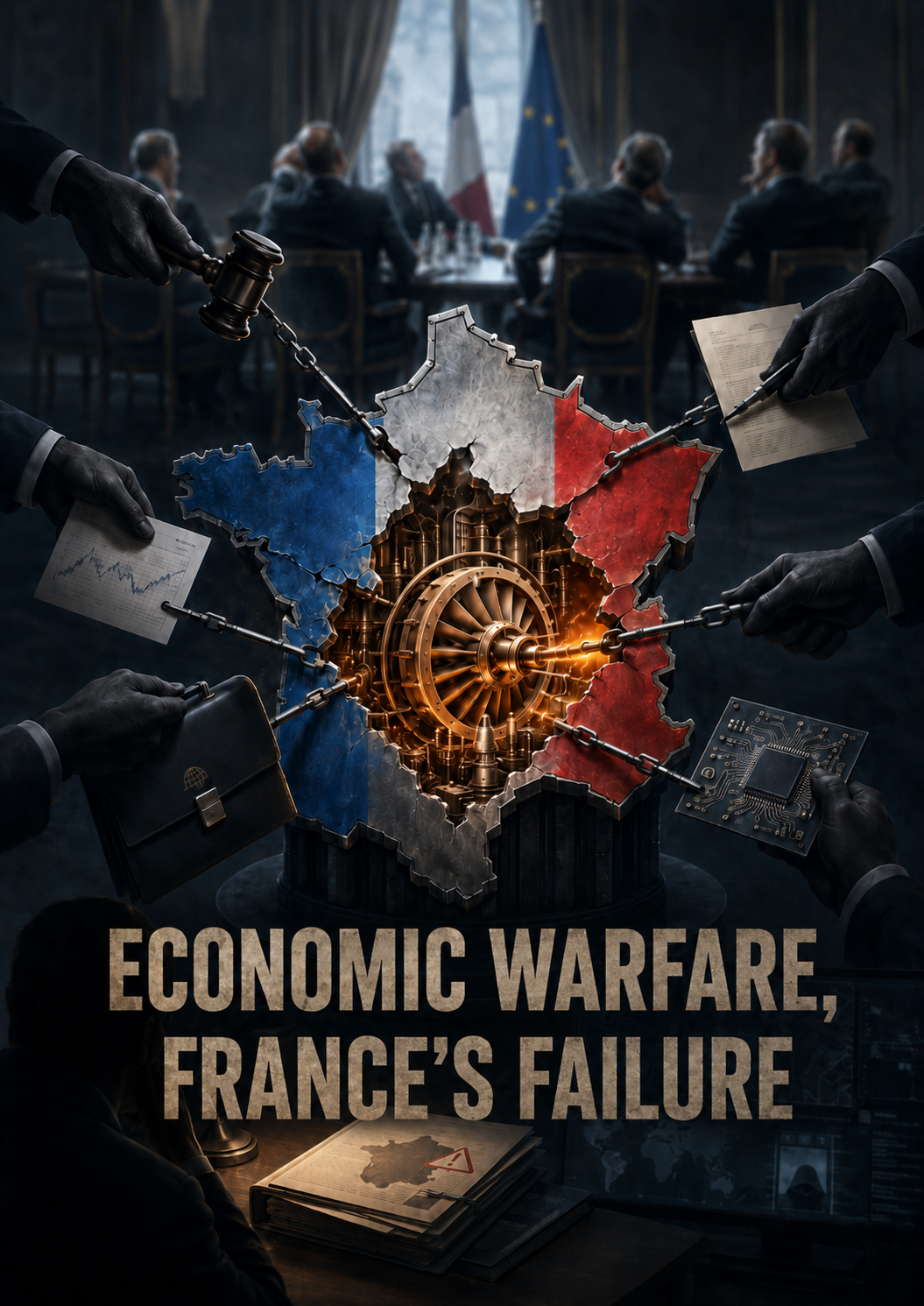
Alstom, Péchiney, Arcelor, Alcatel, intelligence, influence networks and sovereignty: the anatomy of several decades of French vulnerability
Some wars destroy cities. Others make industrial capabilities, patents, decision centres, engineers and technologies disappear far more quietly. The second kind is harder to see. There may be no soldiers, tanks or declaration of war. A company simply changes owner; a research centre moves; a technology is transferred; foreign legal proceedings weaken a group; a competitor buys a business; engineers leave. Years later, a country discovers that a capability it once controlled now depends on a foreign company or power. That, too, is economic warfare.
The expression is no longer marginal. In July 2025 the French National Assembly devoted an entire report to economic warfare, explicitly addressing the protection of strategic companies, economic counter-interference, foreign investment, attempts to capture sensitive information and the role of intelligence services in protecting France’s economic, industrial and scientific potential. The scale is significant: the Strategic Information and Economic Security Service, SISSÉ, now handles roughly 750 to 800 economic-security alerts each year involving companies or strategic assets; the same parliamentary work also records 500 to 550 characterised attacks a year against defence-industrial entities and associated research bodies. Capital attacks and attempts to capture sensitive information represent major categories of threat. [Assemblée nationale 2025]
This is therefore not a theory invented after the fact. The French state itself now treats capital predation, economic interference and technology capture as national-security issues. The uncomfortable question is why France had to lose or weaken so many industrial assets before taking that conflict fully seriously. Alstom is not the only subject of this article. It is the case study through which the system can be understood.
ECONOMIC WARFARE: A WAR WITHOUT UNIFORMS
For a long time, international competition was discussed as though it merely opposed companies on markets: the best technology would win, capital would circulate freely, and mergers or acquisitions would essentially be financial decisions. The real world is harsher. A state can use law, currency, sanctions, intelligence services, technical standards, diplomacy, companies, banks, investment rules and judicial procedures to defend economic interests. It can acquire a technology rather than develop it, recruit a rival’s engineers, shape an international standard, exploit supply-chain dependencies, apply its law beyond its borders or obtain industrial information through procedures that appear perfectly lawful.
French institutions now explicitly recognise those mechanisms. Major economic, industrial and scientific interests have been integrated into the protection of the Nation’s fundamental interests, and economic security has become a standing intelligence priority. What used to be described only as “competition”, “investment” or “M&A” can, in certain circumstances, also become an instrument of power.
OLIVIER MARLEIX KNEW THE FILE IN DEPTH — AND THE LIMITS OF WHAT CAN BE CLAIMED MUST BE CLEAR
Olivier Marleix knew the Alstom file particularly well. In 2018 he chaired the National Assembly commission of inquiry into state decisions involving Alstom, Alcatel and STX, with Guillaume Kasbarian as rapporteur. For six months the commission held numerous hearings, travelled to the United States and inspected documents at the French Economy Ministry. [Assemblée nationale 2018]
One clarification is indispensable. Saying that Marleix knew the file in depth refers solely to his parliamentary work, investigations and questions later transmitted to judicial authorities. It does not establish any connection whatsoever between the Alstom affair and his death in 2025. No public evidence supports such a claim. The Alstom record is serious enough without attaching unsupported theories to it.
ALSTOM AND THE POWER OF US EXTRATERRITORIAL JUSTICE
The story did not begin with General Electric. Alstom had been under US investigation for international corruption for years. On 22 December 2014 the company pleaded guilty in the United States and agreed to pay a USD 772.29 million criminal penalty for Foreign Corrupt Practices Act violations. The US Department of Justice documented corrupt payments and accounting failures across several countries and entities. It would therefore be false to tell the story as though a perfectly innocent French company had been fabricated into a criminal target solely in order to steal it. The corruption conduct was real and Alstom admitted it. [U.S. Department of Justice]
But that truth does not remove the second issue: the enormous extraterritorial power of US law enforcement. The 2018 French parliamentary report considered that the prospect of a penalty approaching one billion dollars had accelerated decisions inside Alstom; the company even asked that settlement of the penalty occur after completion of the transaction with General Electric. The chronology is striking but must be interpreted carefully. No public proof establishes that General Electric ordered or orchestrated the Department of Justice action in order to acquire Alstom. What is established is that a massive US legal procedure was weakening a strategic French company at the same time an American company was negotiating the purchase of its Energy activities. That alone raises a question of power relations.
US INTELLIGENCE WAS PART OF THE ENFORCEMENT ENVIRONMENT
The case becomes even more revealing when the means used by Washington are examined. The 2018 parliamentary report recalled that US intelligence services are officially mobilised in support of extraterritorial legislation such as the FCPA and economic sanctions, and stated that hearings enabled the commission to establish their involvement in the Alstom case. The Department of Justice itself identified the FBI as one of the investigating bodies.
Again, this does not prove a secret intelligence operation designed to hand Alstom to General Electric. It proves something broader and more important: the United States knows how to combine law enforcement, intelligence, finance, diplomacy and national strategy. One may criticise the method, dispute extraterritorial jurisdiction or denounce the asymmetry it creates, but the underlying fact remains: American power is organised in an integrated way. The unavoidable next question is what France was doing at the same time.
AND WHAT ABOUT THE FRENCH INTELLIGENCE SERVICES?
This is one of the most revealing passages of the affair. Marleix asked whether the DGSE had been informed of the American investigations concerning Alstom. Representatives of the service declined to answer, citing national-defence secrecy. Marleix wrote that one could only hope it had been informed, while regretting that the authorities to which the service reported had not anticipated how profoundly destabilising the American proceedings could be for Alstom.
That distinction is crucial. I want to believe that French intelligence, counter-intelligence and economic-security professionals were not blind to the strategic dimension of what was happening around a group as important as Alstom, and that they understood at least part of the potential consequences of transferring activities linked to the French nuclear fleet and other strategic capabilities under foreign control. But the documents needed to prove what the services knew are not public.
Two hypotheses therefore remain. The first would be deeply worrying: the services failed to detect a major strategic event. The second, which may be more plausible but cannot be presented as established fact, is that at least part of the danger was detected but the warnings did not trigger a sufficient political response. In that scenario, the failure would not primarily be one of sensors. It would be a failure of transmission, coordination and political decision. Official findings make that possibility impossible to dismiss.
THE PARLIAMENTARY REPORT DESCRIBED A TOTAL LACK OF INTERMINISTERIAL COORDINATION
The 2018 report was severe. It concluded that the Alstom affair exposed an “absence totale de coordination interministérielle” — a total lack of coordination between Justice, Foreign Affairs and the Economy Ministry in the face of US proceedings. Arnaud Montebourg told the commission that he had never been informed of the procedure concerning Alstom. If the minister responsible for the economy was indeed unaware of a foreign proceeding capable of destabilising such a strategic company, the problem is considerable. [French National Assembly 2018]
Possessing information is not enough. It must be transmitted, transmitted early enough, compared across administrations, understood and converted into a decision. Intelligence services do not govern France. The DGSE does not decide whether an Alstom branch is sold. The DGSI does not sign foreign-investment authorisations. The DRSD does not determine national industrial policy. Intelligence collects, analyses, warns and informs. Political authority decides. The essential question is therefore not merely “did the services know?” but “what happened to whatever they knew when it reached those who had the power to act?”
HUNDREDS OF MILLIONS AROUND THE TRANSACTION
The geopolitical dimension was accompanied by an extraordinary number of paid advisers. On the Alstom side, the parliamentary commission listed ten law firms, two advisory banks — Rothschild & Co and Bank of America Merrill Lynch — and two communications agencies, DGM and Publicis. General Electric’s side involved, among others, Lazard, Credit Suisse, Bank of America, Havas and several law firms.
The officially documented cost on Alstom’s side reached €262 million, including certain taxes. The commission considered it difficult to imagine that General Electric had not committed substantial resources of its own. The figure of €600 million sometimes quoted for the whole operation must therefore be presented as an estimate, not as an officially audited total. Yet €262 million is already enough to show the order of magnitude, and the parliamentary commission itself questioned where the boundary lies between professional advice and influence over the decision. That question proves no corruption, but it is not a fantasy either. [French National Assembly 2018]
THE STRUCTURAL CONFLICT OF INTEREST IN DEAL ADVICE
In some mergers and acquisitions, investment banks can receive part of their remuneration as a success fee, meaning payment linked to completion of the transaction. The intellectual problem is obvious: an adviser is supposed to enlighten the client’s decision while it may simultaneously have a direct economic interest in the deal being completed. This does not mean the adviser necessarily gives bad advice, and it is not corruption. It can, however, create a structural conflict of interest, especially when the operation concerns assets relevant to national sovereignty rather than only two private companies. That is why the Marleix-Kasbarian commission considered stronger interest-disclosure rules in investment banking.
NETWORKS, INFLUENCE AND ALLEGED KICKBACKS: DO NOT CONFUSE LEVELS OF PROOF
For years the case has generated allegations of political kickbacks and hidden networks. A clear evidentiary boundary is necessary. No political kickback linked to the sale of Alstom’s Energy activities has been publicly established. Large advisory fees do not prove that money returned clandestinely to a political official. Professional or social proximity between protagonists proves no criminal offence. Emmanuel Macron’s earlier employment at Rothschild is plainly not proof of corruption.
That does not mean judicial questions should be ignored. Public reporting by the anti-corruption association Anticor has referred to a judicial investigation opened in December 2022 concerning aspects of the Energy-branch sale and to the association becoming a civil party in 2026. An investigation exists to determine facts; it is not a conviction. The only defensible position is therefore to let judicial authorities complete their work without turning suspicions into findings of guilt. [Anticor — 2026 proceedings]
EMMANUEL MACRON: RESPECT THE CHRONOLOGY
Emmanuel Macron’s role must likewise be described chronologically. When the Alstom-General Electric operation became public in spring 2014, he was not yet Economy Minister; he had previously served as deputy secretary-general of the Élysée. The protocol between the state, General Electric and Alstom came in June 2014. Macron became Economy Minister on 26 August 2014 and then participated in the authorisation phase.
Marleix developed a more severe interpretation of the earlier period, arguing in particular that Arnaud Montebourg had been bypassed by the Presidency. The report also recalled that the French state shareholding agency had commissioned work as early as October 2012 on the hypothesis of a change in Alstom’s shareholder structure. Those facts matter. They must not, however, be artificially converted into judicial conclusions.
TEN YEARS LATER, EDF RECOVERED THE NUCLEAR TURBINE ACTIVITIES
Then came one of the strongest symbols in the entire story. On 31 May 2024, EDF completed the acquisition from GE Vernova of GE Steam Power’s nuclear activities, now managed within Arabelle Solutions. EDF explained that the acquisition brought back key technologies and skills for the nuclear industry and European energy security. Around 3,300 employees were concerned, and Arabelle turbines are intended for EPR, EPR2 and potentially small modular reactor projects. [EDF]
This reacquisition must not be turned into retroactive proof of corruption. Politically, however, it makes one question extremely difficult to avoid: how could technologies that EDF described in 2024 as key to the nuclear sector and energy security have left French control a decade earlier? A capability can be sellable on a balance sheet while being extremely difficult to replace strategically.
ALSTOM WAS NOT AN ISOLATED ACCIDENT
The analysis must therefore go beyond Alstom. In its 2023 work on economic intelligence and sovereignty, the Senate revisited a long succession of cases that should have helped France build a genuine culture of economic warfare. Péchiney, a French leader in aluminium and packaging, came under Canadian Alcan control in 2003; earlier parliamentary work had already stressed the value of its technological know-how. Arcelor came under Mittal Steel control in 2006. Gemplus, a French smart-card specialist, appears in Senate discussion of economic-intelligence vulnerabilities. Alcatel-Lucent, a major telecommunications and submarine-cable player, came under Nokia control in 2015–2016, and the 2018 commission’s mandate explicitly included Alcatel and STX as well as Alstom. Technip combined with US group FMC Technologies in 2017, while the planned sale of Chantiers de l’Atlantique to Fincantieri later became sensitive enough to trigger direct French political intervention. [Assemblée nationale 2018] · [Sénat 2023]
One could add industrial-data capture, semiconductor vulnerabilities, defence companies and the Australian submarine contract, where hearings later raised the question of whether weak signals had been properly perceived. Every file has its own history. It would be dishonest to pretend that all of them result from the same mechanism, the same decision-maker or one coordinated conspiracy. Their accumulation nevertheless raises one shared question: did France protect the skills, technologies and decision centres on which its future power depends?
The Senate’s answer was unusually severe, pointing to naivety or inaction by public authorities, weak anticipation, insufficient strategic culture and the long absence of a stable national economic-intelligence strategy. That broader continuity is also the subject of the book Le Déclin organisé de la France, which examines industrial disposals, technology transfers, disappearing decision centres and the public choices that gradually turned some capabilities into dependencies. The point is not that every foreign acquisition is harmful. The point is that strategic assets cannot be assessed only as ordinary corporate property.
HAS FRANCE FINALLY UNDERSTOOD THAT IT IS IN AN ECONOMIC WAR?
A fundamental distinction is required. The specialist services have understood it. The political system has understood it far less consistently. It would be absurd today to depict the DGSE, DGSI, DRSD, SISSÉ or DGA as institutions only now discovering economic warfare. The 2025 National Assembly report shows the opposite. Intelligence services are essential sources for SISSÉ and the DGA in protecting strategic assets; the DGSI and DRSD monitor sensitive companies, technologies and research organisations; the DGSE helps identify threats originating abroad; and specialised structures bring together economic-interest intelligence.
Resources have increased. Since its 2022 reorganisation, the DGSE has a structure devoted to economic counter-interference. The DRSD’s economic counter-interference activity has become central to its protection of the defence industrial and technological base. SISSÉ maintains lists of strategic companies, critical technologies and sensitive research organisations so that capital or information threats can be detected early. Those whose job is to observe threats have clearly understood the environment. The problem lies elsewhere.
SERVICES CAN WARN. THEY CANNOT GOVERN.
This distinction matters. French political leadership often appears disconnected from the violence of international economic power relations, but the argument does not rest only on opinion. The Martre report of 1994 already warned of France’s weaknesses in economic intelligence. The Carayon report of 2003 returned to many of the same issues. In 2023, nearly thirty years after Martre, the Senate observed that most of the earlier findings could still be repeated: fragmented information, inadequate public-private relationships, weak economic-intelligence culture and, above all, an absence of regular political sponsorship. [Sénat 2023]
That is devastating because the problem can no longer be reduced to “we did not know”. Reports existed. Cases existed. Services existed. Warnings existed. Losses existed. Parliamentary commissions existed. Yet thirty years later almost the same diagnosis was still being written. That is why the professional intelligence and economic-security apparatus must be distinguished from the political level. A DGSE analyst can explain that an operation is dangerous. A DGSI officer can identify an interference attempt. The DRSD can see that a defence technology is attracting foreign attention. SISSÉ can issue an alert. The DGA can judge a company indispensable to strategic autonomy. In the end, someone must decide: authorise or block; temporarily nationalise or let a sale proceed; invest or abandon; protect a patent; maintain an industrial chain; impose conditions on a foreign investor; defend a company against an extraterritorial proceeding. That decision belongs to politics. Too often, that is where the French chain has broken. [Assemblée nationale 2025]
THE PROBLEM IS NOT ONLY INTELLIGENCE. IT IS WHETHER INTELLIGENCE IS HEARD.
Alstom is almost a perfect case for that distinction. If the DGSE knew nothing of the US investigation or its implications, France needs to understand why. If it understood the importance and warned political authority, France needs to know who received that warning and what was done with it. That is precisely why Marleix’s observation matters: he did not merely ask whether the DGSE knew; he regretted that the authorities receiving its reporting had not anticipated Alstom’s destabilisation.
The critical chain is therefore detection, analysis, transmission, understanding, arbitration and decision. Failure at any stage can produce the same outcome: a technology leaves; a decision centre disappears; a competitor gains know-how; years later everyone agrees that the capability was strategic.
FRANCE HAS MADE PROGRESS, BUT IT HAS NOT LEARNED EVERY LESSON
It would be unfair to claim that nothing changed. Since the mid-2010s France’s economic-security system has been significantly reinforced. Foreign-investment screening expanded, SISSÉ grew in influence, intelligence services devoted greater resources to economic counter-interference and interministerial cooperation improved. The 2025 National Assembly report noted that SISSÉ’s role was recognised across the actors it heard.
Yet the same report identified room for further progress in information exchange. More importantly, the threat is not slowing. Roughly 750 to 800 economic-security alerts are handled each year, while 500 to 550 characterised attacks annually affect entities in the defence industrial and technological base or associated research organisations. A large share of threats concern capital operations or attempts to capture sensitive information. This is not the end of a battle. It is the institutionalisation of the battle. [Assemblée nationale 2025]
SOVEREIGNTY IS NOT A FLAG. IT IS A CAPABILITY.
A country is not sovereign merely because it has a flag, a government and armed forces. It is sovereign because it retains certain capabilities: to produce energy, design weapons, protect communications, manufacture certain medicines and critical components, control data, maintain infrastructure, build the machines its industry needs and, above all, take decisions without needing the permission or assistance of a foreign power.
When a critical competence disappears, nothing dramatic may happen immediately. Ministries stay open and flags keep flying. Then a crisis arrives, and the country discovers that it no longer manufactures something, no longer knows how to repair it, or depends on a patent, software package, company or foreign state. Economic defeat often becomes visible years after the battle that caused it. That is why industrial decisions must be judged over twenty or thirty years, not only against the next quarterly balance sheet.
THE BIGGEST SCANDAL MAY NOT BE THE ONE PEOPLE ARE LOOKING FOR
In major affairs, the public often searches for one spectacular piece of evidence that would explain everything: a kickback, an offshore account, a secret conversation, a hidden order. Perhaps judicial authorities will discover new facts concerning Alstom; perhaps they will not. But the central scandal may already be visible without a conspiracy theory: an American system that thinks in terms of power; French specialist services that now clearly think in terms of economic warfare; and between them, a political system that took decades to grasp that selling a strategic company can mean transferring patents, engineers, industrial secrets, decision centres, maintenance capabilities, supply chains, commercial relationships and ultimately part of the country’s freedom of action.
The Senate’s 2023 diagnosis referred to weak anticipation, insufficient vigilance, underestimation of foreign strategies and a lack of strategic culture among political, administrative and economic leaders. That is already serious enough.
SO, HAS FRANCE FAILED?
Not completely. Intelligence services have progressed. Legislation has strengthened. Foreign-investment screening is more robust. SISSÉ exists. Economic counter-interference has been institutionalised. Defence industry receives greater protection. Critical technologies are mapped and monitored more carefully. But the essential question is no longer simply “Do we have the tools?” It is “Will political leaders use them when doing so carries an economic, diplomatic or electoral cost?” Protecting a strategic asset may mean refusing an attractive acquisition, investing public money, confronting an ally, preserving a temporarily less-profitable activity, imposing constraints on an investor, accepting temporary nationalisation or deciding that a technology has strategic value beyond its accounting value. That is the moment when a sovereignty doctrine is tested. Services can see a threat coming, analyse it, explain it and warn. They cannot force political authority to understand or decide. The lesson of Alstom, Péchiney, Arcelor, Alcatel and other cases is therefore not necessarily that France lacks intelligence. It too often fails to convert available intelligence into political will.
A country that does not know can learn. A country that receives warnings, writes reports, observes similar mistakes for thirty years and repeats them must eventually ask questions not only about its services, but about those who lead them.
ECONOMIC WARFARE: HAS FRANCE FAILED?
Alstom shows how a strategic defeat can be built. Péchiney, Arcelor, Gemplus, Alcatel, Technip and other cases show that the question is wider than one company. French intelligence and counter-interference services now clearly understand the stakes. The question is when political authority will understand that receiving an alert is not enough: sometimes it must have the courage to draw the consequences.
Sovereignty is not proclaimed after a capability has been lost. It consists precisely in understanding, before it is lost, why it needed to be retained. And when a country has to buy back tomorrow what it allowed to leave yesterday, it may be time to stop speaking of isolated accidents and start speaking of national doctrine. Before every operation involving a strategic asset, one elementary question should be asked:
IS THIS GOOD FOR FRANCE TWENTY YEARS FROM NOW?
Not merely for next quarter’s share price. Not only for company management. Not for the bank advising the deal. Not for a government that may be gone in three years. For France. That is probably where any genuine sovereignty policy begins.