Why this reform exists
ANALYSIS Measure 3.03 should not be read as an abolition slogan. Its purpose is to turn a reform intention into a verifiable decision. Every operator needs support functions, but not every operator needs to own the full stack. The State already runs interministerial procurement policies, shared systems and common contracts; the task is to distinguish functions where scale creates real value from those where proximity to the mission remains essential. That distinction is essential: Bible France asks what should change, why, through which legal route and with what net effect for taxpayers and service users. [1]
What the measure actually changes
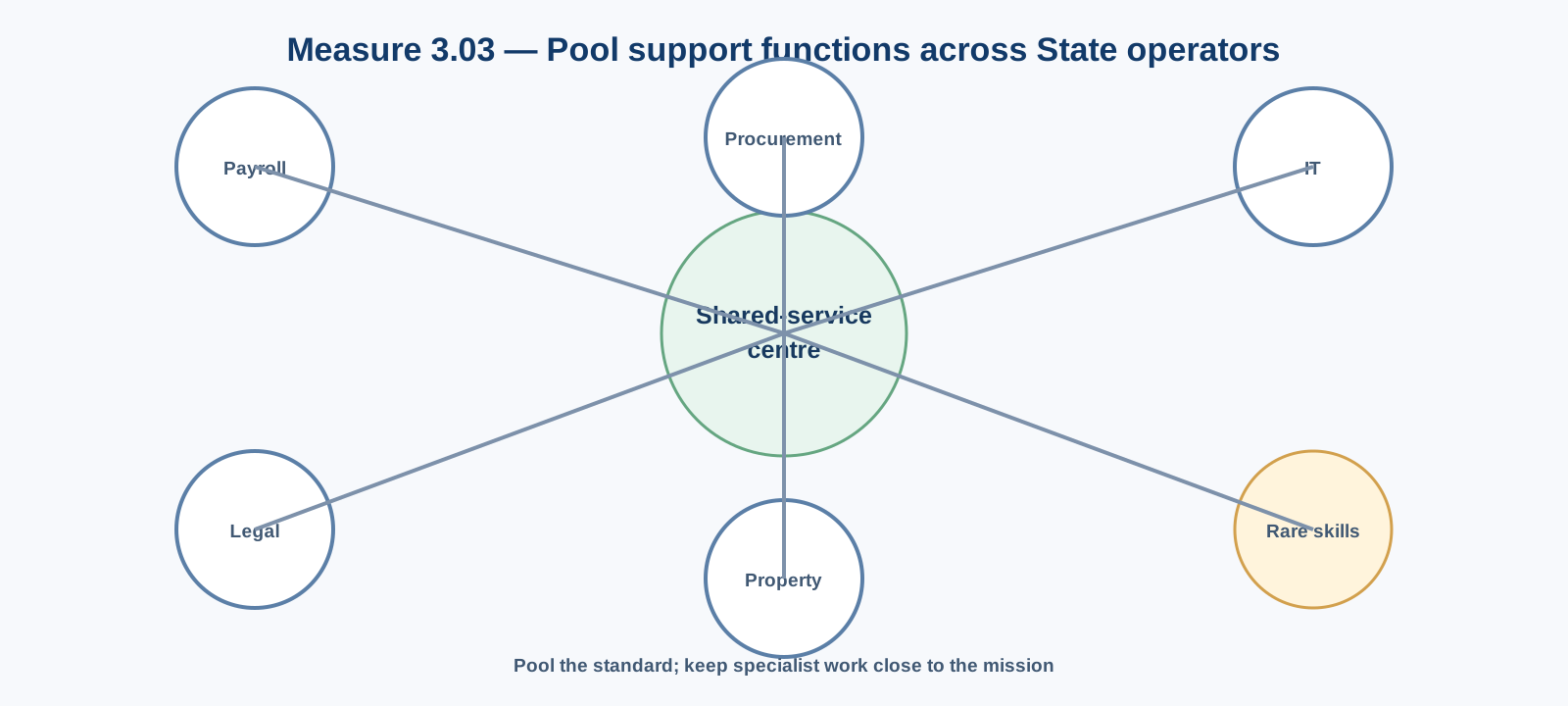
ANALYSIS The proposal is: Reduce duplication in payroll, procurement, IT, property, legal and finance functions without artificially merging mission teams that require distinct expertise. It belongs to the agencies and operators volume, whose general purpose is not to deny public missions but to test the value of each institutional layer. A useful function can be retained while its organisation changes deeply; a small body can also remain autonomous where that autonomy protects expertise or impartiality that cannot credibly be reproduced elsewhere.
Implementation method and timetable
IMPLEMENTATION A national service catalogue would classify support functions into three groups: mandatory pooling for standardisable services, recommended pooling where gains depend on scale, and local retention where legal, operational or security constraints justify it. Shared-service centres would work under measurable service-level commitments. The timetable must include a baseline, target design, transition phase and a date for steady-state measurement. No gain should be claimed while old and new arrangements run in parallel unless that temporary double cost is explicitly separated.
Costing: never confuse funding with savings
COSTING Gross savings come from support posts, contracts, licences and space actually removed. Shared-centre cost, migration, remaining interfaces and extra effort inside client teams are then deducted. Full payback only occurs when duplicate systems are switched off; until then the model separates payroll savings from total recurring savings.
Net recurring saving = costs removed − costs recreated − transferred liabilities − recurring residual costsControl, data and indicators
CONTROL The reform requires a specific dashboard: Support cost per employee; procurement transaction cost; average processing time; mission-team satisfaction; redundant applications retired; net recurring savings after shared-centre costs. These indicators are published before and after transformation. Where the objective is qualitative — faster processing, clearer accountability or better data availability — it is measured directly rather than converted into invented monetary value.
Objections and safeguards
ANALYSIS The central objection is serious: Poorly designed pooling can distance support from users, create a slow internal monopoly and trade payroll savings for longer delays. Transition cost, data migration and payroll continuity must be budgeted before any switch. The safeguard is to document the counterfactual, preserve legal duties and service continuity, then organise independent reviews after twelve and twenty-four months. The reform is corrected if costs merely move elsewhere or service quality deteriorates.
Public decision and success criteria
ANALYSIS Pooling is accepted only when shared centres meet service levels and full cost falls without pushing work back onto mission teams. The review compares transaction cost, payroll incidents, procurement time, IT availability, satisfaction and applications actually retired; staff cuts without system retirement remain incomplete savings.
Measure-specific dossier: what must be demonstrated
Separate genuinely standard support from mission-critical support
Payroll processing, common procurement, licence administration, first-line IT and supplier accounting can often benefit from scale. Specialist legal powers, sensitive cyber-security or scientific support may need to remain close to the mission. French State procurement policy already demonstrates that common rules and infrastructure can coexist with decentralised professional responsibility. [1]
Make shared services accountable to service levels
A shared centre can become an internal monopoly. Each service therefore has a catalogue, unit cost, target turnaround, error rate and escalation route. Client teams receive a monthly dashboard; payroll savings are not booked if delays or correction work rise. PLACE illustrates a common platform without removing accountability from individual buyers. [2]
Retire duplicate systems before claiming full savings
Two organisations can share staff while still paying for two directories, two HR systems and incompatible contracts. The transition plan names applications to retire, migration cost, temporary interfaces and the actual exit date. Until duplicate systems are switched off, the recurring saving remains partial.
Measure impact from the mission team
Success is not the number of support posts removed. It also includes time mission teams spend fixing payroll, chasing invoices or bypassing a slow helpdesk. Cost, delay, satisfaction, incidents and transaction volume are measured together so that costs are not simply shifted from headquarters to operational staff.
Govern the shared-service centre
A pooled service needs an accountable owner, a client committee and a cost-allocation method. It publishes unit cost, volumes, lead times, reopened cases and critical incidents. Sensitive functions may retain a minimal local capability, but this must be justified so that thirteen parallel support teams do not quietly reappear after centralisation.
Converge in waves
The transition starts with lower-risk common services, then moves to finance and HR after data clean-up, and only later to applications deeply embedded in operational work. Each wave has a rollback point and stop criterion. Savings are verified before local capacity is removed, reducing the chance that a political deadline turns a productivity programme into a service outage.
The evidence file that makes the measure challengeable
Every shared centre publishes an analytical account covering staff, licences, property, contracts, workload and unit cost. Client bodies also disclose residual staff time spent on support. Measuring both sides prevents the central support burden from disappearing on paper while reappearing informally inside mission teams.
Full-scale test: payroll and routine procurement
Payroll requires continuity and very low error; routine procurement offers more standardisation. For six months, a group of bodies compares shared and local delivery on cost, turnaround, errors and satisfaction. Pooling expands only where both the financial and operating case are positive.
This measure in the system
Measure 3.03 is assessed with neighbouring measures in the volume: pooling, merger or reintegration must never count the same saving twice.
Notes and sources
- Direction des achats de l’État — orientations stratégiques — institutional document used for the legal, operational or financial baseline of this measure.
- PLACE — plateforme des achats de l’État — institutional document used for the legal, operational or financial baseline of this measure.
- Direction des achats de l’État — rapport d’activité 2025 — institutional document used for the legal, operational or financial baseline of this measure.
- Cour des comptes — Les services déconcentrés de l’État — institutional document used for the legal, operational or financial baseline of this measure.