Why this reform exists
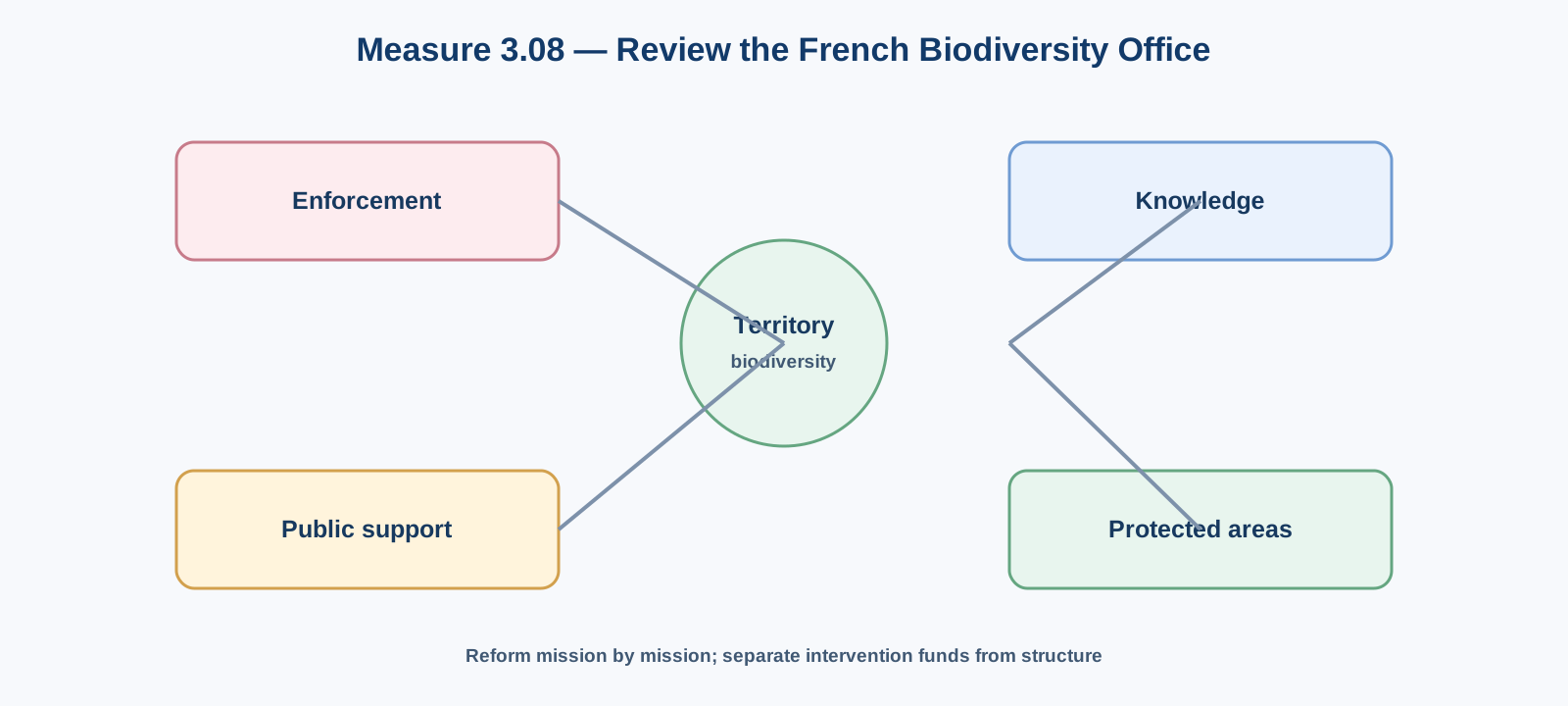
ANALYSIS Measure 3.08 should not be read as an abolition slogan. Its purpose is to turn a reform intention into a verifiable decision. OFB combines very different functions: biodiversity knowledge, enforcement, policy support, stakeholder mobilisation and financial intervention. A serious reform cannot start from the institution’s total cost alone; it must separate these missions and preserve those requiring specific command, expertise or field presence. That distinction is essential: Bible France asks what should change, why, through which legal route and with what net effect for taxpayers and service users. [1]
What the measure actually changes
ANALYSIS The proposal is: Audit environmental enforcement, expertise, knowledge, territorial support and project funding separately to determine which functions need OFB autonomy and which can be pooled. It belongs to the agencies and operators volume, whose general purpose is not to deny public missions but to test the value of each institutional layer. A useful function can be retained while its organisation changes deeply; a small body can also remain autonomous where that autonomy protects expertise or impartiality that cannot credibly be reproduced elsewhere.
Implementation method and timetable
IMPLEMENTATION The review would map missions and locations, analyse interfaces with prefects, territorial services, water agencies and protected-area bodies, then cost three options: retain with pooling, refocus on enforcement and expertise, or transfer selected administrative functions. Any financial scenario would isolate money that funds external action. The timetable must include a baseline, target design, transition phase and a date for steady-state measurement. No gain should be claimed while old and new arrangements run in parallel unless that temporary double cost is explicitly separated.
Costing: never confuse funding with savings
COSTING OFB intervention funding and retained programmes are excluded from the savings base. The calculation focuses on governance, support, pooled contracts, property and proven overlap. Field work transferred elsewhere reappears at full cost in the receiving body, so the Office's total budget cannot be treated as potential savings.
Net recurring saving = costs removed − costs recreated − transferred liabilities − recurring residual costsControl, data and indicators
CONTROL The reform requires a specific dashboard: Intervention budget versus own operating resources; field workforce; processing times; inspections; pooled systems; support costs; data quality and availability; net savings without reducing retained missions. These indicators are published before and after transformation. Where the objective is qualitative — faster processing, clearer accountability or better data availability — it is measured directly rather than converted into invented monetary value.
Objections and safeguards
ANALYSIS The central objection is serious: Weakening field enforcement or breaking data chains can cost more than structural savings. Conversely, retaining duplicate support or funding layers is not justified merely because biodiversity is important. The test concerns the institutional vehicle, not the legitimacy of the policy. The safeguard is to document the counterfactual, preserve legal duties and service continuity, then organise independent reviews after twelve and twenty-four months. The reform is corrected if costs merely move elsewhere or service quality deteriorates.
Public decision and success criteria
ANALYSIS The chosen OFB scenario separately reports effects on enforcement, knowledge, territorial support and intervention funding. The review tracks territorial coverage, response time, inspections, data production, partnerships and support cost. Headquarters savings are not accepted if field or scientific capacity deteriorates.
Measure-specific dossier: what must be demonstrated
Separate enforcement, expertise, knowledge and territorial support
The French Biodiversity Office combines biodiversity knowledge, environmental enforcement, support to public policy, stakeholder mobilisation and protected-area functions. These missions should be reviewed separately to identify what requires national coordination, territorial proximity or specialist expertise. The 2026-2030 performance contract provides a structured starting point. [2]
Map territorial coverage and command chains
For field functions, the relevant unit is not headquarters but geographic coverage: teams, inspection time, relationships with prefects, parks and local authorities. Rationalisation should not move operational expertise away from the places where enforcement and ecological knowledge are needed.
Separate intervention funding from structural cost
The OFB intervention programme funds activities that may continue under a different organisation. Intervention grants, staff, support, property and governance are therefore costed separately. [3] A transferred grant remains public spending even when the paying institution changes.
Judge reform against field outcomes
The dashboard tracks inspections, response times, follow-up, biodiversity data, support cost and partner satisfaction. A budget reduction is not a successful reform if it weakens enforcement or destroys scientific capacity that would later have to be rebuilt.
Separate enforcement, knowledge and support
The OFB combines scientific knowledge, policy support, territorial mobilisation and environmental enforcement. Each mission needs a distinct destination. Enforcement depends on authority, powers and coordination with prosecutors and prefects; knowledge depends on long data series and scientific capability; support depends on territorial networks. A reform cannot therefore be costed from headquarters alone.
Preserve multi-year funding and data series
Intervention programmes, agreements, species monitoring and information systems can span several years. Transfers preserve beneficiaries, contractual obligations and historical data. Structural savings are separated from programme money that still funds biodiversity policy, while payment delays, broken data series and lost expertise are monitored after transition.
The evidence file that makes the measure challengeable
OFB evidence must reach territorial level: field staffing, coverage, types of inspection, partnerships, knowledge systems and main intervention programmes. Grants are separated from the cost of teams administering them, allowing readers to see whether a proposal changes biodiversity policy or only the organisation that delivers it.
Full-scale test: follow one field mission
A complete operational chain—from alert to closure—is tracked, including exchanges with prefects, local authorities, partners and national systems. The target model is judged on continuity of that chain. Headquarters savings that slow field work become visible in the same evidence file.
This measure in the system
Measure 3.08 is assessed with neighbouring measures in the volume: pooling, merger or reintegration must never count the same saving twice.
Notes and sources
- Office français de la biodiversité — l’OFB en bref — institutional document used for the legal, operational or financial baseline of this measure.
- OFB — Contrat d’objectifs et de performance 2026-2030 — institutional document used for the legal, operational or financial baseline of this measure.
- OFB — Programme d’intervention — institutional document used for the legal, operational or financial baseline of this measure.
- Légifrance — Code de l’environnement — institutional document used for the legal, operational or financial baseline of this measure.