Why this reform exists
ANALYSIS Measure 3.12 should not be read as an abolition slogan. Its purpose is to turn a reform intention into a verifiable decision. Water, planning, risk and environmental policies cross several administrations whose powers are not interchangeable. Rationalisation therefore does not mean mechanically merging DDT, DREAL and water agencies; it means reducing points where a project owner rebuilds the same file, interprets multiple opinions or submits the same information repeatedly. That distinction is essential: Bible France asks what should change, why, through which legal route and with what net effect for taxpayers and service users. [1]
What the measure actually changes
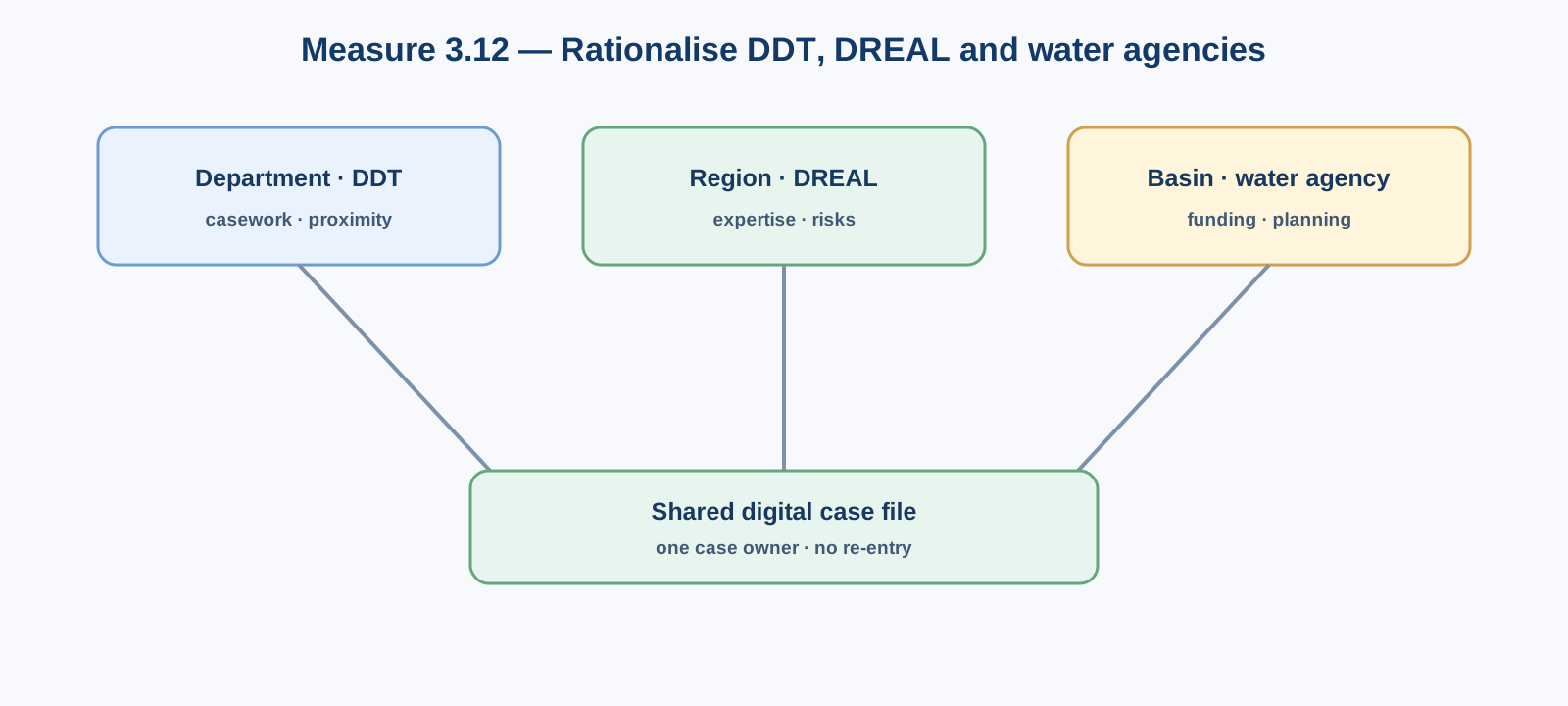
ANALYSIS The proposal is: Build a readable territorial chain for environment, planning and water: one case, one journey owner, shared data and clearly assigned responsibilities. It belongs to the agencies and operators volume, whose general purpose is not to deny public missions but to test the value of each institutional layer. A useful function can be retained while its organisation changes deeply; a small body can also remain autonomous where that autonomy protects expertise or impartiality that cannot credibly be reproduced elsewhere.
Implementation method and timetable
IMPLEMENTATION A procedure-by-procedure map would identify the decision authority, mandatory opinions, funders and required data. A journey owner would be assigned for complex cases. Documents would be submitted once and reused subject to legal rules; opinion timetables would be visible to applicants. The timetable must include a baseline, target design, transition phase and a date for steady-state measurement. No gain should be claimed while old and new arrangements run in parallel unless that temporary double cost is explicitly separated.
Costing: never confuse funding with savings
COSTING DDT/DREAL/water-agency rationalisation is costed by process: case handling, support, systems, premises and repeated consultation. Basin levies and grants that continue are not savings. The model first compares the gain from shared digital casework and targeted pooling with the heavier cost of legal reorganisation.
Net recurring saving = costs removed − costs recreated − transferred liabilities − recurring residual costsControl, data and indicators
CONTROL The reform requires a specific dashboard: Documents requested repeatedly; number of interfaces per procedure; total and agency-specific time; late opinions; incomplete files; data reused; administrative journey cost; user satisfaction. These indicators are published before and after transformation. Where the objective is qualitative — faster processing, clearer accountability or better data availability — it is measured directly rather than converted into invented monetary value.
Objections and safeguards
ANALYSIS The central objection is serious: Simplification must not turn independent checks into automatic approval. Some separations exist to protect water, risk management or impartiality. The first gains should come from coordination and shared information, followed only then by support-function pooling where justified. The safeguard is to document the counterfactual, preserve legal duties and service continuity, then organise independent reviews after twelve and twenty-four months. The reform is corrected if costs merely move elsewhere or service quality deteriorates.
Public decision and success criteria
ANALYSIS The final test is the journey of a citizen or project, not the number of acronyms removed. The report measures duplicate documents, case time, number of contacts, environmental-control quality and administrative cost. Responsibility at department, region and basin level remains public so simplification does not create new opacity.
Measure-specific dossier: what must be demonstrated
Do not treat DDT, DREAL and water agencies as interchangeable layers
These organisations have different legal forms and purposes. Territorial State directorates implement and enforce policy, while water agencies follow river-basin finance and planning. The audit first maps missions by flow—planning, risk, water, environment and infrastructure—before asking whether structures overlap.
Respect the geography of river basins
Water policy follows catchments while many administrative powers follow regions and departments. That different geography can justify a specialist body. Rationalisation should target duplicate expertise, data and support without breaking basin coherence. Water agencies are explicitly organised around this territorial logic. [2]
Create a single digital case when several services examine one project
A shared case file, common timetable and named case owner may deliver more value than legal merger. The audit records documents requested twice, inter-service waiting time, mandatory consultations and data re-entered by applicants or civil servants.
Publish responsibility after the reform
Citizens and project sponsors need to know who decides. The target map names the competent authority, expected time and appeal route for each major act. Reducing organisational labels only matters if it also reduces contacts and delay without weakening environmental or risk oversight.
Recognise three administrative geographies
Departmental, regional and river-basin policies do not naturally share the same boundaries. Rationalisation therefore pools functions where useful without forcing every mission into one map. Shared data, legal expertise or support can coexist with responsibilities that require their own scale. The target should make this overlap simpler for users, not add another layer.
Protect water governance and financing continuity
Water agencies have basin-based funding and multi-year intervention programmes. Any redesign states what happens to commitments, levies, programmes and basin governance. Only demonstrated overlap or support savings are counted; policy funds that still finance water action are not. Payment continuity and hydrological data quality are tracked through the transition.
The evidence file that makes the measure challengeable
The case register lists documents and opinions required for representative projects. Every repeated data entry or duplicated consultation receives an action: shared data, joint opinion, removal or explicit justification. Basin logic remains visible for water agencies so administrative simplification does not erase the physical geography on which water policy depends.
Full-scale test: one project across three territorial levels
A representative project needing departmental casework, regional expertise and basin input is traced document by document. Duplicate requests, waiting time and hand-offs are counted. A shared digital case and case owner are tested before any institutional merger, showing whether the main gain is legal or informational.
This measure in the system
Measure 3.12 is assessed with neighbouring measures in the volume: pooling, merger or reintegration must never count the same saving twice.
Notes and sources
- Cour des comptes — Les services déconcentrés de l’État — institutional document used for the legal, operational or financial baseline of this measure.
- Ministère de la Transition écologique — agences de l’eau — institutional document used for the legal, operational or financial baseline of this measure.
- Légifrance — Code de l’environnement — institutional document used for the legal, operational or financial baseline of this measure.
- Ministère de la Transition écologique — services déconcentrés — institutional document used for the legal, operational or financial baseline of this measure.