Why this reform exists
ANALYSIS Measure 3.13 should not be read as an abolition slogan. Its purpose is to turn a reform intention into a verifiable decision. A consultative committee can be inexpensive yet still generate delay, meetings, secretariat work and diffuse accountability. Conversely, some commissions are useful precisely because they force the administration to hear competing interests. Reform should therefore test the value added by the opinion, not merely count meetings. That distinction is essential: Bible France asks what should change, why, through which legal route and with what net effect for taxpayers and service users. [1]
What the measure actually changes
ANALYSIS The proposal is: Close committees whose legal need has disappeared, whose activity is negligible or whose consultation can be replaced by a simpler process, while preserving opinions that genuinely protect expertise, challenge or representation. It belongs to the agencies and operators volume, whose general purpose is not to deny public missions but to test the value of each institutional layer. A useful function can be retained while its organisation changes deeply; a small body can also remain autonomous where that autonomy protects expertise or impartiality that cannot credibly be reproduced elsewhere.
Implementation method and timetable
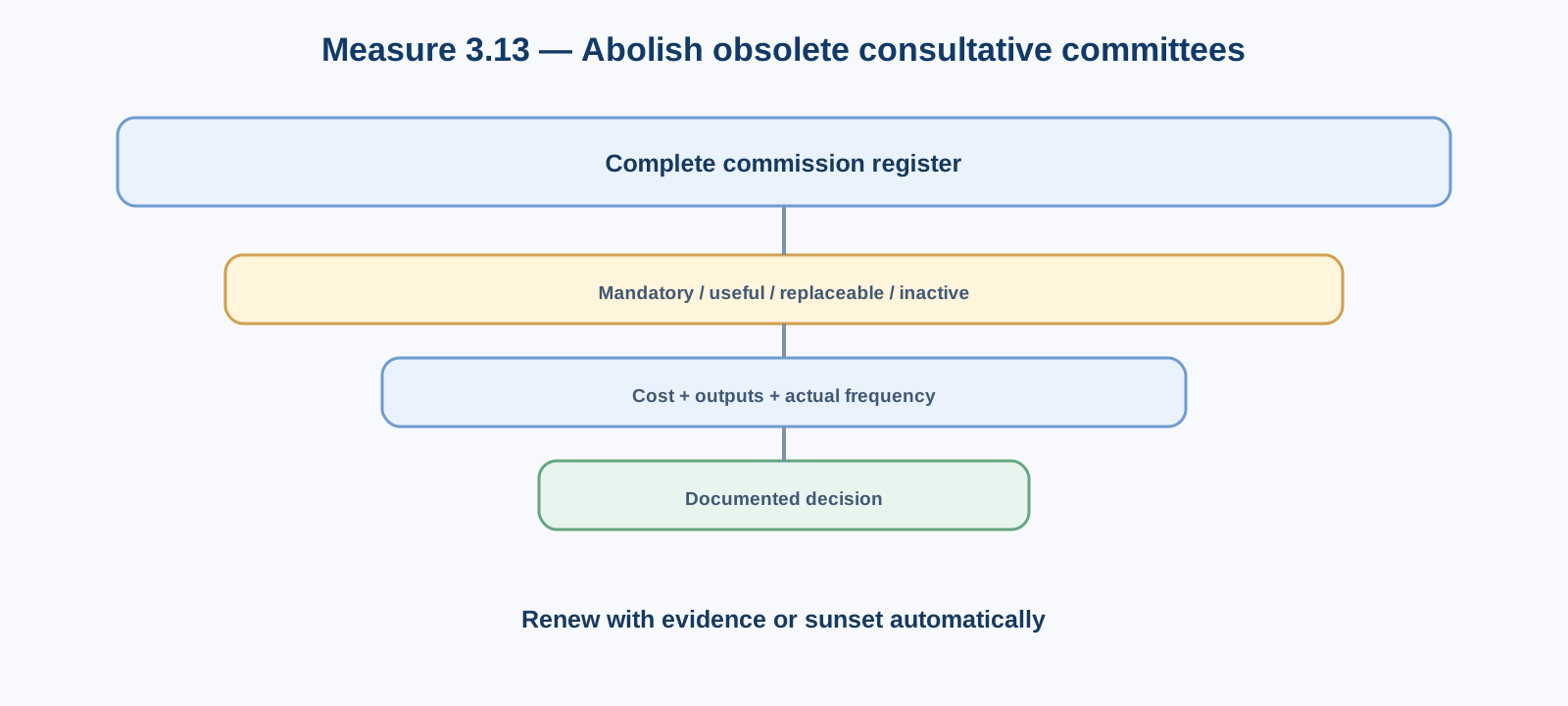
IMPLEMENTATION Each committee would enter a register recording its legal basis, mandatory or optional status, referrals, average delay, secretariat resources and effect of the opinion. Inactive bodies or those whose purpose is now covered elsewhere would be proposed for closure; others could be grouped or consulted digitally where physical deliberation is not necessary. The timetable must include a baseline, target design, transition phase and a date for steady-state measurement. No gain should be claimed while old and new arrangements run in parallel unless that temporary double cost is explicitly separated.
Costing: never confuse funding with savings
COSTING Annual savings include secretariat, allowances, preparation, travel and staff time attributable to bodies actually removed, minus replacement consultation or external expertise. Many committees are inexpensive individually, so the result must stay proportionate: simplification of decision-making may matter more than a large budget figure.
Net recurring saving = costs removed − costs recreated − transferred liabilities − recurring residual costsControl, data and indicators
CONTROL The reform requires a specific dashboard: Committees inventoried; share with no meeting or referral; average opinion delay; secretariat hours; mergers; digital consultations; decisions overturned for consultation defects; recurring cost avoided. These indicators are published before and after transformation. Where the objective is qualitative — faster processing, clearer accountability or better data availability — it is measured directly rather than converted into invented monetary value.
Objections and safeguards
ANALYSIS The central objection is serious: Mass abolition can erase quiet but important checks. French administrative law already provides duration and renewal rules for some consultative commissions: those deadlines should be treated as evaluation points, not automatic renewals. The safeguard is to document the counterfactual, preserve legal duties and service continuity, then organise independent reviews after twelve and twenty-four months. The reform is corrected if costs merely move elsewhere or service quality deteriorates.
Public decision and success criteria
ANALYSIS Every abolished commission leaves an audit trail: repealed legal basis, last activity, secretariat workload, replacement if any and estimated saving. Retained bodies receive a review date. Two years later the State checks whether useful consultation has been recreated under another name and whether disputes or decision errors rose.
Measure-specific dossier: what must be demonstrated
Create a legal inventory of committees
A headline count cannot determine which consultative bodies are obsolete. Each commission is recorded with its legal basis, purpose, actual meeting frequency, opinions produced, members and secretariat effort. The Code governing administrative consultative commissions provides the legal framework for that review. [1]
Classify each body as mandatory, useful, replaceable or inactive
These four categories prevent a blind purge. A body may be legally mandatory; useful because it provides independent expertise; replaceable by another consultation route; or inactive because its subject has disappeared. Abolition is easiest in the last case and requires evidence in the others.
Measure the hidden administrative time
Cost includes preparation, invitations, secretariat, travel, minutes and staff attendance, not only allowances. Those hours are converted into full cost, but the audit also asks whether an opinion prevents later error or litigation. A nominally free committee can be expensive; an expensive committee can occasionally save more than it costs.
Add sunset clauses to new bodies
Future commissions should state purpose, duration, indicators and any body they replace. At the review date they are renewed on explicit evidence or lapse. A public register then prevents the stock from rebuilding invisibly after the one-off clean-up.
Distinguish mandatory consultation from permanent machinery
Some opinions are required by law; others are organisational choices. The inventory links each committee to its legal basis, actual meeting rate, opinions produced and the delay added to decisions. A rarely used body may still be necessary for exceptional cases, while a frequent consultation may be delivered more lightly if the law permits.
Choose among sunset, digital consultation and a smaller body
The outcome can differ by committee: immediate abolition, sunset clause, merger, ad-hoc consultation or an open digital process. The test is the value of the advice, not the number of meetings. Two years later the review checks decision quality, lead times and whether the same consultation has simply reappeared informally.
The evidence file that makes the measure challengeable
The national commission register is machine-readable: creation date, legal basis, ministry, purpose, members, meetings over three years, opinions, secretariat and review date. A body labelled inactive can therefore be challenged against its actual work, and the public can see whether the stock starts growing again after the clean-up.
Full-scale test: audit twenty very different committees
The sample mixes active, rare, technical, political and apparently dormant bodies. Secretariat hours, opinions and decisions influenced are reconstructed for each. The evidence calibrates the categories useful, replaceable and inactive before the wider clean-up.
This measure in the system
Measure 3.13 is assessed with neighbouring measures in the volume: pooling, merger or reintegration must never count the same saving twice.
Notes and sources
- Code des relations entre le public et l’administration — commissions administratives à caractère consultatif — institutional document used for the legal, operational or financial baseline of this measure.
- Légifrance — article R133-15 du CRPA — institutional document used for the legal, operational or financial baseline of this measure.
- Secrétariat général du Gouvernement — qualité de la réglementation — institutional document used for the legal, operational or financial baseline of this measure.
- Vie publique — administration consultative — institutional document used for the legal, operational or financial baseline of this measure.