Why this reform exists
ANALYSIS Measure 3.11 should not be read as an abolition slogan. Its purpose is to turn a reform intention into a verifiable decision. DRAAF are territorial services of the agriculture ministry and deliver its policies in the regions. Their portfolio spans many technical and territorial subjects. The issue is therefore not the existence of a regional tier itself, but potential overlap between regional steering, departmental delivery and central chains. That distinction is essential: Bible France asks what should change, why, through which legal route and with what net effect for taxpayers and service users. [1]
What the measure actually changes
ANALYSIS The proposal is: Clarify the split between regional, departmental and central government to reduce duplicate instructions while retaining agricultural, food-safety, forestry and territorial expertise. It belongs to the agencies and operators volume, whose general purpose is not to deny public missions but to test the value of each institutional layer. A useful function can be retained while its organisation changes deeply; a small body can also remain autonomous where that autonomy protects expertise or impartiality that cannot credibly be reproduced elsewhere.
Implementation method and timetable
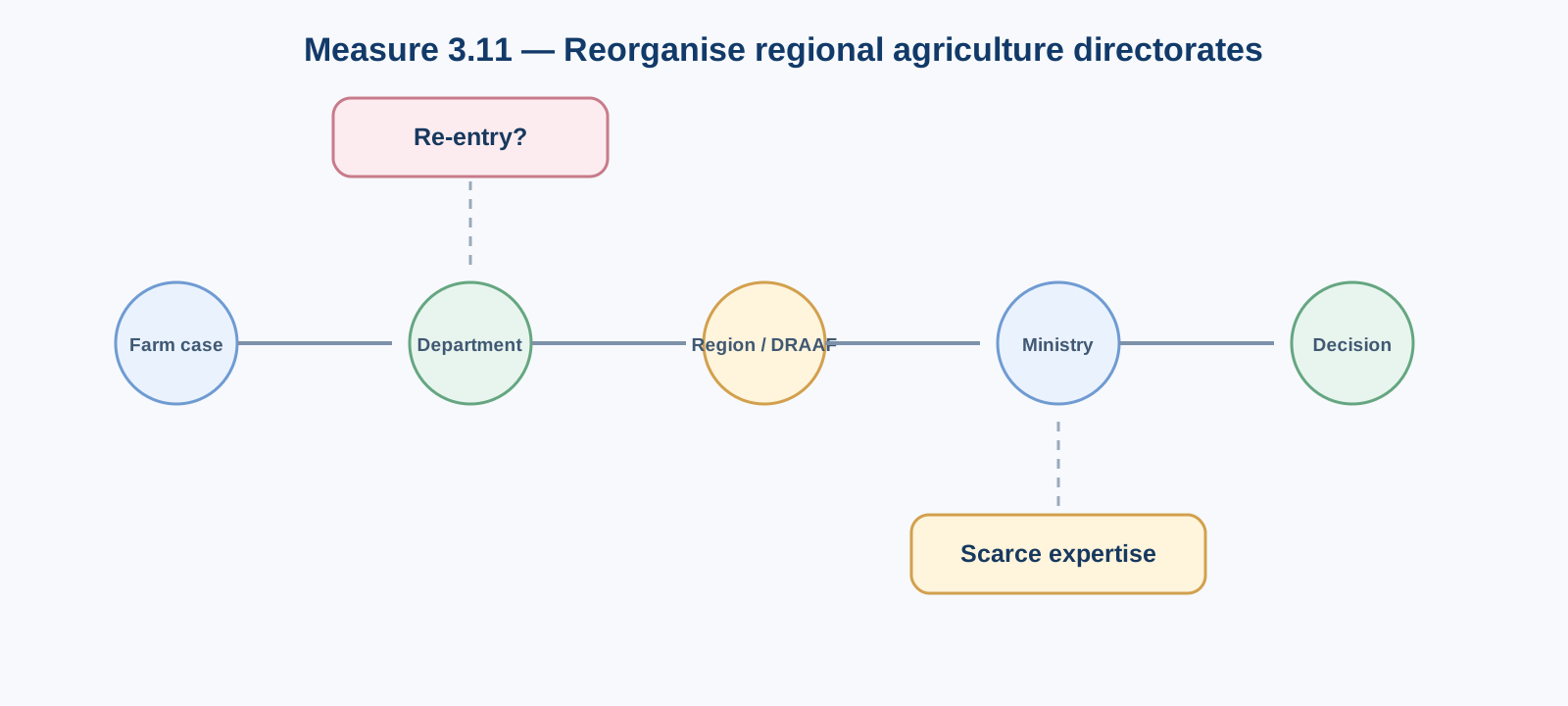
IMPLEMENTATION Reorganisation would start from an activity-by-activity matrix: who sets the rule, processes the file, inspects, pays and answers the user. Scarce expertise would be pooled regionally or interregionally; proximity tasks would remain at the appropriate level. Reporting systems would be harmonised to remove duplicate data entry. The timetable must include a baseline, target design, transition phase and a date for steady-state measurement. No gain should be claimed while old and new arrangements run in parallel unless that temporary double cost is explicitly separated.
Costing: never confuse funding with savings
COSTING The financial model separates retained specialist staff, pooled support, property rationalisation and mobility costs. Posts only count as savings when the underlying work disappears or is absorbed at constant workload. Lease and IT savings follow actual contract exit dates; continuing agricultural programmes remain outside the structural gain.
Net recurring saving = costs removed − costs recreated − transferred liabilities − recurring residual costsControl, data and indicators
CONTROL The reform requires a specific dashboard: Duplicate instructions removed; reporting tools; processing time by act; cases rerouted; support cost; field time; availability of scarce expertise; satisfaction of farmers and local authorities. These indicators are published before and after transformation. Where the objective is qualitative — faster processing, clearer accountability or better data availability — it is measured directly rather than converted into invented monetary value.
Objections and safeguards
ANALYSIS The central objection is serious: Over-centralisation can lose detailed knowledge of sectors, territories and local risks. Conversely, maintaining very rare specialists everywhere can fragment expertise. The right criteria are workload, criticality and the need for physical presence. The safeguard is to document the counterfactual, preserve legal duties and service continuity, then organise independent reviews after twelve and twenty-four months. The reform is corrected if costs merely move elsewhere or service quality deteriorates.
Public decision and success criteria
ANALYSIS The new agricultural administration must handle both routine casework and crisis conditions without rebuilding parallel approvals. The review publishes delay, data re-entry, availability of scarce expertise, support cost and user feedback. Savings count only when removed administrative work does not reappear at departmental or central level.
Measure-specific dossier: what must be demonstrated
Separate sovereign, economic and technical roles
Regional agriculture directorates cover agricultural policy, food, forestry, education, statistics and regional coordination. Their legal organisation is therefore the starting point for identifying which functions need regional expertise and which can move closer to departments. [1]
Follow real agricultural casework end to end
The audit traces several representative processes—aid, plant health, forestry, agricultural education and climate emergency—and records every re-entry of data, approval and change of administrative level. Duplication is identified as repeated work, not as similar job titles.
Protect scarce specialist capability
Plant health, statistics, forestry and European-policy expertise cannot be recreated quickly. The target model therefore sets minimum critical teams and avoids scattering a small regional expert group across many departments. Pooling support must not fragment the profession itself.
Stress-test the structure against a crisis
Drought, epizootic disease, wildfire or a sector shock reveal whether the chain can act quickly. A scenario exercise asks who gathers data, arbitrates, signs, communicates with farmers and coordinates with prefects and the ministry. A lighter chart that cannot operate under stress is not simplification.
Respect the range of regional agricultural missions
Regional directorates combine agricultural policy, food, forestry, education, sector economics, statistics and territorial coordination. The reform separates steering, expertise, inspection and statistical production instead of treating the directorate as one generic office. Rare sanitary or statistical capabilities remain identifiable after any administrative merger.
Keep operational knowledge close to the field
Support functions may be pooled without removing dialogue with farmers, industries, schools and departmental services. The file tracks sites, travel time, response time and expert availability. A central saving can be offset if specialists spend more time travelling or local actors need more contacts to solve the same problem.
The evidence file that makes the measure challengeable
An annex times five representative journeys before and after reform: farm aid, health control, forestry, agricultural education and crisis management. It states which acts disappear, move level or keep regional expertise. The saving is therefore tied to concrete processes rather than simply to a smaller organisation chart.
Full-scale test: drought and routine casework
The new structure is tested on both a normal agricultural case and a drought episode requiring data, specialist advice and prefectural coordination. If repeat work falls without slowing crisis action, the design gains credibility; if experts become fragmented and coordination calls multiply, it is revised before rollout.
This measure in the system
Measure 3.11 is assessed with neighbouring measures in the volume: pooling, merger or reintegration must never count the same saving twice.
Notes and sources
- Décret n° 2010-429 relatif aux directions régionales de l’alimentation, de l’agriculture et de la forêt — institutional document used for the legal, operational or financial baseline of this measure.
- Ministère de l’Agriculture — Conseil général de l’alimentation, de l’agriculture et des espaces ruraux — institutional document used for the legal, operational or financial baseline of this measure.
- Cour des comptes — Les services déconcentrés de l’État — institutional document used for the legal, operational or financial baseline of this measure.
- Ministère de l’Agriculture — services régionaux — institutional document used for the legal, operational or financial baseline of this measure.