Why this reform exists
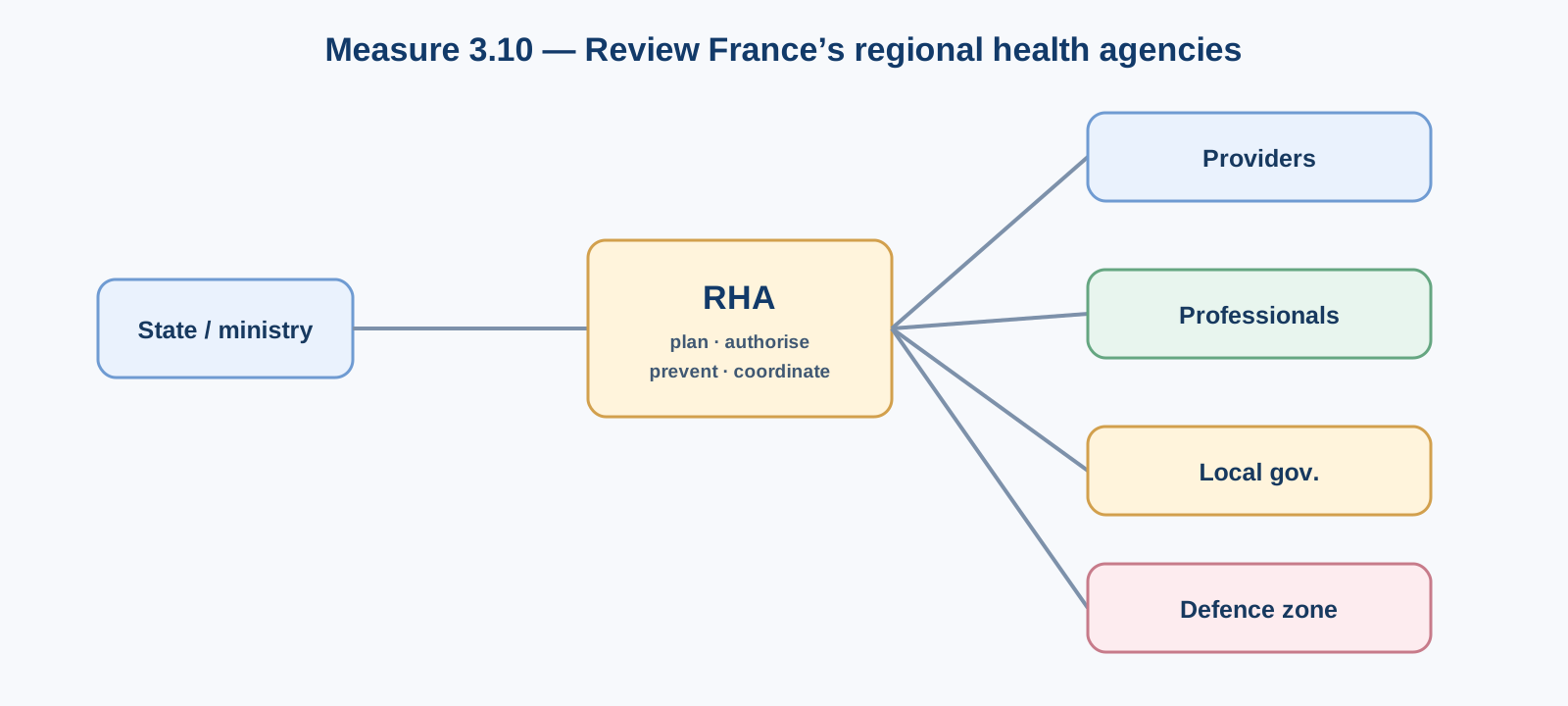
ANALYSIS Measure 3.10 should not be read as an abolition slogan. Its purpose is to turn a reform intention into a verifiable decision. Regional health agencies are not merely administrative counters: they contribute to health planning, resource allocation, surveillance, emergency preparedness and relationships with many providers. Any reorganisation must therefore begin with a responsibility map rather than nominal abolition. That distinction is essential: Bible France asks what should change, why, through which legal route and with what net effect for taxpayers and service users. [1]
What the measure actually changes
ANALYSIS The proposal is: Separate health functions that require regional coordination, crisis management and expertise from those that could be simplified, brought closer to State services or delivered with fewer decision layers. It belongs to the agencies and operators volume, whose general purpose is not to deny public missions but to test the value of each institutional layer. A useful function can be retained while its organisation changes deeply; a small body can also remain autonomous where that autonomy protects expertise or impartiality that cannot credibly be reproduced elsewhere.
Implementation method and timetable
IMPLEMENTATION The audit would compare decision chains across the ministry, ARS, prefectures, health insurance and providers. It would identify files requiring regional expertise, those suitable for national standardisation and those better handled closer to departmental level. Health emergencies and zonal missions would be tested as critical functions in their own right. The timetable must include a baseline, target design, transition phase and a date for steady-state measurement. No gain should be claimed while old and new arrangements run in parallel unless that temporary double cost is explicitly separated.
Costing: never confuse funding with savings
COSTING RHA cost is rebuilt mission by mission. Teams, systems and contracts transferred to prefectures, ministries or other services remain expenditure. Savings come from governance, support and genuine duplication removed, less transition and extra capacity required by the receiver. Health-policy funds that continue to be spent are never structural savings.
Net recurring saving = costs removed − costs recreated − transferred liabilities − recurring residual costsControl, data and indicators
CONTROL The reform requires a specific dashboard: Number of steps per case; authorisation times; duplicate data requests; pooled functions; regional administrative cost; time spent in the field; emergency performance; provider satisfaction. These indicators are published before and after transformation. Where the objective is qualitative — faster processing, clearer accountability or better data availability — it is measured directly rather than converted into invented monetary value.
Objections and safeguards
ANALYSIS The central objection is serious: The main risk is simplifying the organisation chart while multiplying informal interfaces. A reform that removes one layer but forces providers to enter the same data in several systems would fail. Continuity of emergency management and funding flows must be contractually secured before transition. The safeguard is to document the counterfactual, preserve legal duties and service continuity, then organise independent reviews after twelve and twenty-four months. The reform is corrected if costs merely move elsewhere or service quality deteriorates.
Public decision and success criteria
ANALYSIS Regional-health reform is judged against the real care chain: authorisation times, crisis coordination, data quality and relationships with providers, professionals and local authorities. Every mission names its new holder and transferred staff. More contacts or slower decisions trigger correction before structural savings are confirmed.
Measure-specific dossier: what must be demonstrated
Understand the bundle of functions inside the regional health agencies
Regional health agencies were created by the HPST reform to combine responsibilities that had previously been dispersed. Their remit includes care planning, prevention, health security, environmental health and resource allocation. [1][2] Any abolition scenario must therefore name the future holder of each power.
Match each function to the right territorial level
A health alert, hospital authorisation, local care contract and environmental-health control do not require the same geography. Some functions need regional scale; others interact with defence zones or departments. Ministry pages on reference and zonal missions show why a single blanket transfer would be simplistic. [3][4]
Do not export bureaucracy to prefectures or hospitals
Moving authority back into territorial State services only simplifies the chain if staff, systems and expertise move with it. Otherwise hospitals and prefectures inherit forms and coordination without capacity. The transition model therefore identifies staff, sensitive data, planning tools and regional contracts that must be taken over.
Measure access and crisis coordination, not headquarters size
Success is tracked through authorisation time, crisis response, data quality, relationships with providers and administrative cost by function. Saving on a regional headquarters while multiplying local contacts or slowing decisions would be a service failure, even if the organisation chart looks smaller.
Decompose what a regional health agency actually does
An ARS covers health-care planning, public health, health security, prevention and the medico-social field, in coordination with national government, prefects, health insurance, providers, local authorities and professionals. The target model maps every responsibility to its future owner. Without that map, abolishing the legal entity does not describe a functioning replacement.
Design for crisis conditions
Health security exposes dependencies that routine work can hide: on-call arrangements, alerts, laboratories, providers, stocks and zonal coordination. The target model states who triggers action, who arbitrates, who consolidates information and who speaks to the national level outside office hours. A live crisis exercise is part of the test before support savings are booked.
The evidence file that makes the measure challengeable
The RHA matrix covers at least health authorisations, care planning, surveillance, prevention, zonal missions, environmental health, contracts and sensitive data. Every line names the legal basis, current owner, future owner, staff, IT system and transition time. Without this matrix, 'abolish the regional health agencies' remains a slogan rather than an operating model.
Full-scale test: authorisation, crisis and prevention
Three RHA journeys run in parallel: an activity authorisation, a health emergency and a prevention programme. Each involves different actors and timing. The target model must name the decision-maker and data flow at every stage, preventing a reform designed only for routine administration.
This measure in the system
Measure 3.10 is assessed with neighbouring measures in the volume: pooling, merger or reintegration must never count the same saving twice.
Notes and sources
- Code de la santé publique — agences régionales de santé — institutional document used for the legal, operational or financial baseline of this measure.
- Vie publique — loi HPST et création des agences régionales de santé — institutional document used for the legal, operational or financial baseline of this measure.
- Ministère de la Santé — organisation des missions de référence — institutional document used for the legal, operational or financial baseline of this measure.
- Ministère de la Santé — missions zonales — institutional document used for the legal, operational or financial baseline of this measure.