Why this reform exists
ANALYSIS Measure 3.16 should not be read as an abolition slogan. Its purpose is to turn a reform intention into a verifiable decision. The 2026 Finance Act opens €648,033,908 for the Radio France programme in the public broadcasting account. That amount is funding, not an available saving. Cutting the allocation without changing costs can simply create a deficit, debt or lower service, so reform must start from functions and transformable cost bases. That distinction is essential: Bible France asks what should change, why, through which legal route and with what net effect for taxpayers and service users. [1]
What the measure actually changes
ANALYSIS The proposal is: Test a transformation of Radio France across costs, networks, property, procurement and services while clearly separating lower public funding, avoided costs and consequences for public-service missions. It belongs to the agencies and operators volume, whose general purpose is not to deny public missions but to test the value of each institutional layer. A useful function can be retained while its organisation changes deeply; a small body can also remain autonomous where that autonomy protects expertise or impartiality that cannot credibly be reproduced elsewhere.
Implementation method and timetable
IMPLEMENTATION The audit would separate editorial production, transmission, national and local networks, orchestras and music ensembles, digital activity, support, procurement, property and technical assets. Three options would be costed for each block: retain, pool with other public-media companies, or resize with explicit effects on services. The timetable must include a baseline, target design, transition phase and a date for steady-state measurement. No gain should be claimed while old and new arrangements run in parallel unless that temporary double cost is explicitly separated.
Costing: never confuse funding with savings
COSTING The Radio France model separates public funding, own revenue, function-level charges, investment and assets. A grant cut is not a saving until linked to recurring charges removed. Property sales are one-off receipts. Social restructuring, technical double-running and migration investment are shown separately before recurring savings are calculated.
Net recurring saving = costs removed − costs recreated − transferred liabilities − recurring residual costsControl, data and indicators
CONTROL The reform requires a specific dashboard: Cost by network and function; payroll; pooled procurement; property footprint; broadcast and digital audience; distribution cost; content reuse; net saving after restructuring; public-service mission indicators. These indicators are published before and after transformation. Where the objective is qualitative — faster processing, clearer accountability or better data availability — it is measured directly rather than converted into invented monetary value.
Objections and safeguards
ANALYSIS The central objection is serious: A purely accounting reform can destroy capacities that are hard to rebuild and shift costs to other public companies. Conversely, cultural purpose does not justify the absence of indicators. Transparency should cover cost by function, audiences, content reuse and territorial value. The safeguard is to document the counterfactual, preserve legal duties and service continuity, then organise independent reviews after twelve and twenty-four months. The reform is corrected if costs merely move elsewhere or service quality deteriorates.
Public decision and success criteria
ANALYSIS Radio France scenarios must state, function by function, the service retained and the avoidable cost. The review separates public-funding cuts, actual cost reduction, own revenue, deferred investment and social restructuring costs. Editorial and territorial effects are reported alongside budget effects for every network, digital activity or cultural function changed.
Measure-specific dossier: what must be demonstrated
Break Radio France into observable functions
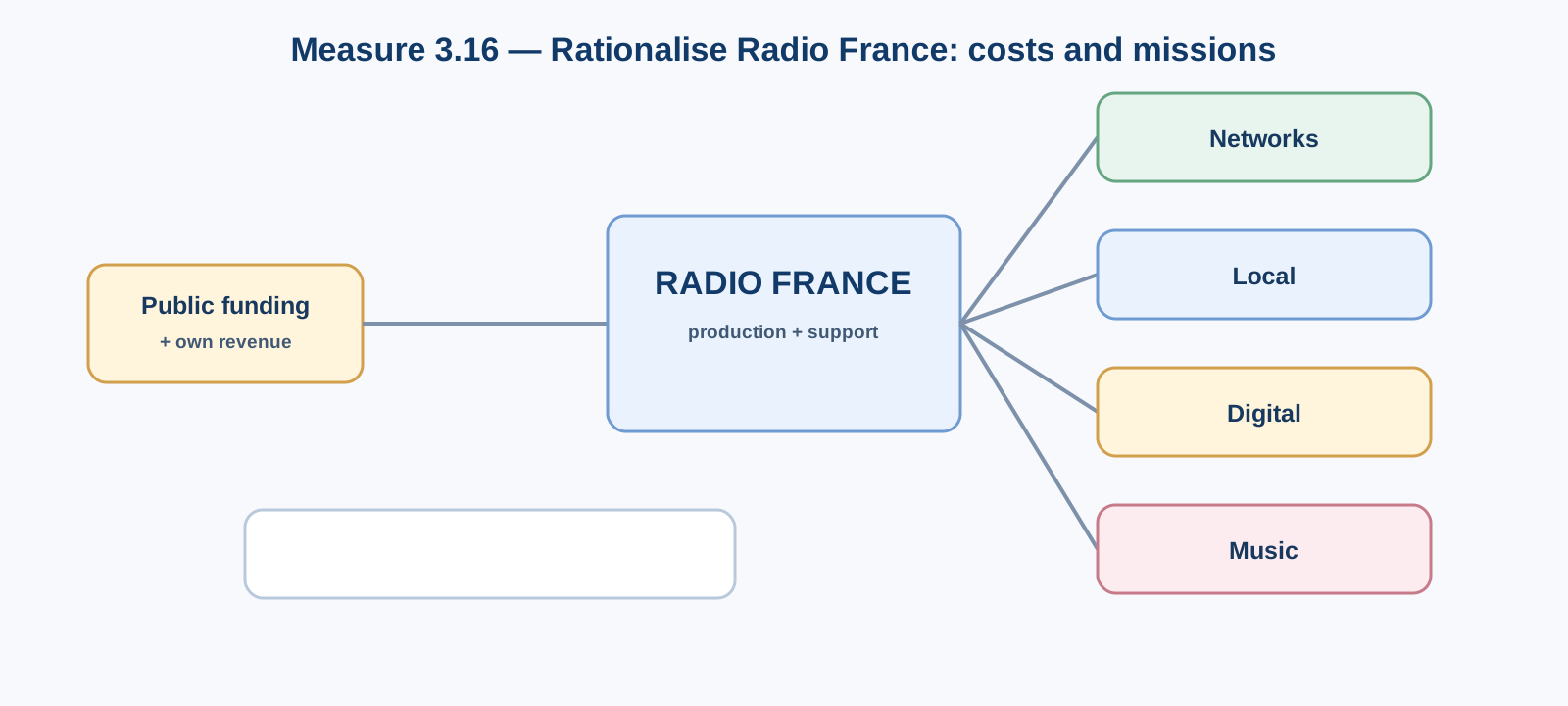
Radio France combines national and local radio networks, content production, digital services, technical operations, property and cultural ensembles. The reform therefore costs networks, news, local services, digital, engineering, music ensembles, support, procurement and property separately. Company key figures anchor the analysis in real accounts and staffing rather than in one public-funding number. [2]
Separate public funding, revenue and avoidable cost
The budget law records public funding, but cutting a grant does not prove that economic cost disappears. Own revenue, fixed costs, contracts and public-service obligations are analysed alongside the appropriation. A funding cut without operational change may simply create a deficit rather than a saving.
Test pooling and resizing function by function
For engineering, procurement, property and some digital tools, scenarios compare standalone operation, pooling with other public-media companies and external provision. For stations and networks, each scenario states the editorial consequence: coverage, local news, music diversity and digital access. Readers can then see both the saving and the service change.
Treat assets and professional skills over the long term
Studios, distribution systems, concert facilities and engineering skills cannot be switched off like a software subscription. Restructuring, property disposal, social commitments and deferred investment are separated from recurring savings. Governance and institutional results published by Radio France are used to test the realism of each scenario. [3][4]
Read Radio France as a production and distribution system
The group combines national services, a local network, news, music, podcasts and digital products alongside cultural and musical activities and a major technical/property base. The analysis therefore separates editorial production, distribution, digital, support, studios, cultural activities and property. Public funding cannot be turned into a saving through one uniform percentage without stating which services change.
Compare several restructuring scenarios
A cautious scenario can focus on procurement, support, property and common tools; an intermediate one can reorganise production and digital workflows; a disruptive one can alter the scope of services themselves. Social costs, investment and one-off asset receipts are separated from recurring savings. Audience reach, territorial coverage, programme diversity and digital availability remain explicit safeguards.
The evidence file that makes the measure challengeable
The financial publication reconciles public funding, own revenue, payroll, procurement, property, investment, engineering and spending by activity. Pooling scenarios name the partner, migration cost, double-running period and expected saving. Cultural and territorial missions keep explicit non-commercial indicators so the reform is not reduced to audience figures.
Full-scale test: one support function and one editorial mission
A pooling-friendly support function is analysed alongside a territorial editorial mission. The first receives a conventional business case; the second states coverage, audience, local value and cost. Trade-offs are explicit rather than hiding cultural consequences behind a savings number or exempting every mission from measurement.
This measure in the system
Measure 3.16 is assessed with neighbouring measures in the volume: pooling, merger or reintegration must never count the same saving twice.
Notes and sources
- Légifrance — loi de finances pour 2026, audiovisuel public — institutional document used for the legal, operational or financial baseline of this measure.
- Radio France — chiffres clés — institutional document used for the legal, operational or financial baseline of this measure.
- Radio France — gouvernance et organisation — institutional document used for the legal, operational or financial baseline of this measure.
- Radio France — résultats et actualités institutionnelles — institutional document used for the legal, operational or financial baseline of this measure.
- Radio France — missions et antennes — institutional document used for the legal, operational or financial baseline of this measure.