Why this reform exists
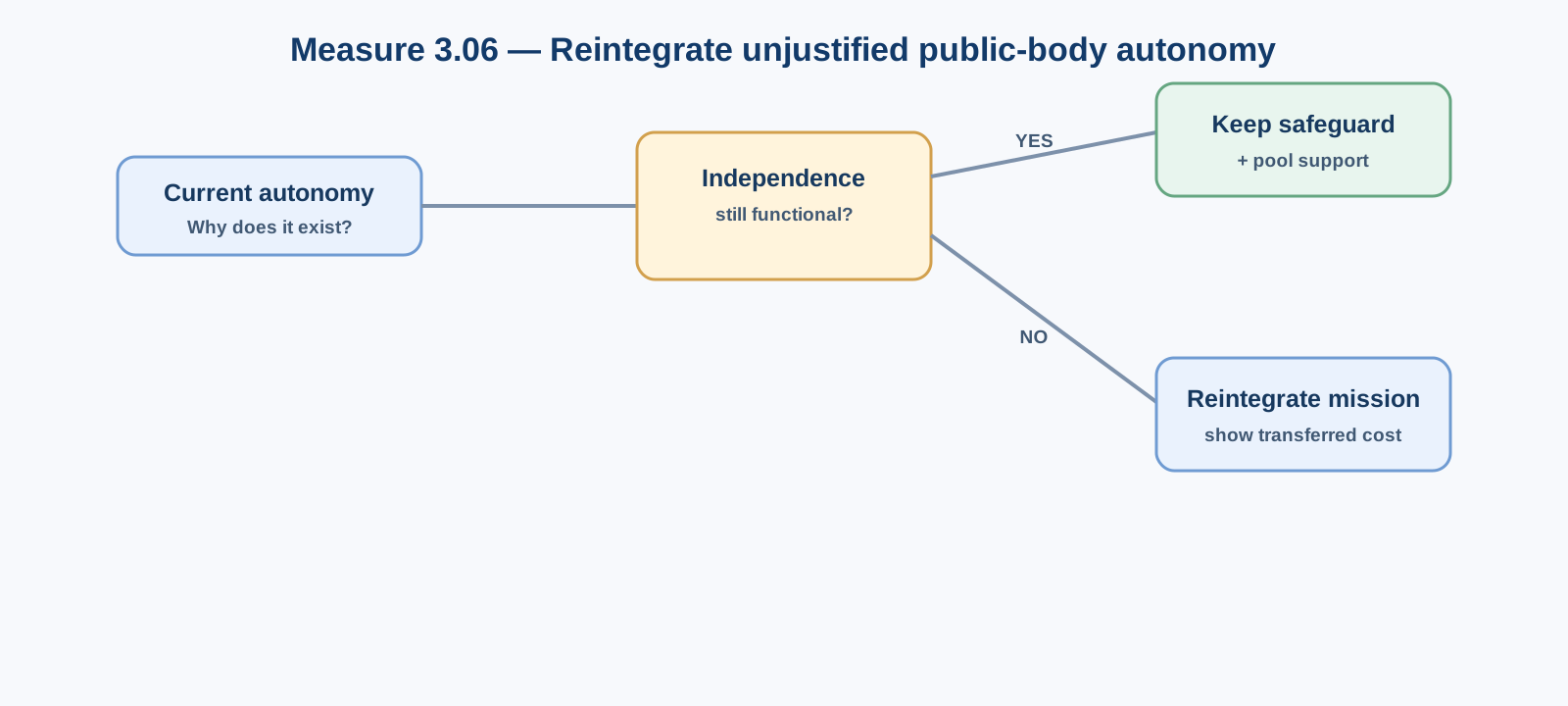
ANALYSIS Measure 3.06 should not be read as an abolition slogan. Its purpose is to turn a reform intention into a verifiable decision. Reintegration is not abolition of the mission. It asks a narrower question: does the function still need a separate legal personality, board, executive team and systems, or can it become a clearly identified ministerial service without losing expertise or impartiality? That distinction is essential: Bible France asks what should change, why, through which legal route and with what net effect for taxpayers and service users. [1]
What the measure actually changes
ANALYSIS The proposal is: Keep useful public missions while removing a separate legal or administrative layer when that autonomy no longer creates demonstrable value. It belongs to the agencies and operators volume, whose general purpose is not to deny public missions but to test the value of each institutional layer. A useful function can be retained while its organisation changes deeply; a small body can also remain autonomous where that autonomy protects expertise or impartiality that cannot credibly be reproduced elsewhere.
Implementation method and timetable
IMPLEMENTATION For each candidate entity, an autonomy test would examine independence requirements, own powers, contracts, property, funding, staff and statutory safeguards. Reintegration would proceed only when the receiving ministry has a target organisation, budget and continuity timetable. The timetable must include a baseline, target design, transition phase and a date for steady-state measurement. No gain should be claimed while old and new arrangements run in parallel unless that temporary double cost is explicitly separated.
Costing: never confuse funding with savings
COSTING The model compares current autonomy cost—governance, support, contracts and property—with the cost taken over by the receiving service. Mission funding appears in both columns. Only the structural difference after transfer, less transition and any new staffing required by the ministry, is a recurring saving.
Net recurring saving = costs removed − costs recreated − transferred liabilities − recurring residual costsControl, data and indicators
CONTROL The reform requires a specific dashboard: Governance costs removed; costs recreated in the ministry; contracts transferred; continuity incidents; decision times; retention of scarce skills; net saving after two full financial years. These indicators are published before and after transformation. Where the objective is qualitative — faster processing, clearer accountability or better data availability — it is measured directly rather than converted into invented monetary value.
Objections and safeguards
ANALYSIS The central objection is serious: A poor reintegration can recreate an operator inside the ministry without removing costs, or politicise a function that should remain independent. Regulatory, oversight or protected-expertise functions therefore require a stronger test. The safeguard is to document the counterfactual, preserve legal duties and service continuity, then organise independent reviews after twelve and twenty-four months. The reform is corrected if costs merely move elsewhere or service quality deteriorates.
Public decision and success criteria
ANALYSIS Reintegration succeeds only when the receiving ministry discloses the resources it has taken over and the mission performs at least as well. The review tracks decision time, scarce capability, transferred cost, support genuinely removed and any loss of independence. Merely deleting an autonomous budget is not a saving.
Measure-specific dossier: what must be demonstrated
Ask what autonomy still achieves today
Historic autonomy may have been justified by technical expertise, a dedicated board, earmarked revenue or useful distance from ministers. The review tests whether that reason still exists by comparing decision time, governance cost, recruitment capacity and the risk created by returning the mission to a ministry.
Choose the right degree of reintegration
Reintegration does not require every team to move into central administration. A mission may return to a territorial State service, ministry directorate or common operator while retaining an advisory scientific committee. The target architecture is defined before savings are calculated.
Expose the cost taken over by the ministry
When a body disappears, the staff, software, leases and contracts needed for the mission reappear elsewhere. The receiving ministry therefore publishes a transfer line so that disappearance of the agency budget cannot be mistaken for a saving. The Cour des comptes stresses clear supervision, objectives and resources in State-operator relations. [2]
Preserve independence when it is functional
Some missions require genuine distance in order to certify, inspect or advise credibly. The test separates legal independence, managerial autonomy and simple organisational separation. Where trust depends on distance from political decision-makers, support can be rationalised without destroying the institutional safeguard.
Test autonomy across several dimensions
Autonomy can be justified by independent expertise, regulation, continuity, own-source funding, contracting powers or direct user relationships. Each dimension receives a documented justification. Where autonomy adds no capability that a ministry or field service could provide, reintegration becomes credible; where functional independence matters, it must survive any pooling of support services.
Avoid recreating a hidden agency
Removing legal personality but rebuilding the same hierarchy inside a ministry produces little change. The target map therefore shows management layers removed, services genuinely pooled and the final owner of each mission. Decision lead times are tracked too: lower administrative cost is not a complete success if additional ministerial approvals substantially slow the service.
The evidence file that makes the measure challengeable
The before/after file lists decisions previously taken autonomously, new delegations, transferred spending and safeguards retained. It distinguishes independence that serves the mission from administrative autonomy that merely duplicates management. This makes it possible to remove a layer while preserving a scientific board or independent procedure where it is genuinely needed.
Full-scale test: reintegrate without recentralising everything
A candidate body becomes the case study. Decision powers return to the ministry, while specialist expertise remains in a dedicated unit and some staff sit in territorial services. The test shows whether removing legal autonomy shortens processes or simply recreates a central approval layer.
This measure in the system
Measure 3.06 is assessed with neighbouring measures in the volume: pooling, merger or reintegration must never count the same saving twice.
Notes and sources
- Direction du Budget — opérateurs de l’État — institutional document used for the legal, operational or financial baseline of this measure.
- Cour des comptes — Les relations entre l’État et ses opérateurs — institutional document used for the legal, operational or financial baseline of this measure.
- Légifrance — service public de diffusion du droit — institutional document used for the legal, operational or financial baseline of this measure.
- Direction du Budget — chiffres clés 2026 — institutional document used for the legal, operational or financial baseline of this measure.