Why this reform exists
ANALYSIS Measure 3.02 should not be read as an abolition slogan. Its purpose is to turn a reform intention into a verifiable decision. State operators differ widely in size, skills markets and legal status. Comparing a single gross salary while ignoring benefits, variable pay, housing, vehicles, supplementary pensions or severance gives an incomplete picture. The starting point must be a common definition of total compensation and publication of exceptions. That distinction is essential: Bible France asks what should change, why, through which legal route and with what net effect for taxpayers and service users. [1]
What the measure actually changes
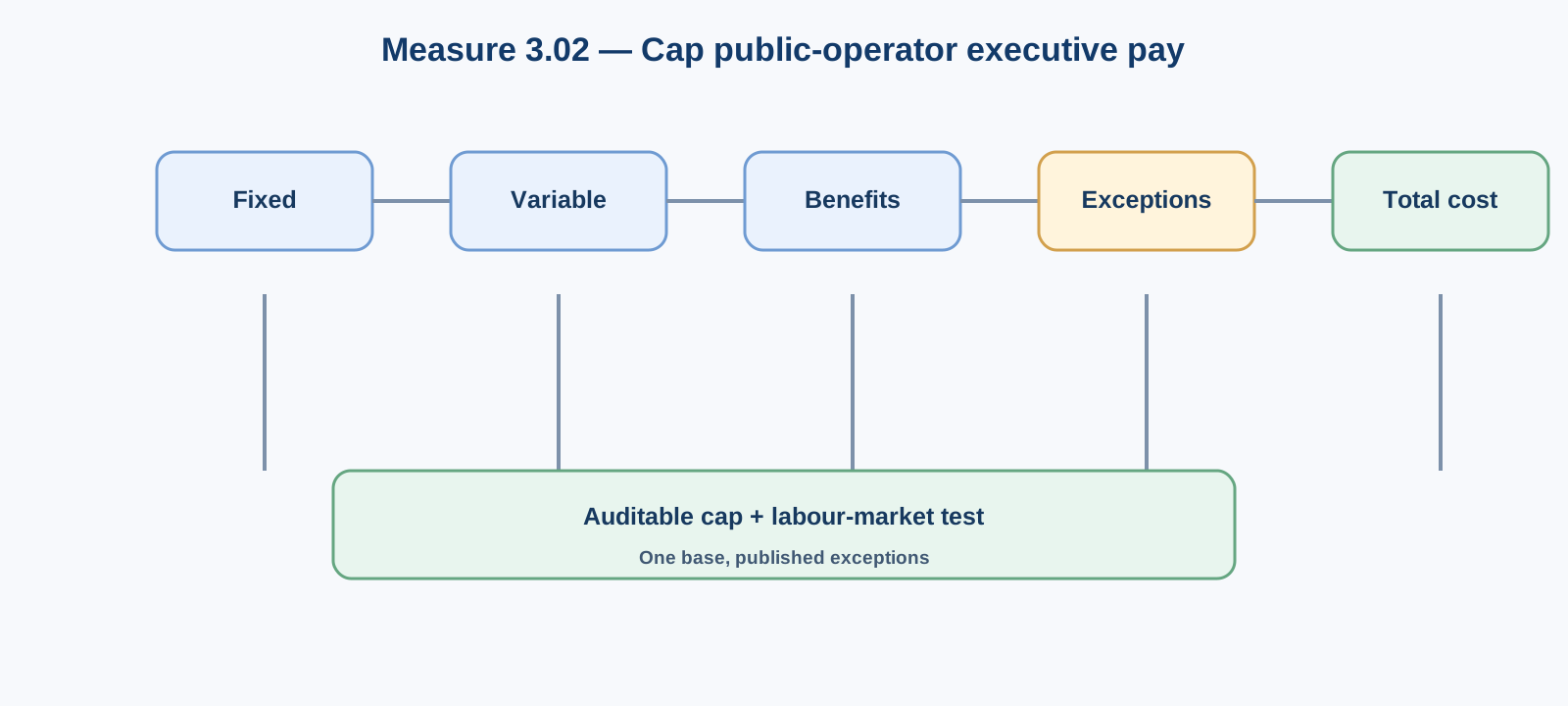
ANALYSIS The proposal is: Create a public, auditable ceiling for total executive compensation while separating fixed pay, variable pay, benefits and genuinely exceptional cases. It belongs to the agencies and operators volume, whose general purpose is not to deny public missions but to test the value of each institutional layer. A useful function can be retained while its organisation changes deeply; a small body can also remain autonomous where that autonomy protects expertise or impartiality that cannot credibly be reproduced elsewhere.
Implementation method and timetable
IMPLEMENTATION Implementation would proceed in three steps: inventory total compensation, set a default ceiling by responsibility tier, then allow a published, reasoned exception where skills scarcity or labour-market constraints are demonstrated. The supervising ministry would sign and own each exception. The timetable must include a baseline, target design, transition phase and a date for steady-state measurement. No gain should be claimed while old and new arrangements run in parallel unless that temporary double cost is explicitly separated.
Costing: never confuse funding with savings
COSTING Costing starts with total compensation above the proposed cap, then subtracts justified exceptions and any replacement cost created by the rule. The prudent saving is therefore not 'number of executives × gap to cap': it depends on the actual distribution, benefits included in the base and substitution into consultancy. First-year transparency costs are disclosed separately.
Net recurring saving = costs removed − costs recreated − transferred liabilities − recurring residual costsControl, data and indicators
CONTROL The reform requires a specific dashboard: Share of executives under the ceiling; number and rationale of exceptions; average and median total cost; change in outsourced executive services; gender gaps; publication delay. These indicators are published before and after transformation. Where the objective is qualitative — faster processing, clearer accountability or better data availability — it is measured directly rather than converted into invented monetary value.
Objections and safeguards
ANALYSIS The central objection is serious: An overly rigid ceiling can push compensation into opaque benefits, deter some profiles or increase reliance on more expensive contractors. The rule therefore has to monitor total cost, consultancy substitution and include periodic review rather than treating one number as universally optimal. The safeguard is to document the counterfactual, preserve legal duties and service continuity, then organise independent reviews after twelve and twenty-four months. The reform is corrected if costs merely move elsewhere or service quality deteriorates.
Public decision and success criteria
ANALYSIS Implementation is only complete when the compensation base is public, every exception has a reason and expiry date, and external management contracts are monitored for circumvention. After two financial years, the report compares total executive cost, exceptions, recruitment difficulty and governance outcomes.
Measure-specific dossier: what must be demonstrated
Define the compensation base before setting a ceiling
A cap is meaningless unless total compensation is defined. The published base should include fixed and variable pay, benefits in kind, housing, vehicles, supplementary pension arrangements, severance and comparable advantages. The 2017 decree already distinguishes a functional component, possible personal supplement and variable component linked to qualitative and quantitative criteria. [2] The reform therefore caps a defined total cost, not a headline salary.
Use responsibility tiers and a controlled exception route
A small administrative agency, a scientific establishment and a public company competing for scarce executives do not recruit on the same market. The default ceiling can vary by responsibility tier, while exceptions require evidence of scarcity, a time limit, a signed rationale, publication and review.
Close compensation workarounds
A fixed-pay cap alone can shift remuneration into bonuses, consultancy contracts, benefits or subsidiaries. Oversight therefore follows total employer cost, severance, management contracts and representation expenses. The annual disclosure reports median pay, distribution, exceptions and the use of external executive services. The Cour des comptes framework on State-operator relations helps connect those figures to the supervising ministry. [4]
Require an auditable labour-market test
Before approving an exception, the ministry documents comparable roles, recruitment difficulty, applications received and the operational consequence of the ordinary ceiling. Six to twelve months later it reports whether the exception achieved its stated purpose. This avoids both slogans: that high pay is always market-driven, or that one figure works for every public responsibility.
Define who is actually in scope
The register must distinguish chief executives, executive-committee members, subsidiary managers and posts already governed by a specific statutory regime. A subsidiary must not become an automatic route around a parent-body cap. The file therefore publishes control chains, contract type, legal employer and the share of remuneration ultimately borne by public funds, while keeping genuinely different levels of responsibility distinguishable.
Audit exceptions as a risk portfolio
Every exception needs a reason, a duration, a decision-maker and a review date. Annual control compares the promised recruitment rationale with the outcome, tracks repeated exceptions and identifies whether bonuses, consultancy contracts or subsidiaries have replaced capped pay. If exceptions cluster in one sector, the market or operator model must be reconsidered rather than hidden behind individual decisions.
The evidence file that makes the measure challengeable
The evidence file reconstructs compensation without unnecessary personal disclosure: responsibility tier, cap base, beneficiary count, aggregate amounts, exceptions, valued benefits, executive contractors and supervising-ministry decisions. A separate schedule compares contractual pay with total employer cost so that an apparent saving cannot be cancelled by consultancy spending elsewhere.
Full-scale test: five executive profiles
Before scale-up, the rule is simulated across five profiles: a small administrative body, large national operator, scientific establishment, market-facing public company and scarce-skill role. Each case shows fixed pay, variable pay, benefits, cap, possible exception and the cost of an alternative recruitment route. The test exposes unrealistic effects and gaps in the compensation base.
This measure in the system
Measure 3.02 is assessed with neighbouring measures in the volume: pooling, merger or reintegration must never count the same saving twice.
Notes and sources
- Décret n° 2017-870 — rémunération des dirigeants de certaines entreprises publiques — institutional document used for the legal, operational or financial baseline of this measure.
- Décret n° 2017-870, article 5 — part fonctionnelle, complément personnel et part variable — institutional document used for the legal, operational or financial baseline of this measure.
- Direction du Budget — chiffres clés du budget de l’État 2026 — institutional document used for the legal, operational or financial baseline of this measure.
- Cour des comptes — Les relations entre l’État et ses opérateurs — institutional document used for the legal, operational or financial baseline of this measure.