Why this reform exists
ANALYSIS Measure 3.14 should not be read as an abolition slogan. Its purpose is to turn a reform intention into a verifiable decision. Arcom now regulates audiovisual and digital communication, protects freedom of communication, audiences and works, and also supervises aspects of major online platforms. This broader remit makes interface analysis essential: an overlap can only be established after comparing legal powers, regulated objects and available sanctions. That distinction is essential: Bible France asks what should change, why, through which legal route and with what net effect for taxpayers and service users. [1]
What the measure actually changes
ANALYSIS The proposal is: Preserve regulatory independence while auditing support functions, interfaces with other authorities and the accumulation of digital duties so responsibility is clear. It belongs to the agencies and operators volume, whose general purpose is not to deny public missions but to test the value of each institutional layer. A useful function can be retained while its organisation changes deeply; a small body can also remain autonomous where that autonomy protects expertise or impartiality that cannot credibly be reproduced elsewhere.
Implementation method and timetable
IMPLEMENTATION The audit would build a powers matrix with other regulators and administrations, then distinguish independent decision-making, expertise, case handling, technical monitoring and support. Pooling would focus on non-regulatory support — procurement, property, selected tools and data — without putting regulatory decisions under ministerial dependence. The timetable must include a baseline, target design, transition phase and a date for steady-state measurement. No gain should be claimed while old and new arrangements run in parallel unless that temporary double cost is explicitly separated.
Costing: never confuse funding with savings
COSTING Arcom spending is split by function before any savings assumption. A mission transferred to another authority remains funded and may only create support or pooling savings. Case, system and archive migration is disclosed separately. Net savings come from genuinely removed overlap, not from deleting a regulatory budget line.
Net recurring saving = costs removed − costs recreated − transferred liabilities − recurring residual costsControl, data and indicators
CONTROL The reform requires a specific dashboard: Referrals redirected; case times; shared competences identified; tools pooled; support cost; jurisdiction disputes; regulated-sector satisfaction; preservation of independence safeguards. These indicators are published before and after transformation. Where the objective is qualitative — faster processing, clearer accountability or better data availability — it is measured directly rather than converted into invented monetary value.
Objections and safeguards
ANALYSIS The central objection is serious: The key mistake would be to confuse institutional independence with autonomy of every support function. The latter can sometimes be pooled; the former must be protected where law requires it. Conversely, multiple regulators without referral protocols can create an unreadable path for platforms, media and citizens. The safeguard is to document the counterfactual, preserve legal duties and service continuity, then organise independent reviews after twelve and twenty-four months. The reform is corrected if costs merely move elsewhere or service quality deteriorates.
Public decision and success criteria
ANALYSIS Arcom reform is only validated after publication of the powers matrix: retained mission, pooled mission, transferred power and the independence safeguard attached to it. The dashboard tracks timelines, decisions, sanctions, litigation, cost by function and platform workload. Savings caused mainly by longer queues are excluded.
Measure-specific dossier: what must be demonstrated
Begin with Arcom’s statutory missions
Arcom is not merely a television watchdog. Its remit spans audiovisual services, online platforms, pluralism, protection of audiences and several digital obligations. The 1986 law and Arcom’s own mission map therefore define the baseline before any claim of overlap is made. [1][3]
Build a genuine overlap matrix
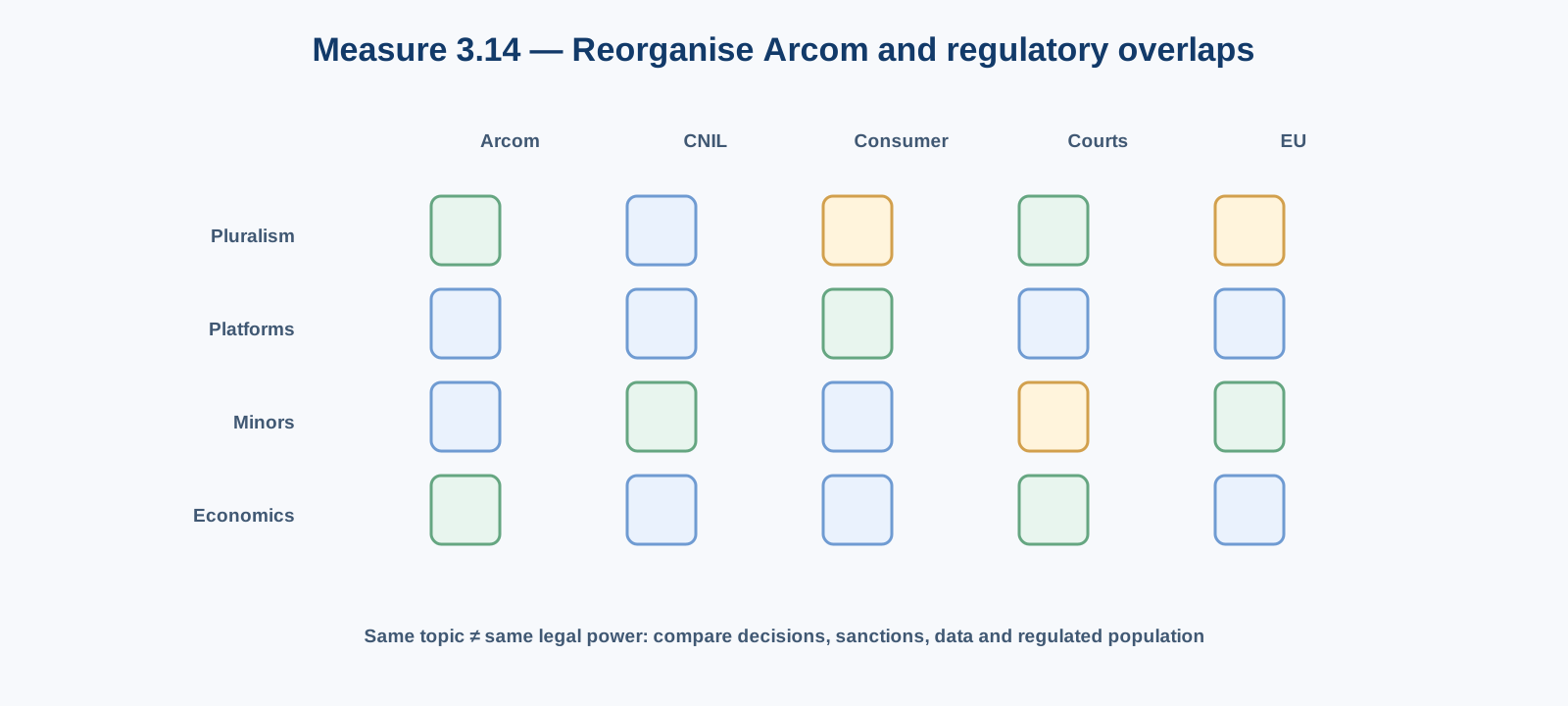
For each function the audit identifies another body with a potentially adjacent role, such as CNIL, consumer authorities, courts or European regulators. Sharing a topic does not mean holding the same legal power. The matrix compares legal basis, decision, sanction, data and regulated population.
Separate the board, investigation functions and support
Collegial governance, case investigation and support functions have different purposes. Procurement, property or tools may be pooled without changing regulatory independence. Moving sanction powers into a ministry, by contrast, may change the institutional safeguard. Savings are therefore costed function by function.
Evaluate regulation through outcomes and timeliness
The annual report becomes the dashboard: case times, decisions, sanctions, litigation, cost by mission, platform workload, protection of minors and pluralism. A reform is only accepted if retained functions remain measurable and savings do not simply come from longer queues.
Map missions, not only boxes
Arcom works across frequencies, pluralism, audience protection, creation, audiovisual economics and online platforms. Potential overlap must be tested mission by mission against other authorities: legal basis, decision power, data and affected users. Thematic proximity alone does not prove duplication; the outcome may be cooperation, shared data, a common gateway or a genuine transfer of power.
Protect regulatory independence
Pooling support must not become indirect control of an independent regulator. Procurement, property or some tools can be shared while investigations, deliberations, confidential files, enforcement priorities and publication of decisions remain under the authority's control. A cheaper structure fails if it makes independence or accountability less clear.
The evidence file that makes the measure challengeable
Arcom's overlap matrix compares powers, not themes: receiving complaints, investigating, requiring information, sanctioning, referring to a court or imposing obligations. This prevents two bodies working in the same sector from being called duplicates when their legal powers differ. Every transfer also records the procedural safeguard that follows the power.
Full-scale test: one complaint touching several regulators
A hypothetical case combines a platform, minor protection, data and consumer conduct. The pilot follows who can request information, decide, sanction or refer to court. The resulting map distinguishes coordination from genuine legal overlap far better than comparing topics in annual reports.
This measure in the system
Measure 3.14 is assessed with neighbouring measures in the volume: pooling, merger or reintegration must never count the same saving twice.
Notes and sources
- Arcom — nos missions — institutional document used for the legal, operational or financial baseline of this measure.
- Arcom — rapport annuel — institutional document used for the legal, operational or financial baseline of this measure.
- Légifrance — loi du 30 septembre 1986 relative à la liberté de communication — institutional document used for the legal, operational or financial baseline of this measure.
- Arcom — organisation et fonctionnement — institutional document used for the legal, operational or financial baseline of this measure.