Why this reform exists
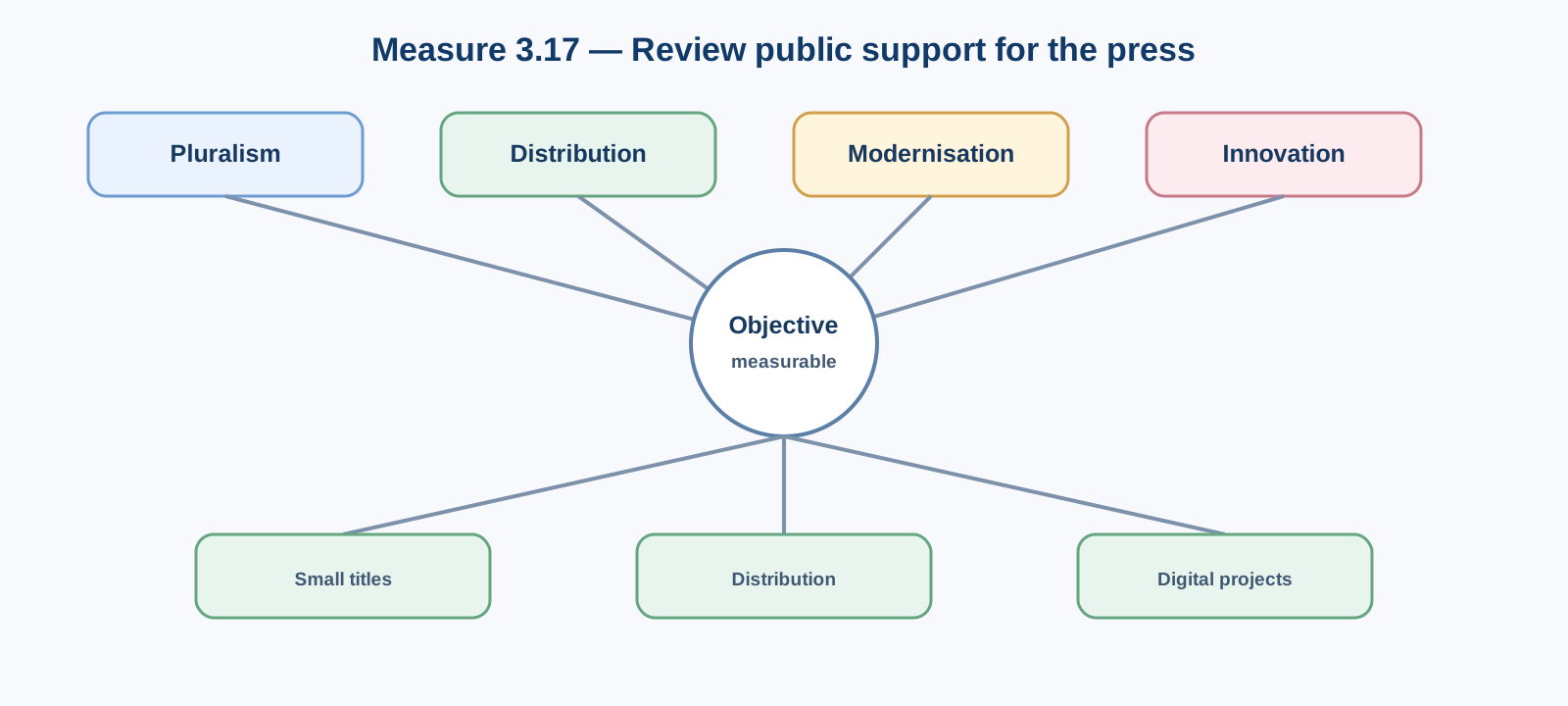
ANALYSIS Measure 3.17 should not be read as an abolition slogan. Its purpose is to turn a reform intention into a verifiable decision. Public support for the press pursues distinct goals: pluralism, transport and distribution, modernisation and innovation. These goals should not be collapsed into one judgement. A scheme may be justified to preserve nationwide distribution without the same logic justifying a separate digital-investment subsidy. That distinction is essential: Bible France asks what should change, why, through which legal route and with what net effect for taxpayers and service users. [1]
What the measure actually changes
ANALYSIS The proposal is: Assess each support scheme against pluralism, distribution and modernisation, publish beneficiaries and outcomes, then concentrate funding on demonstrated market failures rather than renewing every scheme by inertia. It belongs to the agencies and operators volume, whose general purpose is not to deny public missions but to test the value of each institutional layer. A useful function can be retained while its organisation changes deeply; a small body can also remain autonomous where that autonomy protects expertise or impartiality that cannot credibly be reproduced elsewhere.
Implementation method and timetable
IMPLEMENTATION The review would create a standard file for each scheme: legal basis, beneficiaries, objective, amount, eligibility, concentration of payments, expected result and counterfactual without support. Schemes would then be classified as retain, retarget, merge with another instrument, or phase out. The timetable must include a baseline, target design, transition phase and a date for steady-state measurement. No gain should be claimed while old and new arrangements run in parallel unless that temporary double cost is explicitly separated.
Costing: never confuse funding with savings
COSTING Costing is scheme by scheme. Phase-out saves the funding no longer paid, less transition and replacement measures; retargeting only counts the fraction genuinely removed. Administration cost is separated from amounts distributed, and the model publishes expected effects on pluralism or distribution alongside the budget result.
Net recurring saving = costs removed − costs recreated − transferred liabilities − recurring residual costsControl, data and indicators
CONTROL The reform requires a specific dashboard: Share of funding by objective; concentration by beneficiary; cost per copy or project where relevant; pluralism; distribution; investment triggered; schemes reaching sunset; administrative cost of each scheme. These indicators are published before and after transformation. Where the objective is qualitative — faster processing, clearer accountability or better data availability — it is measured directly rather than converted into invented monetary value.
Objections and safeguards
ANALYSIS The central objection is serious: The political risk is two-sided: removing support essential to pluralism based on a gross figure, or preserving rent without evidence in the name of press freedom. Publication is the safeguard: rules, amounts, beneficiaries, indicators and evaluations should be available in a comparable format. The safeguard is to document the counterfactual, preserve legal duties and service continuity, then organise independent reviews after twelve and twenty-four months. The reform is corrected if costs merely move elsewhere or service quality deteriorates.
Public decision and success criteria
ANALYSIS Every press-support scheme receives an explicit outcome—retain, retarget, merge or phase out—and an indicator tied to its objective. Two years later the review compares savings, beneficiary concentration, pluralism, distribution and investment. A cut that damages the recognised objective is reconsidered; an instrument with no measurable effect should not survive by inertia.
Measure-specific dossier: what must be demonstrated
Separate support schemes by purpose
French press support is not one homogeneous pot. Schemes target pluralism, distribution, modernisation, innovation and other specific goals. The Culture Ministry portal makes it possible to rebuild the policy scheme by scheme. [1] Each instrument is therefore evaluated against its own objective rather than against the total budget.
Publish beneficiaries, concentration and the counterfactual
For each scheme the file states amount, beneficiaries, concentration of payments, eligibility, administrative cost and expected result. It then asks what would happen without support. Where a documented market failure exists, the exit scenario must show the consequence; where no measurable difference can be identified, automatic renewal becomes difficult to defend.
Protect pluralism without freezing every historical mechanism
Press freedom does not make every legacy subsidy untouchable. Equally, a budget number alone cannot prove that pluralism support is useless. Targeted schemes are assessed through diversity of titles, access to distribution, readership and the survival of low-resource voices. Official eligibility and calendar documents make the review reproducible. [2][3]
Use retention, retargeting, merger or phase-out as distinct outcomes
The review is not binary. A scheme may remain, be capped, retargeted, merged or phased out with transition. The public report compares cost and outcomes two years later so that readers can distinguish a cash saving from a coherent reform of press policy.
Separate direct aid, distribution mechanisms and pluralism goals
Press support contains instruments with different purposes. The analysis reconstructs the economic beneficiary, public cost, eligibility rule and policy objective for each scheme. Adding every mechanism into one headline number obscures which one works; looking at one grant alone can understate the total support received. The schemes are therefore treated as a portfolio of separately testable policies.
Design a transition that separates savings from disappearance
A sudden withdrawal can affect publications differently according to size, business model and territory. The scenario identifies highly dependent titles, tracks market concentration and defines pluralism indicators after reform. Some schemes may be retained or retargeted while others are phased out. The final account separates budget savings from changes in distribution, title diversity and concentration.
The evidence file that makes the measure challengeable
Press-support data should be downloadable and comparable year to year: scheme, legal basis, beneficiary, amount, objective, eligibility and outcome indicator. Pluralism support is not judged by the same metric as a modernisation fund. This granularity allows a weak instrument to be removed without turning the review into a blanket judgement on all public support for the press.
Full-scale test: four schemes, four logics
The pilot selects one scheme each for pluralism, distribution, modernisation and innovation. Beneficiaries, concentration, objective and the no-support scenario are built for each. They cannot share one success metric, and that diversity becomes the template for the rest of the portfolio.
This measure in the system
Measure 3.17 is assessed with neighbouring measures in the volume: pooling, merger or reintegration must never count the same saving twice.
Notes and sources
- Ministère de la Culture — soutien public à la presse — institutional document used for the legal, operational or financial baseline of this measure.
- Ministère de la Culture — calendrier des aides à la presse — institutional document used for the legal, operational or financial baseline of this measure.
- Ministère de la Culture — aides au pluralisme — institutional document used for the legal, operational or financial baseline of this measure.
- Ministère de la Culture — aides à la diffusion et à la modernisation — institutional document used for the legal, operational or financial baseline of this measure.